Costume Designer Resume Examples: the lines they read
Write a Costume Designer Resume That Reads Like a Production Credit List
By Mustafa Tarabya, founder of CVBooster · Published · Updated
Costume designer resume example with credits, sketching and build skills, fittings, budgets, keywords and a writing guide.
Sample resumes for a costume designer
The same costume designer content laid out in three CVBooster templates, so you can see what the finished document looks like before you write a word.
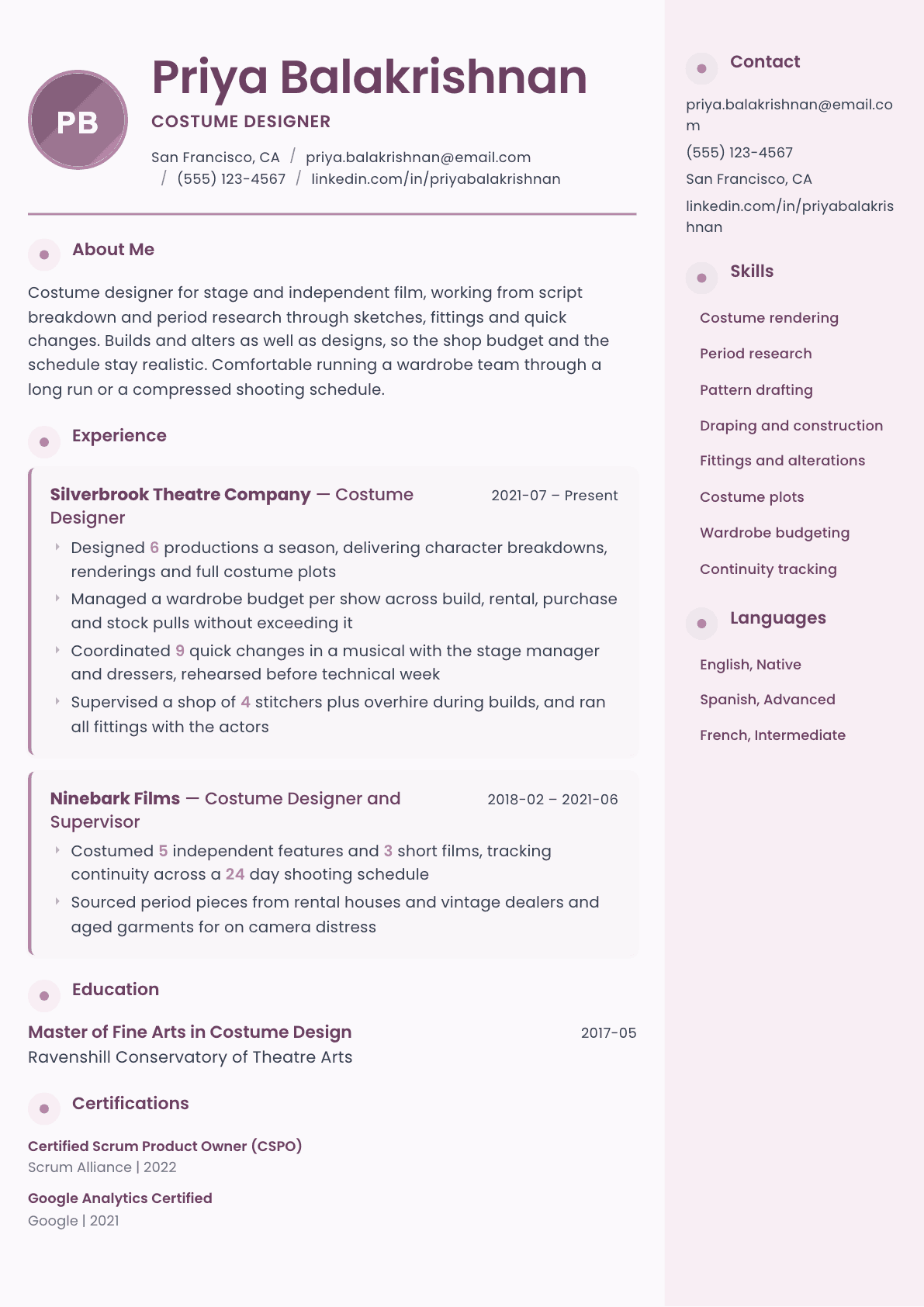
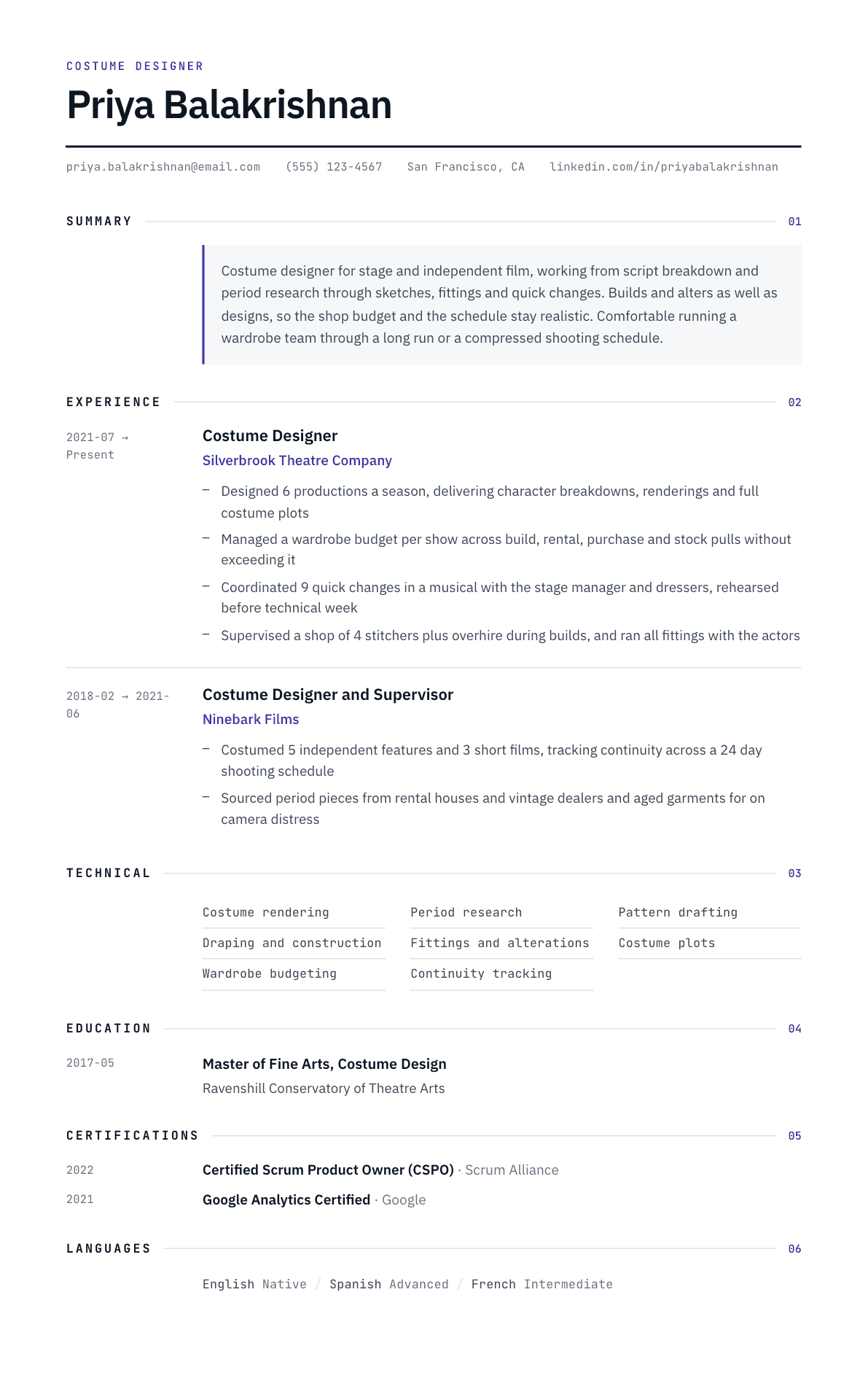
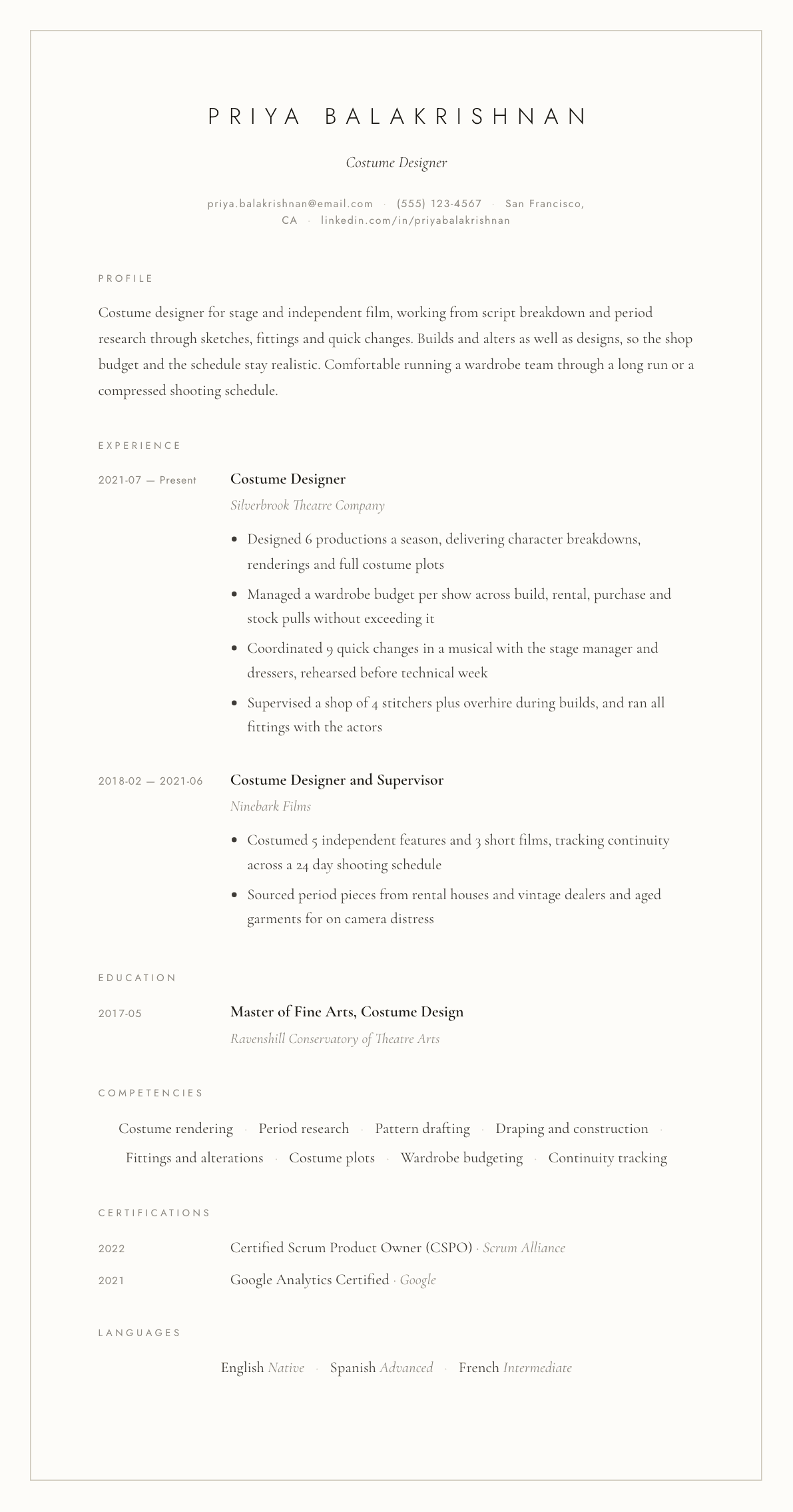
Example Costume Designer summary
Costume designer with nine years across regional theater and independent film, from script breakdown and period research to renderings, fittings and quick changes. Drafts patterns and builds as well as designs, which keeps shop budgets and schedules honest. Supervises stitchers and dressers through long runs and compressed shoots. Looking for design work on character driven productions where the clothes carry part of the story.
Skills to list on a Costume Designer resume
- Costume design
- Costume rendering
- Period research
- Pattern drafting
- Draping
- Garment construction
- Tailoring and alterations
- Fittings
- Costume plots
- Wardrobe budgeting
- Fabric sourcing
- Dyeing and distressing
- Continuity tracking
- Wardrobe team supervision
What actually gets this resume read
- Lead with a credits list: production, company or studio, director, and the year, in reverse order.
- Split stage credits from film and television, because continuity and quick changes are different disciplines.
- Show what you can make yourself: pattern drafting, draping, tailoring, millinery, dyeing and distressing.
- State budget size in relative terms and how you balanced build, rental, purchase and stock to fit it.
- Describe fitting practice and how you work with actors, since that relationship decides whether a design survives.
- Include research depth for period work, naming the sources and how you translated them into wearable pieces.
How to write a costume designer resume
A costume designer is hired on credits and trust. The artistic director or producer reading your resume is deciding whether you can carry a whole show or shoot: research a period accurately, render a character the director recognizes, run fittings that actors leave feeling supported, and land all of it inside a wardrobe budget that never feels like enough. The document has to answer all four in a form that can be read in a production meeting.
What most candidates underplay is the making. A designer who can draft a pattern, drape a bodice, tailor a jacket, dye and distress fabric knows what a build actually costs in hours, so the budget and the schedule they propose are realistic. Shops and producers notice that quickly, and it is one of the clearest reasons one designer gets rehired.
This guide covers how to build a credits list, why stage and screen work should be separated, how to write about fittings and actor relationships, how to describe budget and sourcing decisions, and what a costume portfolio needs beyond renderings.
Format: a credits document, not an essay
Lead with credits: production, company or studio, director, and year, in reverse order. Two pages are normal and expected once the list grows. Keep the layout plain, since these pages circulate as printouts and attachments through producers, stage managers and department heads.
Under the credits, add short blocks for construction and making skills, wardrobe management, software and research, then training. If you have supervised a shop or run wardrobe on a long run, give that its own heading, because supervision is a separate hire from design in many companies.
- Header: name, title, city, phone, email, portfolio address, union status if you hold it.
- Credits split by medium: stage, film, television, dance, opera, commercial work.
- Skills blocks: design and rendering, making and construction, wardrobe management, research.
Split stage credits from film and television
The two disciplines share a craft and almost nothing else operationally. Stage work is built around a long run, quick changes, dressers, repeated wear and maintenance. Screen work is built around continuity, multiples of the same garment, weather and schedule chaos, and a costume that has to survive being shot out of order.
Naming which world each credit belongs to lets a reader place your experience without asking. If you work in both, say so in the summary and let the credits blocks prove it, because designers who move comfortably between them are genuinely useful to companies that produce both.
Experience: breakdown, renderings, plots and fittings
Describe the design chain rather than the finished look. Script breakdown and character analysis, period and cultural research, renderings the director signs off, and a full costume plot tracking every character through every scene and change. The plot is the document that proves you think in production terms and not only in images.
Fittings deserve their own bullets. Say how you run them, how you work with actors on fit, movement and character, and what you do when a piece is not working on a body it was designed for. Directors ask about this in interviews because a difficult fitting room damages a whole company.
Quick changes are the classic stage detail. Coordinating a set of changes with the stage manager and dressers, rehearsed before technical week rather than discovered during it, shows a designer who plans the mechanics of wearing, not just the design of it.
Budget, sourcing and the shop you run
Wardrobe budgets are split across build, rental, purchase, stock pulls and alterations, and the design decisions follow the split. Say how you balance those categories, where you spend the money for the characters that carry the story, and where you save. Stating that you held the budget across a season is worth more than any adjective about resourcefulness.
Add sourcing detail: rental houses, vintage dealers, fabric suppliers, and the aging and distressing you do in house. Then the shop: how many stitchers you supervised, whether you brought in extra help during builds, and how you scheduled a build against a rehearsal calendar.
- Budget categories: build, rental, purchase, stock, alterations and maintenance.
- Making: pattern drafting, draping, tailoring, millinery, dyeing, aging and distressing.
- Team: stitchers, cutters, extra help during builds, dressers and wardrobe crew.
Portfolio: renderings, research and the garment on a body
Show three layers for a few productions: the research board, the rendering, and a production photograph of the costume worn under stage or camera light. A rendering alone leaves a producer guessing whether the drawing became a garment that moved and read from the back row.
Include one build in detail: the pattern, the fabric choices, a fitting photograph and the finished piece. That sequence proves you can make as well as design, which is the credential that most reliably separates costume designers who get rehired.
Costume Designer resume summary examples
Assistant or first design credits
Costume designer and wardrobe assistant with 3 years on independent features and short films, tracking continuity across compressed shooting schedules and sourcing period pieces from rental houses and vintage dealers. Drafts patterns and alters on set. Seeking lead design credits in regional theater or independent film.
Nine years in
Costume designer with 9 years across regional theater and independent film, from script breakdown and period research through renderings, fittings and quick changes. Designs 6 productions a season, manages each wardrobe budget across build, rental, purchase and stock, and supervises a shop of 4 stitchers during builds.
Design lead or supervisor
Costume designer and wardrobe supervisor with 15 years of stage and screen credits, including two seasons leading a resident design team. Sets the design language with directors, runs research and rendering, oversees builds and rentals, and manages wardrobe crews through long runs and out of order shooting schedules.
Work experience bullets: before and after
Before: Designed costumes for the theater season.
After: Designed 6 productions a season, delivering character breakdowns, renderings signed off by the director, and a full costume plot tracking every character through every scene and change.
The costume plot is the production document that proves you design for a running show, not for a drawing.
Before: Managed the costume budget.
After: Managed a per show wardrobe budget across build, rental, purchase and stock pulls, spending the build money on the two characters carrying the story and pulling the ensemble from stock.
Naming where the money went shows the design judgment behind budget control rather than mere thrift.
Before: Handled quick changes during the show.
After: Coordinated 9 quick changes in a musical with the stage manager and dressers, rigging garments with hidden closures and rehearsing every change before technical week.
The mechanics and the rehearsal timing show planning instead of a problem solved in a panic.
Before: Supervised the costume shop.
After: Supervised a shop of 4 stitchers plus extra help during builds, scheduling each garment against the rehearsal calendar so principals had rehearsal pieces before technical week.
Scheduling against the rehearsal calendar is the supervision detail a production manager cares about most.
Before: Did research for period productions.
After: Researched period silhouettes, fabrics and construction from museum collections and dated photographs, then adapted them into pieces actors could move and sing in for a two hour show.
The translation from research to wearable garment is the actual skill, and stating it proves the research was applied.
Hard skills
- Costume design and character breakdown
- Costume rendering
- Period and cultural research
- Pattern drafting
- Draping
- Garment construction
- Tailoring and alterations
- Fittings
- Costume plots and tracking
- Wardrobe budgeting
- Fabric sourcing and rentals
- Dyeing, aging and distressing
- Continuity tracking for camera
- Wardrobe team supervision
Soft skills
- Actor communication in fittings
- Director collaboration
- Discretion about bodies and sizing
- Calm during technical rehearsals
- Scheduling under a rehearsal calendar
Mistakes that cost costume designer candidates the interview
- Writing paragraphs of description when producers expect a scannable credits list.
- Combining stage and screen credits, which hides whether you have handled continuity or quick changes.
- Showing renderings only, with no photograph of the finished costume worn under light.
- Leaving out making skills, so a shop cannot judge whether your build estimates are realistic.
- Saying nothing about budget, when balancing build against rental is most of the daily work.
- Omitting the director name from credits, which is often how a reader verifies and recognizes the work.
Costume Designer resume questions
How should a costume designer list credits?
One line per production with the title, the producing company or studio, the director, and the year, newest first, split into stage and screen blocks. State clearly when a credit was assistant, associate or supervisor rather than lead design.
Do I need sewing and construction skills to be a costume designer?
You can design without them, but making skills change how you are trusted. A designer who drafts patterns, drapes and tailors estimates build hours realistically, communicates with a shop precisely, and can solve a fitting problem in the room.
What should a costume design portfolio contain?
Research boards, renderings and production photographs shown together for several productions, plus one build documented from pattern through fitting to finished garment. That combination proves the drawing became something wearable that read on stage or on camera.
How do I describe wardrobe budget experience?
Name the categories you balanced, build, rental, purchase, stock and alterations, and describe one decision where you concentrated spending on the characters carrying the story. Relative scale is fine when exact figures are confidential.
How do I move from theater costume work into film?
Emphasize continuity thinking, multiples of a garment, aging and distressing, and working out of sequence, then take a costumer or assistant credit to learn set protocol. Keep your making skills visible, since screen work often needs fast on set alterations.