Fitness Manager Resume Examples: the lines they read
Write a Fitness Manager Resume Clubs Hire From
By Mustafa Tarabya, founder of CVBooster · Published · Updated
Fitness manager resume sample with revenue, retention and staffing detail, club systems, keywords and a complete writing guide.
Sample resumes for a fitness manager
The same fitness manager content laid out in three CVBooster templates, so you can see what the finished document looks like before you write a word.
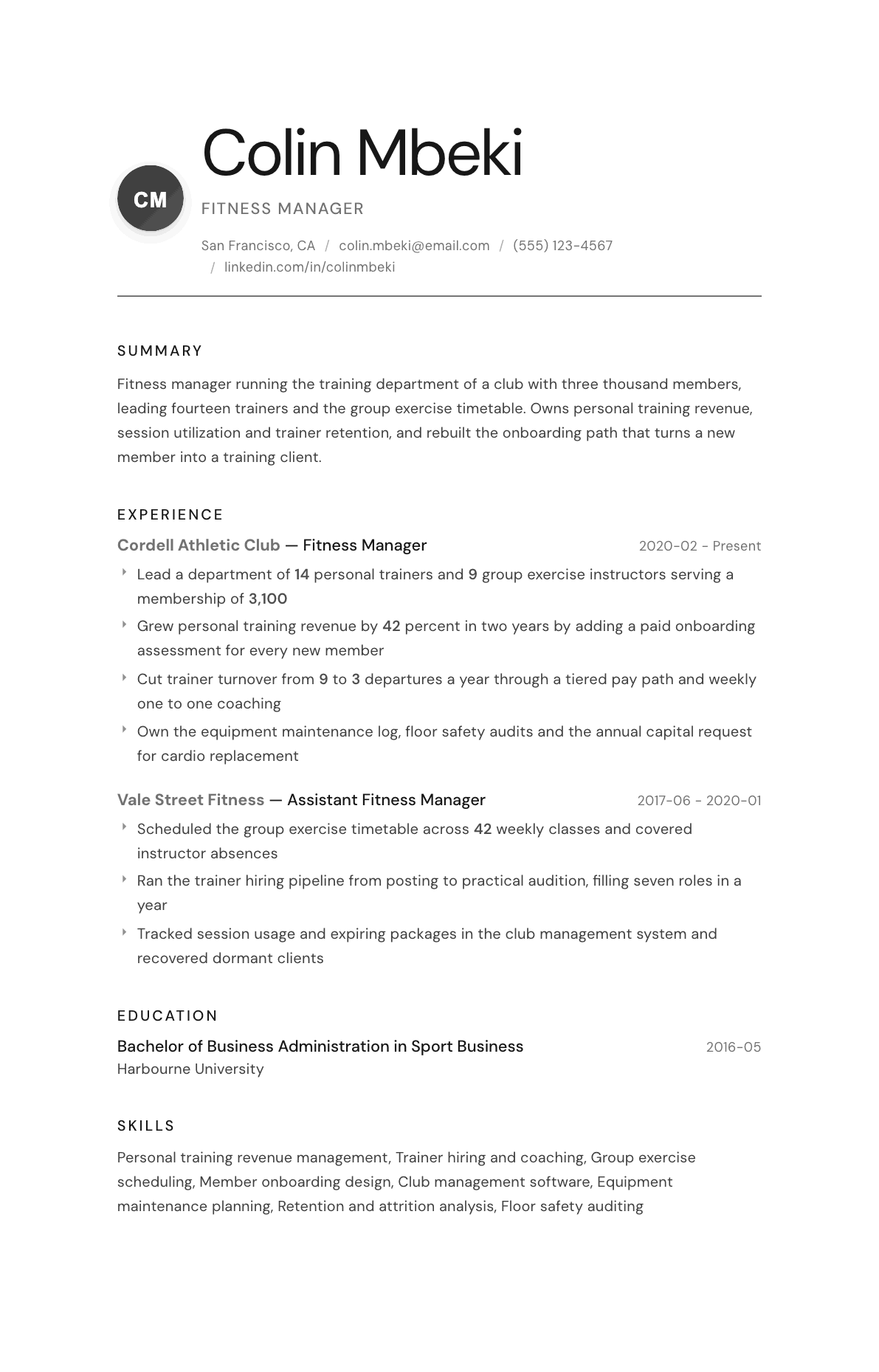
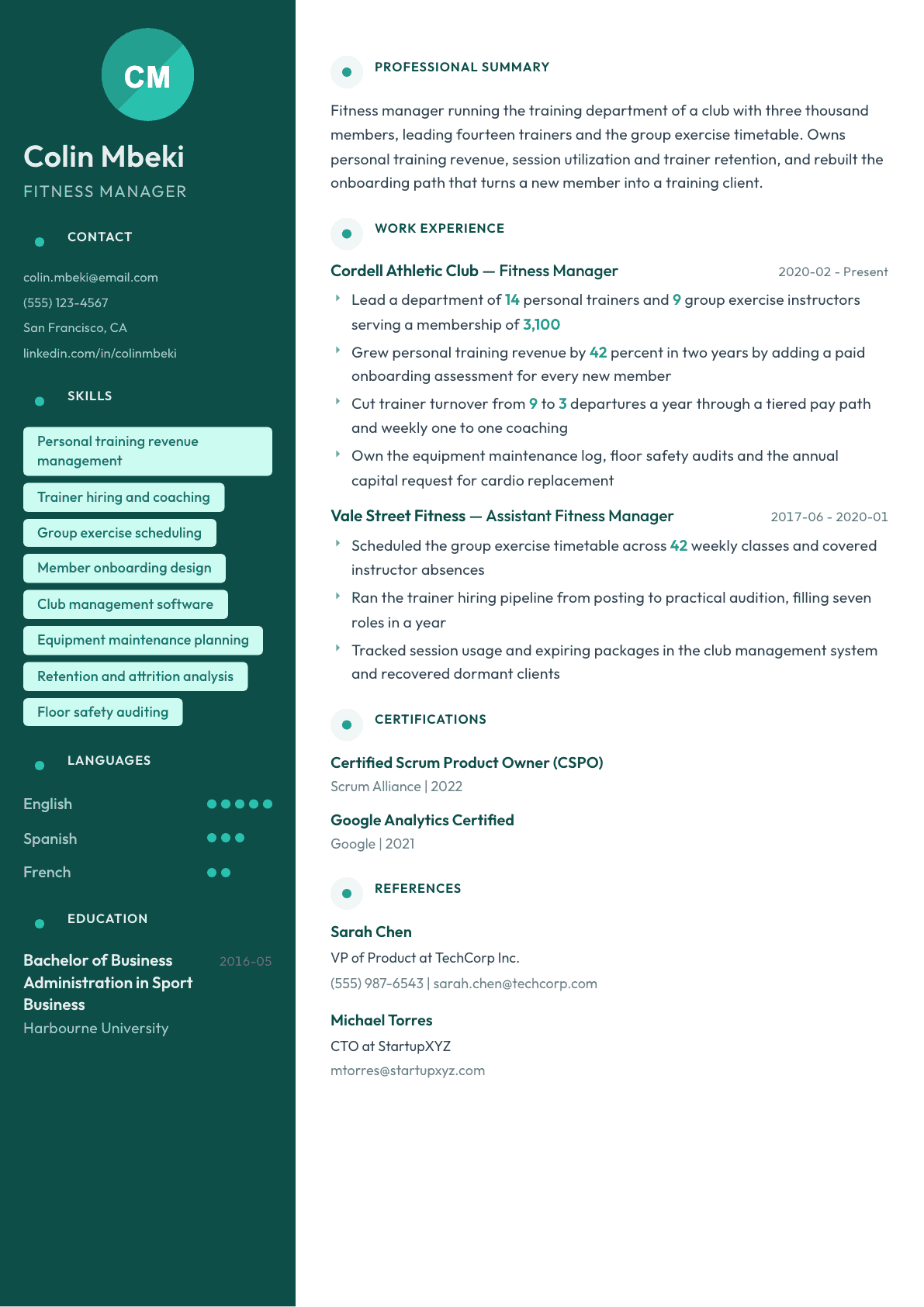
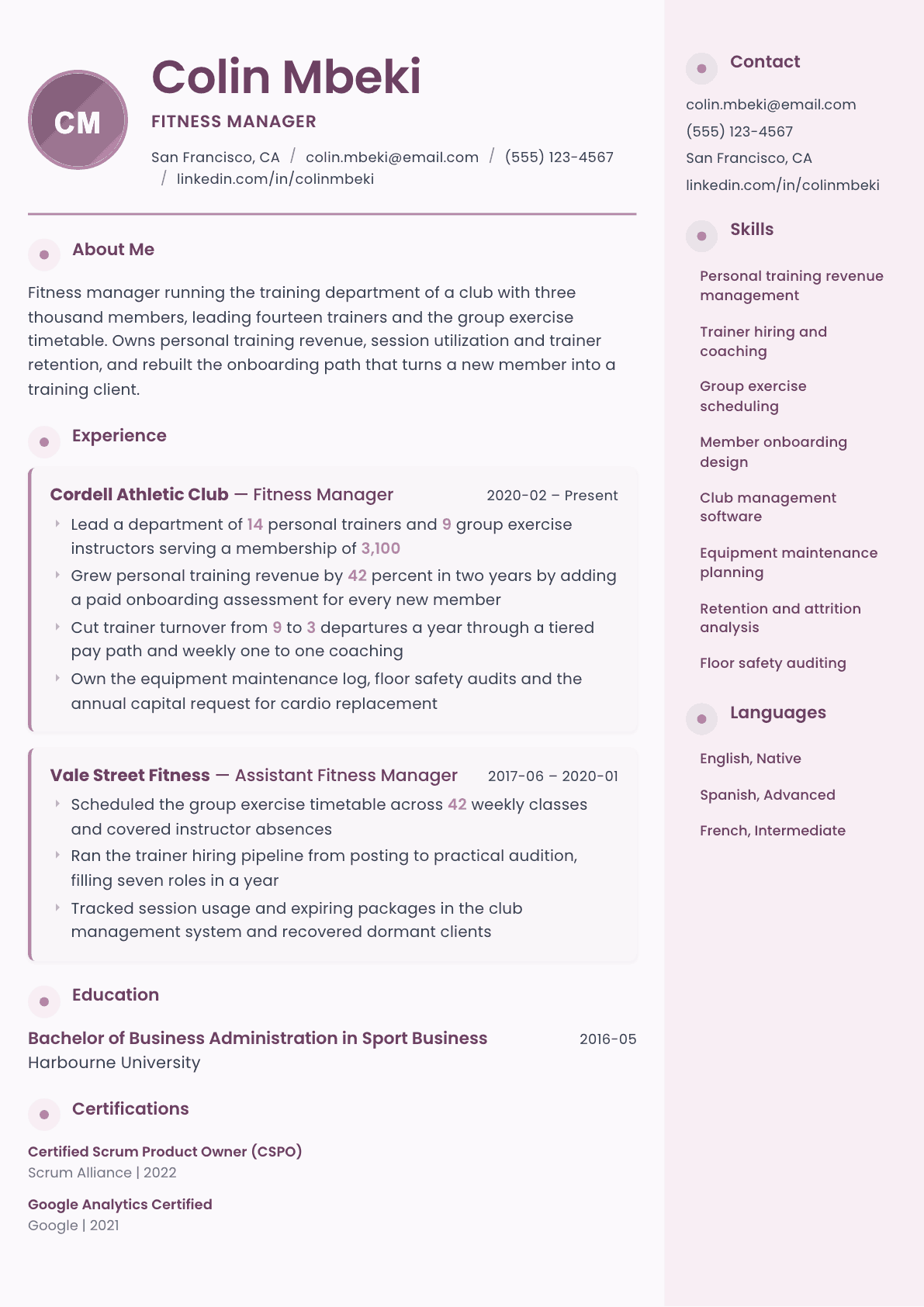
Example Fitness Manager summary
Fitness manager with six years running training departments in multi-site clubs, currently leading fourteen trainers and nine group exercise instructors for a membership of three thousand. Owns training revenue, session utilization and trainer retention, redesigned member onboarding around a paid assessment, and manages the equipment and safety audit calendar. Certified as a personal trainer and looking for a general manager track at a growing club group.
Skills to list on a Fitness Manager resume
- Department leadership
- Personal training sales
- Session utilization tracking
- Trainer recruitment and auditions
- Trainer development and pay tiers
- Group exercise programming
- Member onboarding and assessment
- Retention and attrition analysis
- Club management software
- Staff scheduling and payroll review
- Equipment maintenance planning
- Floor safety and risk audits
- Budgeting and capital requests
- Member complaint resolution
What actually gets this resume read
- Lead with the numbers a club owner cares about: training revenue, session utilization, member retention and trainer turnover.
- Give the size of what you ran: membership count, trainer headcount, class timetable and the square footage of the floor.
- Keep your own training certification current and listed, because a manager who cannot cover a session is a risk.
- Show the systems you have run, from club management software to scheduling and payroll, since these change with every employer.
- Describe how you develop trainers, including audition process, pay tiers and coaching cadence, not just that you managed them.
- Include equipment, maintenance and safety audit work, because a fitness manager owns the floor and its liability.
How to write a fitness manager resume
A fitness manager resume is read by a general manager or a regional director who is looking at a profit and loss statement while she reads it. The training department is one of the few lines in a club that grows without adding square footage, so she is trying to work out whether you can raise training revenue, keep trainers from leaving, and stop the floor from becoming a liability.
That means the resume has to be commercial. A page describing your training philosophy and your certifications is a personal trainer resume with a different title on top. A fitness manager writes about revenue, utilization, headcount, retention, scheduling and equipment budgets, and then proves she can still coach a trainer through a bad month.
This guide covers the sections a club operator reads in order, three summaries for an assistant manager, a fitness manager and a multi-site leader, five rewritten bullets, and the questions that come up when a trainer moves into management for the first time.
Format: scope line, results, then systems
Reverse chronological, and open every role with a scope line rather than a duty list. Membership size, trainer headcount, group exercise instructors, class timetable size and the floor you were responsible for. A regional director sorts candidates by scope before she reads anything else.
One page works until you have managed more than one site. Two pages suit a multi-site or regional candidate, with the second page carrying department numbers rather than a longer certification list.
- Scope line: membership count, trainer headcount, instructor count, weekly class count, floor size.
- Results block: training revenue movement, session utilization, trainer turnover, member retention.
- Systems block: club management software, scheduling, payroll review, maintenance logging.
- Then your own training certification, education and any operations or safety credentials.
Summary: scope, the number you own, the system you built
Four lines. The scope of the department you ran, the commercial number you were accountable for, the system you built that produced it, and your own current training certification. Operators want a manager who has carried a target rather than one who supervised a rota.
A trainer stepping into management should write the summary around leadership evidence already earned: mentoring new trainers, running the onboarding assessment, covering the schedule, handling escalated member complaints. That is the bridge, and stating it beats hoping the reader infers it.
Experience: revenue, utilization and the training team
Lead with the commercial results. Personal training revenue movement, session utilization against sessions sold, package renewal rate, and the share of new members who take a paid assessment. These are the figures a club board reviews monthly, so they are the figures that make a fitness manager credible.
Then write about the team. How trainers are recruited, what the practical audition looks like, the pay tiers they progress through, the coaching cadence you keep with each of them, and what turnover did while you ran the department. Trainer churn is expensive and chronically bad across the industry, so a manager who has reduced it has a real story.
Finish with the floor. Equipment maintenance logging, safety audits, cleaning standards, capital requests for cardio replacement, and how you handle an incident. A fitness manager owns the physical risk in the building, and operators know it even when the job posting does not say so.
Member journey and group exercise
Describe the path a new member takes from joining to becoming a training client: the welcome contact, the assessment, the first program, the follow up, and who owns each step. Clubs lose most new members in the first weeks, so a manager who has designed that path is solving the club biggest leak.
Group exercise sits alongside it. Timetable design, class mix across the week, instructor cover for absences, attendance tracking per class and how you decide to cut a class that is not filling. A timetable that quietly runs at low attendance costs a club money every week it stays untouched.
- Onboarding path: contact, assessment, first program, follow up, and the owner of each step.
- Timetable management: class mix, peak slots, attendance thresholds, cover process.
- Retention work: check ins, program refresh cadence, dormant client recovery.
- Escalation: how a member complaint about a trainer is handled and recorded.
Systems, compliance and budget
Name the club management and scheduling software you have used, because these change with every employer and a manager who has run more than one is cheaper to onboard. Say what you did inside them: session tracking, expiring package reports, payroll review, membership queries.
Then the compliance and budget work. Equipment service contracts, maintenance logs, safety audits of the floor, incident reporting, staff certification expiry tracking, and the annual capital request. Keeping your own training certification current matters as well, because a manager who cannot cover a session when a trainer calls in sick is a scheduling risk.
Keywords in fitness management postings
Club listings repeat a familiar vocabulary: personal training revenue, member retention, staff development, group exercise scheduling, department leadership, equipment maintenance and health and safety compliance. Mirror the exact phrasing once in the summary and once in a role.
Match the language of the operator type as well. A boutique studio, a member club and a large chain use different words for the same job, and the closer your page reads to the posting, the more obvious the fit.
Fitness Manager resume summary examples
Assistant fitness manager
Assistant fitness manager with three years in a club of two thousand members, scheduling a timetable of 42 weekly classes and running the trainer hiring pipeline from posting to practical audition. Tracks session usage and expiring packages in the club system and holds a current personal training certification.
Fitness manager
Fitness manager leading fourteen trainers and nine group exercise instructors for a membership of three thousand. Owns training revenue, session utilization and trainer retention, redesigned member onboarding around a paid assessment and manages the equipment maintenance and safety audit calendar.
Multi-site leader
Area fitness manager overseeing training departments at four clubs, a team of forty trainers and a combined membership of nine thousand. Built the pay tier structure and audition standard used across the group, cut trainer turnover by half and owns the annual equipment capital plan.
Work experience bullets: before and after
Before: Managed the personal training department at the club.
After: Led a department of 14 personal trainers and 9 group exercise instructors serving a membership of 3,100, owning training revenue, session utilization and the class timetable.
Headcount, membership size and the numbers you own define the scope of the job in one line.
Before: Increased personal training sales.
After: Grew personal training revenue by 42% in two years by adding a paid onboarding assessment for every new member and reviewing the booked-to-delivered session gap each week.
The growth is explained by two mechanisms an operator can copy, not by effort.
Before: Reduced staff turnover among trainers.
After: Cut trainer departures from 9 to 3 a year by building a tiered pay path tied to session volume and holding a weekly one to one coaching session with every trainer.
A before and after count with the retention system behind it is the strongest management evidence.
Before: Looked after the gym floor and equipment.
After: Owned the equipment maintenance log, ran a monthly floor safety audit and built the annual capital request that replaced eleven cardio units without unplanned downtime.
Maintenance, audit and capital planning together show ownership of the club physical risk.
Before: Scheduled group exercise classes.
After: Managed a timetable of 42 weekly classes across nine instructors, tracked attendance per class and replaced three consistently low sessions with formats that filled the same slot.
Attendance tracking and a decision made from it turn scheduling into commercial management.
Hard skills
- Training revenue ownership
- Session utilization analysis
- Trainer recruitment and practical auditions
- Pay tier and commission structures
- Group exercise timetable design
- Member onboarding and assessment design
- Retention and attrition reporting
- Club management software
- Staff scheduling and payroll review
- Equipment maintenance and service contracts
- Floor safety audits and incident reporting
- Departmental budgeting and capital requests
Soft skills
- Coaching underperforming trainers
- Difficult member conversations
- Delegation across a shift pattern
- Hiring judgment
- Calm handling of floor incidents
- Cross-department cooperation with sales
Certifications worth listing
- NASM Certified Personal Trainer (National Academy of Sports Medicine)
- ACE Certified Personal Trainer (American Council on Exercise)
- NSCA Certified Strength and Conditioning Specialist (National Strength and Conditioning Association)
- Adult First Aid, CPR and AED (American Red Cross)
Mistakes that cost fitness manager candidates the interview
- Writing a personal trainer resume with a manager job title on top of it.
- Leaving out the scope line, so the reader cannot tell a studio of two hundred from a club of four thousand.
- Talking about team culture without a single retention or turnover figure.
- Ignoring equipment, maintenance and safety audits, which are the liability the job actually carries.
- Listing every certification you have ever held while giving the department results two lines.
- Never naming the club management or scheduling software, when onboarding cost is a real hiring factor.
- Failing to say whether you still coach sessions yourself, which every operator wants to know.
Fitness Manager resume questions
What numbers should a fitness manager put on a resume?
Training revenue movement, session utilization, package renewal rate, trainer turnover and member retention. Give a before and after for at least two of them, because an operator is trying to predict what happens to her own numbers if she hires you.
How do I move from personal trainer to fitness manager?
Lead with the leadership work you already do without the title: mentoring new trainers, running onboarding assessments, covering the schedule and handling escalated complaints. Then show that you understand the commercial side by naming the metrics a department is measured on.
Should a fitness manager keep a personal training certification current?
Yes. Operators want a manager who can cover a session at short notice and who can audit a trainer program credibly. An expired certification also reads as someone who stopped paying attention to the craft the department is built on.
How much detail belongs on equipment and maintenance?
A short block covering the maintenance log, service contracts, safety audits and any capital request you have prepared. It is unglamorous work, and it is the part of the role that protects the club when something goes wrong on the floor.
Does group exercise experience matter for a fitness manager job?
It does when the timetable reports to you, which it usually does. Show timetable size, instructor cover process and at least one scheduling decision you made from attendance data, since a poorly filled class costs the club money every week.
Related resume examples
- Gym Manager Resume example
- Fitness Instructor Resume example
- Personal Trainer Resume example
- Group Fitness Instructor Resume example
- Recreation Director Resume example
- Gym Receptionist Resume example