Recreation Director Resume Examples: what gets the call
Write a Recreation Director Resume That Shows Command
By Mustafa Tarabya, founder of CVBooster · Published · Updated
Recreation director resume examples covering budget, staff and facility leadership, with a guide to writing for parks, campus and club director roles.
Sample resumes for a recreation director
The same recreation director content laid out in three CVBooster templates, so you can see what the finished document looks like before you write a word.
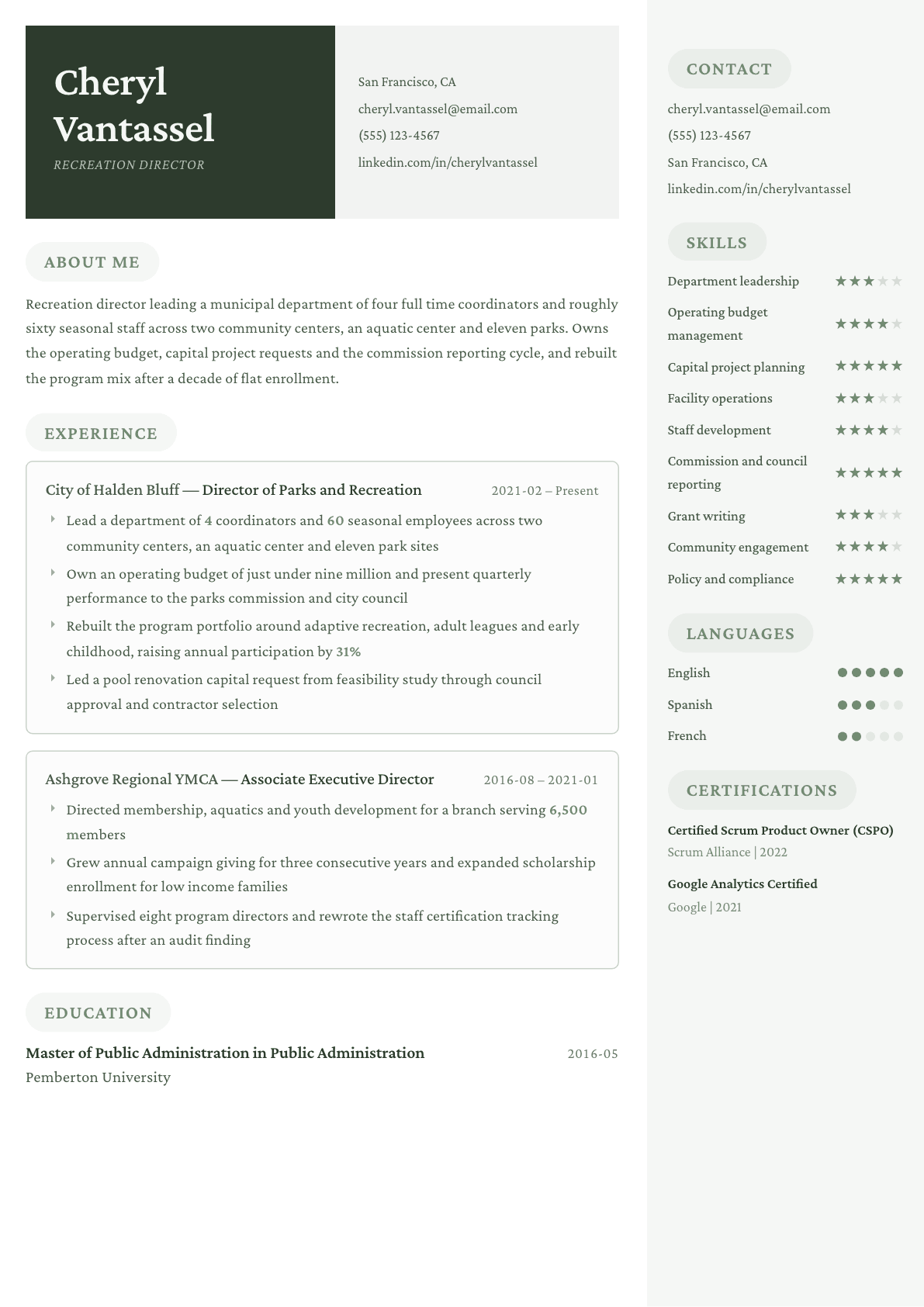
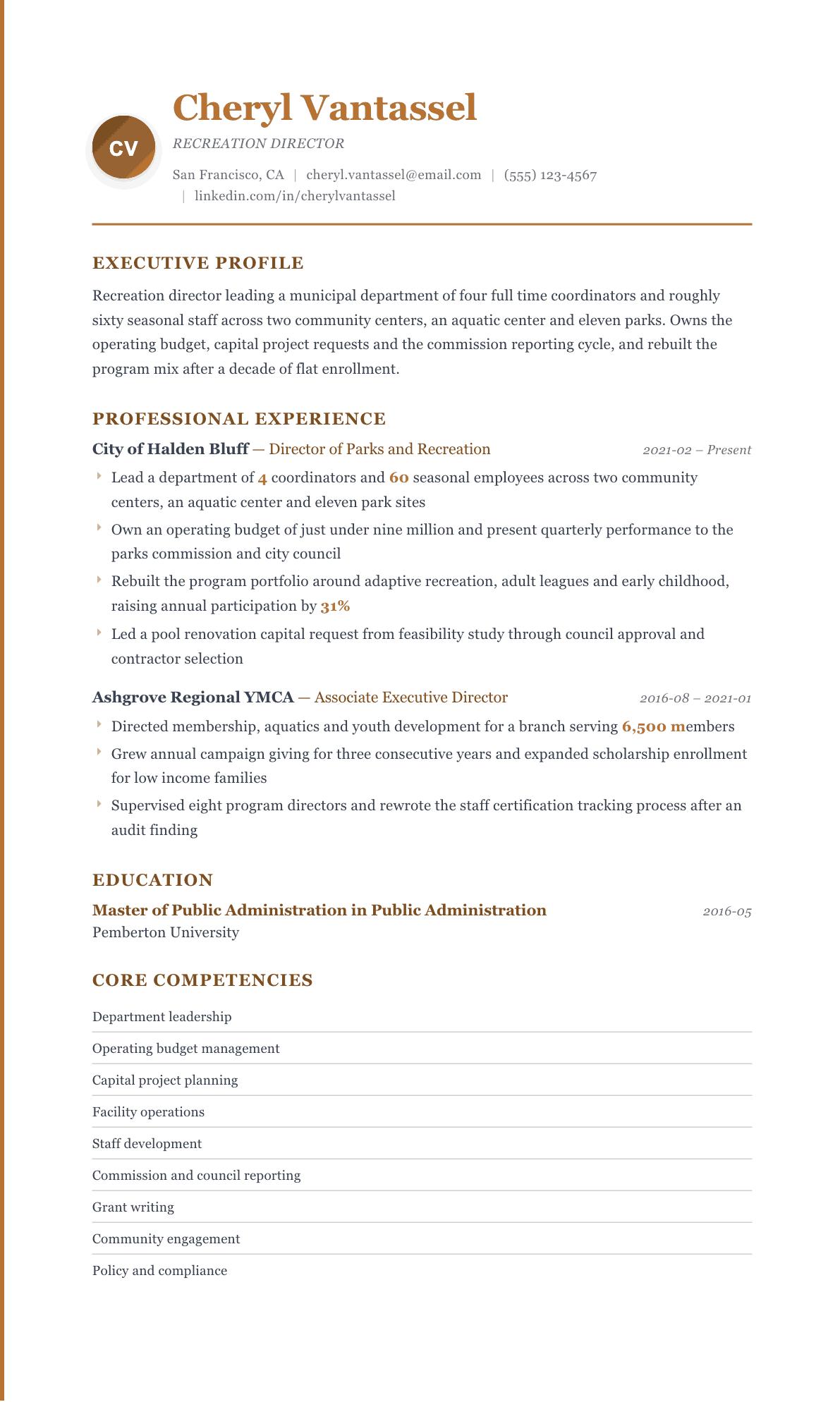
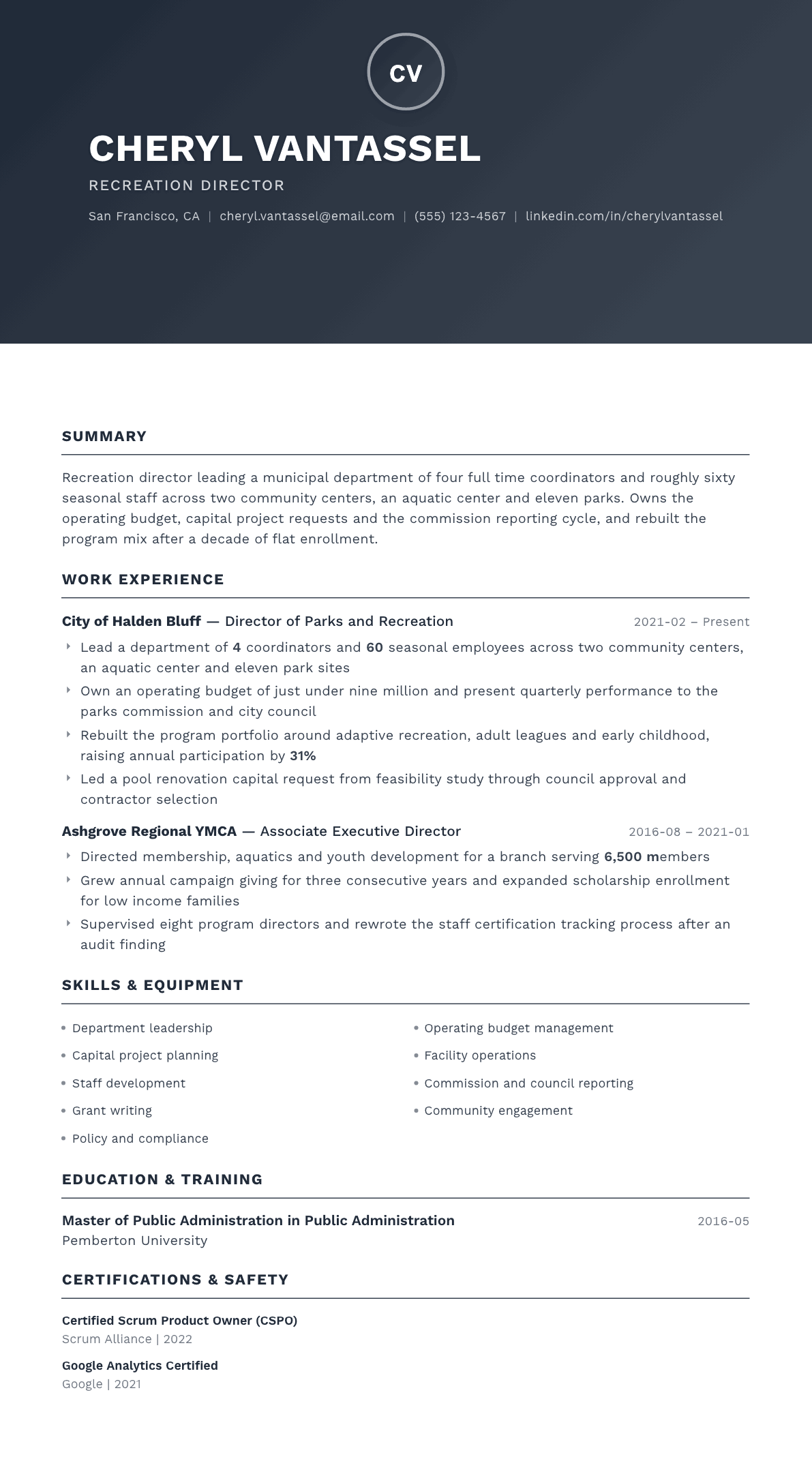
Example Recreation Director summary
Recreation director leading a municipal department of four coordinators and about sixty seasonal staff across two community centers, an aquatic center and eleven parks. Owns the operating budget, presents quarterly to the parks commission, carried a pool renovation from feasibility study to council approval, and rebuilt the program portfolio around adaptive and adult offerings.
Skills to list on a Recreation Director resume
- Department and multi site leadership
- Operating and capital budget management
- Parks commission and council reporting
- Facility operations and maintenance planning
- Aquatics and athletics oversight
- Staff hiring, development and succession
- Grant writing and fund development
- Strategic and master planning
- Policy, risk and compliance
- Community engagement and public meetings
- Partnership agreements with schools and leagues
- Program portfolio evaluation
- Adaptive and inclusive recreation
What actually gets this resume read
- Open with scope: how many staff, how many facilities, how many participants and what budget you actually control.
- Report budget size in words rather than a figure with a comma, and always pair it with what you did with it.
- Show governance work, since directors live in commission meetings, council packets and public comment periods.
- Include capital projects from request through delivery, because that is the difference between a manager and a director.
- Name the certification you hold, such as CPRP or CPRE, with the issuing body, since many postings list it as preferred.
- Give one bullet on equity and access programming, which is now written into most public recreation strategic plans.
How to write a recreation director resume
A director search is a governance hire. The city manager, board or executive committee running it wants to know whether you can hold a public meeting when residents are angry about a pool closure, defend a budget in a council chamber, and still develop the coordinators underneath you. Program delivery skill is assumed by the time someone reaches this title, so a resume that lists programs reads as a coordinator resume with a bigger job header.
What changes at director level is scope and accountability. Staff count, facility portfolio, operating budget, capital projects, commission reporting, partnership agreements and strategic planning are the categories a search committee scores. The applications that advance put all of that in the first fifteen lines and support it underneath.
This guide covers the order a search committee reads, gives sample summaries for a first director role, an established director and an executive candidate, rewrites the bullets that appear on most director applications, and answers the questions that come up when a strong operator cannot get past a panel interview.
Format: two pages, scope in the first block
Two pages, occasionally three when the record includes significant capital work or multiple agencies. Reverse chronological. Plain layout, because these applications move through municipal portals, board packets and printed committee binders, and anything decorative degrades at each step.
Open with a scope block rather than a personal statement. Staff supervised, facilities operated, participants served, budget owned, capital delivered. A search committee comparing six finalists wants those five numbers next to each other, and the candidate who supplies them controls the comparison.
- Header: name, city and state, phone, email, and your CPRP or CPRE credential with the issuing body.
- Section order: scope summary, leadership experience, capital and budget highlights, credentials, education, service.
- Include board, commission and professional association service, since committees weigh public governance exposure.
- A short list of capital projects with role, scale and status is worth more than another paragraph of program detail.
Summary: the five numbers that define a director job
Staff, sites, participants, budget, governance. Say how many full time and seasonal employees report through you, how many centers, pools, parks or fields you operate, roughly how many residents or members you serve, the size of the operating budget in words rather than a figure, and who you report to.
Then one line on the mandate you were hired against or the one you delivered. Rebuilding a program portfolio, recovering from an audit finding, opening a new facility, restoring participation after a closure. Directors are hired to fix or grow something specific, and naming yours tells a committee what kind of leader you are.
Experience: budget, capital, governance, people
Budget bullets should show the full cycle: building the annual request, defending it, monitoring through the year, and closing it. Cost recovery is the metric public recreation leadership is judged on, so if you changed a fee structure or a subsidy policy, that belongs on the page with what it did to the recovery ratio.
Capital work is what separates a director resume from a superintendent one. Take each project from feasibility study through public engagement, council or board approval, contractor selection and opening. Name your role honestly at each stage, because committees call references specifically to test this.
Governance and people come next. Commission agendas, council presentations, public comment sessions, master plan adoption and interagency agreements show you can operate in the open. Staff development, succession planning and labor relations show the department survives your departure. Both categories get scored, and both are usually thin on the applications that lose.
- Give the reporting line and the body you present to, whether commission, board, council or executive committee.
- State the operating budget scope in words and the cost recovery direction you moved it.
- List capital projects with your role, the approval path and the current status.
- Show staff structure: direct reports, total department headcount, and any succession or development program you built.
- Include partnership and interagency agreements with school districts, leagues and neighboring jurisdictions.
- Name the planning documents you owned, such as a master plan, strategic plan or level of service study.
Credentials, service and the professional record
The Certified Park and Recreation Professional and the Certified Park and Recreation Executive credentials from the National Recreation and Park Association carry weight in this hiring, and executive postings often name the second one directly. Aquatic facility operator credentials matter where you run pools. Public administration coursework and a completed public sector leadership program belong in education.
Add professional service. State association board seats, conference presentations, accreditation review team participation and agency accreditation work all signal that you operate beyond your own department, which is exactly what a committee hopes a director brings back to it.
Keywords a director posting repeats
Director job descriptions share a vocabulary: operating and capital budget, cost recovery, strategic planning, master plan, commission relations, community engagement, staff development, risk management, interagency partnerships, grant funding, facility operations. Use the ones that describe your record, and place each next to the evidence rather than in a keyword block that a committee will discount.
Recreation Director resume summary examples
First director role
Recreation superintendent stepping up to director, currently leading athletics, aquatics and facility operations for a department serving eight park sites. Supervises three coordinators and forty seasonal staff, manages a division budget, and led the fee study that raised cost recovery across adult programs.
Sitting director
Recreation director leading a municipal department of four coordinators and about sixty seasonal staff across two community centers, an aquatic center and eleven parks. Owns the operating budget, presents quarterly to the parks commission, and carried a pool renovation from feasibility study through council approval and contractor selection.
Executive candidate
Parks and recreation executive with fifteen years across two agencies, most recently leading a department of ninety full time staff, four community centers and a regional trail network. Delivered three capital projects, secured state and federal grant funding, and led the agency through national accreditation review.
Work experience bullets: before and after
Before: Managed the parks and recreation department.
After: Led a department of four coordinators and sixty seasonal employees across two community centers, an aquatic center and eleven park sites, reporting to the city manager and the parks commission.
Staff structure, facility portfolio and reporting line define the job in a way the word managed never can.
Before: Responsible for the department budget.
After: Owned an operating budget of just under nine million, presented quarterly performance to the parks commission, and raised adult program cost recovery through a rebuilt fee schedule.
Scope, governance and a fiscal outcome together show a director who defends money rather than merely spends it.
Before: Oversaw a facility renovation project.
After: Led a pool renovation from feasibility study through public engagement, council approval, contractor selection and reopening, coordinating with public works and the design consultant throughout.
Naming each stage lets a committee verify your role instead of guessing which part of the project was yours.
Before: Increased program participation.
After: Rebuilt the program portfolio around adaptive recreation, adult leagues and early childhood offerings, raising annual participation by 31% across three seasons.
Saying what you changed and over what period makes a growth figure credible rather than decorative.
Before: Worked with community groups and schools.
After: Negotiated joint use agreements with the school district and three youth leagues, adding gym and field hours at no capital cost and resolving a decade of scheduling disputes.
A named agreement type with a concrete gain shows partnership work that produced capacity, not meetings.
Hard skills
- Operating and capital budget management
- Cost recovery and fee policy
- Capital project delivery
- Commission and council reporting
- Strategic and master planning
- Facility and aquatics operations oversight
- Grant writing and fund development
- Joint use and interagency agreements
- Staff development and succession planning
- Risk management and policy administration
- Agency accreditation processes
- Community engagement and public meetings
Soft skills
- Composure at a contentious public hearing
- Political judgment with elected officials
- Delegating to coordinators without hovering
- Negotiating with partner agencies
- Communicating hard decisions to staff
- Long range thinking under annual budget pressure
Certifications worth listing
- Certified Park and Recreation Executive (CPRE) (National Recreation and Park Association)
- Certified Park and Recreation Professional (CPRP) (National Recreation and Park Association)
- Aquatic Facility Operator (AFO) (National Recreation and Park Association)
- Certified Pool Operator (CPO) (Pool and Hot Tub Alliance)
Mistakes that cost recreation director candidates the interview
- Submitting a coordinator resume with a director title, full of program lists and empty of budget, capital and governance evidence.
- Omitting the reporting line and the body you present to, which is the first thing a search committee wants to place you against.
- Claiming a capital project without naming your role at each stage, when reference calls test exactly that.
- Ignoring cost recovery, the metric public recreation leadership is most often measured and interviewed on.
- Leaving out staff development and succession, so the committee cannot tell whether the department improves under you.
- Using a designed template that breaks when the application is printed into a board packet for committee review.
Recreation Director resume questions
How do I show budget size without printing a salary style figure?
Write the scope in words, for example an operating budget of just under nine million, and pair it with what you did: a fee study, a cost recovery shift, a reallocation between divisions. Committees care about stewardship more than the exact number.
What separates a director resume from a superintendent one?
Governance and capital. Superintendents run divisions and programs well. Directors defend budgets in public, carry capital projects through approval bodies, negotiate interagency agreements and own the strategic plan. Show those four and the level reads correctly.
Is the CPRE credential necessary?
It is preferred on many executive postings rather than universally required, and the CPRP is more common at earlier stages. If you hold neither, list relevant public administration education and state association leadership so the credential gap is offset.
Should I include community meeting and public comment experience?
Yes, explicitly. A large share of the job happens in front of residents who disagree with a decision. Naming the hearings you led, the master plan you took to adoption or the closure you communicated shows the composure a committee is screening for.
How much program detail should stay on the page?
Enough to show you understand delivery, no more. Two or three portfolio decisions with outcomes are sufficient. The space belongs to budget, capital, partnerships and staff, because those are the categories the search committee scores at this level.
Related resume examples
- Recreation Coordinator Resume example
- Program Coordinator Resume example
- Gym Manager Resume example
- Fitness Manager Resume example
- Event Coordinator Resume example
- Head Coach Resume example