Personal Trainer Resume Examples: the lines they read
Flex Your Personal Trainer Resume
By Mustafa Tarabya, founder of CVBooster · Published · Updated
Personal Trainer resume examples with expert tips, ATS keywords, and professional templates. See exactly what a winning certified personal trainer resume looks like.
Sample resumes for a personal trainer
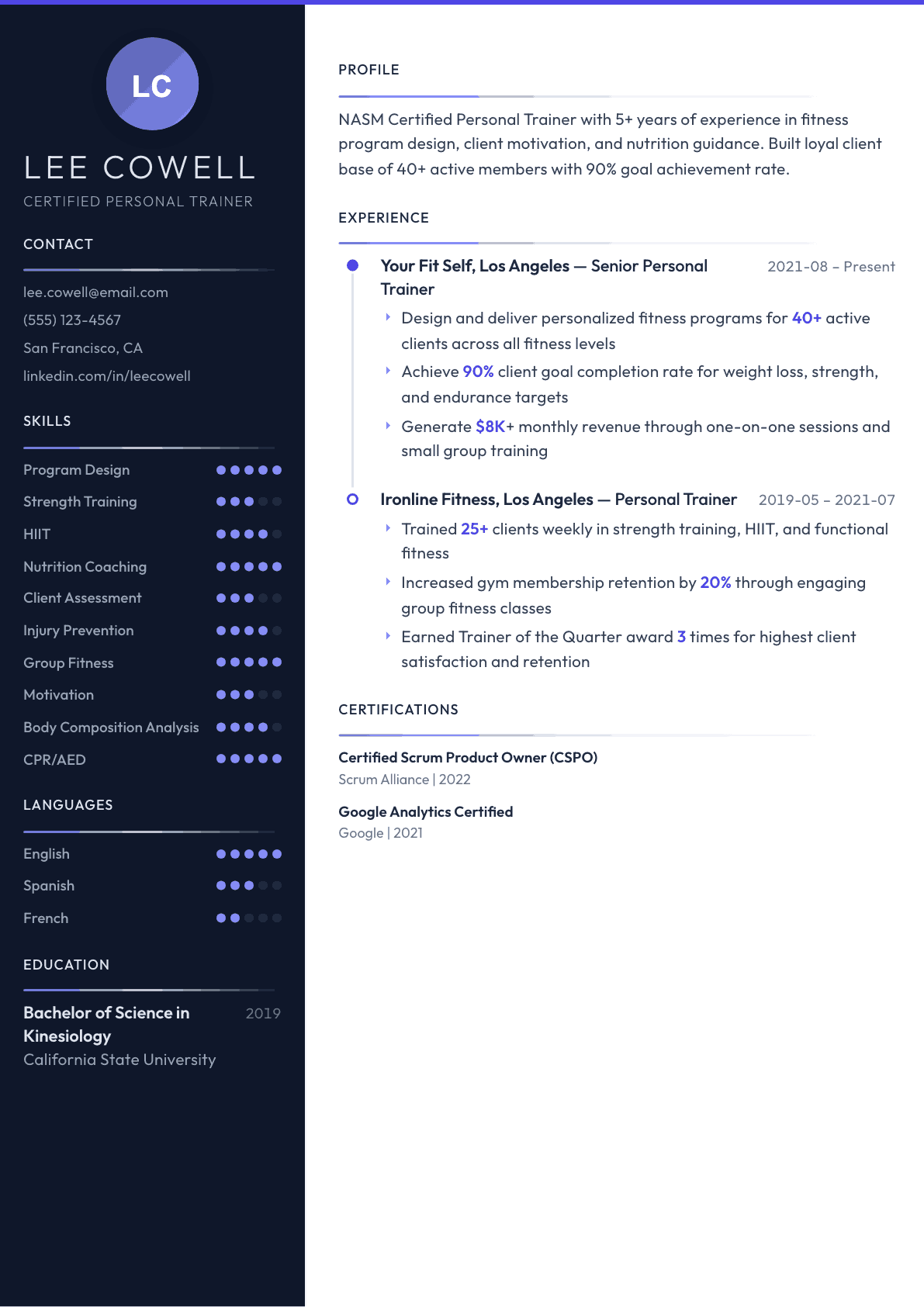
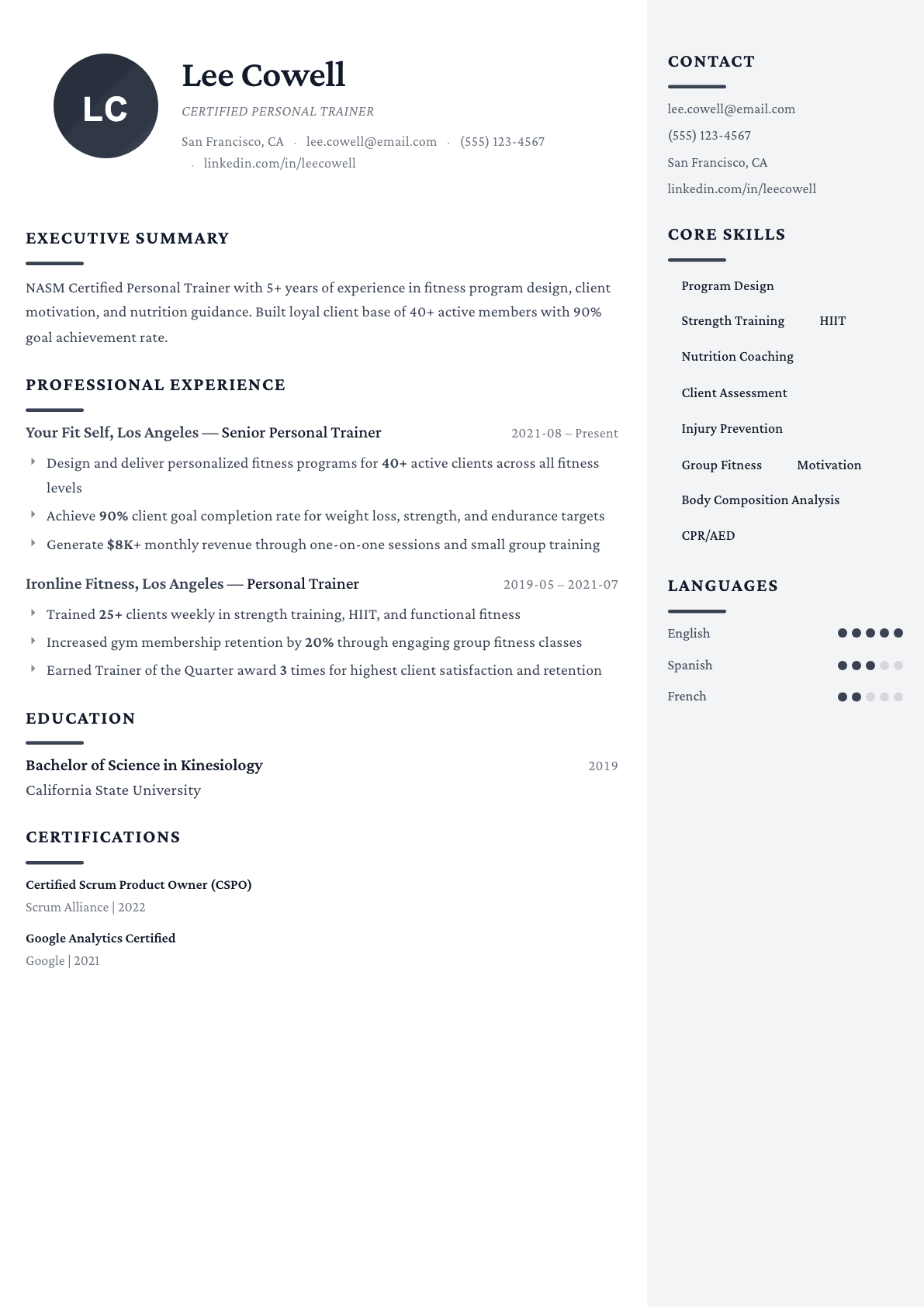
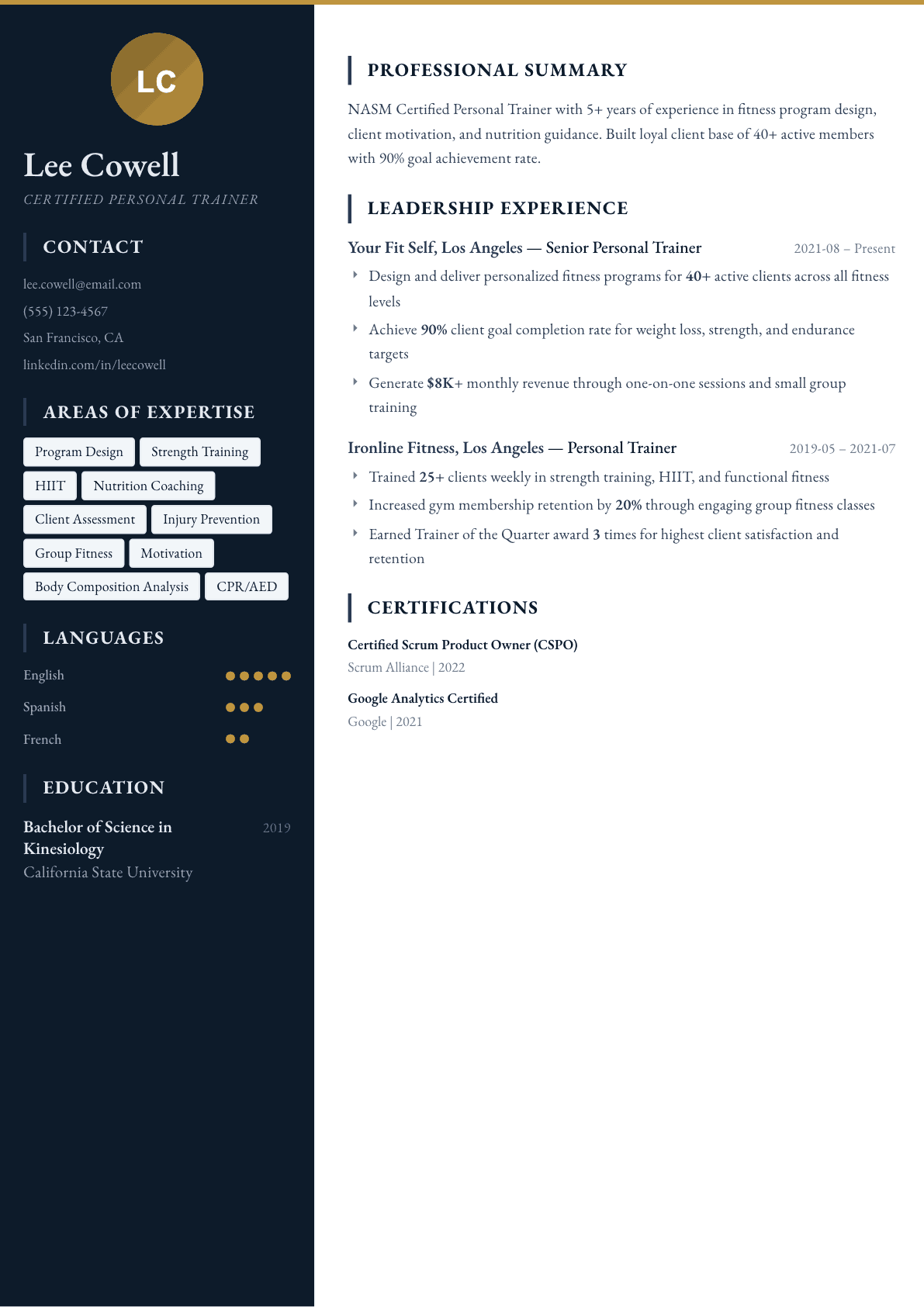
The same personal trainer content laid out in three CVBooster templates, so you can see what the finished document looks like before you write a word.
Example Personal Trainer summary
NASM certified trainer, 5 years, 40 active clients and $8K a month in one-to-one and small group revenue. Ninety percent of clients hit their stated weight, strength or endurance goal, and group classes raised gym retention 20% at a previous club.
Skills to list on a Personal Trainer resume
- Program Design
- Strength Training
- HIIT
- Nutrition Coaching
- Client Assessment
- Injury Prevention
- Group Fitness
- Motivation
- Body Composition Analysis
- CPR/AED
What actually gets this resume read
- List certifications prominently (NASM, ACE, ACSM, CSCS).
- Quantify client results: weight loss, strength gains, goal achievement rates.
- Show revenue generation and client retention metrics.
- Include specialization areas (sports performance, senior fitness, weight loss).
- Mention group fitness class experience and class sizes.
How to write a personal trainer resume
A personal trainer resume is judged on three things before anyone reads a sentence: is the certification from a body the club recognizes, is it current, and does the CPR/AED card have life left on it. Big-box clubs and hospital-affiliated wellness centers will not put a trainer on the floor without an accredited credential and proof of insurance, so a resume that buries NASM, ACE, ACSM or NSCA in the last third of page one is making the fitness director hunt for the one fact that decides the interview.
After the credential, the person hiring you is running a profit center. A club general manager wants sessions sold and sessions kept: how many active clients you carried, how many of them renewed, how full your book was, whether you closed complimentary assessments into paid packages. A studio owner wants the same numbers in a smaller frame. A strength coach at a performance facility wants the population and the programming instead, because the money there comes from athlete outcomes and referrals, not floor sales.
This guide covers the header and credential line, how to write experience for a commercial gym, a private studio and an independent book of business, three summaries from a newly certified trainer to a fitness manager, before-and-after bullets, and the questions trainers ask when they sit down to rewrite.
Format: one page, with the credential visible in the header
Keep it to a single page until you have run a department. Reverse-chronological, plain sections, no photo, no skill bars showing your own strength rated out of five. The header should carry your name with the credential attached the way the industry writes it, for example "Lee Cowell, NASM-CPT, CES", then city, phone and email.
Order the sections so the reader hits certifications second. A club recruiter screening a stack of applicants is checking eligibility before they check quality, and a certifications block placed directly under the summary answers that question without a scroll.
- Header: name plus certification abbreviations, city and state, phone, email.
- Sections in this order: summary, certifications, training experience, specializations, education.
- Newly certified trainers add a section for practical hours, shadowed sessions and any internship at a gym floor.
- Group fitness formats you are licensed to teach belong with certifications, not in the skills list.
Summary: population, setting, book size, one specialization
Two or three lines. Name the certifying body, the years, the setting you have worked in, the client population you know best, and the one specialization the posting asked for. A trainer who has spent four years with post-rehabilitation and older adult clients is a different hire from one who has spent four years with collegiate athletes, and the summary is the only place that difference lands before the reader reaches the jobs.
Trainers who run their own book should say so plainly. "Independent trainer with an active book of thirty clients across two rented studio spaces" tells a studio owner you can bring revenue with you, which is the single most attractive thing an applicant can offer a small facility.
Experience: facility, model, book size, retention
Head each job with the facility type and your commercial model, because "trainer" covers four different jobs. A floor trainer at a commercial club sells his own sessions and works to a monthly quota. A studio trainer is scheduled by an owner and paid per session. A semi-private coach runs two to four clients on one clock. A contractor rents space and keeps the whole fee. Say which one you were.
Then give the numbers a manager checks: active clients on your book, sessions delivered per week, package renewal rate, complimentary assessment conversion, average client tenure, and attrition. Avoid describing exercise. "Designed customized workout plans" is what every trainer does and it takes the space a retention number needs.
For group work, give the format, the class size and the schedule slot, since a Saturday morning class at capacity is a different achievement from a Tuesday midday class of four. If you have covered small group training, name the ratio you ran.
- Facility line: club, studio, corporate wellness site, performance center or in-home, plus the membership base if it is a club.
- Populations: general fitness, weight management, older adults, pre and postnatal, youth athletes, post-rehabilitation referrals.
- Commercial numbers: sessions per week, active clients, renewals, assessment-to-package conversion, cancellations recovered.
- Programming detail: assessment battery used, periodization model, movement screens, progression review cadence.
Certifications, insurance and continuing education
Give each credential its issuing body and the current status. Clubs care that the certifying agency is accredited by the National Commission for Certifying Agencies, so name the agency in full at least once rather than relying on the abbreviation alone. CPR and AED belong here too, with the issuer, since it is the item most likely to have expired.
Continuing education units are worth one short line if you have specialized. A trainer who has completed corrective exercise, kettlebell or pre and postnatal coursework should list the specialization by name, because that is what a fitness director matches against the members who keep asking for help nobody on staff can give.
If you hold your own liability coverage, say so in a single line. Independent trainers and contractors are asked for it in the first phone call.
Skills and specializations the posting is scanning for
Use the vocabulary a club job description uses: client assessment, program design, movement screening, progressive overload, body composition analysis, nutrition coaching within scope, member retention, floor hours, and the scheduling and billing software you have worked in, such as Mindbody, Trainerize or ABC Fitness. Naming the software matters more than trainers expect, because onboarding cost is real to a small studio.
Keep the claim honest about scope. A certified trainer without a dietetics credential coaches habits and food behaviors, and phrasing it that way reads as a professional who knows where the line sits.
Personal Trainer resume summary examples
Newly certified
NASM-certified personal trainer with 120 supervised floor hours and CPR/AED current. Ran complimentary assessments and small group circuits during a gym internship, and coached general fitness and weight management clients from intake through a twelve-week progression. Seeking a floor trainer role in a commercial club.
Five years in
ACE-certified personal trainer with five years in a commercial club, carrying an active book of 38 clients and averaging 26 sessions a week. Corrective exercise specialist working with post-rehabilitation referrals and older adults, with a 78% package renewal rate over the last two years.
Fitness manager
Fitness manager and CSCS with nine years on the floor and four leading a training department of eleven trainers across two clubs. Owns hiring, credential compliance, session quota and the assessment-to-package funnel, while keeping a personal book of twelve long-tenured clients.
Work experience bullets: before and after
Before: Created customized workout plans for clients.
After: Built twelve-week periodized programs for an active book of 38 clients, reassessing movement screens and body composition every four weeks and adjusting load from the results.
The book size, the cycle length and the reassessment rhythm show a system rather than the generic promise every trainer makes.
Before: Helped clients reach their fitness goals.
After: Held a 78% package renewal rate across two years by scheduling a goal review at session ten and rebooking before the current package closed.
Renewal is the number a club manager is measured on, and naming the mechanism proves the result was not luck.
Before: Sold personal training packages to gym members.
After: Converted 44% of complimentary fitness assessments into paid packages, the highest rate among six trainers on the floor.
Conversion from assessment is the club sales metric, and the internal ranking gives it a reference point.
Before: Taught group fitness classes.
After: Taught six weekly classes including a 5:30 am strength circuit that filled to its cap of 24 for eleven straight months.
The slot, the cap and the streak turn an ordinary duty into evidence that members chose you.
Before: Worked with clients recovering from injuries.
After: Coached 15 post-rehabilitation clients referred by two local physical therapy clinics, training within the discharge restrictions and reporting progress back to the referring therapist.
Naming the referral source and the reporting loop shows professional boundaries, which is what a facility worries about with rehabilitation clients.
Hard skills
- Client assessment and movement screening
- Program design and periodization
- Strength training instruction
- Body composition analysis
- Corrective exercise
- Small group training
- Nutrition coaching within scope
- Group fitness instruction
- Injury prevention and progression
- Mindbody and Trainerize scheduling
- Session and package sales
- Client retention tracking
Soft skills
- Motivational interviewing
- Accountability coaching
- Punctuality across split shifts
- Rapport with new members
- Boundary setting
- Referral relationships
Certifications worth listing
- Certified Personal Trainer (NASM-CPT) (National Academy of Sports Medicine)
- Certified Personal Trainer (ACE-CPT) (American Council on Exercise)
- Certified Personal Trainer (ACSM-CPT) (American College of Sports Medicine)
- Certified Strength and Conditioning Specialist (CSCS) (National Strength and Conditioning Association)
- Corrective Exercise Specialist (CES) (National Academy of Sports Medicine)
- Performance Enhancement Specialist (PES) (National Academy of Sports Medicine)
- Certified Personal Trainer (International Sports Sciences Association)
- CPR and AED for the Professional Rescuer (American Red Cross)
Mistakes that cost personal trainer candidates the interview
- Listing a certification without the issuing body, which leaves a fitness director unable to tell an accredited credential from a weekend course.
- Letting the CPR and AED card sit undated on the resume when it is the item most often expired at hire.
- Filling bullets with exercise names instead of book size, renewals and conversion, the numbers a club actually pays on.
- Hiding the commercial model, so the reader cannot tell whether you sold your own sessions or were handed a schedule.
- Claiming to write meal plans without a dietetics credential, which reads as a scope problem to any serious employer.
- Sending the same resume to a commercial club and a strength and conditioning facility when one buys sales and the other buys athlete outcomes.
- Using a graphic template with rating bars for your own skills, which tells a manager nothing and eats the space a retention figure needs.
Personal Trainer resume questions
Which personal trainer certification should I put first on my resume?
Put the accredited one the posting names, and if the posting names none, lead with the credential from the largest recognized body you hold, then the specializations. A general certification plus one specialization beats three overlapping general certifications from unknown agencies.
How do I write a personal trainer resume with no clients yet?
Lead with education and the certification, then build a practical hours section: supervised floor hours, shadowed assessments, internship work, and any friends or family you programmed for over a documented block with before and after measurements you can defend in an interview.
Should I include client results and numbers?
Yes, but use the numbers a manager can verify against their own reporting: active clients, weekly sessions, renewal rate, assessment conversion, class attendance. Individual client weight loss figures are weaker evidence because no employer can check them.
Do I need a degree to work as a personal trainer?
Most commercial clubs accept an accredited certification without a degree, so list the certification first and the education after. A kinesiology or exercise science degree matters more for strength and conditioning roles, corporate wellness and hospital-based programs, where it is often required.
How should an independent trainer format the experience section?
Treat your own practice as an employer entry with a business name, the years, and the setting, then use bullets for book size, session volume, retention and how you acquired clients. Studio owners read that as revenue you can bring rather than a gap in employment.
Related resume examples
- Yoga Instructor Resume example
- Fitness Instructor Resume example
- Physical Therapist Resume example
- Fitness Coach Resume example
- Gym Receptionist Resume example
- Horse Trainer Resume example