Gym Manager Resume Examples: free ATS score and gap list
Create a Gym Manager Resume That Opens Doors
By Mustafa Tarabya, founder of CVBooster · Published · Updated
Build a results-driven gym manager resume that showcases your facility operations, membership growth, and team leadership skills.
Sample resumes for a gym manager
The same gym manager content laid out in three CVBooster templates, so you can see what the finished document looks like before you write a word.
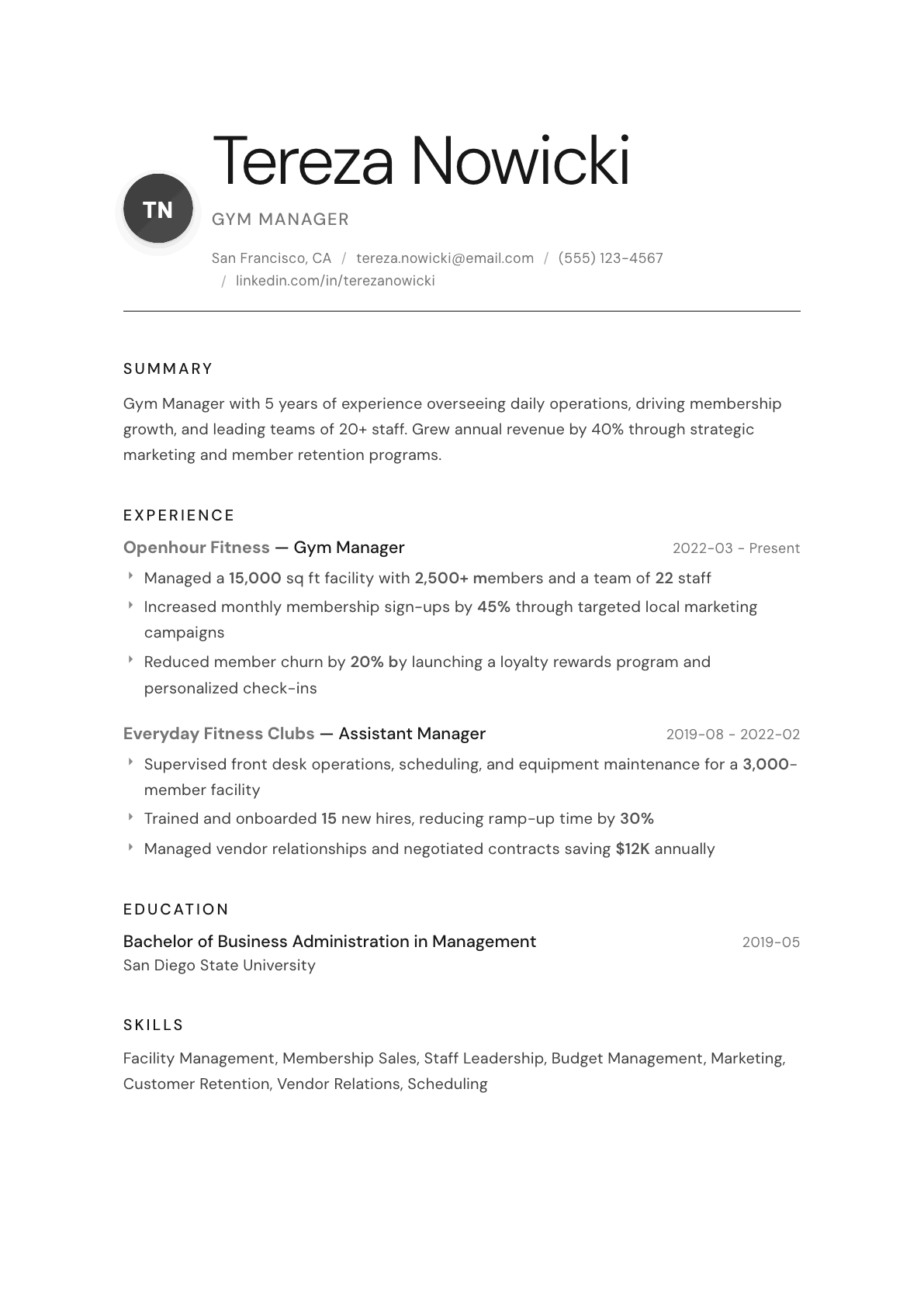
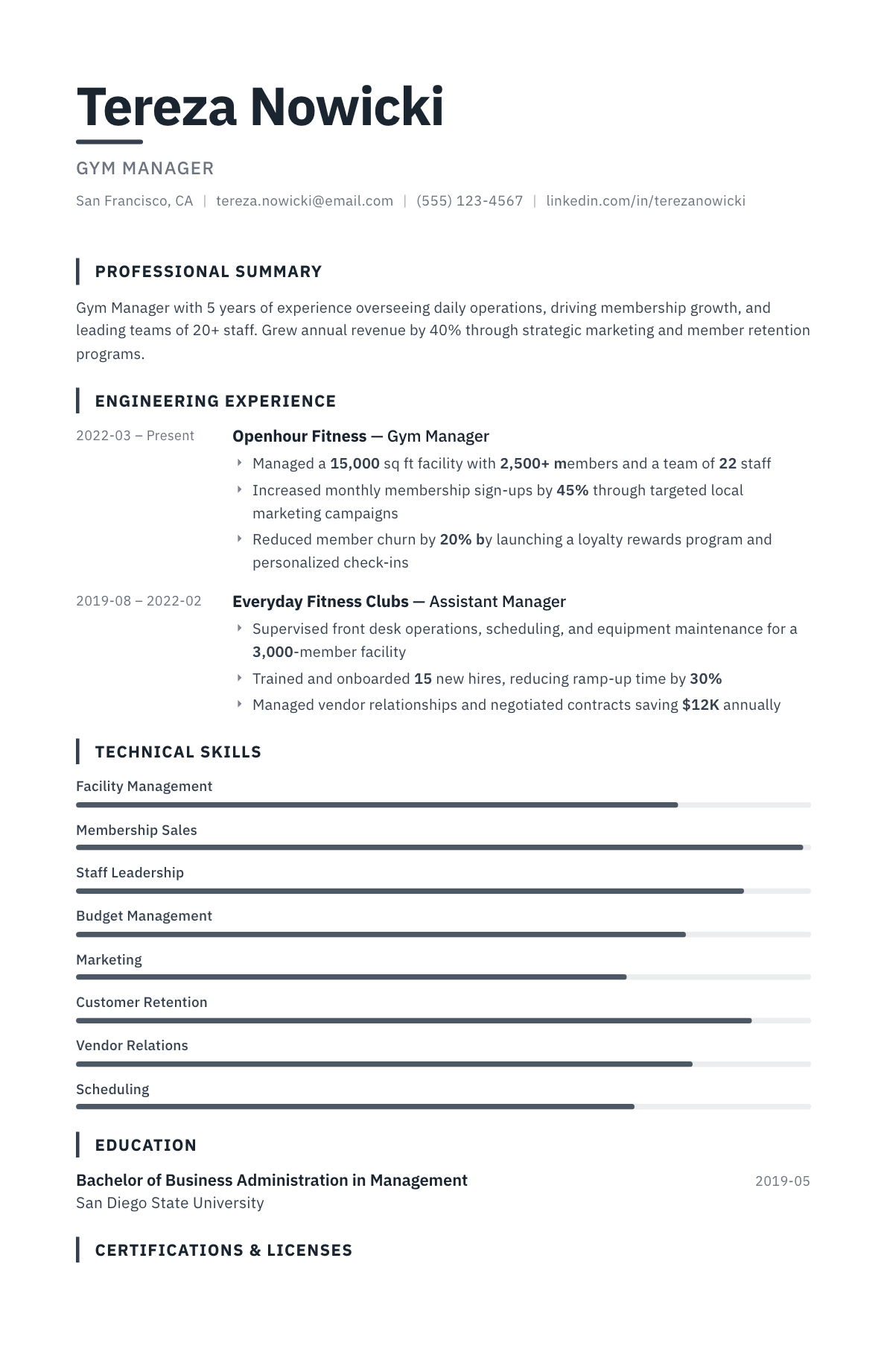
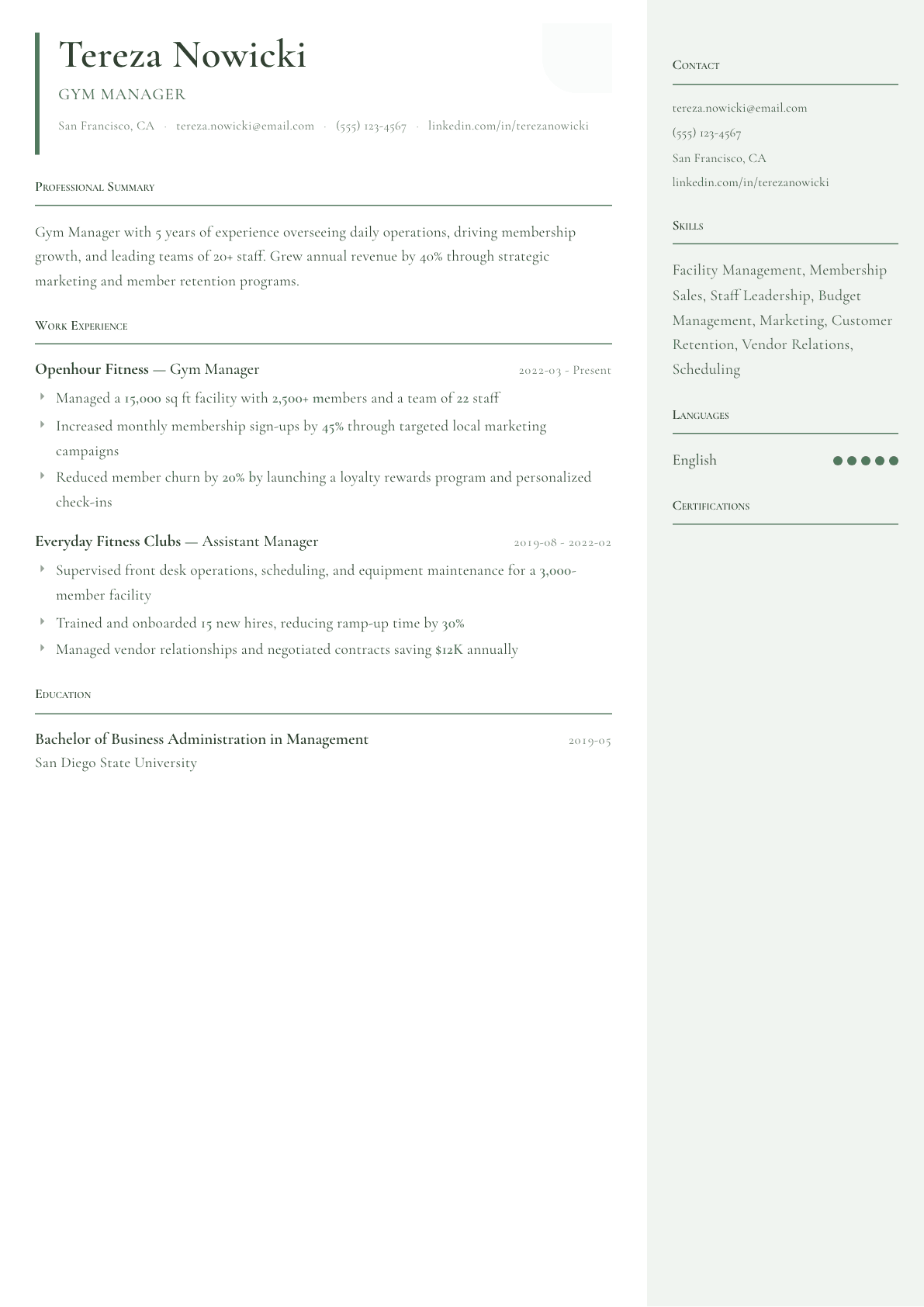
Example Gym Manager summary
Gym manager, 5 years, running a 15,000 square foot club with 2,500 members and 22 staff. Grew monthly joins 45% with local marketing and cut churn 20% with a rewards program and personal check-ins, and holds the equipment maintenance and vendor contracts.
Skills to list on a Gym Manager resume
- Facility Operations
- Membership Growth
- Revenue Management
- Staff Recruitment
- Team Leadership
- Customer Retention
- Marketing Campaigns
- Budget Planning
- Vendor Negotiation
- Conflict Resolution
What actually gets this resume read
- Lead with membership growth and revenue numbers to immediately demonstrate business impact.
- Highlight staff management experience including hiring, training, and performance reviews.
- Include facility size and member count to give context to the scale of your operations.
- Mention vendor management and cost-saving initiatives to show financial acumen.
How to write a gym manager resume
A gym manager resume is a business document that happens to be about fitness. The regional or ownership-level reader is looking at a profit and loss statement in their head: membership count and net growth, attrition, average revenue per member, payroll as a share of revenue, and personal training penetration. If your resume talks about passion for fitness and not about those, it reads as an instructor resume with a manager title on it.
The second thing they weigh is people. A club runs on a front desk team, trainers, group fitness instructors and cleaning staff, mostly hourly, often young, and turnover eats the manager's week. Evidence that you hired well, scheduled to labor targets and kept people longer than the market does is worth as much as the sales numbers.
This guide covers how to show club scope, the membership and revenue metrics to attach to each role, summaries from an assistant manager through a multi-site or general manager, and rewrites that turn duty statements into operating results.
Format: two pages at most, club scope on every role
One page if you have managed a single club, two once you have run several or moved into a regional role. Every job needs a scope line before the bullets: square footage of the facility, membership count, staff headcount by function, annual revenue band, and whether it was a franchise, an independent studio, a corporate club or a community facility. Those are different businesses with different levers.
Group your bullets under membership and revenue, operations, and team, in that order. Regional managers scan for revenue first every time, and structuring the page around their reading order is free advantage.
- Scope line: facility size, member count, staff headcount, club type.
- Order: summary, management experience grouped by theme, systems, education, certifications.
- Note openings, remodels or ownership changes you managed through, since they are hard-earned experience.
Membership and revenue: the numbers that get the interview
Report net membership growth rather than joins alone, because a club that signs a hundred and loses a hundred and ten is shrinking. Then give attrition or cancellation rate, average revenue per member, and the mix between membership dues and ancillary revenue such as personal training, small group, retail, supplements and childcare.
Personal training penetration deserves its own line, since it is often the largest ancillary line and the hardest to grow. Say how many members were on a training agreement, how you moved that number, and what the trainer productivity looked like in sessions serviced per week.
Show the sales system you ran: lead generation sources, tour to join conversion, the follow-up cadence for unclosed leads, referral programs, corporate memberships and how you handled promotional pricing without hollowing out dues revenue.
- Net membership growth and the attrition rate behind it.
- Average revenue per member and the ancillary revenue mix.
- Personal training penetration and trainer session productivity.
- Tour to join conversion and the lead sources feeding it.
Operations: the club floor, the budget and the risk
Operations bullets should show control. Payroll managed to a percentage of revenue, scheduling to peak traffic, equipment preventive maintenance contracts and replacement planning, cleaning standards and inspection results, and vendor negotiation on everything from towel service to the music license.
Then the risk side, which owners care about more than candidates expect. Incident reporting and emergency response, AED placement and staff certification currency, member injury documentation, pool or sauna compliance where applicable, opening and closing security procedures, and cash handling controls.
Team: hiring, scheduling and the turnover you fixed
Say how many people you hired, in which roles, and what happened to retention. Front desk turnover is chronic in this industry, so a manager who reduced it has a genuinely differentiating result. Include the mechanisms: a structured interview, a real onboarding week, a shift trade system that stopped the last-minute scramble, or a pay structure change you argued for and won.
Include the trainer and instructor side too. Recruiting instructors for hard-to-fill slots, running a class schedule audit that cut low-attendance classes, and coaching trainers on member acquisition are all manager work with a revenue consequence.
- Hires made by role and the retention that followed.
- Scheduling to labor targets and peak traffic patterns.
- Performance management: reviews, coaching, documented corrections.
- Class schedule decisions based on attendance data.
Systems and member experience
Name the club management platform you have administered: ABC Fitness, Mindbody, Club Automation, Zen Planner, Glofox, Jonas Fitness or a franchise-specific system. Say what you did in it, such as building reporting on attrition by tenure, managing billing and failed payment recovery, or cleaning a member database before a system migration.
Member experience is the retention engine, so treat it as measurable. Review scores and response practice, cancellation reasons captured at the point of exit, a save process for members who ask to cancel, cleanliness audits and equipment downtime are the levers a manager actually pulls.
Gym Manager resume summary examples
Assistant manager
Assistant gym manager with 3 years at a twelve thousand square foot club with 2,100 members, supervising an 8-person front desk team and running the daily sales floor. Lifted tour to join conversion by tightening the follow-up cadence on unclosed leads.
Five years managing
Gym manager with 5 years running a 2,600-member independent club with 24 staff. Grew net membership 3 consecutive years while cutting monthly attrition, raised personal training penetration from 9% to 15%, and held payroll to target through a remodel.
General or multi-site manager
General manager with 11 years across franchise and independent clubs, currently overseeing 3 locations, 70 staff and 9,000 members. Opened one club from build-out through the first year, standardized the sales process across sites, and reduced front desk turnover by half.
Work experience bullets: before and after
Before: Responsible for daily operations of the fitness facility.
After: Ran a 2,600-member independent club of eighteen thousand square feet with 24 staff across front desk, training and group fitness, holding full accountability for the club profit and loss statement.
Member count, facility size, headcount and profit responsibility set the scope a regional reader sorts on.
Before: Increased gym memberships through marketing.
After: Grew net membership for 3 consecutive years by building a referral program, adding 4 corporate partnerships, and raising tour to join conversion from 31% to 44% with a same-day follow-up rule.
Net growth with named lead sources and a conversion figure shows a sales system rather than a good season.
Before: Worked to retain members.
After: Cut monthly attrition by capturing cancellation reasons at the point of exit, launching a save offer for tenure under 6 months, and calling every member whose visits dropped below twice a month.
The three retention mechanisms are specific enough that an owner can picture you implementing them.
Before: Managed staff schedules and payroll.
After: Scheduled 24 staff to peak traffic patterns pulled from check-in data and held payroll at target as a share of revenue through a remodel that closed the group fitness studio for 6 weeks.
Using traffic data and hitting a labor target through a disruption is operational control, not calendar work.
Before: Grew the personal training department.
After: Raised personal training penetration from 9% to 15% of members by adding a complimentary assessment at join, coaching 6 trainers on the consultation, and tracking sessions serviced weekly.
Penetration, the acquisition mechanism and trainer productivity are the exact metrics a club owner reviews.
Hard skills
- Membership sales and conversion
- Attrition analysis and retention programs
- Profit and loss management
- Payroll and labor cost control
- Personal training program growth
- Class schedule and studio utilization
- Equipment maintenance and capital planning
- Vendor contracts and negotiation
- ABC Fitness and Club Automation
- Mindbody and Zen Planner reporting
- Billing, dues collection and failed payment recovery
- Health and safety compliance and incident reporting
Soft skills
- Hiring judgment for hourly roles
- Handling an angry member at the desk
- Coaching trainers on sales
- Steadiness during a remodel
- Setting standards and holding them
- Reading a floor and stepping in
Certifications worth listing
- Certified Personal Trainer (NASM-CPT) (National Academy of Sports Medicine)
- Certified Personal Trainer (ACE-CPT) (American Council on Exercise)
- CPR and AED (American Red Cross)
- Certified Pool Operator (CPO) (Pool and Hot Tub Alliance)
- ServSafe Food Handler (National Restaurant Association)
Mistakes that cost gym manager candidates the interview
- Reporting joins without cancellations, when net membership is the only growth number an owner believes.
- Leaving out club size, member count and staff headcount, so a regional manager cannot place your experience.
- Writing about passion for fitness in a role that is judged on revenue, labor cost and retention.
- Omitting personal training penetration, usually the largest ancillary revenue line in the building.
- Describing staff management without a retention or turnover figure attached to it.
- Skipping the club management platform, since system familiarity shortens onboarding meaningfully.
- Ignoring safety and compliance work, which is the risk an owner is most exposed to and least willing to gamble on.
Gym Manager resume questions
What metrics should a gym manager put on a resume?
Net membership growth, attrition rate, average revenue per member, personal training penetration, tour to join conversion, payroll as a share of revenue and staff retention. Those seven cover the sales, operations and people sides that an owner evaluates.
Do I need a personal training certification to manage a gym?
It is not usually required, but it helps you coach a training team credibly and some clubs prefer it. Keep it in a credentials line rather than at the top, since the hiring decision at manager level rests on business results.
How do I move from assistant manager to gym manager?
Show the pieces of the manager job you already own: the sales floor, the schedule, hiring input, a vendor relationship, or the club report you produce weekly. Then attach numbers to each, because assistant managers are usually passed over for writing duties instead of results.
How do I present a club whose membership declined while I managed it?
State the context factually, such as a competitor opening nearby or a remodel, and show what you controlled: attrition slowed, ancillary revenue grew, payroll stayed at target. Owners have all lived through a hard year and they respect a manager who can account for one.
Should a gym manager resume include franchise experience details?
Yes, because franchise clubs run to a defined model with prescribed pricing, programming and reporting, while independents give the manager far more discretion. Naming which you have run tells the reader how much autonomy you are used to handling.
Related resume examples
- Fitness Instructor Resume example
- Sports Coach Resume example
- Loss Prevention Manager Resume example
- Sports Marketing Manager Resume example
- Student Athlete Resume example
- Gym Receptionist Resume example