Flight Attendant Resume Examples: the lines they read
Flight Attendant Resume and Cabin Crew CV Examples That Get Shortlisted
By Mustafa Tarabya, founder of CVBooster · Published · Updated
Flight attendant resume and cabin crew CV examples, with UK CV layout, service and safety bullets, languages, and the practical checks airlines make.
Sample resumes for a flight attendant
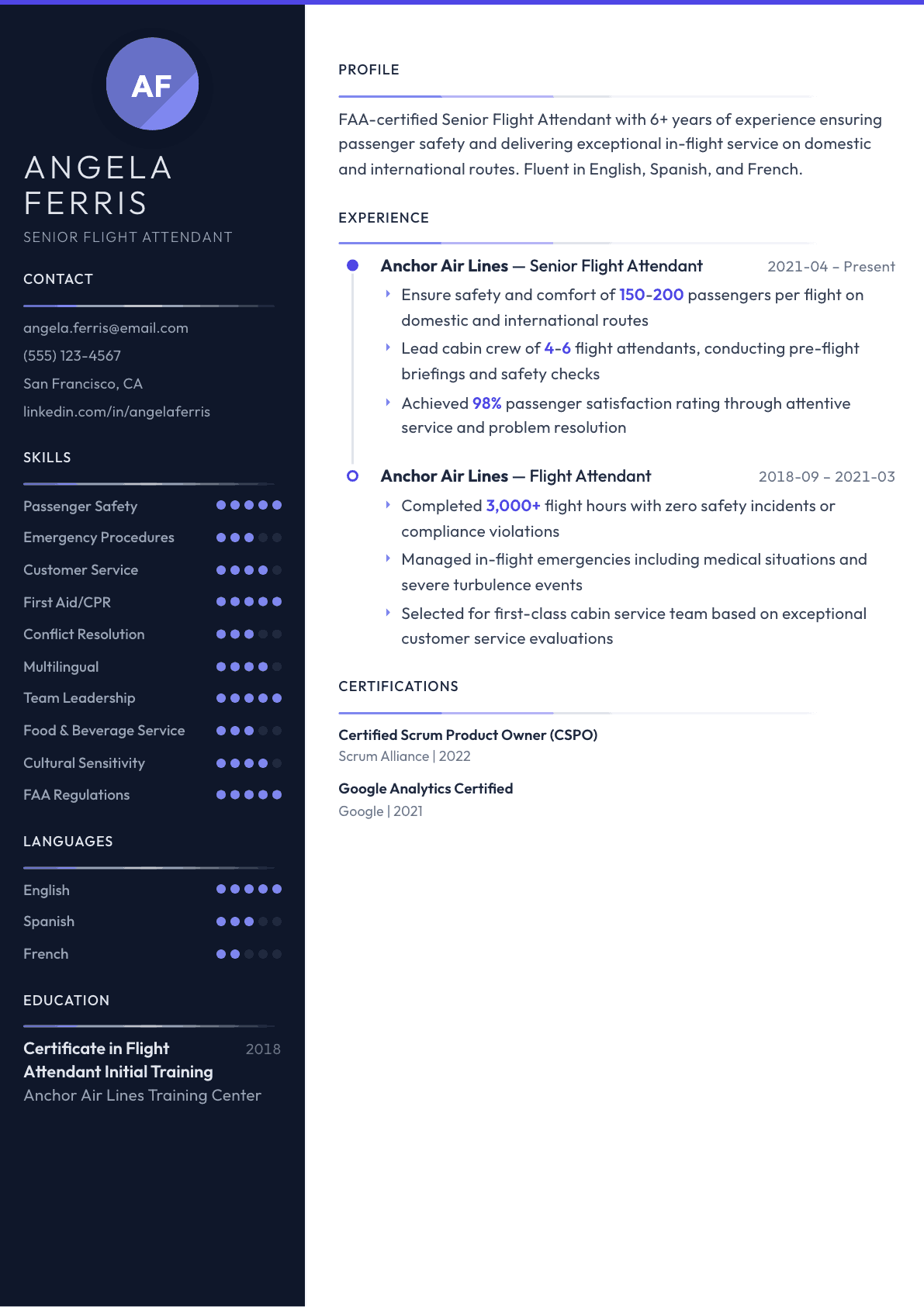
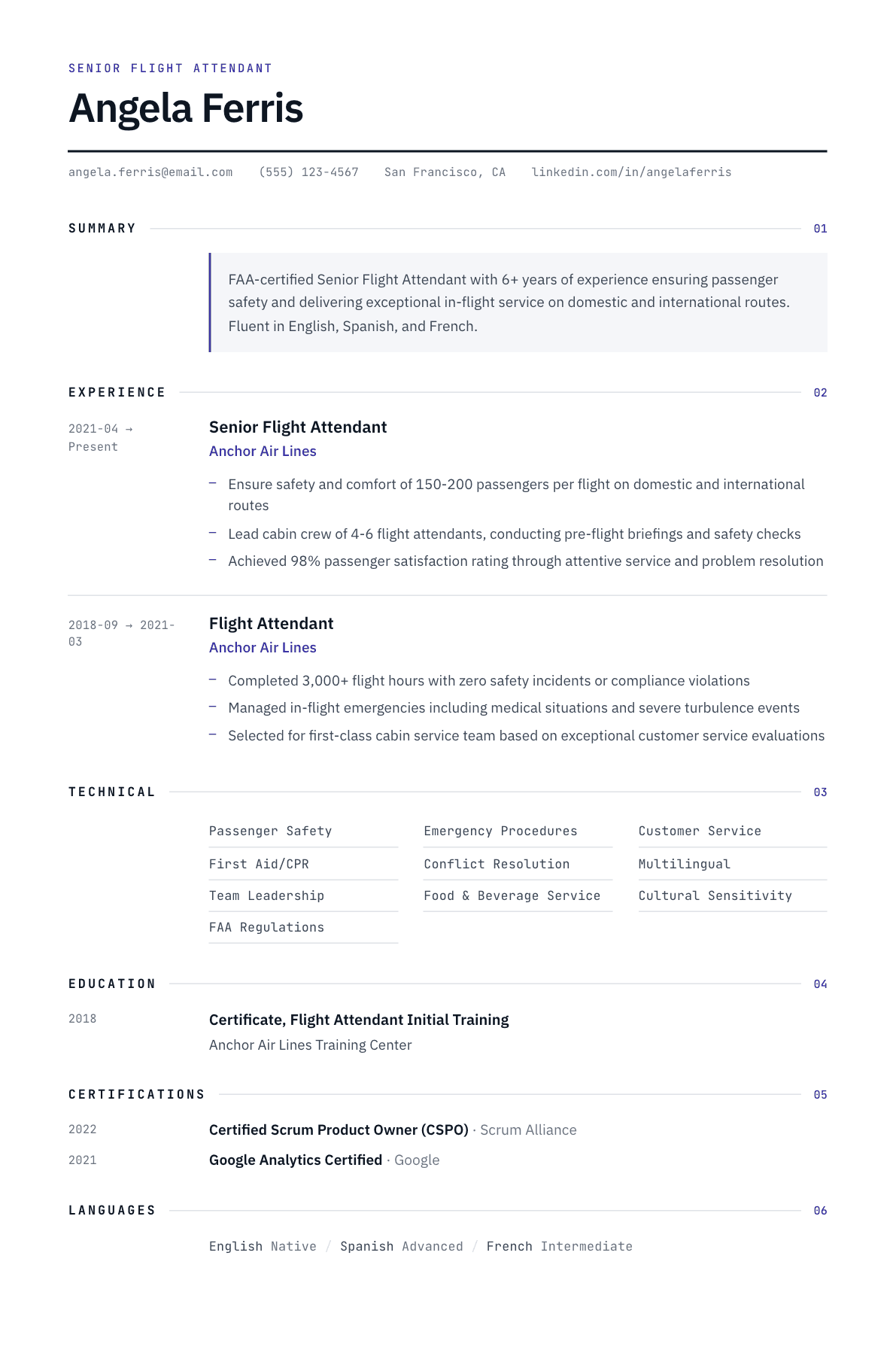
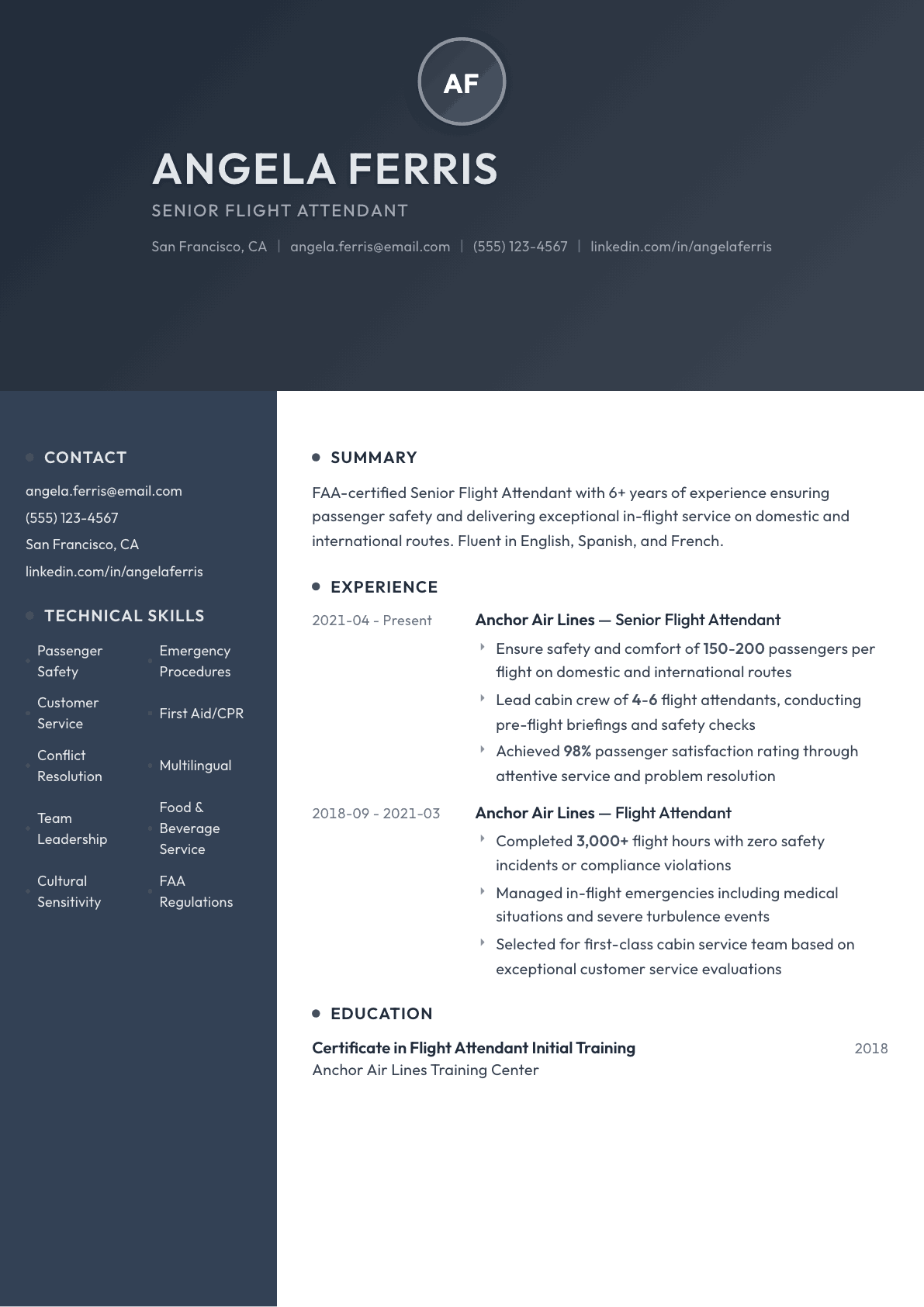
The same flight attendant content laid out in three CVBooster templates, so you can see what the finished document looks like before you write a word.
Example Flight Attendant summary
Senior flight attendant, 6 years and 3,000 flight hours with no safety incident, holding a current FAA certificate of demonstrated proficiency. Leads cabin crews of four to six on domestic and international routes, has worked medical events and severe turbulence, and speaks English, Spanish and French.
Skills to list on a Flight Attendant resume
- Passenger Safety
- Emergency Procedures
- Customer Service
- First Aid/CPR
- Conflict Resolution
- Multilingual
- Team Leadership
- Food & Beverage Service
- Cultural Sensitivity
- FAA Regulations
What actually gets this resume read
- Highlight FAA certification and safety training credentials.
- Include flight hours and safety record.
- Show language proficiency for international routes.
- Mention emergency response training and real-world experience.
- Demonstrate customer service excellence with specific examples.
How to write a flight attendant resume
Airline recruiters read a flight attendant resume as a safety hire first and a service hire second. The cabin crew position exists because federal regulation requires qualified crewmembers on board, and every interview eventually tests whether you can command a cabin during an evacuation. A resume built entirely around hospitality language misses the half of the job the airline is legally obligated to staff.
The other thing recruiters check is whether you clear the practical gates: reach requirement, passport with unrestricted travel, ability to relocate to a base, availability for reserve, and a background history that will pass an airport security badge check. Candidates who address those directly move through the process visibly faster than candidates who leave them to be discovered.
This guide covers how to structure the document for an airline hiring process, how to write service and safety experience that survives a group assessment day, sample summaries for a career changer, a regional crewmember and a purser, and the questions people ask when they apply to cabin crew for the first time. In the UK and many other countries the same document is called a cabin crew CV or cabin crew curriculum vitae, usually with a short personal statement at the top; the content below works under either name.
Format: flight attendant resume or cabin crew CV, built for assessment
One page, reverse-chronological, plain and easy to read. Airlines run high volume recruiting events where a recruiter may skim your resume standing up, in a room of several hundred candidates, minutes before speaking with you. A dense two page document works against you in that setting.
Presentation counts more here than in most professions because grooming and polish are part of the job standard. Consistent alignment, one font and generous white space read as attention to detail, which is exactly the trait an airline is watching for during a hiring event.
Cabin crew CV sample, the top third written out for a UK airline: Sophie Bennett, Cabin Crew, Manchester. Personal statement: Front desk team leader with four years in a busy city hotel, first aid trained, fluent in English and conversational in Spanish, looking for a first cabin crew role based at Manchester. Key details: full UK passport with no travel restrictions, right to work in the UK, able to reach the base within the airline's report time. Experience: Front Desk Team Leader, a 200 room city hotel; handles late arrivals and complaints from guests on long delays, and acts as fire warden for the ground floor.
- Header: name, city and state, phone, email, and the bases you are willing to be assigned to.
- Order: summary, customer service and safety experience, languages, training and certifications, education, availability.
- State passport status, unrestricted travel documents and reserve availability in a short availability line at the end.
Summary: service scale, safety exposure, languages, mobility
Three lines. Give the service environments you have worked in with volume, any safety or emergency responsibility you have carried, the languages you speak and at what level, and your willingness to relocate and fly reserve. Airlines assign new hires to a base by seniority, and mobility is a genuine screening factor.
For career changers, translate rather than apologize. Hospitality, healthcare, retail and restaurant work all contain crowd management, conflict de-escalation, safety procedure and service recovery. Name those elements instead of the job title, and the summary reads like relevant experience rather than a leap.
Experience: safety and service in the same bullet
The strongest cabin crew bullets pair a service outcome with a procedural one. Serving a full cabin on a short turn is service; completing the safety demonstration, verifying exit row briefings and securing the galley before descent is procedure. A recruiter wants proof you do both without one degrading the other.
For current crewmembers, give the fleet types, whether the flying is regional, domestic narrowbody or international widebody, the position worked, and the crew complement. Add the irregular operations experience: diversions, medical events handled, decompression drills, passenger removals and the reports you filed afterward.
For candidates without flying experience, quantify the customer volume and pressure of your current work. Guests served per shift, complaints resolved without escalation, cash handled, emergencies you responded to, and any safety or first aid role you held. Numbers give a recruiter a way to compare you to other applicants.
Training, languages and the practical requirements
List first aid, CPR and automated external defibrillator training with the issuing organization, plus any de-escalation, food safety or emergency response training you have completed. Current crewmembers should list the FAA Certificate of Demonstrated Proficiency and the aircraft types on it, since that is the credential the airline verifies.
Give language proficiency honestly and specifically, because airlines assign language of destination positions and will test you. Say whether you read, speak and write the language, and note any formal assessment you have passed. Fluency in a language that matches an airline route network is one of the strongest differentiators on a cabin crew application.
Language a cabin crew posting repeats
Airline postings use a consistent vocabulary: cabin safety, emergency procedures, passenger briefings, service recovery, conflict de-escalation, crew resource management, first aid response, onboard sales, grooming standards, reserve availability and irregular operations. Use the ones you can evidence, and pair at least two with a concrete situation in the experience section so the assessment day interviewer has something to ask about.
Flight Attendant resume summary examples
Career changer applying to cabin crew
Hospitality professional with five years in a 300 room hotel, handling 200 guest interactions a day, service recovery and emergency evacuation drills as a designated floor warden. Current first aid and CPR certification, conversational Spanish, passport in hand and open to any base.
Three years flying
Flight attendant with three years on regional jets, flying four leg days across 40 domestic stations. Handled 6 in-flight medical events with ground consultation, holds a Certificate of Demonstrated Proficiency, and rated highest in cabin readiness during the last two line checks.
Purser on international routes
Purser with nine years on widebody international routes, leading crews of up to 12 across long haul sectors. Runs preflight briefings, manages irregular operations and diversions, mentors new hires through initial operating experience, and works cabin service in English and French.
Work experience bullets: before and after
Before: Provided excellent customer service to passengers.
After: Served a 76 seat cabin on four leg days, completing beverage service, onboard sales reconciliation and cabin readiness checks within short turn times.
Cabin size, leg count and the specific service tasks show a recruiter you understand the pace of the actual job.
Before: Handled emergencies and followed safety procedures.
After: Responded to 6 in-flight medical events, administered oxygen and first aid, coordinated with ground medical advisory, and completed the required incident reports before block in.
Event count, the actions taken and the reporting step demonstrate procedural discipline rather than a safety claim.
Before: Dealt with difficult passengers.
After: De-escalated 12 disruptive passenger situations over a year, using verbal warning cards and coordination with the captain, with no diversion required in any case.
Naming the tool, the chain of command and the outcome shows judgment an assessment day interviewer can probe.
Before: Worked as part of a team on every flight.
After: Led preflight briefings for crews of 8 on long haul sectors, assigning exit responsibilities and service positions, and debriefed the crew after every irregular operation.
Crew size and specific leadership actions turn teamwork into evidence of purser potential.
Before: Used language skills to help international customers.
After: Worked the language of destination position on Paris routes, delivering safety briefings and service in French for cabins where roughly 40% of passengers were non-English speakers.
A named route and a real duty prove the language is operational, not decorative.
Hard skills
- Cabin safety and emergency procedures
- Evacuation and exit row briefings
- First aid, CPR and defibrillator use
- Onboard medical event response
- Emergency equipment preflight checks
- Crew resource management
- Food and beverage service in flight
- Onboard sales and cash reconciliation
- Passenger briefing and public address delivery
- Irregular operations handling
- Federal aviation regulations for cabin crew
- Multilingual passenger communication
Soft skills
- Composure in an emergency
- Conflict de-escalation
- Cultural sensitivity
- Stamina across time zones
- Discretion with passenger issues
- Fast rapport with a new crew
Certifications worth listing
- Certificate of Demonstrated Proficiency (Federal Aviation Administration)
- First Aid, CPR and AED (American Red Cross)
- Basic Life Support (American Heart Association)
- Restricted Radiotelephone Operator Permit (Federal Communications Commission)
- Aviation Security Awareness Training (Transportation Security Administration)
Mistakes that cost flight attendant candidates the interview
- Writing the resume as pure hospitality and never touching safety, when safety is the reason the position legally exists.
- Leaving out relocation and reserve availability, which airlines screen on before they read anything else.
- Claiming fluency in a language you cannot sustain under questioning, since airlines assess language of destination candidates directly.
- Running to two pages when a recruiter at a hiring event will skim the page in under a minute.
- Omitting first aid and CPR currency, which is the easiest credential to hold and a visible gap when missing.
- Describing customer service without volume, so a recruiter cannot compare your cabin readiness to another applicant.
Flight Attendant resume questions
Do I need an FAA certificate before applying to be a flight attendant?
No. The Certificate of Demonstrated Proficiency is issued after you complete an airline initial training program, so applicants cannot hold one in advance. List first aid, CPR and any safety or emergency training you do have instead.
How do I write a flight attendant resume with no aviation experience?
Translate the work you have done into cabin terms. Passenger volume becomes guests served, conflict handling becomes de-escalation, and any safety warden, first aid or evacuation role becomes emergency procedure experience. Keep the airline vocabulary accurate rather than approximate.
Should I include a photo on a cabin crew resume?
For airlines in the United States, no, because employers there generally discard resumes with photos to avoid discrimination risk. Several carriers outside the United States do request one, so follow the instructions in the posting rather than a general rule.
What should a cabin crew CV include in the UK?
A short personal statement, your passport and right to work status, languages with an honest level, first aid or safety training, and customer service experience written with passenger or guest numbers. A UK CV can run to two pages where a US resume stays at one. Follow the posting on photos, and keep the layout plain because airline application portals often read the file into a form.
What availability information belongs on the resume?
Say which bases you accept, whether you can relocate on short notice, and that you are available for reserve assignment. New hires are assigned by seniority and often sit reserve for a long period, so airlines screen out candidates whose constraints will not work.
Related resume examples
- Customer Service Resume example
- Receptionist Resume example
- Hotel Manager Resume example
- Air Traffic Controller Resume example
- Pilot Resume example
- Rideshare Driver Resume example