Air Traffic Controller Resume Examples: read this first
Take Control of Your Career with an Air Traffic Controller Resume
By Mustafa Tarabya, founder of CVBooster · Published · Updated
Create an air traffic controller resume highlighting your FAA certification, radar proficiency, and safety-critical decision-making skills.
Sample resumes for a air traffic controller
The same air traffic controller content laid out in three CVBooster templates, so you can see what the finished document looks like before you write a word.
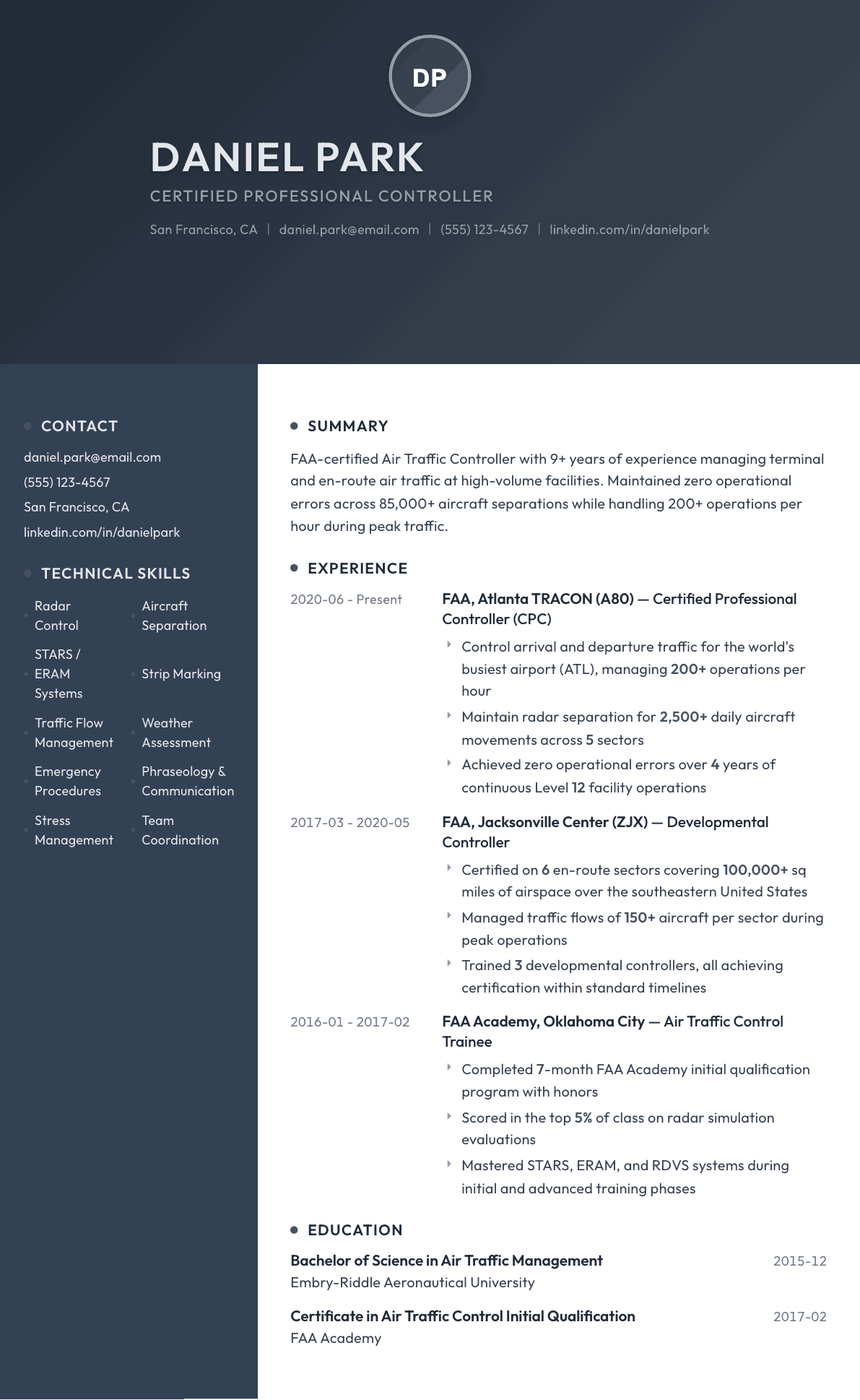
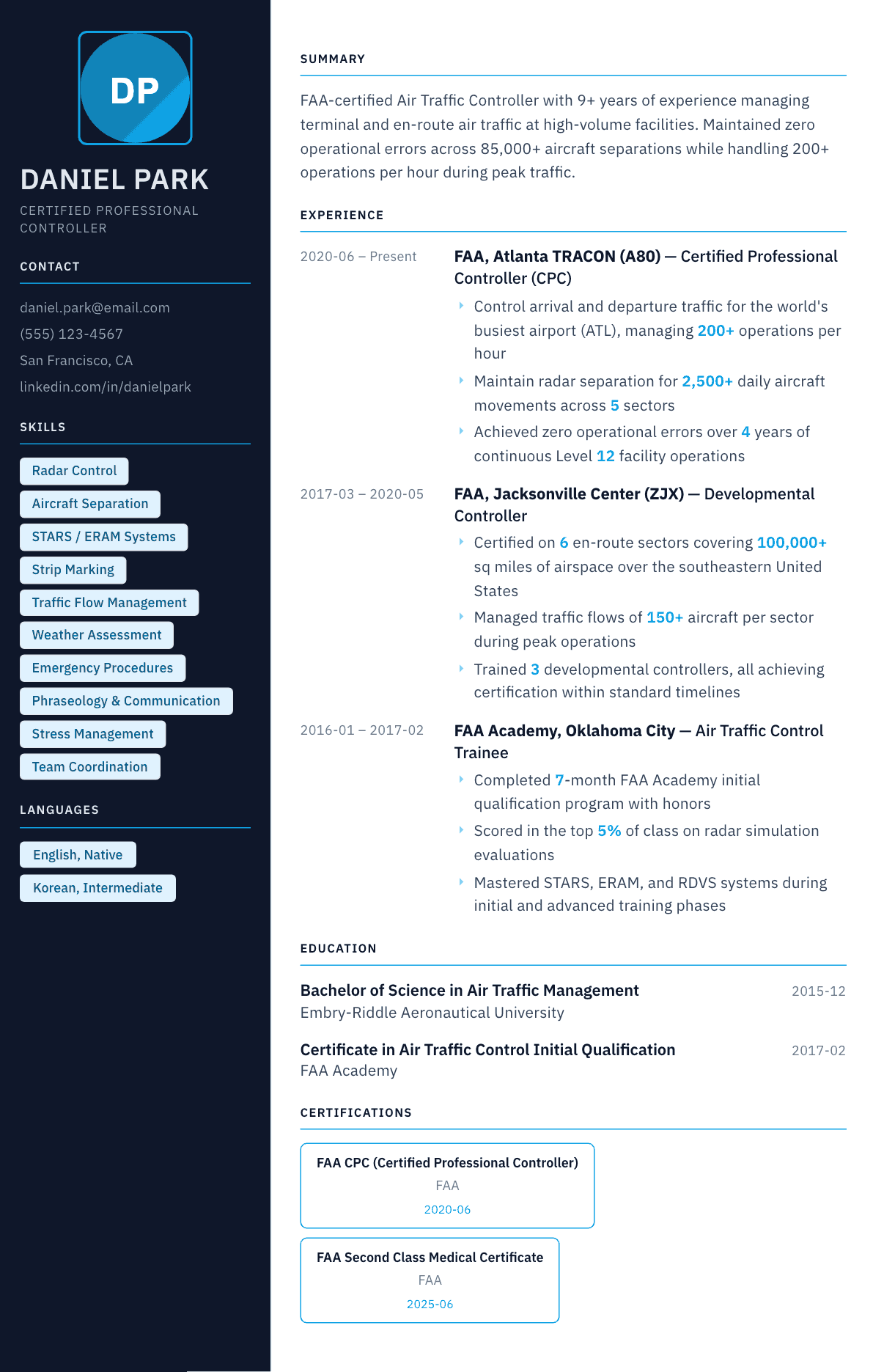
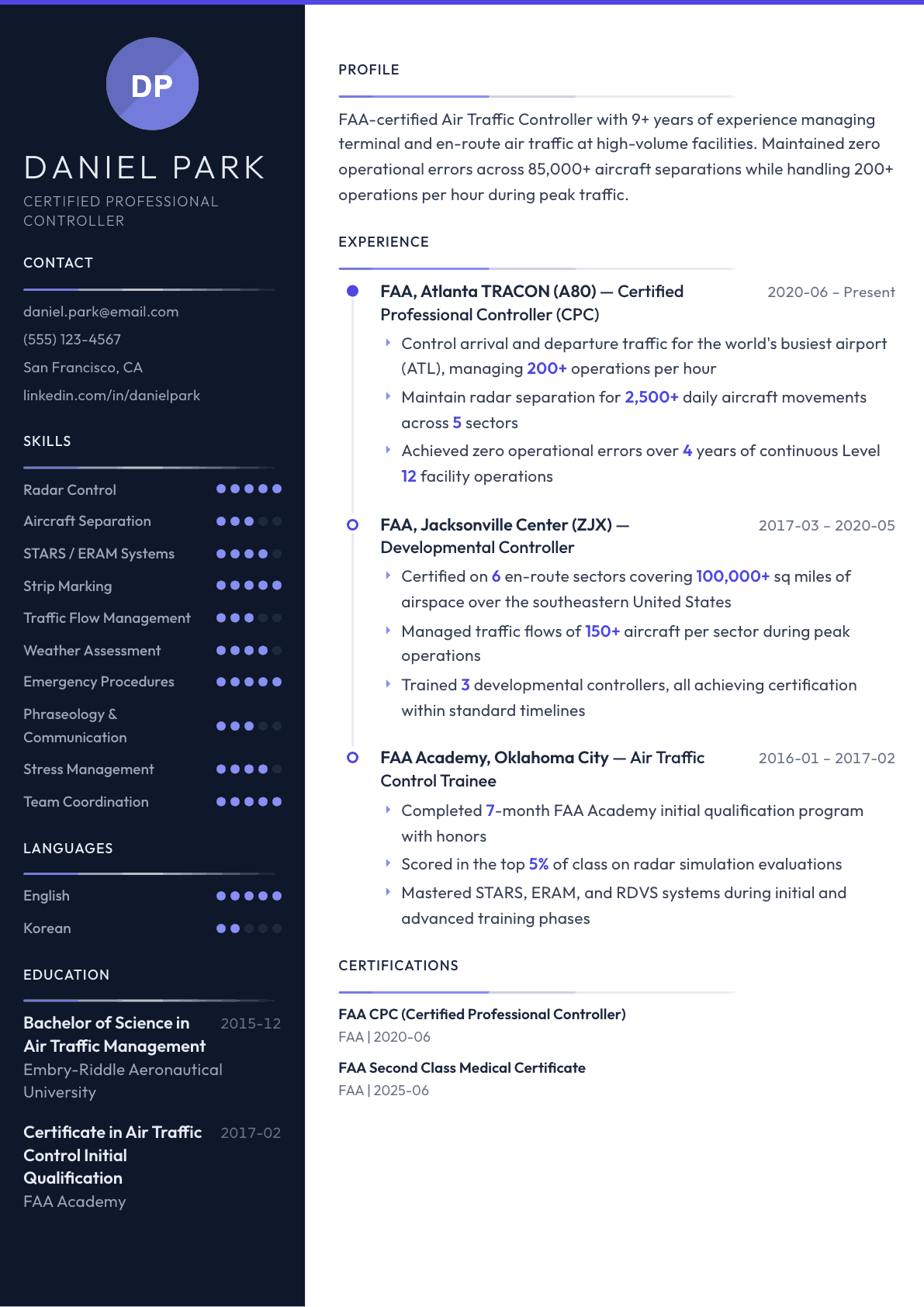
Example Air Traffic Controller summary
FAA-certified Air Traffic Controller with 9 years of experience at high-volume Level 12 facilities. Maintained zero operational errors across 85,000+ aircraft separations. Seeking a traffic management unit or supervisory controller position.
Skills to list on a Air Traffic Controller resume
- Radar Approach Control
- En-Route Control
- Tower Control
- Aircraft Separation
- STARS / ERAM
- Traffic Flow Management
- Weather Assessment
- Emergency Procedures
- ATC Phraseology
- Conflict Resolution
- Stress Management
- Team Coordination
- Training & Mentoring
- Safety Management Systems
What actually gets this resume read
- List your FAA CPC certification and facility level (Level 4-12) prominently.
- Quantify your operational volume: operations per hour, daily movements, sectors certified on.
- Emphasize your operational error record. Zero errors is the gold standard.
- Include the ATC systems you are proficient with: STARS, ERAM, RDVS, CARTS, DASR.
- Mention any training or mentoring experience with developmental controllers.
How to write a air traffic controller resume
Air traffic control resumes are read against a rulebook rather than a taste. A federal hiring panel is checking eligibility first: the certificate you hold, the medical clearance, the security investigation, and whether your experience matches the option being filled. A contract tower operator or an overseas provider is checking the same certificate plus the facility types you have been current at. Nothing about tone or design moves either reader.
What separates two qualified applicants is facility detail. A controller who has worked a Level 12 terminal facility with parallel approaches has carried something different from one who has worked a Level 5 tower with a single runway, and both are different from an en route controller certified on six sectors. The resume has to say the facility, its level, the positions you were certified on, the traffic volume, and the equipment suites you are current in, because that is how a supervisor estimates your training time.
This guide covers the federal resume format, how to write certifications and currency, how military controllers translate their records, three summaries from a developmental through a supervisor, before-and-after bullets, and the questions controllers ask when they apply to a new facility or leave the tower for industry.
Format: a federal resume is longer than a private-sector one
An application through the federal system is not a one-page document. Each position needs the employer, the location, dates by month and year, hours per week, supervisor contact, and enough detail under each entry for a rating panel to score it against the announcement. Trimming that detail to look concise is the most common self-inflicted rejection in this field.
For a contractor, an overseas provider or a move into industry, use a conventional two-page resume with reverse-chronological jobs and a certifications block near the top. In both versions, the certificate and medical status belong above the fold.
- Header: name, city and state, phone, email, citizenship status where an announcement requires it.
- Sections in this order: summary, certificates and clearances, facility experience, training and instruction, education.
- Federal applications add hours per week and supervisor details under each position.
- Applicants from the military add the service, the control facility, and the equivalent civil rating.
Certificates, ratings and currency
List the Control Tower Operator certificate with any ratings, the facility certifications you have held, and the positions you were signed off on. Say plainly whether each certification is current or lapsed and when you last worked traffic, because currency drives whether a facility can put you into training or must run you through initial qualification again.
Medical clearance and the background investigation belong in the same block. A hiring official has to know whether your medical is current and what level of investigation you have already been through, since those steps set the earliest possible start date.
Instructor and evaluator credentials deserve their own lines. On-the-job training instructor status is one of the strongest signals on a controller resume, because facilities are usually constrained by training capacity rather than by staffing headcount.
Facility experience: level, positions, traffic and equipment
Head each entry with the facility name, its type and its level: tower, terminal radar approach control, or en route center. Then give the positions you certified on, the airspace or sectors, the runway configuration if it matters, and the traffic figures a supervisor recognizes such as operations per hour at peak and daily movements.
Name the automation and communication suites you have worked. Terminal and en route platforms, flight data systems, voice switches and surface detection equipment are each a training cost to the receiving facility, so every system you are already current on shortens your ramp and belongs in writing.
Then write bullets around the parts of the job that carry consequence: separation applied under specific conditions, sequencing arrival flows, handling emergencies and aircraft in distress, weather deviations and reroutes, coordinating traffic management initiatives, and running combined positions during reduced staffing. Avoid the sentence that says you maintained separation between aircraft, since that is the definition of the job rather than a description of your performance.
- Facility line: type, level, airspace or sector count, runway configuration, adjacent facilities coordinated with.
- Positions certified: local, ground, clearance delivery, flight data, radar and radar associate, coordinator, controller in charge.
- Traffic: peak operations per hour, daily movements, mix of commercial, general aviation and military traffic.
- Events: emergencies worked, weather deviation days, runway configuration changes, equipment outages handled on backup procedures.
Training, instruction and the safety record
Give a section to instruction if you have any. Developmental controllers trained to certification, hours of on-the-job instruction delivered, classroom or simulator sessions taught, and any role writing training documentation all belong here with numbers attached.
Handle the safety record carefully and honestly. Long stretches without an operational error are worth stating, and so is participation in safety reporting programs, quality assurance review, or event debriefs. Never claim a perfect record that a facility file would contradict, because this profession verifies.
Controllers who have served as a controller in charge, a supervisor or a traffic management coordinator should treat that as a distinct role with its own entry: staffing decisions, position combinations, operational supervision and coordination with the traffic management unit are supervisory work, not an extension of controlling.
Leaving the tower: translating controlling for industry
Controllers moving into airline operations, airport operations, unmanned traffic management, simulation or safety consulting have to translate. Airlines and airports read for decision making under time pressure, coordination between agencies, weather disruption management and knowledge of procedures. A resume that reads as pure operational shorthand loses the reader who has never worked a scope.
Keep the technical vocabulary where it proves expertise, and add one plain sentence per entry saying what the work amounted to: managing a continuous flow of aircraft against a fixed capacity, deciding in seconds with incomplete information, and coordinating between parties who cannot all see the same picture. That sentence is what a non-controller hiring manager remembers.
Air Traffic Controller resume summary examples
Developmental controller
FAA Academy graduate from an air traffic collegiate training program, certified on flight data and clearance delivery at a Level 7 tower and currently in training on ground control. Holds a current medical clearance and a completed background investigation. Seeking a developmental position at a busier terminal facility.
Certified professional controller
Certified professional controller with six years at a Level 10 terminal radar approach control, current on all radar and tower positions and working peak flows above 90 operations per hour. Certified on-the-job training instructor who has taken three developmentals to full certification.
Front line supervisor
Front line supervisor with fourteen years in en route control, certified on six sectors, and four years directing an operational area of 22 controllers. Owns position combinations, staffing during weather events, quality assurance reviews and coordination with the traffic management unit.
Work experience bullets: before and after
Before: Maintained separation between aircraft using radar.
After: Worked radar arrival positions at a Level 10 approach control, sequencing simultaneous flows to two parallel runways at peak rates above 90 operations per hour during summer convective weather.
Facility level, position, runway configuration and rate tell a supervisor exactly what workload you have carried.
Before: Handled emergencies when they occurred.
After: Worked eleven declared emergencies including two engine failures and a medical diversion, clearing the approach corridor, coordinating with the airport fire service and holding downstream traffic until the runway reopened.
Counted events with the actions taken show composure that a general claim about emergencies cannot.
Before: Trained new controllers at the facility.
After: Delivered more than 600 hours of on-the-job instruction as a certified instructor, taking three developmentals from initial position training to full certification without a training failure.
Instruction hours and certification outcomes are the numbers a training department is staffed against.
Before: Used various air traffic control systems.
After: Current on the terminal automation platform, the flight data processing system and the voice switch, and worked a full shift on backup procedures during a radar outage without loss of separation.
Naming the systems and proving competence during a degraded mode shows readiness a system list alone does not.
Before: Acted as controller in charge when needed.
After: Served as controller in charge on 40 shifts, combining and decombining positions to match traffic, briefing arriving crews on the runway configuration and reporting equipment outages to the technical operations desk.
Shift count and the specific decisions made turn an occasional duty into demonstrated supervisory judgment.
Hard skills
- Radar separation and sequencing
- Tower local and ground control
- En route sector control
- Terminal and en route automation platforms
- Flight data processing and strip management
- Traffic flow management coordination
- Emergency and distress handling
- Weather deviation and reroute coordination
- Standard phraseology and radio discipline
- Letters of agreement and facility procedures
- On-the-job training instruction
- Backup and degraded mode procedures
Soft skills
- Decision making under time pressure
- Sustained concentration
- Clear voice communication
- Position relief briefings
- Composure during emergencies
- Team coordination across positions
Certifications worth listing
- Control Tower Operator (CTO) Certificate (Federal Aviation Administration)
- Air Traffic Control Specialist Certificate (Federal Aviation Administration)
- Airman Medical Certificate, Second Class (Federal Aviation Administration)
- Private Pilot Certificate (Federal Aviation Administration)
Mistakes that cost air traffic controller candidates the interview
- Compressing a federal application to one page and losing the hours per week, supervisor details and duty descriptions a rating panel scores.
- Naming the airport but not the facility level, so a reader cannot judge the traffic you have worked.
- Omitting which positions you were certified on, which is the first question any receiving facility asks.
- Leaving out currency, so nobody can tell whether you last worked traffic last month or several years ago.
- Writing that you maintained separation, which describes the job rather than your performance in it.
- Skipping the automation and voice systems you are current on, which is the largest single factor in your training time.
- Using pure operational shorthand on an application to an airline or airport, where the reader has never worked a control position.
Air Traffic Controller resume questions
How long should an air traffic controller resume be?
A federal application runs several pages because each position needs dates, hours per week, supervisor contact and full duty descriptions for the rating panel. A contractor or industry application should be two pages with the certificates, facility levels and positions certified near the top.
How do military controllers write a civilian air traffic control resume?
Give the service facility, its type and traffic volume, then translate the ratings into the civil equivalents and state whether you hold a Control Tower Operator certificate. Name the positions you were certified on and the equipment worked, since those decide how much retraining a civil facility must fund.
What should I say about my safety record?
State verifiable facts only: time worked without an operational error, participation in safety reporting and quality assurance reviews, and any event debriefs you contributed to. Facilities check records, so an overstated claim ends an application faster than an honest gap would.
Do I need a college degree to become an air traffic controller?
Hiring routes vary and include collegiate training programs, prior military control experience and general public announcements with combinations of education and progressively responsible work. List whichever route applies to you clearly, along with any aviation coursework or pilot certificate you hold.
How do I move from controlling into an airline or airport job?
Keep the technical detail that proves expertise, but add one plain sentence per role describing the work as flow management, real-time decision making and coordination between agencies. Then mirror the vocabulary of the posting, whether that is irregular operations, airfield operations or safety management.
Related resume examples
- Harbor Pilot Resume example
- Dispatch Coordinator Resume example
- Transportation Planner Resume example
- Flight Attendant Resume example
- Distribution Manager Resume example
- Baggage Handler Resume example