Pilot Resume Examples: what a hiring manager reads first
Pilot Resume Examples and an Aviation Resume Template Built on Hours and Ratings
By Mustafa Tarabya, founder of CVBooster · Published · Updated
Pilot resume examples and an aviation resume template with flight hour tables, certificates, type ratings and medical status, plus aviation keywords.
Sample resumes for a pilot
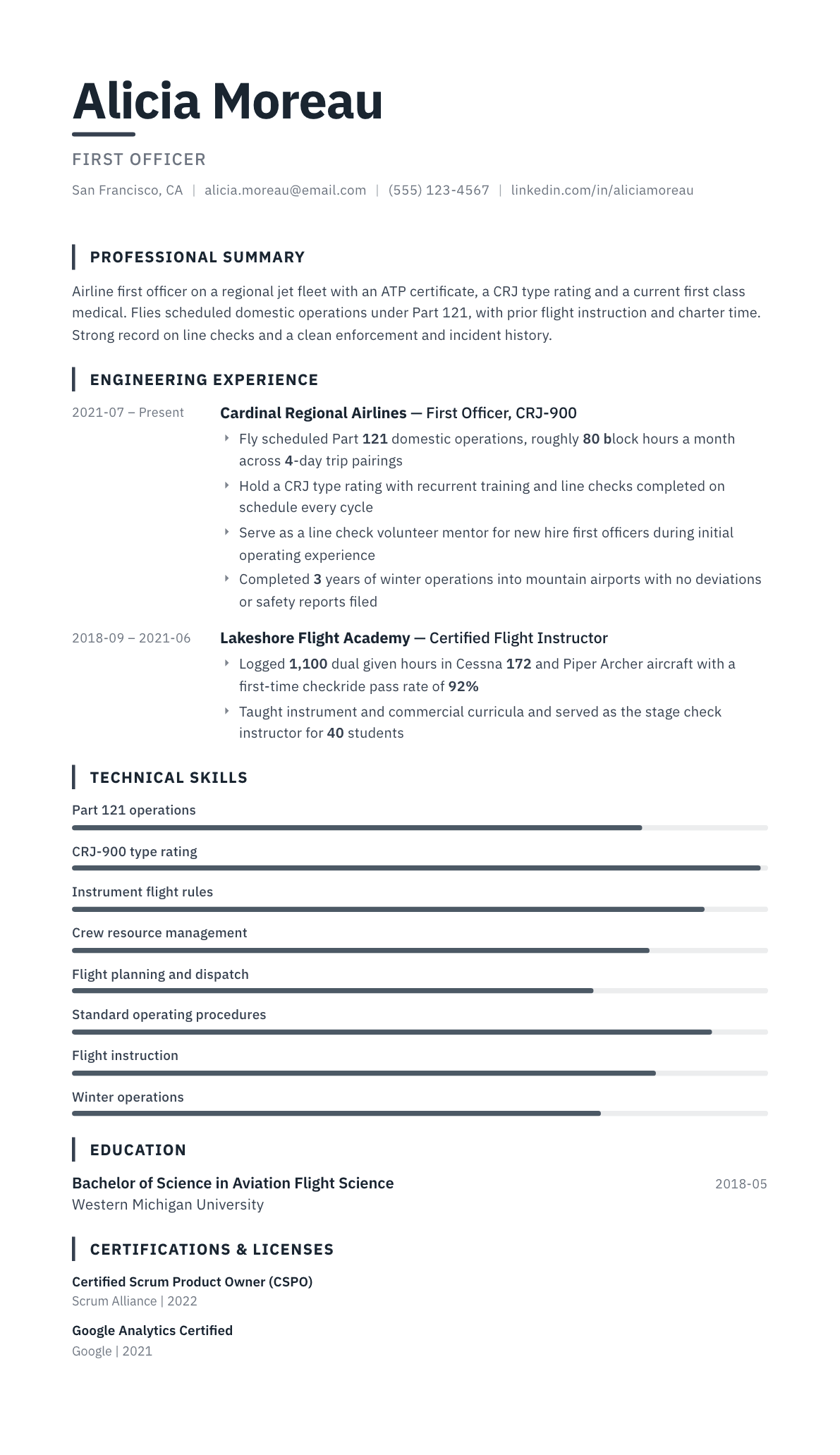
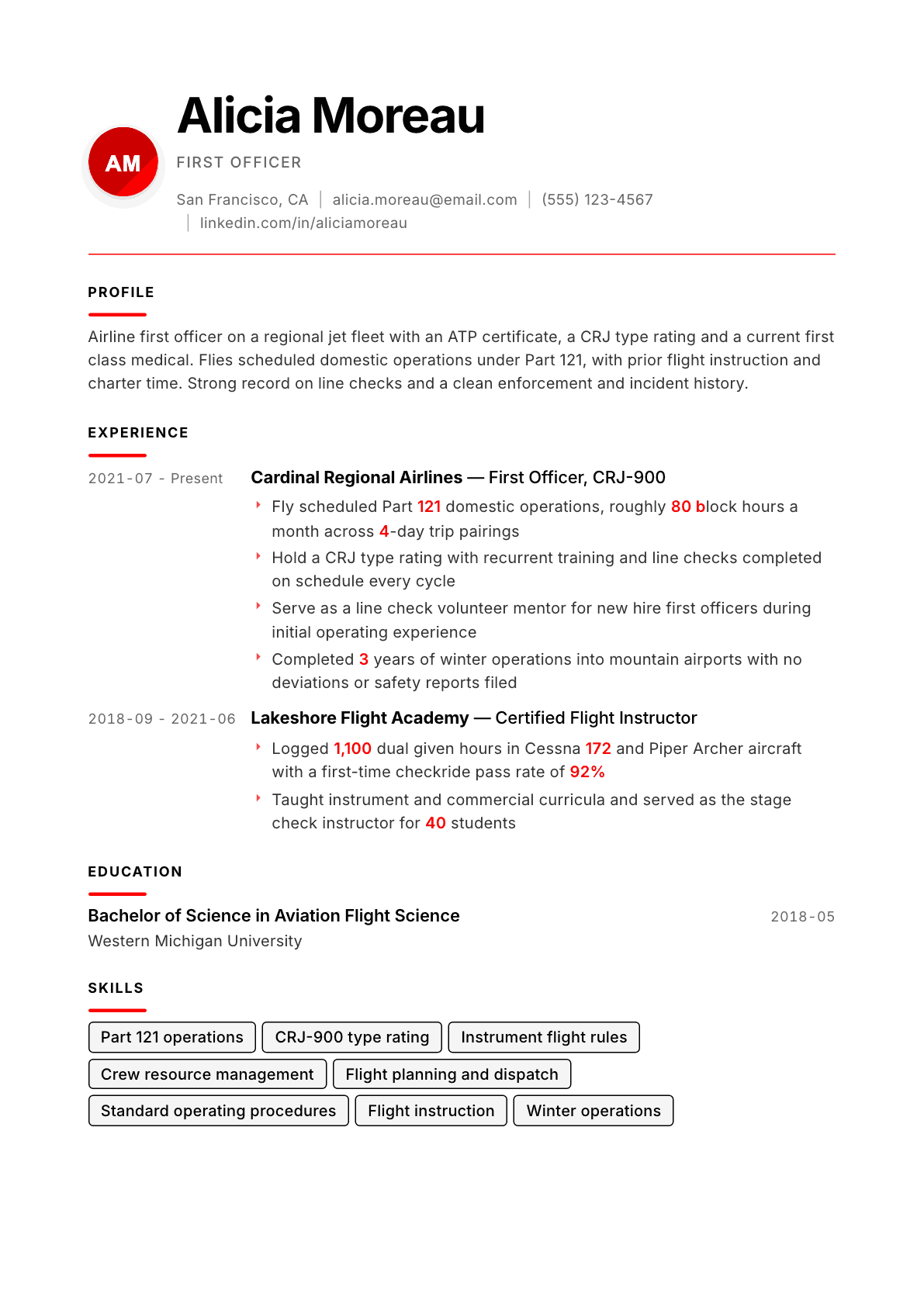
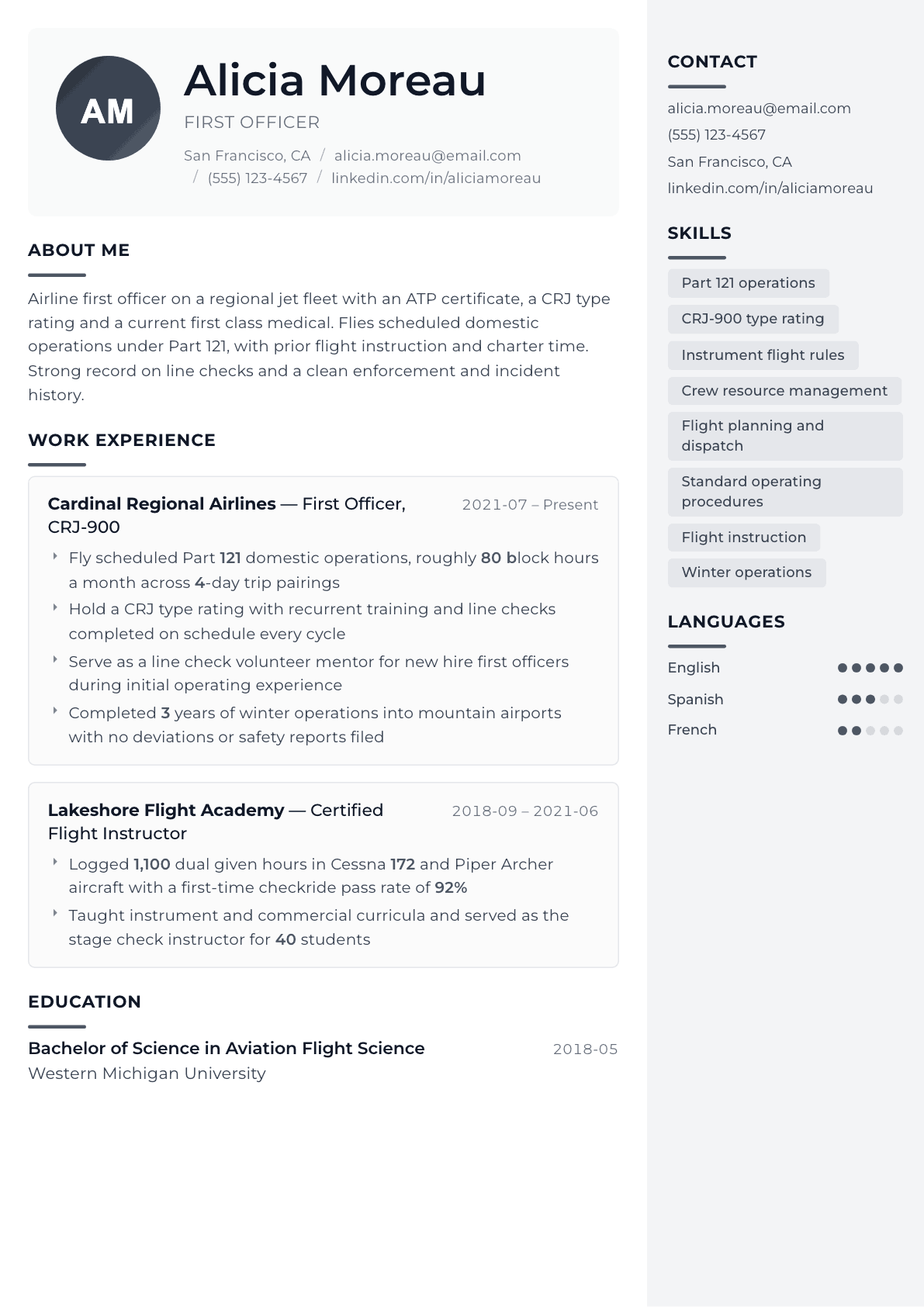
The same pilot content laid out in three CVBooster templates, so you can see what the finished document looks like before you write a word.
Example Pilot summary
Airline first officer with an ATP certificate, a CRJ-900 type rating and a current first class medical, flying scheduled domestic Part 121 operations. Logged flight instruction and charter time before the airline, with strong first-time checkride results as an instructor. Clean record of accidents, incidents and enforcement actions. Seeking a captain upgrade or a narrow-body first officer seat with a mainline carrier.
Skills to list on a Pilot resume
- Airline Transport Pilot certificate
- Type rating currency
- Instrument flight rules
- Crew resource management
- Part 121 operations
- Part 135 charter operations
- Flight planning
- Weight and balance
- Standard operating procedures
- Threat and error management
- Flight instruction
- Winter and mountain operations
- Aviation safety reporting
- Multi-crew coordination
What actually gets this resume read
- Put the flight time table high on page one: total, pilot in command, multi-engine, turbine, instrument and night.
- List certificates and ratings exactly as printed, including the ATP, type ratings and any instructor certificates.
- State medical class and currency, because a recruiter cannot move your file forward without knowing it.
- Say plainly that your record is clean of accidents, incidents, violations and enforcement actions if that is true.
- Name the aircraft you have flown by type, not by category, since fleet experience drives interview invitations.
- Keep the format conservative and text based, because airline application systems parse plain layouts most reliably.
How to write a pilot resume
A pilot resume is unusual among professional resumes because most of the decision is made from a table of numbers. The recruiter opens the file, finds the flight time block, and checks total, pilot in command, multi-engine, turbine, instrument and night against the minimums for the position. If those numbers meet the requirement, the rest of the page gets read. If they do not, nothing else on it matters.
The second decision is about risk. Airlines and operators are hiring someone who will be trusted with an aircraft and a cabin, so the resume has to make certificates, ratings, medical currency and record cleanliness immediately verifiable. Anything a reader has to infer becomes a question, and questions slow a file down in a process that already involves training records, background checks and verification of previous employment.
This guide covers how to build the flight time table, where certificates and ratings belong, three summary examples across career stages, before-and-after bullets for aviation work history, and the questions pilots ask when preparing an application for a regional, a mainline carrier or a corporate flight department.
Format: one page, conservative layout, numbers above the fold
One page for most pilots, two only if you carry extensive type experience or a long instructing and military record. Use a plain, text-based layout with no graphics or columns. Airline application systems parse conservative documents most reliably, and many carriers still require the resume to match data you also enter by hand into their portal.
The flight time block goes in the top third of the page, laid out as clean labeled lines rather than a graphic table. Total time, pilot in command, second in command, multi-engine, turbine, instrument actual and simulated, night, cross country and instruction given if applicable. Make the numbers current as of a stated month rather than leaving the reader to guess how stale they are.
- Header: name, city and state, phone, email, and a single line naming your certificate level and current type rating.
- Section order: summary, flight time, certificates and ratings, medical, flight experience, training and education.
- Keep formatting identical between the resume and any application portal entry, since discrepancies are treated as accuracy problems.
Summary: certificate, ratings, medical, record
Three lines. Certificate level and any type rating, the operation you fly and the equipment, medical class and currency, and a plain statement about your record. A pilot summary is not the place for personality; it is a compressed set of facts that lets a recruiter confirm eligibility before they reach the flight time block.
If you are transitioning between operations, say so and name what transfers. An instructor moving to an airline should lead with total and instruction given, instrument experience and a checkride record. A corporate pilot moving to a carrier should lead with turbine time, international operations and crew experience rather than the flexibility of a charter schedule.
Flight experience: operation, equipment and responsibility
Each aviation position needs the operator, the seat, the equipment and the regulatory part you flew under. Scheduled airline work, on-demand charter, corporate flight departments, air ambulance and flight instruction sit under different rule sets, and a recruiter reads the part designation as a shorthand for the environment you are used to.
Under that, describe responsibility rather than duties. Every pilot conducts preflight inspections and follows checklists, so bullets built from those facts say nothing. What distinguishes a candidate is line check performance, mentoring during initial operating experience, dispatch and flight planning involvement, operations into demanding airports or terrain, and any additional role such as check airman, standards work or safety committee membership.
If you have instructed, quantify it: dual given hours, curricula taught, stage check responsibilities and checkride outcomes. Instruction is the most common route to airline minimums, and how you describe it separates a candidate who taught mechanically from one who developed standards for a school.
- Name aircraft by specific type, since fleet familiarity drives interview invitations more than total time alone.
- State the operation type for every role, because a reader will not assume it from an operator name.
- Include recurrent training and line check history, as consistent first-attempt results are a quiet but strong signal.
Certificates, medical and record
List certificates exactly as they appear on the document: airline transport pilot with the appropriate category and class, commercial pilot, flight instructor with instrument and multi-engine privileges where held, and any type ratings with the limitation status. A remote pilot certificate belongs here too if you hold one and it is relevant to the operator.
State medical class and the month of the most recent examination, and confirm that the certificate is current. Then address the record directly. A single plain sentence saying you have no accidents, incidents, violations or enforcement actions removes the largest unanswered question on the page. If something does exist in your history, prepare to address it in the application process rather than through a vague resume phrase.
Aviation resume template: the section order to copy
An aviation resume template is mostly a fixed order of blocks, because airline recruiters and application portals look for the same information in the same place. Use the order below for pilot applications at regionals, mainline carriers, cargo operators and corporate flight departments, and keep the layout plain so it parses cleanly when you upload it.
Aviation roles outside the flight deck use a different template. A maintenance technician leads with the airframe and powerplant certificate and the aircraft types maintained, and cabin crew lead with service and safety training rather than flight time.
- Header: name, city and state, phone, email, certificate level and current type rating on one line.
- Summary: three lines with certificate, equipment, operation type, medical class and record.
- Flight time: total, pilot in command, second in command, multi-engine, turbine, instrument, night and cross country, current as of a stated month.
- Certificates and ratings, then medical, written exactly as on the documents.
- Flight experience: operator, seat, equipment and operating part for each role, newest first.
- Training and education: degree, training programs, recurrent training and additional duties.
Keywords aviation postings use
Airline transport pilot, commercial pilot, certified flight instructor, type rating, instrument rating, multi-engine land, turbine time, pilot in command, second in command, crew resource management, standard operating procedures, threat and error management, flight planning, weight and balance and first class medical. Use the ones that are true of your certificates and keep the phrasing identical to the certificate wording.
Pilot resume summary examples
Building time
Commercial pilot and certified flight instructor with instrument and multi-engine privileges, holding 1,150 total hours including 900 dual given and 140 multi-engine. First class medical current, no accidents, incidents or enforcement actions. Seeking a first officer position with a regional carrier on a regional jet fleet.
Airline first officer
Airline first officer with an ATP certificate, a CRJ-900 type rating and roughly 3,400 total hours including 2,300 turbine. Flies scheduled domestic operations at about 80 block hours a month, mentors new first officers during initial operating experience, and holds a clean record with first-attempt line checks throughout.
Captain
Airline captain with 9,200 total hours, 4,100 as pilot in command on transport category aircraft, and current type ratings on two narrow-body fleets. Serves as a line check airman conducting initial operating experience, contributes to the standards committee, and has flown international operations across three regions.
Work experience bullets: before and after
Before: Flew passenger flights for a regional airline.
After: Flew scheduled domestic operations under Part 121 on the CRJ-900 at roughly 80 block hours a month across 4-day trip pairings from a northeastern base.
Operation type, aircraft, monthly hours and pairing structure describe the flying environment a recruiter is matching against.
Before: Worked as a flight instructor at a flight school.
After: Logged 1,100 dual given hours in Cessna 172 and Piper Archer aircraft teaching private, instrument and commercial curricula, with a first-time checkride pass rate of 92%.
Hours, aircraft, curricula and a pass rate turn a job title into evidence of instructional standard.
Before: Followed all company procedures and checklists.
After: Completed 4 consecutive recurrent training cycles and line checks on first attempt, with no deviations, safety reports or training extensions during that period.
Training outcomes are checkable and directly relevant, while procedural compliance is assumed of every certificated pilot.
Before: Helped train new pilots at the airline.
After: Mentored 6 new hire first officers through initial operating experience, briefing threat and error management for mountain airport approaches before each leg.
A trainee count and a specific briefing focus show a mentoring role with substance behind it.
Before: Flew in challenging weather conditions.
After: Operated three full winter seasons into mountain airports with contaminated runway performance planning and deicing coordination, with no deviations filed.
Naming the operational challenge and the planning discipline shows capability rather than exposure to bad weather.
Hard skills
- Instrument flight procedures
- Crew resource management
- Standard operating procedure adherence
- Flight planning and fuel management
- Weight and balance computation
- Performance and contaminated runway planning
- Threat and error management
- Aircraft systems knowledge
- Automation and flight management systems
- Flight instruction and evaluation
- Aviation weather interpretation
- Safety management system reporting
Soft skills
- Decision making under time pressure
- Multi-crew communication
- Briefing clarity
- Composure during abnormal events
- Professional discipline
- Mentoring junior crew
Certifications worth listing
- Airline Transport Pilot Certificate (Federal Aviation Administration)
- Commercial Pilot Certificate (Federal Aviation Administration)
- Certified Flight Instructor, Instrument and Multi-Engine (Federal Aviation Administration)
- First Class Medical Certificate (Federal Aviation Administration Aviation Medical Examiner)
- Remote Pilot Certificate (Federal Aviation Administration)
Mistakes that cost pilot candidates the interview
- Burying the flight time block below the work history, forcing a recruiter to hunt for the numbers that decide the file.
- Leaving the flight times undated, so a reader cannot tell whether the totals are current or a year out of date.
- Writing bullets about preflight inspections and checklist discipline, which are true of every certificated pilot and distinguish nobody.
- Omitting medical class and currency, which is an eligibility fact rather than an optional detail.
- Saying nothing about accidents, incidents and enforcement actions, leaving the largest question on the page unanswered.
- Using a designed template with graphics or columns, which airline application systems parse poorly and which reads as unprofessional in this field.
- Listing aircraft by category rather than by type, when fleet-specific experience is what generates interview invitations.
Pilot resume questions
How should I lay out flight hours on a pilot resume?
As labeled lines in the top third of the page: total, pilot in command, second in command, multi-engine, turbine, instrument, night, cross country and instruction given. Add the month the totals are current as of, and make sure they match your logbook and any application portal entry exactly.
Is there an aviation resume template that works for pilots?
Yes. Use a plain one page layout with the header, a three line summary, the flight time block, certificates and ratings, medical, flight experience and training, in that order. Keep it text based with no columns or graphics, since many airlines also ask you to enter the same data in their own portal.
Do I need to mention my medical certificate?
Yes. State the class and the month of your most recent examination. It is an eligibility requirement rather than a personal detail, and leaving it out means a recruiter has to ask before they can advance your file through the process.
How do I write a pilot resume when transitioning from military flying?
Translate the operation without losing the substance. Give hours in the civilian categories, convert aircraft to type designations a civilian reader recognizes, and describe instructor, evaluator or standards roles in plain terms. Keep unit names brief and expand on responsibility instead.
What should I include if I have low total time?
Everything that shows quality of experience. Instruction given, first-attempt checkride outcomes for your students, instrument time, complex and high performance endorsements, and any operational flying such as banner towing, survey or pipeline patrol. Consistency and clean training records matter while hours build.
Related resume examples
- Air Traffic Controller Resume example
- Flight Attendant Resume example
- Commercial Pilot Resume example
- Flight Instructor Resume example
- Ramp Agent Resume example
- Helicopter Pilot Resume example