Freelancer Resume Examples: free ATS score and gap list
Turn Freelance Client Work Into a Resume Employers Can Read
By Mustafa Tarabya, founder of CVBooster · Published · Updated
Freelancer resume example, keyword list and writing guide covering client rosters, retainers, project outcomes and moving from contract work to staff.
Sample resumes for a freelancer
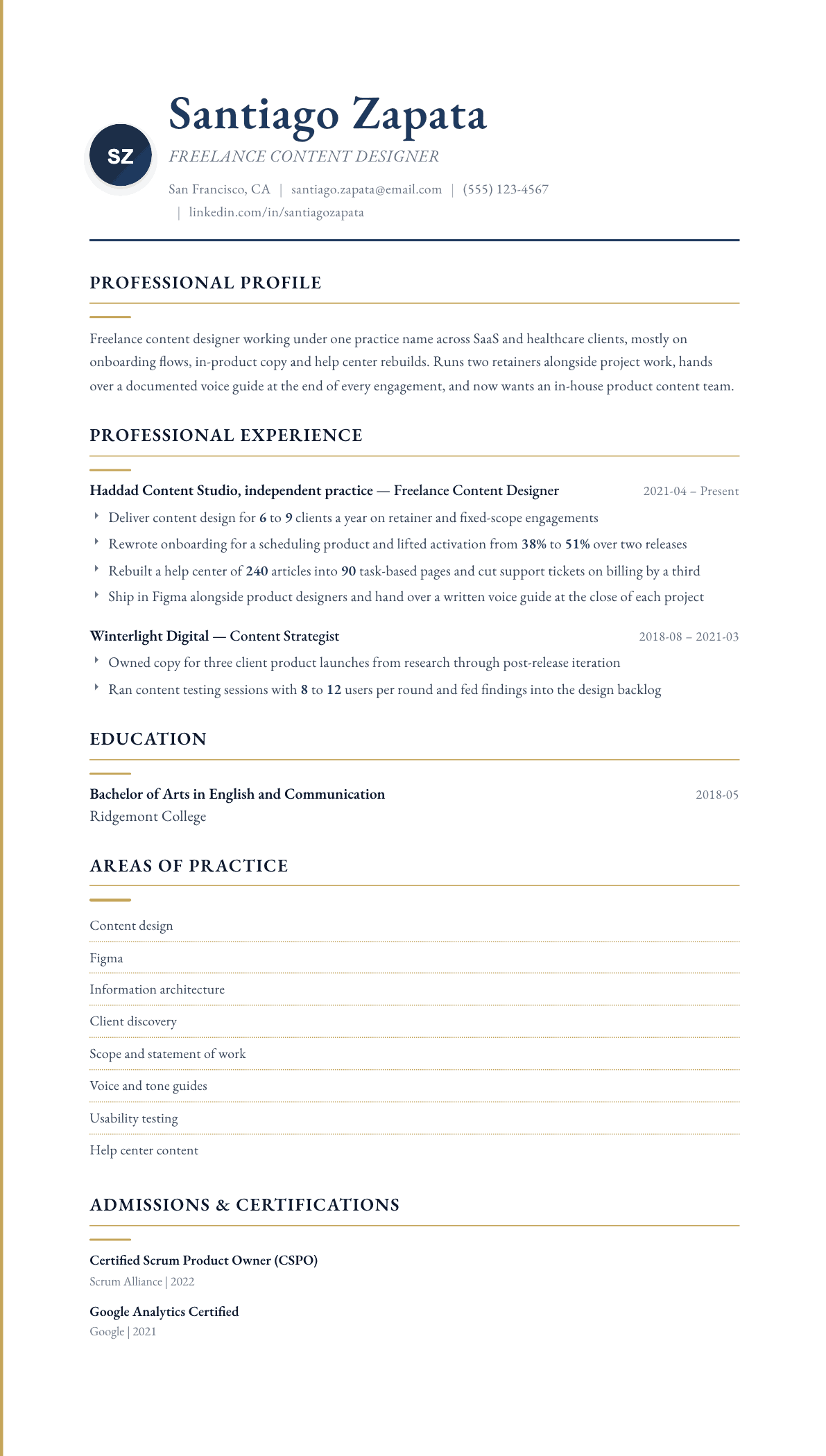
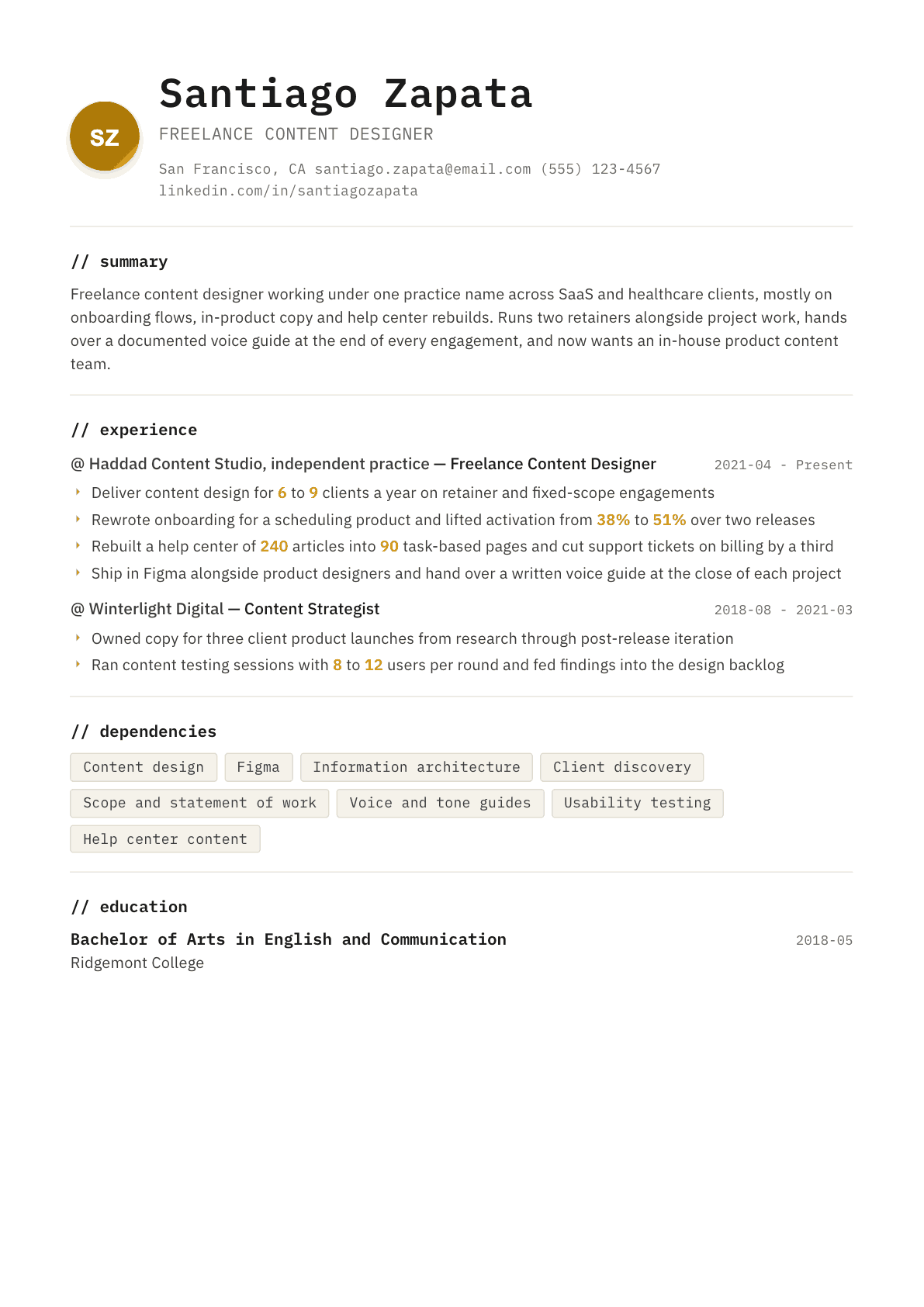
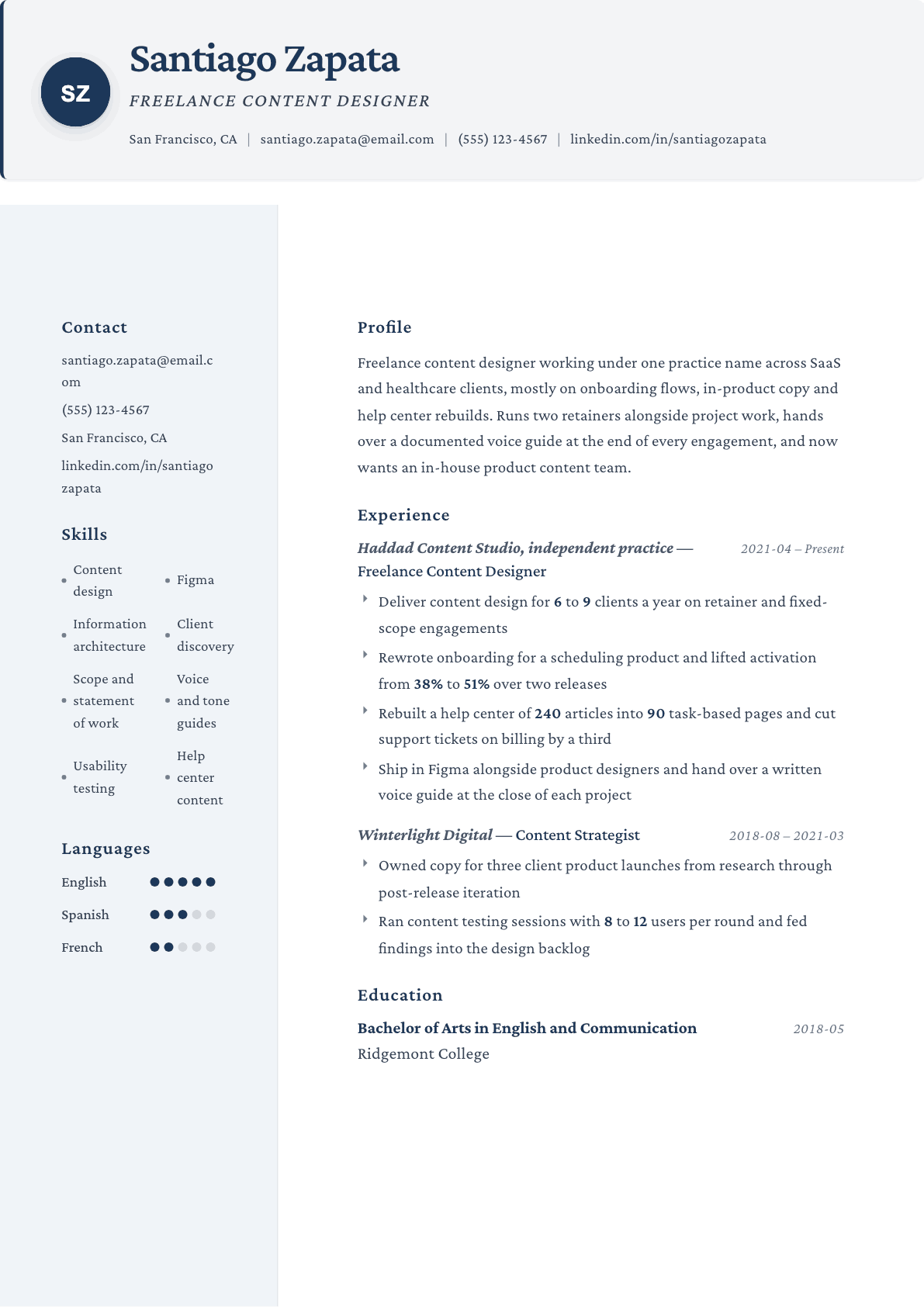
The same freelancer content laid out in three CVBooster templates, so you can see what the finished document looks like before you write a word.
Example Freelancer summary
Freelance content designer running an independent practice across SaaS and healthcare clients, with two active retainers and fixed-scope work delivered from discovery through release. Rebuilt a help center of 240 articles into 90 task-based pages and lifted onboarding activation over two releases. Works in Figma beside product teams and documents voice guidelines at handover. Seeking an in-house product content role.
Skills to list on a Freelancer resume
- Client discovery and scoping
- Statement of work drafting
- Retainer management
- Project estimation
- Portfolio curation
- Client communication cadence
- Invoicing and payment terms
- Subcontractor coordination
- Revision and approval cycles
- Handover documentation
- Referral pipeline
- Rate negotiation
- Deadline management across clients
- Contract-to-staff positioning
What actually gets this resume read
- Give your practice one consistent name and one date range so the freelance years read as a single job.
- Nest client engagements as bullets under that practice instead of listing each contract as a separate role.
- Name the clients you may name, and describe the rest by industry and size when a contract forbids it.
- Show retainers separately from one-off projects, because repeat business is the proof of quality.
- Add a portfolio line with a live link and say which pieces you owned end to end.
- Answer the stability question in the summary by stating plainly that you are seeking a staff role now.
How to write a freelancer resume
A freelance history is the hardest kind of experience to lay out on a page, because the raw material fights the format. You have thirty engagements instead of three jobs, overlapping date ranges, clients you are contractually forbidden to name, quiet months and months where you ran four projects at once. Dumped onto a resume unedited, that looks like instability. Organized properly, it looks like a person who has sold, scoped, delivered and been rehired without a manager standing behind them.
The screener reading a freelance resume has two questions. Can this person do the work at the level we need, and will they stay once the next interesting contract appears. The first is answered by the portfolio and the outcomes. The second is answered by you, explicitly, in the summary, and by the shape of the page: a single continuous practice with a date range beats a scattered list of gigs every time.
This guide covers structuring freelance years as one entry, how to name clients you can name and describe the ones you cannot, which numbers a freelancer should show, how retainers change the read, and the specific moves that get an independent professional hired onto a staff team.
Structure: one practice, one date range, clients as bullets
Give your freelance years a single entry. Use your practice name or your own name followed by the discipline, put the full date range on it, and describe the practice in one line: what you do, for whom, and at what scale. Then list the engagements as bullets or as short sub-entries underneath. This is not cosmetic. It removes the illusion of eight short jobs and puts a continuous professional history on the page.
Sub-entries work well when three or four engagements were long and substantial, for example a nine-month embedded contract. Keep the sub-entry format identical to a normal job entry, with the client, the role you played and the dates, so a reader does not have to work out what they are looking at.
- One heading: practice or trading name, discipline, city, and the full date range including Present.
- A one-line practice description: services, client types, typical engagement length.
- Three to six engagement bullets or sub-entries, ordered by relevance to the posting, not by date.
- A portfolio line with a live link and a note on which pieces you owned end to end.
- Any pre-freelance staff jobs below, in the ordinary reverse chronological way.
Naming clients, and describing the ones you cannot name
Name every client your agreement allows, because a recognizable logo does more for credibility than three lines of description. Where a nondisclosure clause applies, describe the client by industry, size and situation instead: a Series B scheduling product, a regional health system, a family-owned manufacturer with two plants. That carries almost the same weight and breaks no contract.
Never list a client you merely subcontracted through without saying so. If an agency brought you in, name the agency and describe the end client generically. Hiring managers check, and a claimed relationship that turns out to be two steps removed ends the conversation.
Numbers a freelancer can prove
Independent work generates its own metrics and most freelancers ignore them. Repeat business is the strongest, because it is a client voting with a purchase order: how many clients rehired you, how many moved onto a retainer, how many years the longest relationship has run. Volume is the second: engagements a year, concurrent projects held, articles or screens or builds delivered.
Then the client-side outcome, which is what a staff hiring manager actually buys. Activation lifted over two releases, support tickets on billing down after a help center rebuild, a launch delivered inside a fixed window. Attach the outcome to the release or the quarter it landed in, since a freelance claim without a timeframe is easy to discount.
Leave rates and revenue off the page. They invite the wrong comparison against a salary band and tell a hiring manager nothing about the quality of the work.
- Clients served per year and how many were repeat or retained.
- Longest continuous client relationship, in years.
- Concurrent engagement load at peak, which shows scheduling capability.
- Delivery outcomes tied to a named release, launch or quarter.
- On-time delivery record across fixed-scope engagements.
The business half: scoping, contracts and client management
Half of freelancing is not the craft. It is discovery calls, statements of work, change control when the client asks for a fifth revision, invoicing terms and the awkward conversation when a payment is late. Those are real skills, and they map directly onto staff work: requirements gathering, stakeholder management, estimating and prioritization.
Show them in the vocabulary of the destination job. A freelancer who writes that she scopes engagements against a written statement of work and holds change requests to a documented revision cycle has just described requirements discipline in a way any product or agency manager will recognize.
Moving from freelance to staff without triggering the flight risk question
The retention doubt is real and it is best answered head on. One sentence in the summary saying you are looking for a permanent role, with the reason, removes most of it. Wanting to own a product over years rather than in eight-week slices, or wanting a team rather than a solo practice, are reasons a manager believes because they are the reasons people actually give.
Then support it structurally. Emphasize the longest engagements over the short ones, foreground embedded work where you sat inside a client team with its rituals and its stand-ups, and mention any freelance relationship that led to an offer. A freelancer who has already worked inside someone else's process for nine months is not a flight risk, and the page should say so without saying so.
Freelancer resume summary examples
First two years freelancing
Freelance graphic designer with 2 years of independent work for local hospitality and retail clients, delivering brand identities, menu systems and social templates. Delivered 14 fixed-scope projects with 6 clients returning for a second engagement. Building toward an in-house junior designer role on a brand team.
Established independent practice
Freelance content designer running an independent practice across SaaS and healthcare clients, holding two active retainers alongside fixed-scope work. Rebuilt a help center of 240 articles into 90 task-based pages and lifted onboarding activation from 38% to 51% over two releases. Seeking an in-house product content role.
Senior freelancer with subcontractors
Independent development consultant of 9 years, delivering platform migrations for mid-market retailers and coordinating a bench of 3 subcontractors on larger builds. Longest client relationship runs 6 years across four projects. Targeting a lead engineer role where the work continues past the launch date.
Work experience bullets: before and after
Before: Worked with many clients on various design projects.
After: Delivered content design for 6 to 9 clients a year across retainer and fixed-scope engagements, with 4 clients returning for a third project.
Client count plus repeat business shows both volume and the quality that produces a rehire.
Before: Redesigned a client's onboarding.
After: Rewrote onboarding for a scheduling product across two releases in 2024, lifting activation from 38% to 51% and cutting the setup support queue.
The outcome, the timeframe and the release cadence turn a task into evidence of impact.
Before: Handled contracts and invoices for my freelance business.
After: Scope every engagement against a written statement of work with a defined revision cycle, and hold change requests to a documented approval step before delivery.
Described this way, the business half reads as requirements discipline a staff manager already values.
Before: Worked with a big healthcare company under NDA.
After: Embedded for 9 months with a regional health system's digital team, running weekly content reviews inside their design process under a confidentiality agreement.
Industry, duration and working arrangement carry the credibility that a hidden client name cannot.
Before: Delivered projects on time and on budget.
After: Closed 22 of 23 fixed-scope engagements on the agreed date, with the exception rescheduled at the client's request after a launch was moved.
A real ratio with an honest exception is far more persuasive than a claim every freelancer makes.
Hard skills
- Client discovery and requirements gathering
- Statement of work drafting
- Project estimation and scoping
- Retainer and engagement management
- Change request control
- Portfolio curation and case studies
- Invoicing and payment terms
- Subcontractor coordination
- Handover documentation
- Referral and pipeline development
- Rate and contract negotiation
- Concurrent deadline management
Soft skills
- Saying no to scope that was never agreed
- Reading a client's real priority behind the brief
- Working alone without a manager setting the pace
- Chasing payment without damaging the relationship
- Adapting to each client's internal rituals
Mistakes that cost freelancer candidates the interview
- Listing every engagement as a separate job, which turns a stable practice into a page of short stints.
- Leading with services offered instead of outcomes delivered, which reads as a brochure rather than a resume.
- Naming clients that a nondisclosure agreement covers, or claiming end clients reached through an agency.
- Putting rates or annual revenue on the page, where they invite a comparison that helps nobody.
- Ignoring repeat business and retainers, the two numbers that prove clients were satisfied enough to return.
- Leaving the retention question unanswered when applying for a staff role after years of independence.
- Sending a portfolio link with agency work mixed in and no note on which parts you personally owned.
Freelancer resume questions
Should I list each freelance client as a separate job?
No. Use one entry for the practice with a continuous date range, then list clients as bullets or short sub-entries beneath it. Separate entries create the appearance of constant job changes even when the underlying work was steady.
What do I put as my employer if I have no company name?
Your own name followed by the discipline works: Noor Haddad, Freelance Content Design. It is accurate, it fills the employer field that most applicant tracking systems require, and it reads as deliberate rather than improvised.
How do I show freelance work when everything is under a confidentiality agreement?
Describe each client by sector, rough size and the situation you were hired into, then describe your work and its outcome in full. The specifics of what you did are almost never covered by the agreement, only the client identity.
Will employers think I cannot handle a full-time job?
Some will wonder, so answer it. Say in one line that you are seeking a permanent role and why, then foreground your longest and most embedded engagements, since working inside a client team for months is the closest thing to proof.
Do I still need a separate portfolio if my resume has the outcomes?
Yes, for any craft discipline. The resume gets you the click and the portfolio gets you the interview. Keep it short, lead with three pieces closest to the job you want, and label your exact contribution on each one.