Self-Employed Resume Examples: free ATS score and gap list
Write a Self-Employed Resume That Reads as a Real Job
By Mustafa Tarabya, founder of CVBooster · Published · Updated
Self-employed resume example, keyword list and writing guide covering business ownership, revenue framing, staff management and returning to employment.
Sample resumes for a self-employed
The same self-employed content laid out in three CVBooster templates, so you can see what the finished document looks like before you write a word.
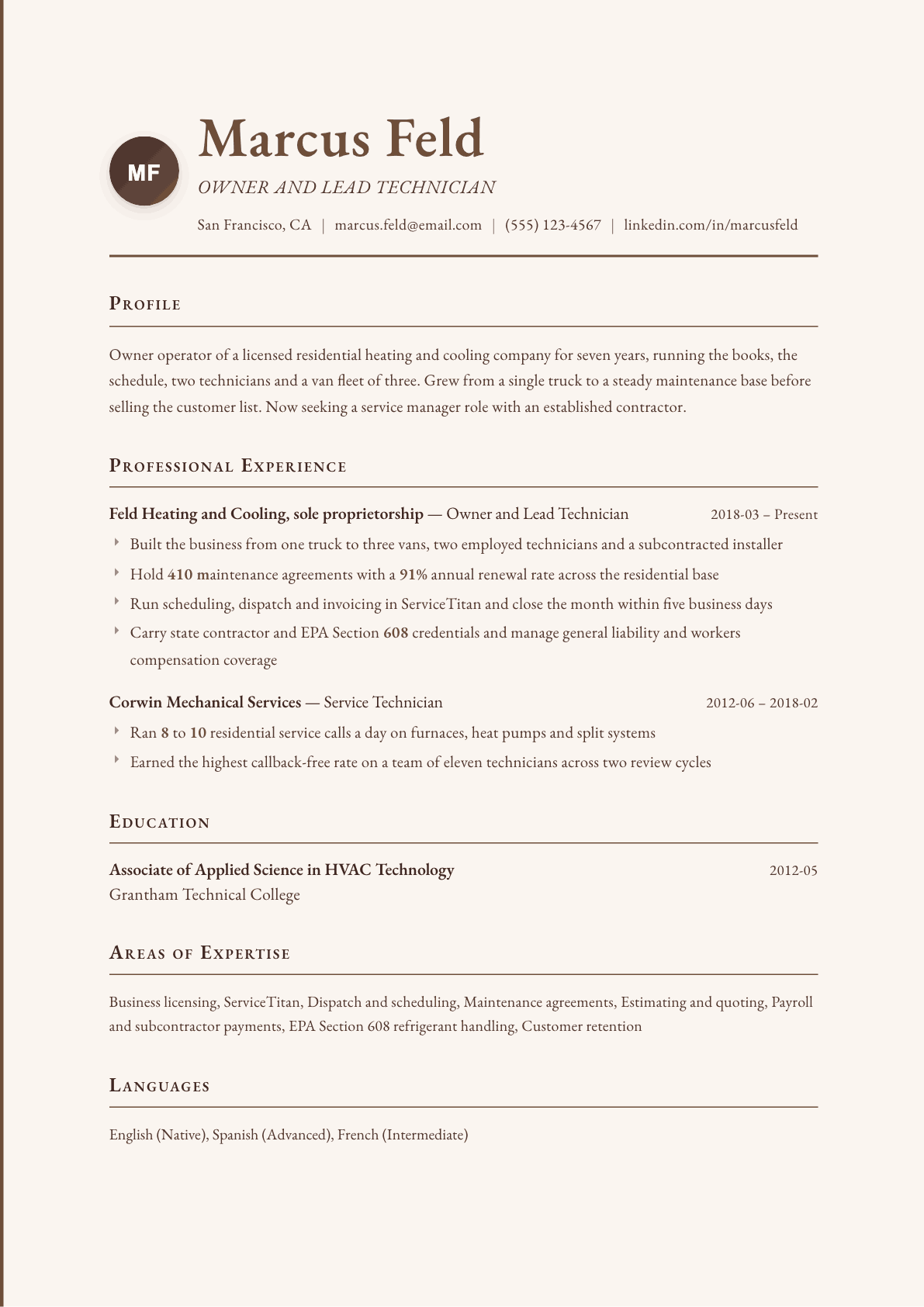
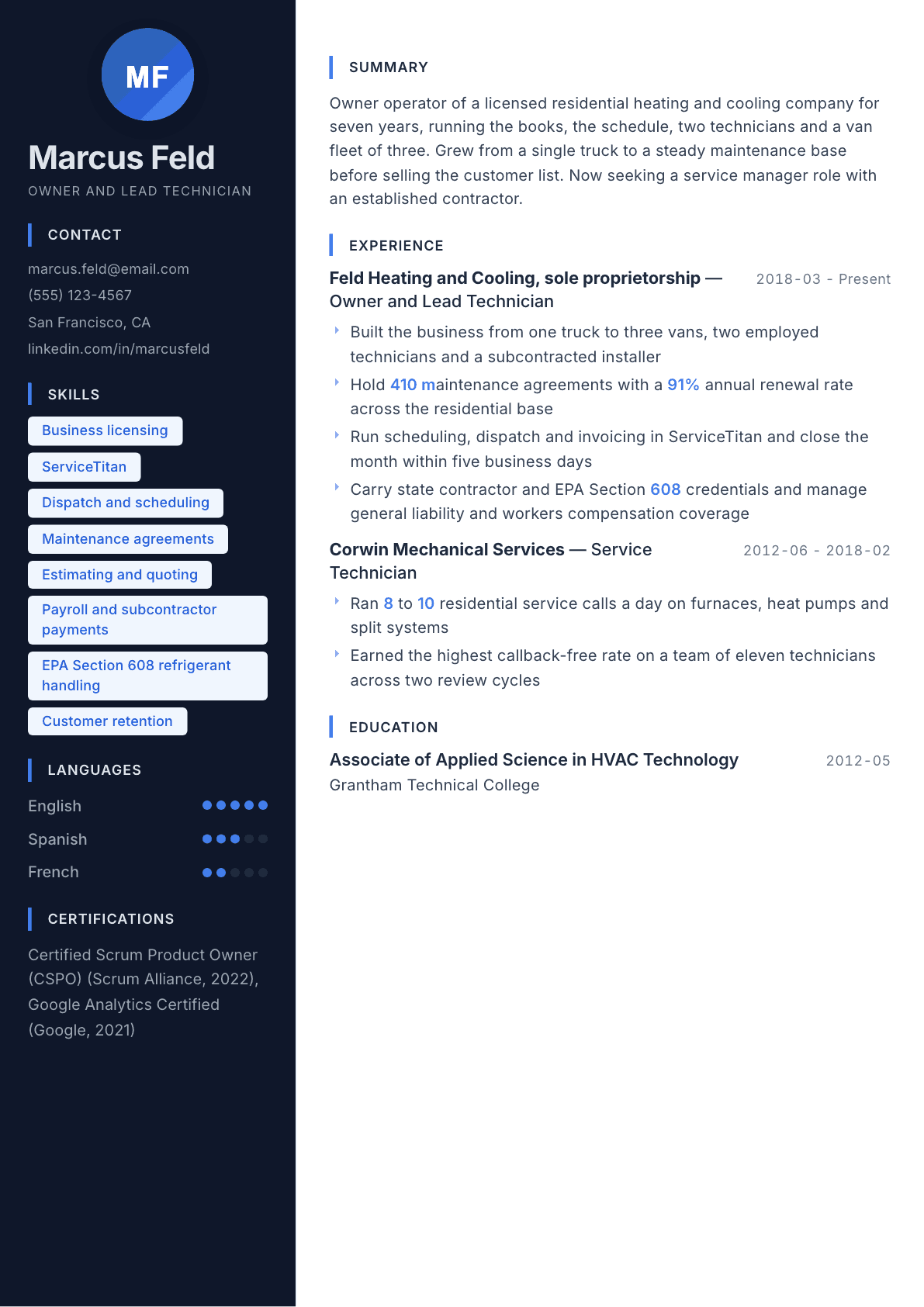
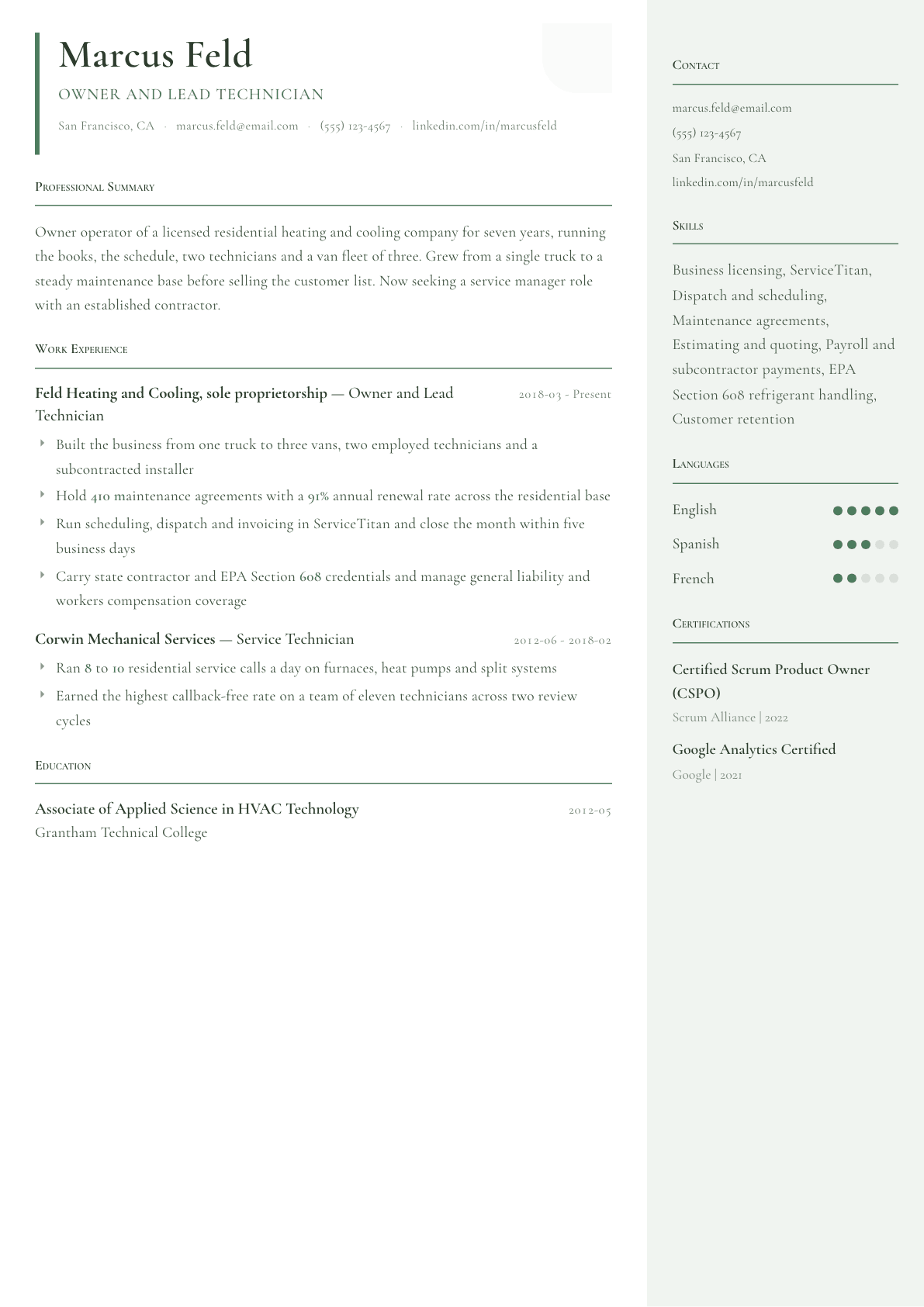
Example Self-Employed summary
Licensed owner operator who built a residential heating and cooling company from one truck to three vans, two technicians and 410 maintenance agreements with a 91% renewal rate. Runs estimating, dispatch, payroll, purchasing and quality control, and closes the books monthly in ServiceTitan. Holds state contractor and EPA Section 608 credentials. Seeking a service manager role with an established contractor.
Skills to list on a Self-Employed resume
- Business formation and licensing
- Profit and loss management
- Estimating and pricing
- Hiring and scheduling staff
- Payroll administration
- Customer acquisition
- Account retention
- Vendor and supplier negotiation
- Insurance and compliance
- Bookkeeping software
- Quality control
- Contract administration
- Cash flow planning
What actually gets this resume read
- Give the business a formal entry with the legal structure, the trading name and the years you operated.
- Translate ownership into functions a hiring manager recognizes: sales, scheduling, hiring, payroll and quality control.
- Use relative growth and renewal rates rather than raw revenue, which reads as unverifiable on a resume.
- Name the number of people you employed or subcontracted, since it is the clearest measure of scale.
- State why you are returning to employment so nobody assumes you will leave to restart the business.
- List the licenses, insurance and tax registrations you held, because they prove the operation was legitimate.
How to write a self-employed resume
A self-employed candidate applies with a stronger hand than they think and a weaker page than they need. They have carried payroll, chased receivables, hired and fired, priced work, held licenses and answered to a tax authority, all without a manager. Then they write owner on a resume, add three lines about wearing many hats, and hand a hiring manager nothing she can compare against another candidate.
The manager reading it has specific worries. Will an owner take direction. Was the business closed because it failed. Is this person going to leave the moment a new venture idea arrives. Those doubts are answered by structure and by specificity: a formal entry with the legal form of the business, functional bullets that map to the job being applied for, and one honest sentence about why the chapter ended.
This guide covers how to present a business you owned as a real job, which measures to use when revenue is not something a resume can verify, how to prove you can work under someone else's process, and how to handle the situation where the business is still open while you look for work.
Give the business a proper entry with its legal shape
Write it as you would any employer. Trading name first, then the legal form, then your title, then the dates. Feld Heating and Cooling, sole proprietorship, Owner and Lead Technician, with the years you traded. That single line answers whether this was a registered operation or occasional side work, which is the first thing a screener wants to establish.
Follow it with a scope line before the bullets: the sector, the customer type, the headcount and the geography. A reader can then size the operation in one sentence and stops guessing. Two employees and three vans across one metro area is a very different job from a single-person consultancy, and both are legitimate, but only one of them is what your bullets describe.
- Trading name, legal form, your title and the full trading date range.
- A scope line: sector, customer base, employees and subcontractors, service area.
- Functional bullets grouped the way the target job is grouped: sales, delivery, people, finance.
- Licenses, registrations and insurance held, which prove the operation was compliant.
- A closing line stating why the business ended or how it continues alongside employment.
Translate ownership into the functions a hiring manager buys
Owner is not a job description, it is a legal position. Break it into the functions you actually performed and name them the way a corporate posting names them: business development, estimating and pricing, scheduling and dispatch, recruitment and payroll, purchasing, quality control, customer retention. Then attach evidence to each one.
Weight those functions toward the job you want. Applying for a service manager role means dispatch, technician development and callback rates lead, and the tax filings drop to a single line. Applying for an account manager role means the customer acquisition and retention work leads instead. The same business supports several very different resumes, and sending the generic version to all of them is why owners get filtered out.
Drop the phrase about wearing many hats. Every owner writes it, it names no skill, and it occupies the line where a measurable outcome should be.
Numbers that work when the books are private
A resume cannot verify revenue, and stating it invites an uncomfortable conversation about what the business really earned. Use measures that describe the operation instead: customers on a recurring agreement, renewal rate, headcount grown, vans or locations added, average job value trend, days from invoice to payment, review score across a public listing.
Growth expressed as movement is safer and more readable than an absolute figure. From one truck to three vans and two employed technicians tells a manager everything about scale and trajectory without exposing a single financial number.
If the business had a genuine failure, do not manufacture growth. A contractor who says the residential base shrank when a major developer client stopped building, and who then names what he did about it, reads as honest and commercially aware. Fabricated momentum falls apart in the first interview.
- Recurring customers or agreements on the books, and the annual renewal rate.
- Headcount employed and subcontracted, with the growth over the trading period.
- Operational scale: vehicles, locations, service area, jobs completed per week.
- Collections discipline: average days from invoice to payment.
- Public review average with the number of reviews behind it.
Answer the two silent objections: direction and departure
Managers worry that an owner will resist supervision. Show the opposite with evidence of working inside someone else's rules: a general contractor whose schedule you worked to, a franchise standard you operated under, an inspection regime you passed, a client whose systems you used rather than your own. Any of those proves you can take direction from outside.
Then explain the transition in one sentence. Sold the customer list, wound the business down when the lease ended, closed after a partner left, or keeping it open at reduced hours while employed. All of those are acceptable. What is not acceptable is silence, because silence lets the reader assume the business collapsed and that you will restart it as soon as the market improves.
Formatting details owners consistently get wrong
Keep the resume in the standard reverse chronological order and put any pre-ownership employment below the business entry. That earlier employment matters more than owners expect, because it proves you have held a job with a supervisor and a timesheet, and it is often the record a background check can confirm quickly.
Prepare references that are not friends. A commercial client, a supplier account manager, a subcontractor who worked under you and an accountant all count as professional references, and a hiring manager will accept them once you explain the structure. Owners who offer only personal contacts lose credibility at the last stage of a process they had already won.
Self-Employed resume summary examples
Small operation, returning to employment
Owner operator of a two-person residential cleaning business for 3 years, holding 40 recurring weekly accounts and a 4.8 public review average. Handled quoting, scheduling, supplies purchasing and payroll for one employee. Seeking a supervisor role with an established commercial cleaning contractor.
Established trade business
Licensed owner operator who grew a residential heating and cooling company from one truck to three vans and two employed technicians, holding 410 maintenance agreements at a 91% renewal rate. Runs estimating, dispatch, payroll and quality control. Seeking a service manager role with an established contractor.
Owner of a multi-site business
Founder and managing director of a 3-location retail food business over 11 years, employing 34 staff at peak and building the supplier and compliance framework across all sites. Sold the business in 2025. Targeting a multi-site operations manager role in hospitality or specialty retail.
Work experience bullets: before and after
Before: Ran my own business and wore many hats.
After: Operated a licensed residential heating and cooling company covering estimating, dispatch, purchasing, payroll for two technicians and warranty resolution across a single metro service area.
Naming the functions gives a hiring manager six comparable skills instead of an untranslatable job title.
Before: Grew the business significantly over the years.
After: Grew from a single truck to three vans, two employed technicians and a subcontracted installer, adding 410 maintenance agreements with a 91% annual renewal rate.
Movement in units and a renewal rate describe growth credibly without exposing private financials.
Before: Handled all the invoicing and accounts.
After: Cut average collection from 47 days to 19 by moving to card capture at job completion and reconciling the ledger weekly in ServiceTitan.
A collections number with the method behind it is a finance outcome any operations manager understands.
Before: Hired and managed staff.
After: Recruited and trained two technicians from apprentice level to independent service calls, running ride-alongs for the first 6 weeks and a monthly callback review with each of them.
Development with a defined method reads as management capability rather than an administrative duty.
Before: Closed the business in 2025.
After: Sold the customer list and maintenance agreements to a larger contractor in 2025 and completed a 3-month handover of service histories and scheduled visits.
An orderly exit with a handover reframes the ending as a managed transaction instead of a failure.
Hard skills
- Business formation and licensing
- Estimating and pricing
- Profit and loss management
- Bookkeeping and reconciliation
- Payroll administration
- Recruitment and staff scheduling
- Purchasing and supplier negotiation
- Insurance and regulatory compliance
- Customer acquisition and retention
- Contract administration
- Cash flow planning
- Quality control and warranty handling
Soft skills
- Taking direction after years of setting it
- Commercial judgment under cash pressure
- Direct conversations about money
- Deciding alone with incomplete information
- Building trust with repeat customers
Mistakes that cost self-employed candidates the interview
- Writing owner with no legal form, no scope line and no indication of how large the operation was.
- Describing the role as wearing many hats, which names none of the functions a manager is hiring for.
- Putting annual revenue on the page, where it cannot be verified and invites the wrong comparison.
- Leaving out the reason the business ended, which lets a reader assume the worst version of the story.
- Sending the same owner resume to a sales role and an operations role instead of reweighting the functions.
- Omitting pre-ownership employment, the part of the history that proves you have worked for a supervisor.
- Offering only personal references when clients, suppliers and subcontractors are the professional ones.
Self-Employed resume questions
How do I list a self-employed business on a resume?
As a normal employer entry: trading name, legal form, your title and the trading dates, followed by a scope line and functional bullets. Treating it any differently signals that you consider it lesser experience, and the reader will agree.
Should I say the business failed?
Say it ended and give the commercial reason in a few words, such as a lease ending, a partner leaving or a main client stopping work. Businesses close constantly for reasons unrelated to the owner's competence, and an honest line closes the topic.
What if my business is still running while I look for a job?
State it plainly with your intended arrangement: winding down, reducing to weekends, or transferring to a partner. Employers accept a wind-down period, but they need to know you will not be dispatching your own jobs during their working hours.
Will employers think I am unmanageable because I was the boss?
Some will, so put evidence of working inside external rules on the page: a general contractor's schedule, a franchise standard, an inspection regime or a client whose systems you used. That is more convincing than any claim about being a team player.
Who can I use as references if I never had a manager?
A long-standing commercial client, a supplier account manager, an accountant and a subcontractor who worked under you are all professional references. Give the hiring manager the relationship alongside the name so nobody has to guess how they know you.