Law School Applicant Resume Examples: what gets the call
Law School Applicant Resume Written for the Admissions File
By Mustafa Tarabya, founder of CVBooster · Published · Updated
Law school applicant resume example and guide covering the LSAC format, work history, research, advocacy activities and what admissions readers check.
Sample resumes for a law school applicant
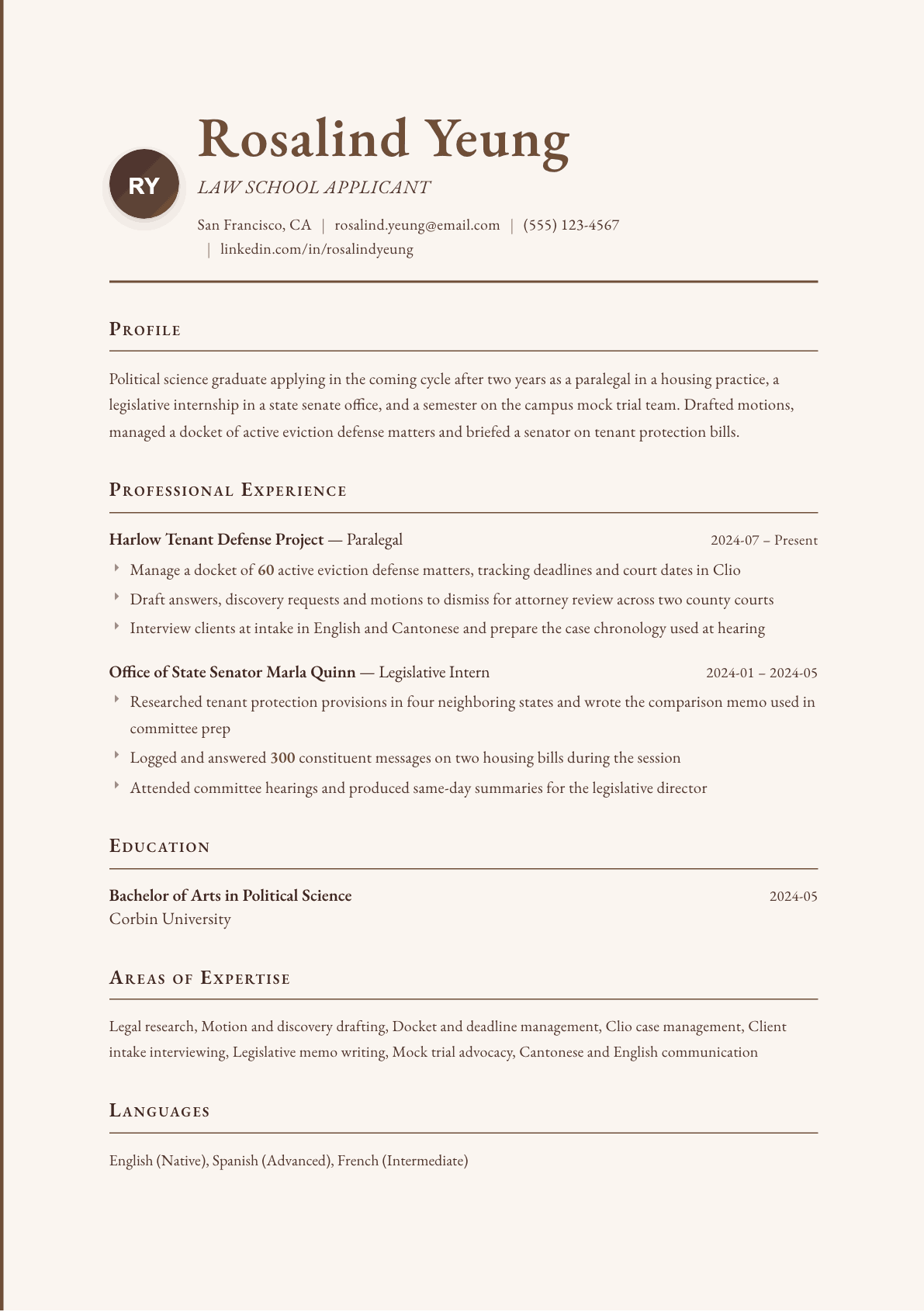
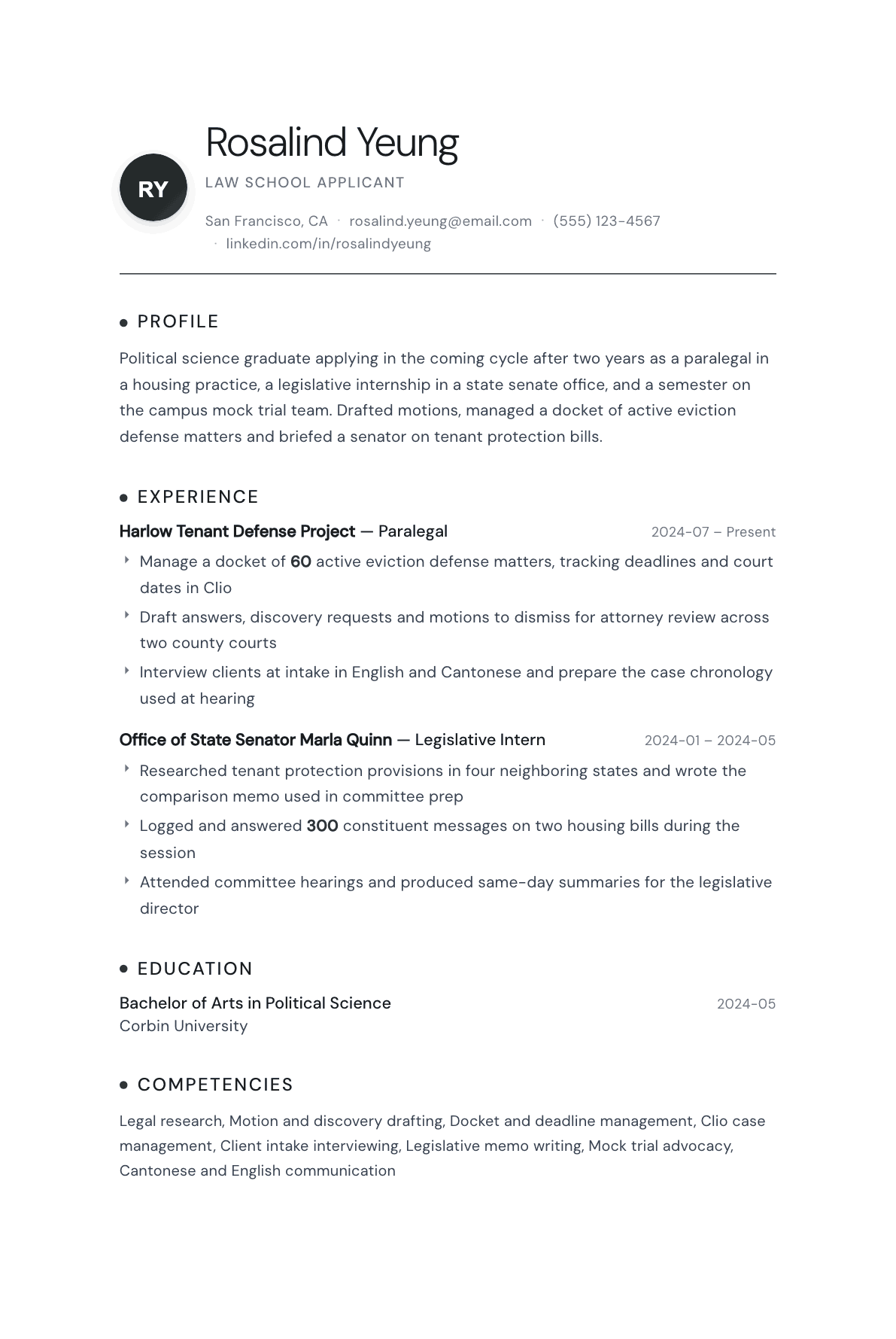
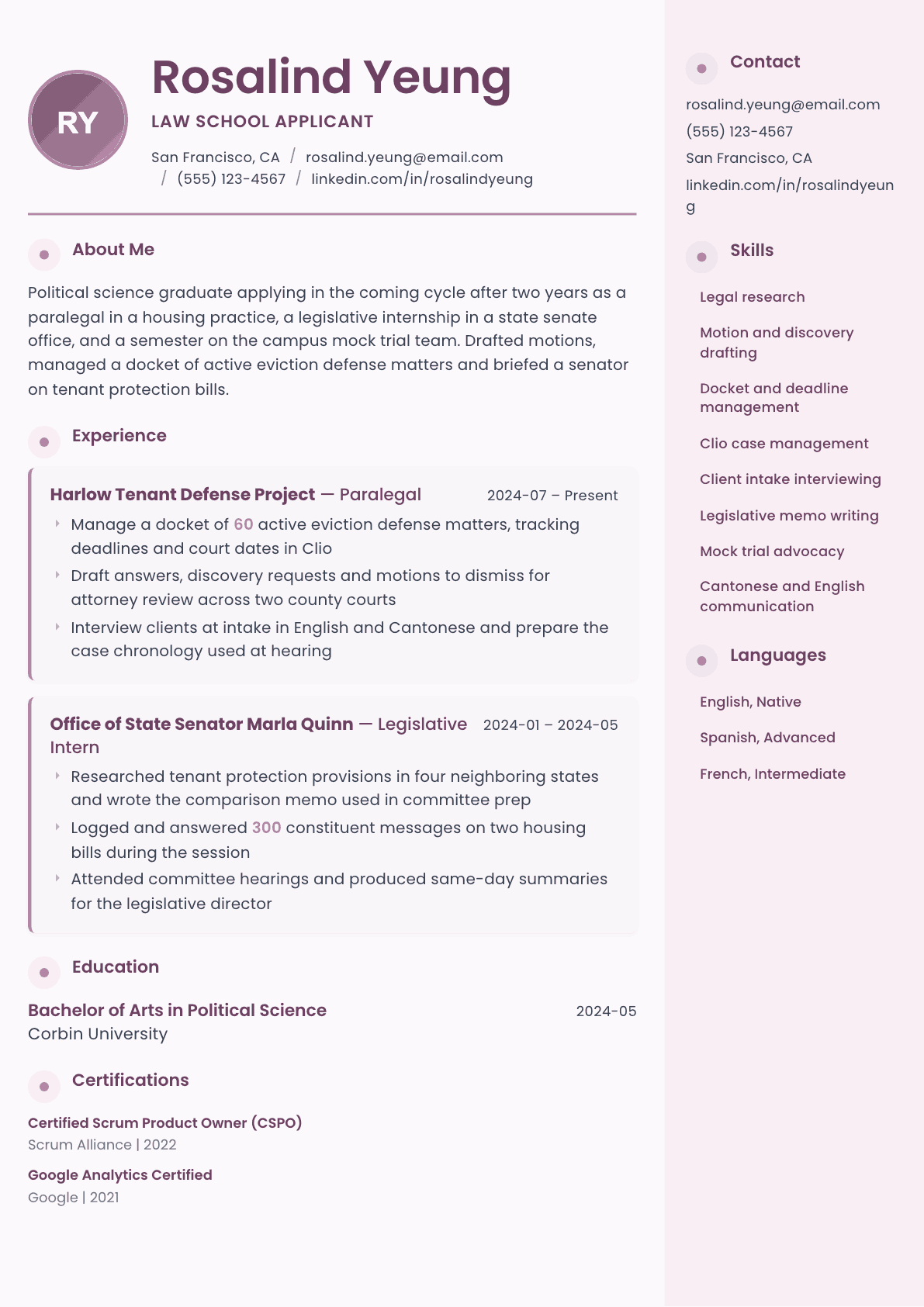
The same law school applicant content laid out in three CVBooster templates, so you can see what the finished document looks like before you write a word.
Example Law School Applicant summary
Law school applicant with a political science degree, two years as a paralegal in an eviction defense practice and a legislative internship in a state senate office. Manages a docket of active housing matters, drafts motions and discovery for attorney review, and interviews clients in two languages. Competed on the campus mock trial team. Applying to programs with strong housing and public interest clinics.
Skills to list on a Law School Applicant resume
- Legal research and citation
- Memo and motion drafting
- Discovery preparation
- Docket and deadline tracking
- Case management software
- Client intake interviewing
- Legislative and policy research
- Committee hearing summaries
- Mock trial and moot court advocacy
- Public speaking and oral argument
- Records review and redaction
- Constituent correspondence
- Bilingual client communication
- Confidentiality practice
What actually gets this resume read
- Use the plain reverse chronological format law schools expect, with no summary paragraph and no skills bar chart.
- Account for every period since you started college, including full-time work, because gaps invite a question.
- State hours per week for jobs held during term, since admissions readers weigh work carried alongside a full course load.
- Describe legal work by the document you produced, whether a memo, a motion, a chronology or a discovery response.
- Keep activities separate from employment, and give each one your role and the years you held it.
- Include military service, caregiving and family business work, all of which admissions readers count as real experience.
- Spell out honors and scholarships instead of using campus abbreviations no outside reader will recognize.
How to write a law school applicant resume
A law school admissions reader opens your resume immediately after the personal statement, and reads it for a different purpose than any employer would. She is not filling a vacancy. She is checking whether the story you just told is supported by how you have actually spent your time, and whether the years since you started college are accounted for without gaps she has to wonder about.
That difference explains almost every rule that surprises applicants. No summary paragraph. No skills bar chart. No design flourishes. Plain reverse chronological entries with dates that reconcile, hours per week for jobs you held during term, and enough plain language that a reader outside your university understands what the campus organization with the Greek name actually did.
This guide covers the format admissions files expect, how to write legal and non-legal work so it earns its space, three summaries for a junior applying early, a graduating senior and an applicant with years of work behind them, and the questions applicants ask when the page has to sit beside a personal statement.
Format: plain, chronological, and accounted for
One page is normal for an applicant coming straight from college. Two pages is expected once you have several years of full-time work, and no admissions office penalizes the second page when the content earns it. Use a standard serif or clean sans face, consistent dates on the right, and no columns that a scanner will scramble.
Account for your time from the start of college to the present. A summer with no entry reads as a question. If you worked in a family business, cared for a relative, served in the military or were between jobs while studying for the admissions test, put the entry in with dates. Admissions readers respect a full accounting far more than a curated highlight reel.
- Reverse chronological throughout, with month and year on every entry.
- Hours per week noted for any job held during term, since carrying work alongside a full load is read as evidence.
- No objective, no summary block, no self-assessment of your own skills.
- Campus organizations written out in full, with one plain phrase saying what the group does.
Legal work: write the document you produced
Paralegal, legal assistant, intern and clerk entries land when they name the work product. A memo, a motion, a set of discovery responses, a case chronology, a privilege log, an intake summary. Add the practice area and the volume of matters you supported, because a docket of sixty active eviction defense files says something a job title does not.
Be precise about supervision. Everything you drafted went to an attorney for review, and saying so costs you nothing while a claim that reads as unauthorized practice costs you credibility. The strongest entries pair the document with the process around it: deadlines tracked in a case management system, client interviews conducted at intake, exhibits assembled for a hearing.
Non-legal work counts, and often counts more
A large share of admitted applicants have never worked in a law office. Teaching, military service, nursing, retail management, journalism, engineering, restaurant work: all of it is read seriously, because the qualities admissions readers are looking for are sustained responsibility, written output and the capacity to work with people under pressure. Write those jobs in full rather than compressing them to make room for a two-week legal internship.
The translation that works is not to make the job sound legal. It is to make the responsibility visible. How many people you supervised, what you were accountable for, what you wrote regularly, what happened when something went wrong on your shift. A restaurant closing manager entry with real scope beats a vague internship entry every time.
- Scope: headcount supervised, budget held, caseload carried, territory or shift covered.
- Writing output: reports, briefings, correspondence, curricula, anything produced on a schedule.
- Duration and progression, since a promotion inside one employer is a strong quiet signal.
- Military service written with rank, unit type and responsibility in plain civilian language.
Activities, honors and advocacy experience
Keep activities separate from employment so a reader can see at a glance what you were paid for and what you chose. Mock trial, moot court, debate, student government, a campus newspaper, a legal aid volunteer shift and a tenant organizing group all sit here with your role and the years held.
Write honors plainly and never in campus shorthand. Name the award, the awarding body and what it was for, since an admissions reader at a school across the country has no way to decode an abbreviation your department invented. Scholarships that are need-based or that you earned while working full time are worth naming, because they say something about the context of your record.
Language, publications and the details readers check
State language ability at a level you could defend: conversational, professional working, fluent, native. Applicants routinely inflate this and law schools with clinics that serve immigrant communities do notice. If you have interviewed clients or interpreted in a second language, that belongs in the work entry itself rather than only in a language line.
Publications, thesis work and long research projects deserve a short section with the title and the venue. An honors thesis with a defended argument is direct evidence of the sustained writing law school demands, and it gives an interviewer or a scholarship committee something concrete to open with.
Law School Applicant resume summary examples
Junior applying early
Third-year political science major applying next cycle, working 15 hours a week at the campus legal aid clinic on intake interviews and case chronologies. Competes on the mock trial team as a closing advocate, tutors constitutional law discussion sections, and spent last summer interning in a state senate office.
Graduating senior
Political science senior applying this cycle after two summers in a housing practice and a semester interning with a public defender office. Drafted intake summaries and case chronologies under attorney supervision, competed to a regional mock trial semifinal, and wrote an honors thesis on eviction filing patterns.
Applicant with work experience
Applicant with four years of full-time work, currently a paralegal managing a docket of 60 active eviction defense matters and drafting motions for attorney review. Previously taught middle school mathematics for two years. Interviews clients in English and Cantonese and supervises two intake volunteers.
Work experience bullets: before and after
Before: Worked as a paralegal at a legal services organization.
After: Managed a docket of 60 active eviction defense matters, tracking court dates and filing deadlines in Clio and drafting answers, discovery requests and motions to dismiss for attorney review.
Caseload, system and named documents show the actual work rather than the job title.
Before: Interned for a state senator.
After: Researched tenant protection provisions across four neighboring states and wrote the comparison memo used in committee preparation, then produced same-day summaries of hearings for the legislative director.
A research question, a deliverable and a reader turn an internship into demonstrated written output.
Before: Was on the mock trial team.
After: Competed as closing advocate on the mock trial team for three years, reaching a regional semifinal, and ran the witness preparation sessions for two incoming team members each fall.
A specific role, a result and a coaching responsibility are all things an interviewer can ask about.
Before: Worked at a restaurant while in school.
After: Ran closing shifts at a 90-seat restaurant for 25 hours a week alongside a full course load, supervising 6 staff, reconciling the till and handling customer complaints without a manager present.
Hours alongside study, headcount and unsupervised responsibility are precisely what an admissions reader weighs.
Before: Volunteered with a community organization.
After: Held a weekly volunteer shift with a tenant organizing group for two years, running know-your-rights sessions for about 20 attendees a month and translating notices for Cantonese-speaking residents.
Duration, cadence and a language contribution make service concrete instead of decorative.
Hard skills
- Legal research and citation
- Memo and motion drafting under supervision
- Discovery preparation and document review
- Docket and deadline tracking
- Case management software
- Client intake interviewing
- Case chronology and exhibit preparation
- Legislative and policy research
- Committee hearing summaries
- Mock trial and moot court advocacy
- Records redaction and confidentiality practice
- Bilingual client communication
Soft skills
- Writing to a deadline that a court set
- Sitting with a client having the worst week of their year
- Taking edits on a draft without losing the argument
- Reading a long record and finding the fact that matters
- Keeping matters confidential outside the office entirely
Mistakes that cost law school applicant candidates the interview
- Adding a summary paragraph or a skills rating graphic, neither of which belongs in an admissions file.
- Leaving an unexplained gap between college and the application, which becomes the first thing a reader notices.
- Using campus abbreviations for organizations and honors that no outside reader can decode.
- Compressing a substantial non-legal job to make room for a two-week legal internship of no depth.
- Describing drafting work in a way that sounds like practicing law without attorney supervision.
- Omitting hours per week for term-time jobs, which hides the strongest evidence in a working student record.
Law School Applicant resume questions
How long should a law school applicant resume be?
One page straight out of college, two pages once you have several years of full-time work or military service. Length is not the concern. An accounted-for chronology is, so use the second page rather than cutting a real job to fit.
Does legal experience matter for admission?
It helps you know what you are choosing, but it is not weighted above sustained responsibility elsewhere. Admissions readers admit teachers, nurses, engineers and restaurant managers every year on the strength of scope, writing and duration rather than proximity to a law office.
Should I put my admissions test score on the resume?
No. The score reaches the school through the application file already, and repeating it on the resume reads as either padding or anxiety. Use the space for an honors thesis, a language, or a job you had to cut for room.
How do I write a gap I spent studying for the test or caring for family?
Enter it plainly with dates and a one-line description. Full-time caregiving, test preparation alongside part-time work, or a period of job searching are ordinary parts of a record, and stating them removes the question a blank stretch would raise.
Can I use the same resume for law school applications and legal jobs?
Keep two versions from one source. The admissions version accounts for all your time and stays plain. The employer version leads with legal work, cuts unrelated jobs to single lines, and can carry a short profile line at the top.