Gallery Assistant Resume Examples: the lines they read
Build a Gallery Assistant Resume That Gets the First Art Job
By Mustafa Tarabya, founder of CVBooster · Published · Updated
Gallery assistant resume guide with inventory, art handling and sales keywords, an example entry-level layout, and what directors screen for.
Sample resumes for a gallery assistant
The same gallery assistant content laid out in three CVBooster templates, so you can see what the finished document looks like before you write a word.
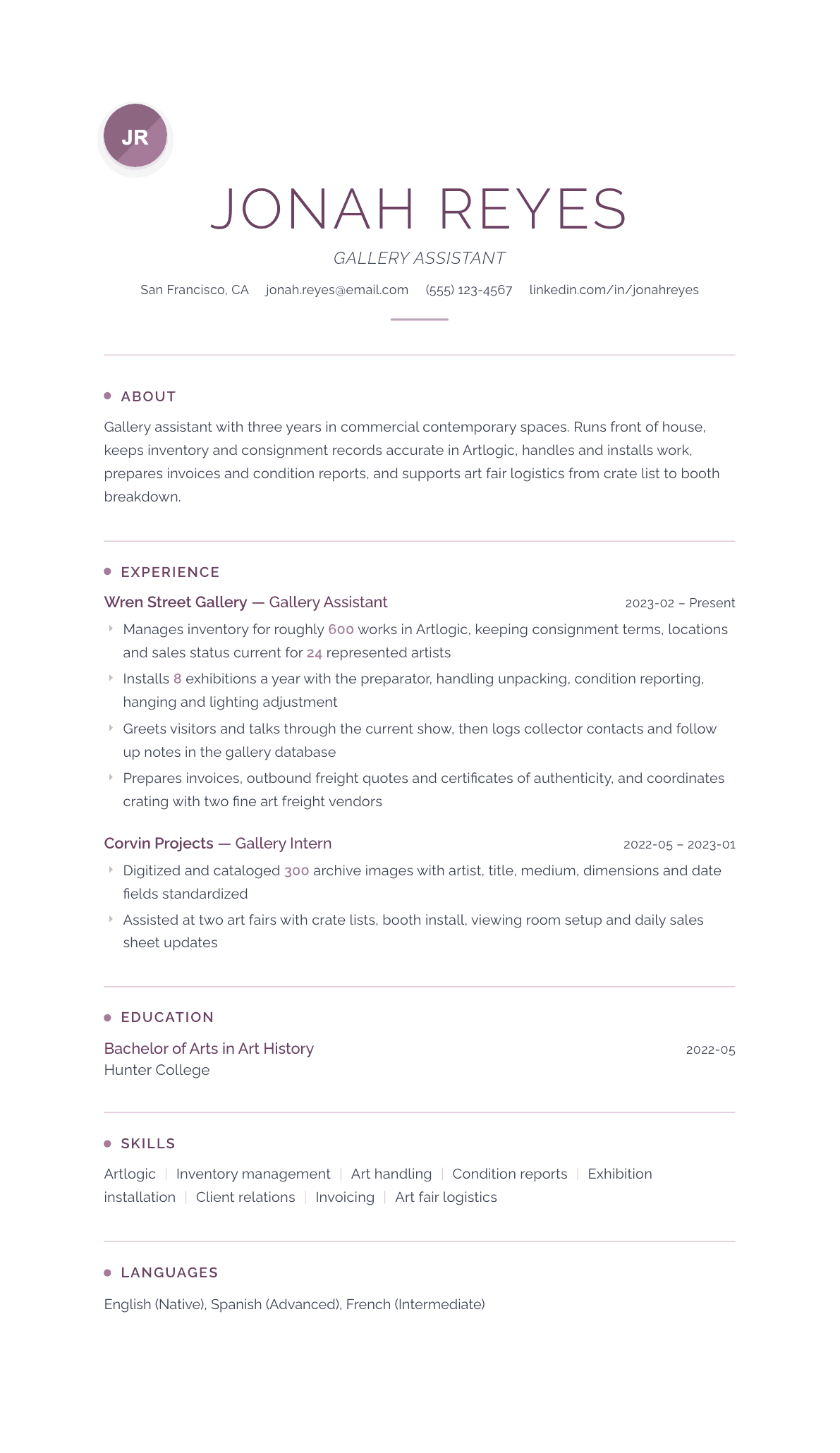
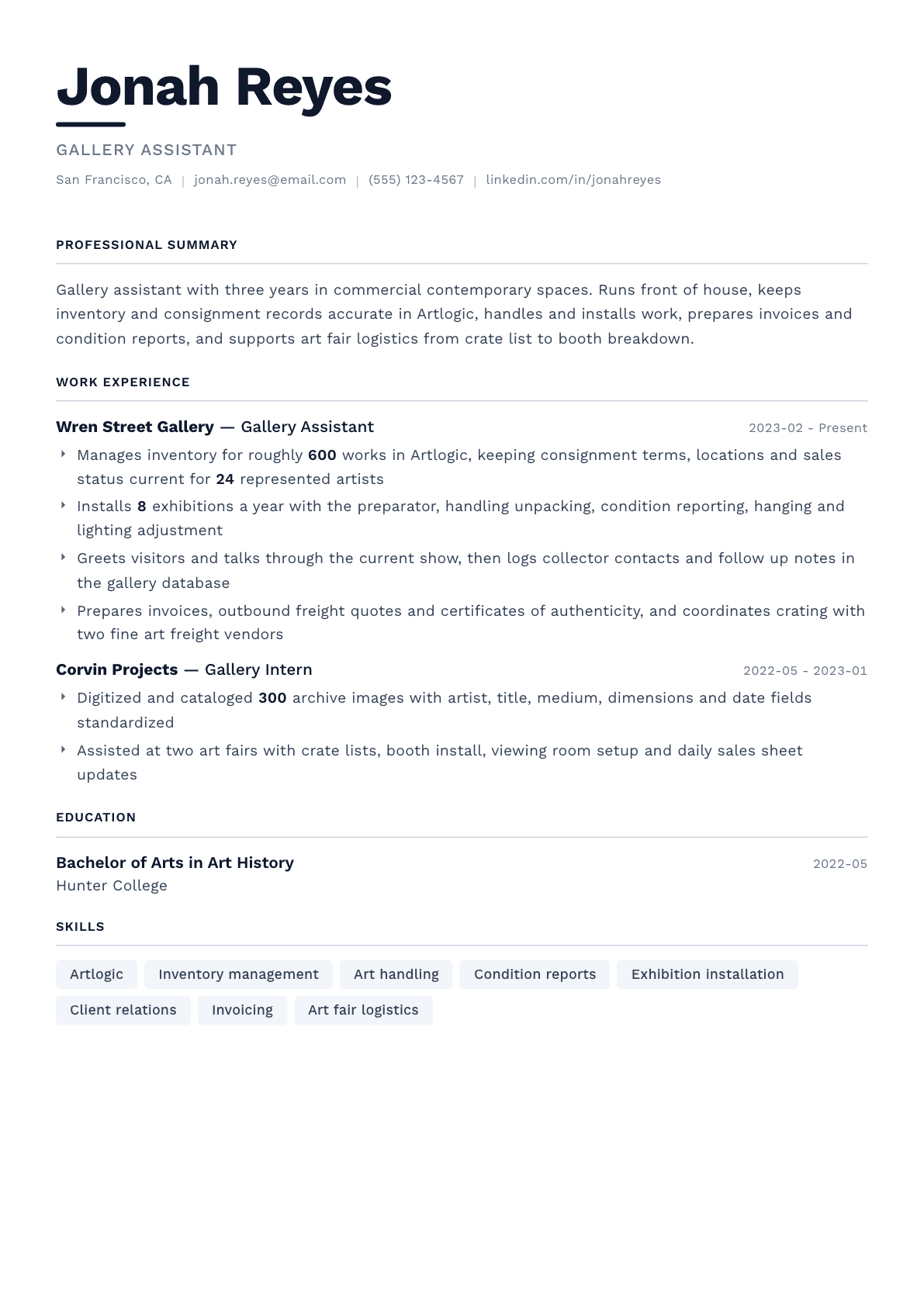
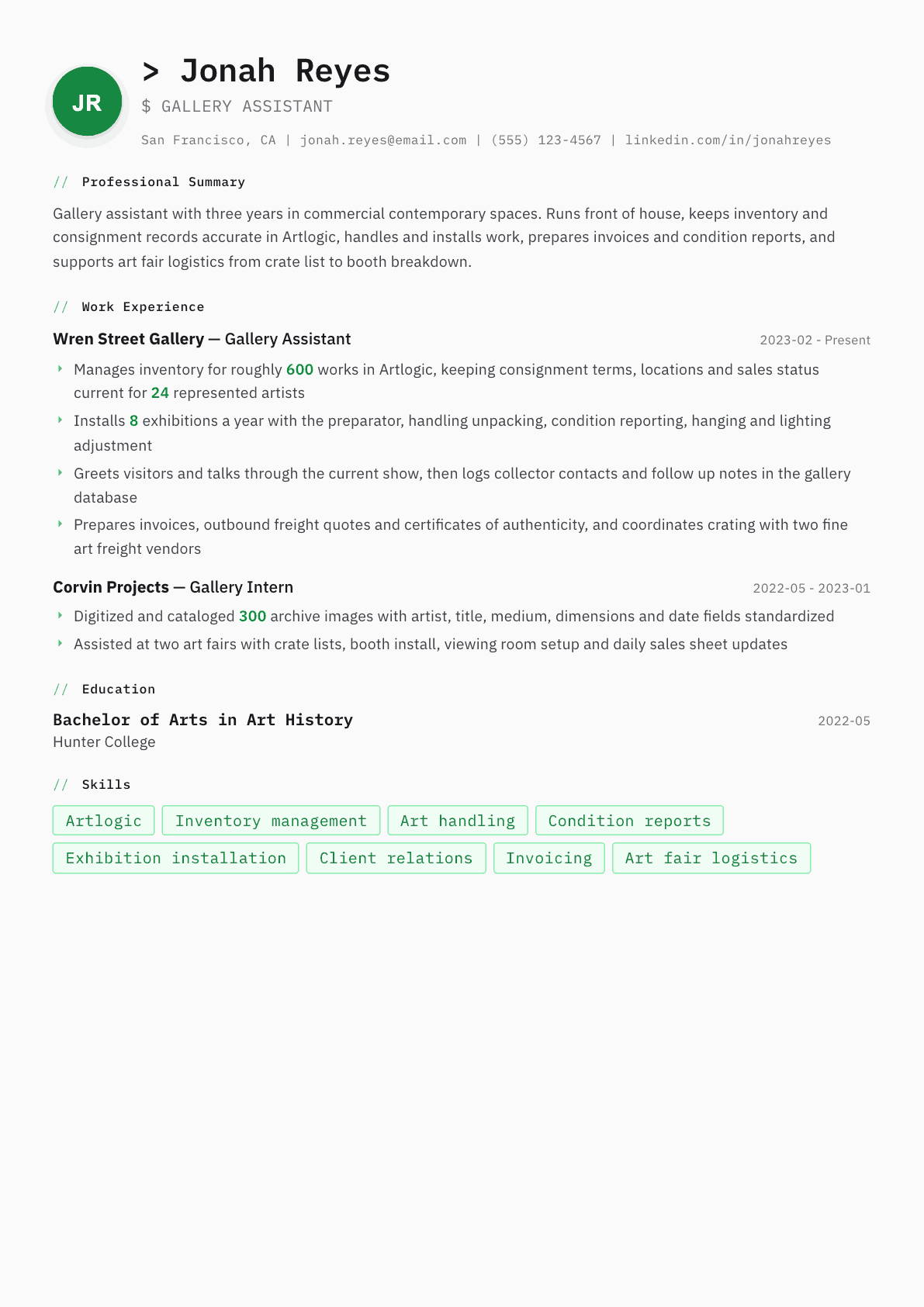
Example Gallery Assistant summary
Gallery assistant with three years in commercial contemporary spaces, covering front of house, inventory and install. Keeps consignment terms, locations and sales status accurate in Artlogic across hundreds of works, condition reports and hangs eight exhibitions a year, and prepares invoices, freight quotes and certificates of authenticity. Experienced with art fair crate lists and booth setup.
Skills to list on a Gallery Assistant resume
- Artlogic
- Inventory management
- Consignment records
- Art handling
- Condition reporting
- Exhibition installation
- Client relations
- Invoicing
- Art fair logistics
- Crating and freight
- Archive cataloging
- Image rights
- Front of house
- Microsoft Excel
What actually gets this resume read
- Put the database you have used in the skills line, because galleries screen for Artlogic, ArtBase or Masterpiece.
- Show that you can handle and install work safely, since directors worry about damage before they worry about polish.
- Include art fair experience with the fair type and your tasks, as fairs are where the hardest weeks happen.
- Mention sales support directly: invoices, consignment paperwork, collector follow up, and viewing room preparation.
- Translate retail or hospitality history into front of house strength if this is your first gallery role.
- Keep it to one page and lead with internships, install crews and registrar assistance rather than coursework.
How to write a gallery assistant resume
A gallery director hiring an assistant is filling a role that is half front of house and half operations, and the fear that governs the decision is damage. Damage to a work in transit, damage to a collector relationship, damage to the inventory record that tells the gallery what it owns, what is on consignment and what has already sold. A resume that proves care and accuracy beats one that proves enthusiasm for art.
The second thing a director checks is whether you can survive a fair. Fair weeks compress an entire exhibition cycle into four days: crate lists, freight deadlines, booth build, condition checks, sales sheets, and a booth that has to look immaculate while three conversations happen at once. Anyone who has done one and can describe it accurately moves up the pile.
This guide covers what belongs on a gallery assistant resume, three summaries across career stages, before and after lines from real inventory and install work, and the questions people ask when they are trying to land a first job in the commercial art world.
Format: one page, plain, and error free
One page. Galleries are small and the director often reads applications personally between other tasks, so a dense second page rarely gets attention. Keep the layout plain and single column, and proofread it obsessively, because the job is partly about producing invoices and price lists that contain no mistakes.
Reverse chronological order. Put internships, install crew shifts and registrar assistance in the experience section rather than in a separate student block, since that work is directly relevant even when it was unpaid or short.
- Header: name, city, phone, email, and a portfolio or writing sample link only if it is relevant to the role.
- Order: summary, experience, education, skills including databases and languages.
- Recent graduates keep education near the top but still lead the page with any gallery, museum or art handling work.
Summary: gallery type, systems, and what you handle
Two or three lines. Name the kind of gallery you have worked in, whether that is commercial contemporary, a secondary market dealer, a print publisher or a nonprofit space, since the daily work differs. Then the database you keep records in, and then the range of tasks you cover from front of house to install.
If this would be your first gallery job, use the summary to bridge honestly. Retail and hospitality history is real front of house training: reading a room, handling a difficult visitor, closing a sale, and keeping a stock record accurate. Say that plainly rather than hoping the reader makes the connection.
Experience: inventory, install, sales support, logistics
Organize your bullets around the four things a gallery assistant actually owns. Inventory first: the number of works tracked, the number of represented artists, and the fields you keep current such as location, consignment terms, edition numbers and sales status. Accuracy at volume is the whole point, so give the volume.
Then installation. Say how many exhibitions a year you install and what you personally do: unpacking, condition reporting, hanging, leveling, plinth placement, lighting adjustment, and patching and painting between shows. Directors want to know whether you can be trusted with a work in your hands.
Then sales support and logistics. Invoices, price lists, certificates of authenticity, consignment paperwork, collector follow up notes, viewing room preparation, freight quotes, crate specification and customs paperwork for cross border shipments. These are the tasks that keep a gallery running and they are rarely written down well on a resume.
- Name the database by name, since galleries screen for the one they already run.
- Include art fair work with the fair type and your specific tasks during build and breakdown.
- Mention any language you speak, because collector and freight conversations often need it.
Art handling: the skill directors quietly rank first
Describe handling in concrete terms: unpacking and repacking to a crate specification, glove use, two person carries, corner protection, hanging systems and hardware, works on paper under glass, and how you document condition on arrival and departure. Any formal art handling training belongs here with the provider named.
If you have worked with fine art shippers, say which parts of that process you ran: booking, packing lists, insurance values, delivery windows and receiving inspections. A director reading that assumes far less supervision will be needed in your first month.
Keywords a gallery posting repeats
The vocabulary in commercial gallery postings is consistent: inventory management, consignment, condition report, art handling, installation, viewing room, price list, invoicing, collector relations, art fair logistics, crating and freight, archive cataloging, and image rights. Mirror the ones you have done once in your skills and once inside a bullet.
Add the specific software. A database for inventory, a spreadsheet tool for sales sheets and fair lists, an image editing tool for artwork documentation, and an email marketing platform if you have sent gallery announcements. Small galleries run on a handful of tools and hire for familiarity with them.
Gallery Assistant resume summary examples
First gallery role
Art history graduate with a gallery internship and two years of retail sales, comfortable at front of house and careful with inventory records. Assisted on two art fairs with crate lists and booth setup, cataloged archive images to a consistent field standard, and holds a clean record with fragile stock.
Three years in
Gallery assistant with three years in commercial contemporary spaces, covering front of house, inventory and install. Keeps consignment terms, locations and sales status accurate across hundreds of works, condition reports and hangs eight exhibitions a year, and prepares invoices, freight quotes and certificates of authenticity.
Gallery manager track
Senior gallery associate managing inventory, logistics and fair operations for a gallery representing 24 artists. Runs the freight calendar with three fine art carriers, supervises install with a preparator, trains new assistants on the database, and supports the director through the full sales cycle.
Work experience bullets: before and after
Before: Kept track of the gallery inventory.
After: Managed inventory for roughly 600 works in the gallery database, keeping consignment terms, locations and sales status current for 24 represented artists.
Volume, artist count and the exact fields you maintain prove accuracy at a scale a director can picture.
Before: Helped install exhibitions.
After: Installed eight exhibitions a year with the preparator, handling unpacking, condition reporting, hanging, leveling and lighting adjustment before each opening.
Listing the physical tasks answers the damage question that governs the hiring decision.
Before: Greeted visitors and answered questions about the art.
After: Greeted visitors and talked through the current exhibition, then logged collector contacts and follow up notes in the gallery database the same day.
Front of house only counts commercially when the conversation ends up in the record for the director to use.
Before: Prepared paperwork for sales.
After: Prepared invoices, outbound freight quotes and certificates of authenticity, and coordinated crating with two fine art freight vendors on collector deadlines.
Naming each document and the vendors shows you can close a sale administratively without supervision.
Before: Worked at art fairs with the team.
After: Assisted at two art fairs with crate lists, booth installation, viewing room setup and daily sales sheet updates through preview and public days.
The fair week tasks are specific and instantly recognizable to anyone who has run a booth.
Hard skills
- Inventory and database management
- Consignment records
- Art handling
- Condition reporting
- Exhibition installation
- Lighting adjustment
- Invoicing and price lists
- Art fair logistics
- Crating and freight coordination
- Archive cataloging
- Image rights and reproduction requests
- Artwork documentation
- Microsoft Excel
Soft skills
- Front of house presence
- Discretion with collectors
- Attention to detail
- Calm under fair week pressure
- Written follow up
- Working with artists directly
Mistakes that cost gallery assistant candidates the interview
- Writing a page about your passion for art without naming a single database, invoice or crate you have handled.
- Leaving art handling off the resume, when damage risk is the first thing a director weighs about a new hire.
- Describing an internship as observation, when directors want the tasks you completed and the volume you managed.
- Omitting retail or hospitality history in a first gallery application, since that is genuine front of house training.
- Sending a resume with a typo or an inconsistent date format, in a job that exists to produce accurate documents.
- Skipping art fair experience because it was only setup work, when fair weeks are the hardest weeks of the year.
Gallery Assistant resume questions
How do I get a gallery assistant job with no gallery experience?
Lead with adjacent proof: art handling shifts, museum or nonprofit volunteering, retail sales with stock responsibility, and any database work. Then apply to smaller galleries first, since they hire for willingness and accuracy rather than a long resume.
Which gallery database should I learn?
Learn whichever one appears in the postings you are targeting, since galleries screen for the system they already run. Any inventory database experience transfers, so describe the fields you maintained rather than only naming the software.
Should a gallery assistant resume mention sales numbers?
Be careful. Client and price information is confidential in the commercial art world, so describe your role in the sales process, the paperwork you produced and the follow up you handled rather than quoting figures a director may consider private.
Do I need an art history degree for a gallery job?
It helps and many postings ask for it, but directors also hire from arts administration, design and unrelated fields when the applicant shows careful handling, clear writing and real front of house experience with a demanding public.
How do I show art fair experience on a resume?
Name the fair type, your tasks across build, preview and breakdown, and anything you owned such as the crate list or the daily sales sheet. Fair weeks are recognized shorthand for stamina and organization in this field.