Fine Artist Resume Examples: free ATS score and gap list
Write a Fine Artist Resume for Jobs and Gallery Applications
By Mustafa Tarabya, founder of CVBooster · Published · Updated
Fine artist resume and artist CV guide covering exhibitions, residencies, teaching, and how to write for a hiring manager as well as a jury.
Sample resumes for a fine artist
The same fine artist content laid out in three CVBooster templates, so you can see what the finished document looks like before you write a word.
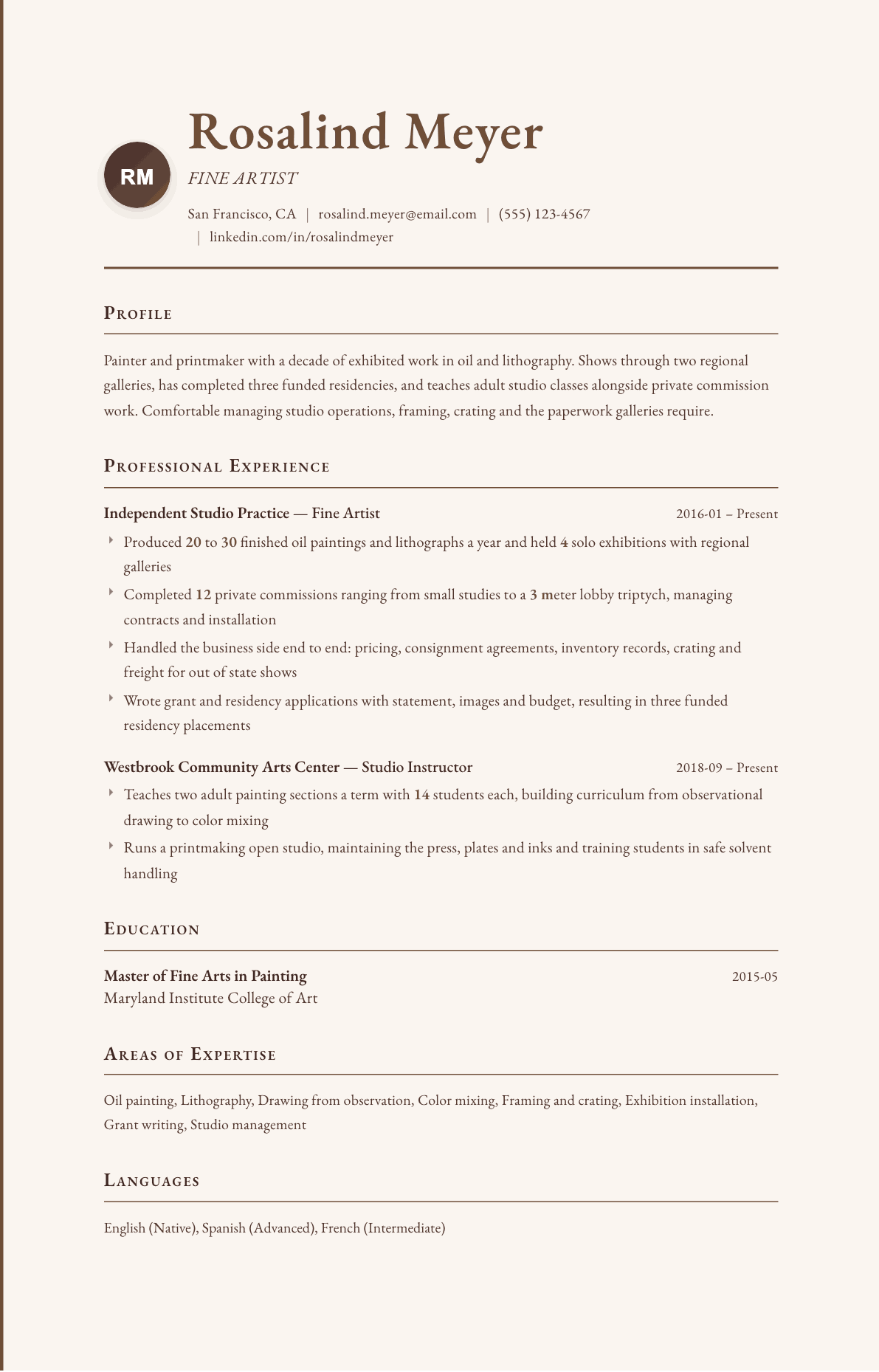
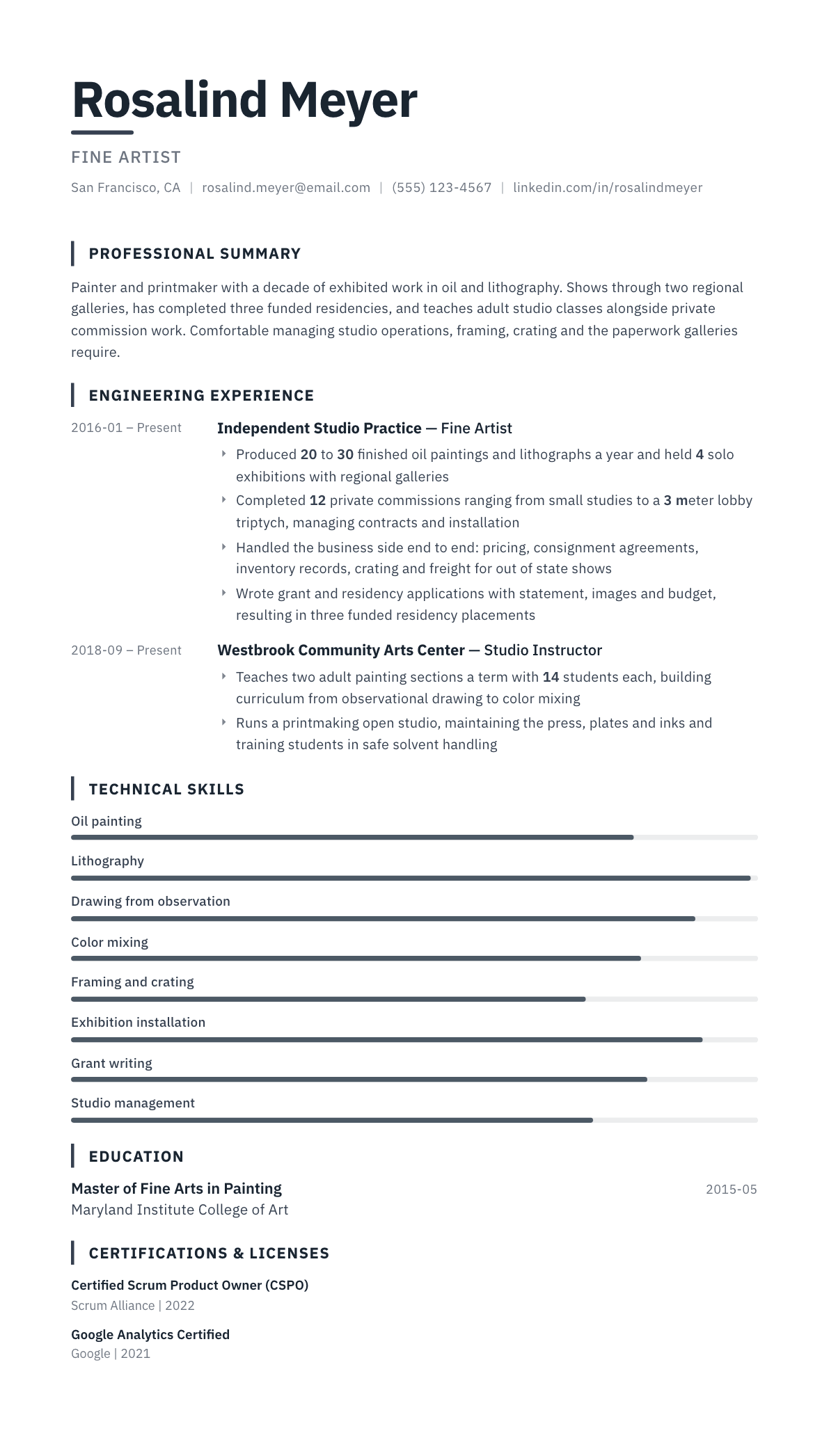
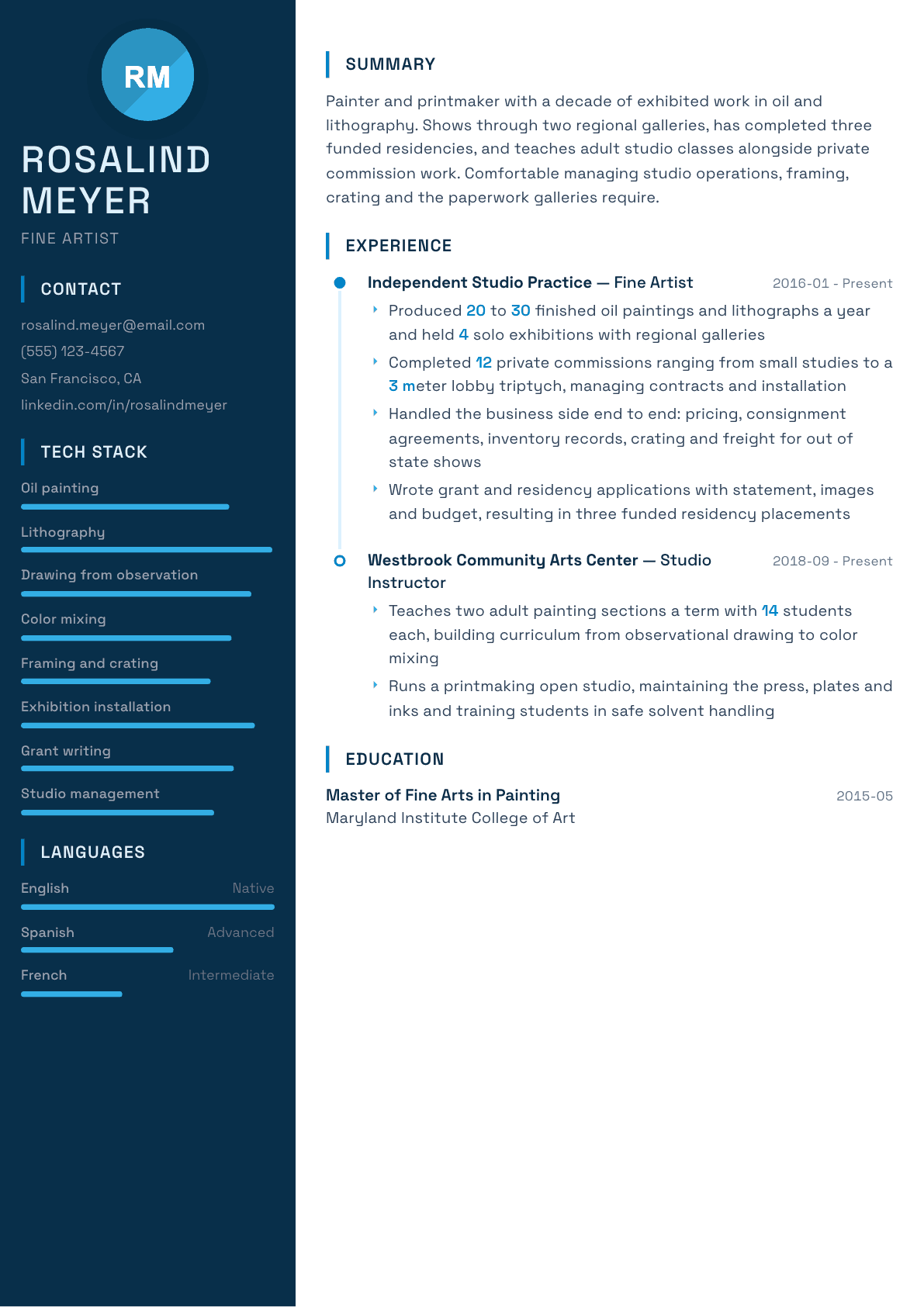
Example Fine Artist summary
Fine artist with ten years of exhibited painting and printmaking, represented by two regional galleries and shown in four solo exhibitions. Completes private commissions from small studies to architectural scale, teaches adult studio classes, and manages the practice end to end: pricing, consignment paperwork, crating, installation, and residency and grant applications with statement and budget.
Skills to list on a Fine Artist resume
- Oil painting
- Acrylic painting
- Drawing
- Printmaking
- Lithography
- Screen printing
- Color theory
- Composition
- Exhibition installation
- Framing and crating
- Studio management
- Grant writing
- Artist statement writing
- Teaching studio art
- Commission management
What actually gets this resume read
- Keep two documents: an artist CV for juries and galleries, and a shorter resume for teaching or studio jobs.
- List exhibitions with venue, city and year, and mark solo, two person and group shows separately.
- Include residencies, grants, awards and collections, because juries read those lines before anything else.
- For an employer, translate studio practice into transferable work: budgeting, teaching, installation, and client management.
- Name your media and processes precisely, since oil, encaustic, intaglio and screen print imply different studio skills.
- Put the portfolio link and an image list where a reviewer sees them without scrolling or opening an attachment.
How to write a fine artist resume
A fine artist needs two documents, and confusing them is the most common reason an application lands badly. The artist CV is written for juries, gallerists, residency panels and grant readers, and it is a list of exhibitions, residencies, awards, collections, publications and teaching in a strict citation-like format. The resume is written for an employer who is hiring for a job, and it translates studio practice into work someone pays a salary for.
Both documents rest on the same practice, but they lead with different facts. A jury wants to know where the work has been seen and who selected it. A gallery education director or a university studio manager wants to know that you can teach a section, maintain a press, hang a show, handle a budget and talk to the public without incident.
This guide covers how to build each version, three summaries across career stages, before and after lines that turn studio activity into readable evidence, and the questions artists ask when they apply for a residency and a paying job in the same month.
Two documents: the artist CV and the working resume
The artist CV can run several pages and grows over a career. It is chronological within sections and it never uses achievement bullets, because the venue and the year are the achievement. Solo, two person and group exhibitions are listed separately, and juried and invitational shows are marked as such.
The working resume stays to one or two pages and behaves like any other resume: a summary, employment history with bullets, education, and skills. Independent studio practice belongs here as a real entry with a real employer line, because self-employment is how the field works and hiding it leaves an unexplained gap.
- CV sections: education, solo exhibitions, group exhibitions, residencies, grants and awards, collections, publications, lectures, teaching.
- Resume sections: summary, experience, education, skills, exhibitions selected rather than complete.
- Keep one master file of every show and prize so both documents are cut from the same record.
Listing exhibitions so a jury can read them fast
Use a consistent line for every show: title of the exhibition in the position your field expects, then venue, then city and state or country, then the year. Group the entries by type and keep the newest first. Mark solo shows clearly, because a panel counts them separately and quickly.
Include the selector when it strengthens the line. A juried show with a named juror, an invitational, or a curated two person exhibition all carry more weight than an open call, and the reader cannot infer that from the venue alone.
Media and process: be precise, not poetic
Name the media and processes you actually work in. Oil, encaustic, egg tempera, intaglio, lithography, screen print, monotype, cast bronze, ceramic, fiber. Each implies a specific studio, specific equipment and specific safety knowledge, and an employer hiring a studio technician is reading for exactly that.
For printmaking and sculpture, add the equipment you can run and maintain: etching press, lithography press, exposure unit, vacuum table, kiln, welding equipment, and the ventilation and solvent handling practice that goes with it. This is the section that turns an artist into a hireable studio staff member.
Translating studio practice for an employer
A hiring manager outside the arts reads a studio practice as self-employment, so describe it that way. You set pricing, wrote consignment agreements, kept an inventory, managed crating and freight, met installation deadlines in venues you did not control, and handled clients through commissions. Those are budget, logistics, client and project skills with an unusual setting.
Teaching is the strongest bridge and it belongs in the experience section with real numbers: sections per term, students per section, the curriculum you built, and the equipment you trained people on. Community and continuing education teaching counts, and search committees for adjunct positions read it closely.
- Give commission work a scale: number of pieces, largest dimension, and whether you handled installation.
- Name the grant and residency applications you wrote, since that is proposal writing with a budget.
- List the software you use for documentation and applications, because image formatting rules are strict.
Portfolio, image list and statement
Almost every application asks for images with an accompanying image list giving title, date, medium, dimensions and, where relevant, edition and price. Format that list exactly as the call specifies, since panels frequently disqualify files that arrive in the wrong shape before anyone looks at the work.
Keep the artist statement separate from the CV and short enough to read aloud in a minute. The CV records where the work has been; the statement says what the work is doing. Mixing them produces a document that serves neither reader.
Fine Artist resume summary examples
Emerging artist
Painter working in oil and gouache with three group exhibitions and one juried regional show. Maintains a consistent studio schedule alongside gallery installation work, handles framing and crating, and assists with adult drawing classes at a community arts center. Seeking studio technician or gallery preparation work.
Mid-career
Painter and printmaker with ten years of exhibited work in oil and lithography, represented by two regional galleries and shown in four solo exhibitions. Completes private commissions from small studies to architectural scale, teaches adult studio classes, and manages pricing, consignment paperwork, crating and installation.
Established practice
Established artist with work in three public collections, six funded residencies and a monograph published with a regional press. Runs a shared print studio, teaches two university sections a term, and mentors emerging artists through a fellowship program while maintaining a full exhibition schedule.
Work experience bullets: before and after
Before: Made paintings and showed them in galleries.
After: Produced 20 to 30 finished oil paintings and lithographs a year and held four solo exhibitions with two regional galleries, each hung and lit on site.
Output volume, show type and the installation detail turn an activity into a record a panel can weigh.
Before: Did commissions for private clients.
After: Completed 12 private commissions from small studies to a three meter lobby triptych, writing the contracts, scheduling approvals and managing installation.
The range, the contracts and the installation make this read as client project management, not a hobby.
Before: Handled the business side of my art practice.
After: Ran pricing, consignment agreements, inventory records, crating and out of state freight for a practice with two representing galleries.
Naming the actual administrative tasks is what an employer needs in order to credit them as work experience.
Before: Applied for grants and residencies.
After: Wrote grant and residency applications with artist statement, image list and itemized budget, resulting in three funded residency placements.
The components you produced and the funded outcome show proposal writing rather than an intention.
Before: Taught art classes to adults.
After: Taught two adult painting sections a term with 14 students each, building a curriculum from observational drawing through color mixing, and ran a printmaking open studio.
Section counts, class size and curriculum scope are what a search committee compares between candidates.
Hard skills
- Oil painting
- Acrylic and gouache
- Drawing from observation
- Lithography
- Intaglio and etching
- Screen printing
- Color mixing and theory
- Framing and crating
- Exhibition installation and lighting
- Press maintenance and solvent safety
- Studio management
- Grant and residency application writing
- Artwork documentation and photography
- Inventory and consignment records
Soft skills
- Self-directed schedule
- Critique and feedback
- Public speaking about the work
- Client management
- Teaching and demonstration
- Deadline reliability
Mistakes that cost fine artist candidates the interview
- Sending an artist CV to an employer, or a job resume to a jury, when the two readers want opposite documents.
- Listing every open call show in one long block, which buries the solo and juried exhibitions that carry weight.
- Describing the work poetically instead of naming the media, so a studio manager cannot tell what you can operate.
- Leaving independent studio practice off the employment history, which creates an unexplained gap in the dates.
- Ignoring the image list format a call specified, which can remove the application before the work is seen.
- Hiding teaching, installation and framing experience because it feels secondary, when that is the paid work being offered.
Fine Artist resume questions
What is the difference between an artist CV and a resume?
The CV is a full record of exhibitions, residencies, awards, collections and publications written for juries and galleries, and it can run several pages. The resume is one or two pages of employment written for a hiring manager, with bullets and outcomes.
How should I list exhibitions on an artist CV?
Newest first, grouped as solo, two person and group, with exhibition title, venue, city and year on one consistent line. Mark juried and invitational shows and name the juror or curator when that adds weight to the entry.
What do I put on a fine artist resume with few exhibitions?
Lead with paid and practical work: gallery installation, framing, studio assisting, teaching, art handling and fabrication. Then list the shows you do have under a selected exhibitions heading so the section never looks thin.
Should I include prices or sales figures?
Not on the CV, and not on a resume either. Prices belong on an inventory sheet or a price list supplied to a gallery. Describe sales in terms of commissions completed and galleries representing you instead.
How do I explain gaps between exhibitions?
You usually do not need to. A CV records what happened rather than a continuous timeline, and periods of studio development, caregiving or other employment are unremarkable to panels. On an employment resume, list the other work you did honestly.