Curator Resume Examples: free score, then the gap list
Write a Curator Resume That Reads Like Real Museum Practice
By Mustafa Tarabya, founder of CVBooster · Published · Updated
Curator resume guide covering exhibitions, collections systems, loans and publications, with a sample and the credentials search committees expect.
Sample resumes for a curator
The same curator content laid out in three CVBooster templates, so you can see what the finished document looks like before you write a word.
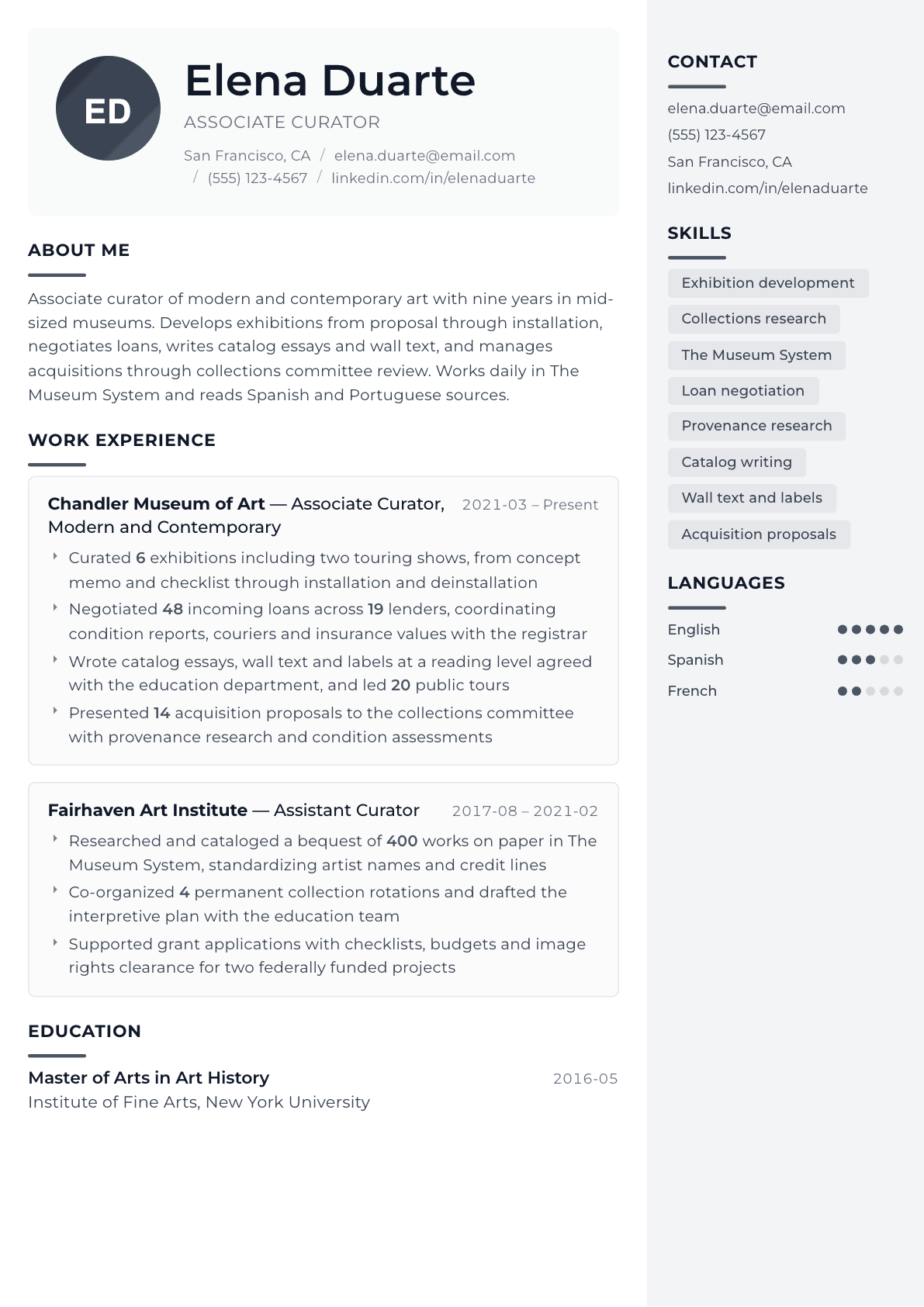
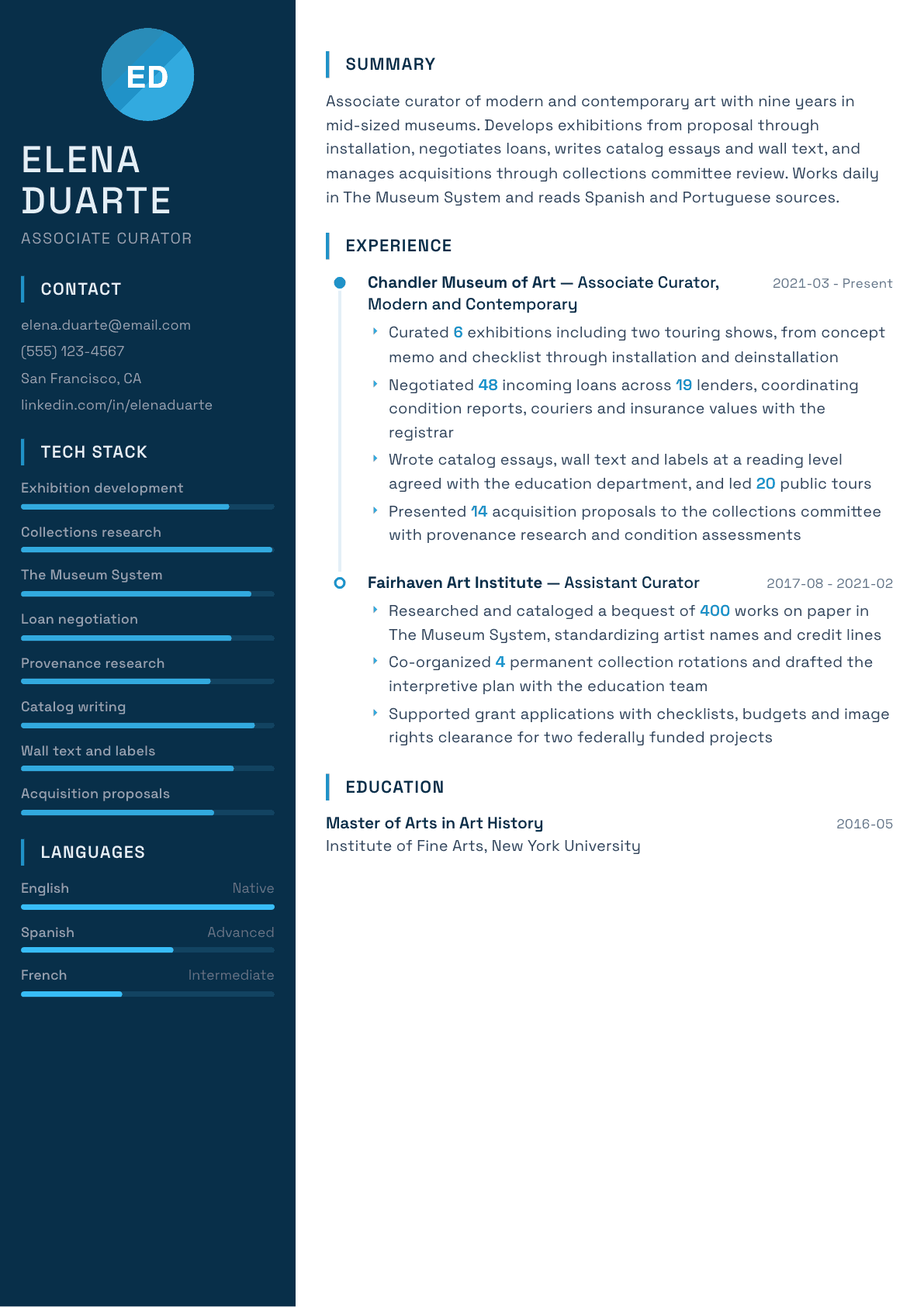
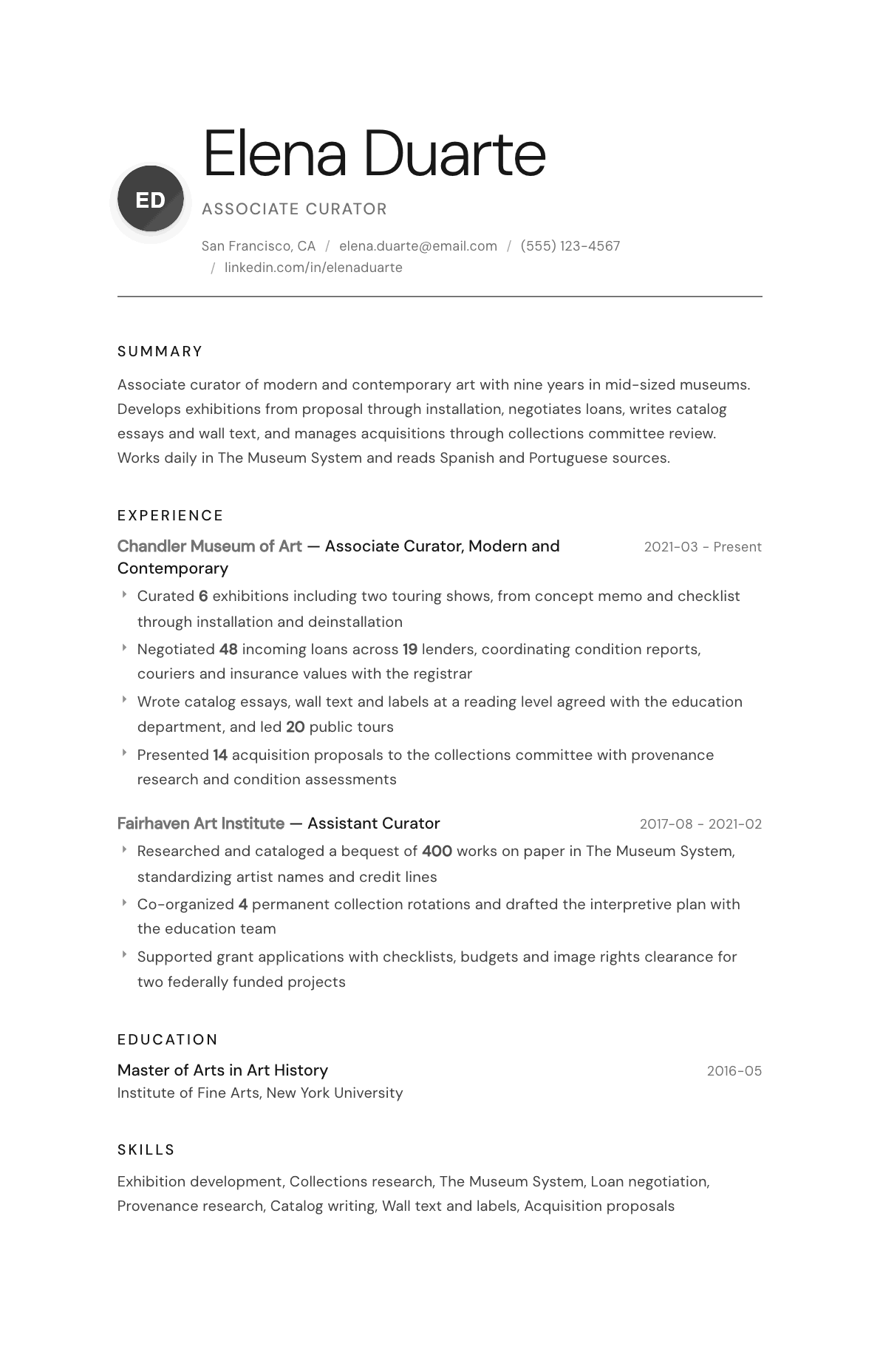
Example Curator summary
Associate curator of modern and contemporary art with nine years in mid-sized museums. Develops exhibitions from concept memo and checklist through installation, negotiates incoming loans with lenders and registrars, and writes catalog essays, wall text and labels. Presents acquisitions to the collections committee with provenance and condition research, and works daily in The Museum System.
Skills to list on a Curator resume
- Exhibition development
- Collections management
- The Museum System
- Provenance research
- Loan agreements
- Condition reporting
- Catalog writing
- Interpretive planning
- Acquisition review
- Grant writing
- Art historical research
- Public speaking
- Donor relations
- Installation planning
- Rights and reproductions
What actually gets this resume read
- Name your specialty by period, region and medium, because search committees hire against a collection gap.
- List exhibitions you organized with venue, scale and your exact role, separating curated from co-organized shows.
- Include publications and conference papers in a separate section, formatted the way your field cites them.
- Show collections work explicitly: cataloging, provenance research, acquisitions, deaccession review, and loan agreements.
- Name the collections management system you use, since committees screen for The Museum System, EmbARK or CollectiveAccess.
- Add languages with reading proficiency, because primary source research is often part of the job description.
How to write a curator resume
Curatorial searches are run by committee, and a committee hires against a gap. A museum looking for someone to steward a Latin American holdings collection, or to build a contemporary program on a small budget, reads every application for a match to that specific gap. A curator resume that describes general art historical interest gives the committee nothing to match against.
The document is also part CV. Museum applications expect exhibitions, publications, conference papers, fellowships and languages recorded the way the field cites them, alongside a normal employment history. Leaving out the publications section signals that you have not applied for a curatorial position before.
This guide covers what belongs in each section, three summaries across curatorial career stages, before and after lines drawn from exhibition and collections work, and the questions curators ask when moving between institution sizes or from a gallery into a museum.
Format: two to three pages, because it is partly a CV
A curator application is normally two to three pages, sometimes longer for senior candidates with a long publication record. Committees expect that length, so a one page resume reads as inexperience rather than as concision. Keep the employment history in bullets and let the exhibition and publication sections run as lists.
Order the document so the committee finds the specialty in the first few lines, then the exhibition record, then employment. Attach the writing sample and the exhibition list separately when the call asks for them, and keep the formatting of citations consistent throughout.
- Header: name, city and state, phone, email, and a professional site if it holds publications.
- Order: summary of specialty, exhibitions organized, professional experience, publications and lectures, education, languages, skills.
- Fellowships, grants and awards get their own short section rather than being folded into education.
Naming your specialty by period, region and medium
Write the specialty the way a job description writes it: period, region and medium. Modern and contemporary art of the Americas, works on paper, photography, decorative arts, or a specific movement. The committee is matching your line against a collection they hold and a program they want to build, and vagueness costs you the match.
Then state the institution scale you have worked at. A curator at a mid-sized museum negotiates loans, writes labels, drafts budgets and hangs the show personally, while a large institution divides those tasks between departments. Committees hire for the version of the job they actually have.
Exhibitions: your role, the scale, and how far you took it
Give every exhibition its title, the venue, the year and your exact role. Curated, co-curated, organized and coordinated mean different things, and a committee that suspects inflation will ask a former colleague. Separate exhibitions you originated from touring shows you hosted, because organizing a traveling presentation is a distinct and respectable skill.
Add the scale a reader needs to size the project: the number of objects in the checklist, the number of lenders, whether a catalog was published, and whether the show traveled. Then say how far you carried it, from concept memo and checklist through loan negotiation, installation, deinstallation and public programs.
- Mark solo artist projects, thematic group shows and permanent collection rotations separately.
- Name the catalog you wrote for and whether you served as editor or contributing author.
- Include public programs and tours, since education partnership is written into most job descriptions.
Collections work: the section most candidates underwrite
Exhibitions attract attention, but collections work is the daily job. Say what you have done with objects: cataloging, provenance research, condition review with the registrar, acquisition proposals to a collections committee, deaccession review, rights and reproductions, and storage or rehousing projects. Give volumes where you can.
Name the collections management system you work in, because committees screen on it and training a new curator on an unfamiliar database costs the registrar weeks. Then name the loan process you have run end to end, including condition reports, couriers, insurance values and facility reports.
Publications, languages and the keywords a search uses
List catalog essays, journal articles, book chapters, reviews and conference papers in the citation format your field uses, newest first. A committee reads this section to judge whether you can write for both a scholarly audience and a wall, so include gallery text and interpretive writing as well as peer reviewed work.
Languages belong on the page with an honest proficiency level, since primary source research and lender correspondence often require them. The recurring vocabulary in curatorial postings is narrow and worth mirroring: interpretive planning, checklist, loan agreement, condition report, provenance, acquisition, accession, donor cultivation and audience engagement.
Curator resume summary examples
Curatorial assistant
Curatorial assistant with a graduate degree in art history and two years supporting exhibitions and collection rotations at a university museum. Researches objects, drafts labels and checklists, and catalogs works on paper in a collections database. Reading proficiency in French and German.
Associate curator
Associate curator of modern and contemporary art with nine years in mid-sized museums. Develops exhibitions from concept memo and checklist through installation, negotiates incoming loans with lenders and registrars, writes catalog essays and wall text, and presents acquisitions to the collections committee with provenance and condition research.
Senior or chief curator
Chief curator leading a department of five with responsibility for the exhibition schedule, acquisition strategy and interpretive standards across a collection of twenty thousand objects. Raises project funding with the development office, edits exhibition catalogs, and represents the museum to lenders, donors and the press.
Work experience bullets: before and after
Before: Curated several exhibitions at the museum.
After: Curated six exhibitions including two touring shows, from concept memo and checklist through installation, public programs and deinstallation.
The count, the touring detail and the span of the project tell a committee exactly how much of the work you carried.
Before: Arranged loans for exhibitions.
After: Negotiated 48 incoming loans across 19 lenders, coordinating condition reports, couriers and insurance values with the registrar and the lenders own staff.
Loan volume and lender count are the accepted measure of exhibition complexity in the field.
Before: Wrote text for exhibitions.
After: Wrote catalog essays, wall text and object labels at a reading level agreed with the education department, and led 20 public tours of the resulting installations.
Writing for a wall and writing for a catalog are different skills, and the tours prove public facing capability.
Before: Proposed new acquisitions.
After: Presented 14 acquisition proposals to the collections committee with provenance research, condition assessments and a written rationale against the collecting plan.
Naming the committee, the research and the collecting plan shows how the museum actually approves an object.
Before: Cataloged a large gift to the collection.
After: Researched and cataloged a bequest of 400 works on paper in the collections database, standardizing artist names, credit lines and dimensions against authority records.
Object count, the system and the standardization work are what a registrar and a committee both check for.
Hard skills
- Exhibition development
- Checklist and budget preparation
- Loan negotiation and agreements
- Condition reporting
- Provenance research
- Collections management systems
- Acquisition and deaccession review
- Catalog and label writing
- Interpretive planning
- Rights and reproductions
- Installation planning
- Grant writing
- Art historical research
- Reading languages for research
Soft skills
- Committee presentation
- Donor and lender relations
- Public speaking
- Cross-department collaboration
- Negotiation
- Editing other people writing
Mistakes that cost curator candidates the interview
- Writing curated for a show you coordinated, which is the fastest way to lose a reference check in a small field.
- Compressing a curatorial application to one page, when committees expect the exhibition and publication record in full.
- Leaving out collections work, which is the majority of the job at any institution below the largest tier.
- Omitting the collections management system, since committees screen for it and retraining costs the registrar time.
- Listing exhibitions without object counts, lenders or catalogs, so the reader cannot size any of the projects.
- Skipping the languages section when the collection you are applying to work with requires primary source reading.
Curator resume questions
How long should a curator resume be?
Two to three pages is standard because the document doubles as a CV with exhibitions, publications and lectures listed in full. Senior candidates with long publication records go longer, and committees expect that rather than penalizing it.
How do I list exhibitions I co-curated?
State the role exactly as it appeared in the credit line and name your collaborator. Committees respect co-curation, and any attempt to present shared authorship as sole authorship is easy to check against the published materials.
Do I need a doctorate to be a curator?
Not always. Many associate and assistant positions ask for a masters degree with strong collections experience, while research-heavy roles at large institutions often require a doctorate. Read the posting and lead with whichever qualification it prioritizes.
How do I move from a commercial gallery into a museum curatorial role?
Emphasize collection handling, condition reporting, checklists, artist relationships and any exhibition you organized rather than sales. Add scholarly writing, a conference paper or a guest curated nonprofit project so the committee sees a research track.
What should go in the publications section?
Catalog essays, journal articles, book chapters, exhibition reviews and conference papers, newest first, in the citation style of your field. Include substantial interpretive and gallery writing, since committees judge whether you can write for a wall as well as a page.