Photo Editor Resume Examples: free ATS score and gap list
Craft a Photo Editor Resume for Newsroom and Brand Teams
By Mustafa Tarabya, founder of CVBooster · Published · Updated
Photo editor resume example with assigning, budgeting and archive language, plus keywords and a guide to writing every section well.
Sample resumes for a photo editor
The same photo editor content laid out in three CVBooster templates, so you can see what the finished document looks like before you write a word.
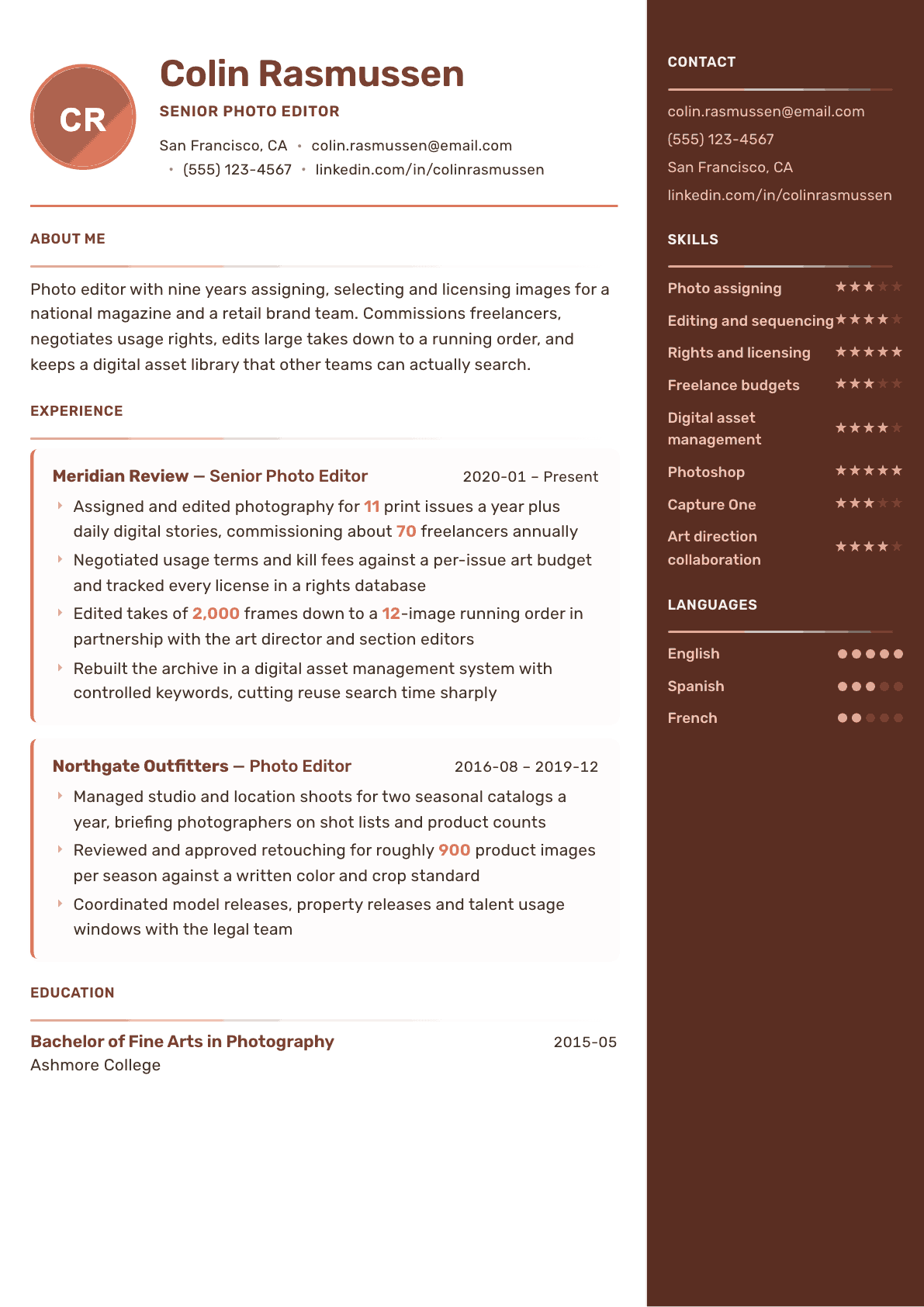
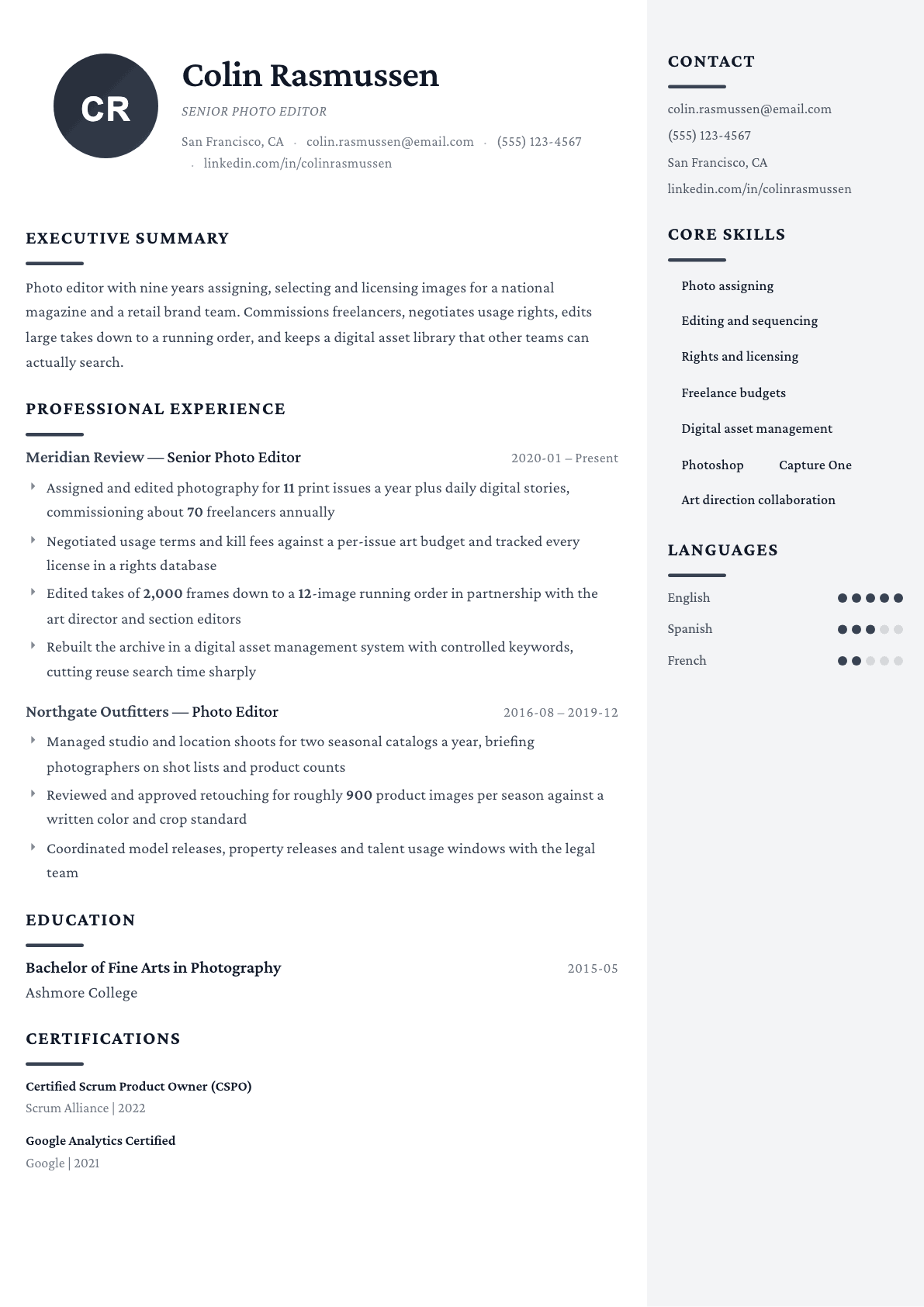
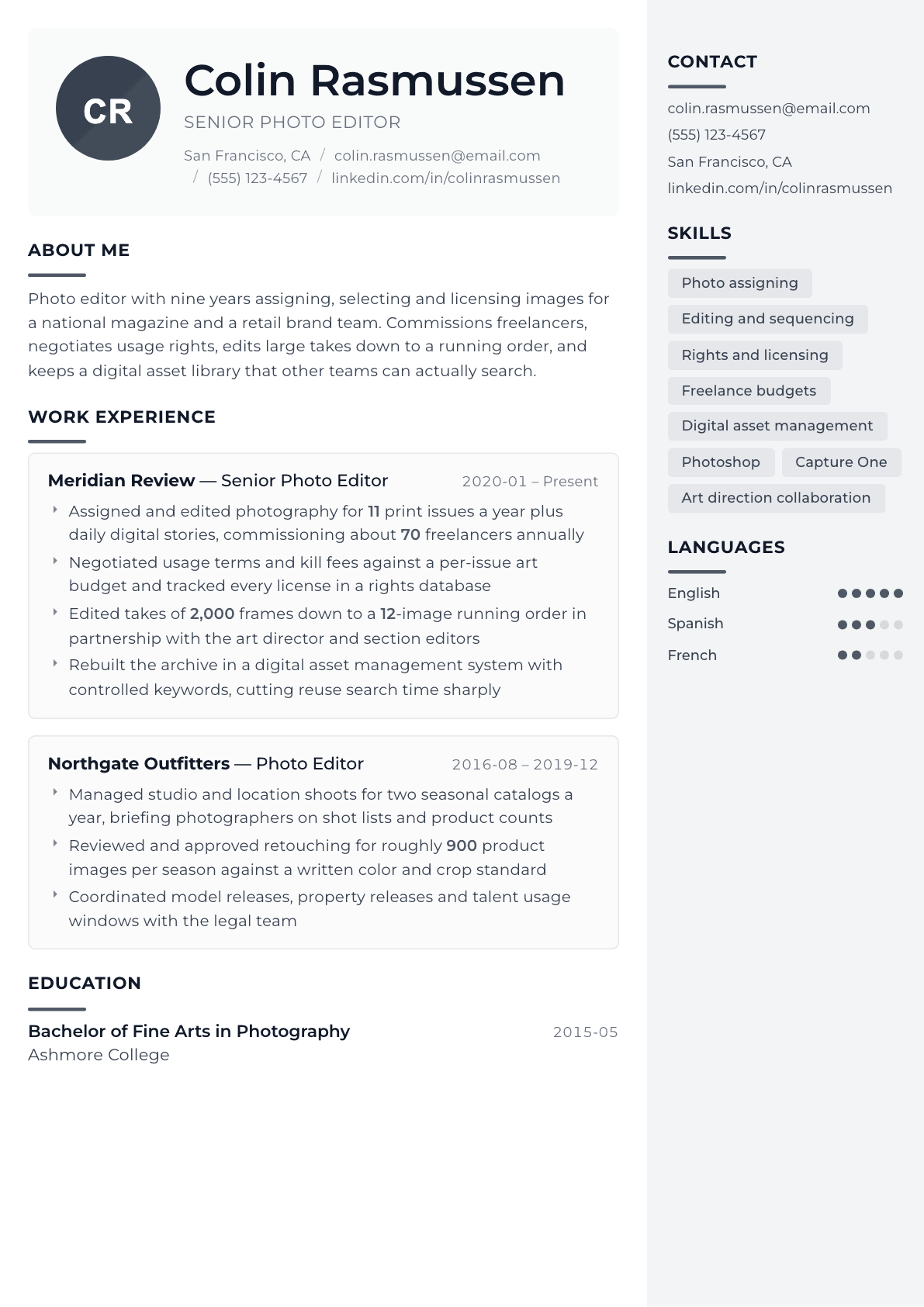
Example Photo Editor summary
Photo editor with nine years commissioning and editing photography for a national magazine and a retail brand team. Assigns freelancers against a monthly art budget, negotiates usage rights, and cuts takes of thousands of frames into a sequence that carries a story. Rebuilt an image archive around a controlled keyword vocabulary so other teams could find and reuse work.
Skills to list on a Photo Editor resume
- Photo assigning
- Photo editing and sequencing
- Rights and usage licensing
- Freelance commissioning
- Art budget management
- Digital asset management
- Controlled keyword vocabularies
- Photoshop
- Capture One
- Color and crop standards
- Model and property releases
- Shoot production
- Caption and credit accuracy
- Archive research
What actually gets this resume read
- Show that you assign, not just select: name the number of freelancers you commission and the budgets you hold.
- Describe an edit by the numbers, moving from a raw take to a final running order, so the scale of your judgment is visible.
- Put rights and licensing experience in its own line, because usage negotiation is what separates editors from picture researchers.
- Name the digital asset management system and the keyword vocabulary you maintained, since archive discipline is a hiring question.
- If you have led a redesign or a visual standard, describe the rule you wrote rather than calling the work strategic.
- Keep a short portfolio of published spreads or campaigns, credited to the photographers, and note your role on each.
How to write a photo editor resume
The word editor hides two very different jobs. One is selection: sitting with a take of thousands of frames and cutting it into a sequence that carries a story. The other is commissioning: choosing a photographer, briefing them, negotiating usage and holding a budget. A photo editor resume has to make clear which of those you have done, because a magazine filling a commissioning post and a brand filling a selection and asset post are not looking for the same person.
Hiring managers in this field read for scale and for rights. Scale means the size of the takes you have handled, the number of freelancers you commission and the publishing cadence you supported. Rights means whether you can read a license, negotiate usage terms, and keep a brand out of a claim it did not see coming.
This guide covers the section order editors expect, how to describe an edit numerically, why licensing belongs in its own line, what to say about digital asset management, and how to present a portfolio when the images are credited to somebody else.
Format: one page early, two when you hold budgets
One page until you have commissioned work and held a budget line, then two is normal. Keep it plain text with no image thumbnails embedded in the document, because larger publishers and retailers route applications through hiring software that discards them and sometimes discards the surrounding text with them.
Add a portfolio link that shows published spreads, covers or campaigns rather than a gallery of pictures. Your work product is the sequence, the pairing and the crop, so a reader needs to see pages, not files.
- Header: name, city, phone, email, and a portfolio address showing published layouts or campaigns.
- Sections: summary, experience, technical and systems skills, education, and a short selected work list if you commission.
- Credit the photographers on every portfolio item and state your role: assigned, edited, sequenced, licensed or produced.
Summary: publication type, cadence, commissioning volume
Name the type of operation first, because a monthly magazine, a daily digital desk, a seasonal catalog and a brand content team run on different clocks. Then the cadence you supported and the number of photographers you commission in a year. Commissioning volume is the fastest read on your professional network, and networks are much of what a publisher is buying.
Close on the thing you own that others do not: a rebuilt archive, a rights database, a visual standard you wrote, or a track record of finding photographers nobody else was calling.
Experience: show the edit as a number, not an adjective
Describe an edit by its arithmetic. Cutting a take of two thousand frames down to a twelve image running order in partnership with the art director is a sentence a reader can weigh. Saying that you edited photography for the magazine is not.
Separate assigning from selecting. If you commissioned, give the freelancer count, the brief you wrote, and the fact that you held a budget for it. If you selected from existing takes or from a stock and archive pool, say that instead. Both are real jobs and conflating them is the most common way these resumes lose trust.
Rights and licensing deserve a dedicated bullet. Negotiating usage terms, agreeing kill fees, tracking license windows and expirations, and clearing model and property releases is the part of the role that carries legal exposure. Picture researchers select; editors negotiate. Make sure a reader can tell which you are.
For brand and retail work, describe the production side: shot lists, product counts per shoot day, retouch review against a written color and crop standard, and how you kept four selling channels consistent. Volume plus a written standard is the persuasive pairing here.
Archive, keywords and asset management
Every organization with more than a few years of imagery has an archive nobody can search. If you have fixed one, that is a headline achievement. Name the digital asset management system, describe the controlled keyword vocabulary you built, and say who else could then find work without asking you.
Be concrete about metadata practice: caption and credit accuracy, embedded fields carried through processing, expiration flags on licensed assets, and naming conventions that survive a system migration. This is unglamorous and highly valued, because it is the part that breaks quietly and expensively.
Keywords a photo editing posting reuses
Expect commissioning, assigning, image selection, sequencing, usage rights, licensing, kill fee, model release, property release, art direction, digital asset management, keywording, retouch review, caption and credit accuracy, and shoot production. Use the posting's exact words once in the summary or skills list and once inside a bullet where the work is shown.
Photo Editor resume summary examples
Photo assistant moving up
Photo assistant with two years supporting a monthly magazine desk: research, permissions, caption and credit checking, and first pass selects from freelance takes. Maintained the image archive and its keyword vocabulary, and coordinated releases for six studio shoots. Ready for a junior photo editor role with commissioning responsibility.
Five years in
Photo editor with five years on a retail brand team, managing studio and location shoots for two seasonal catalogs a year. Briefs photographers on shot lists and product counts, reviews retouching against a written color and crop standard, and clears model and property releases with legal. Comfortable holding a per shoot budget.
Senior photo editor
Senior photo editor with nine years commissioning and editing for a national magazine and a retail brand team, assigning roughly 70 freelancers a year against a per issue art budget. Negotiates usage terms and kill fees, tracks every license in a rights database, and rebuilt the archive around a controlled keyword vocabulary.
Work experience bullets: before and after
Before: Edited photography for the magazine every month.
After: Assigned and edited photography for eleven print issues a year plus daily digital stories, commissioning roughly 70 freelance photographers annually.
Publishing cadence and freelancer count show both the clock you worked to and the size of your network.
Before: Selected the best images from photo shoots.
After: Edited takes of two thousand frames down to a twelve image running order with the art director and section editors, sequencing for pace across the spread.
The arithmetic of the edit demonstrates judgment at scale instead of asserting taste.
Before: Handled photo licensing and contracts.
After: Negotiated usage terms and kill fees against a per issue art budget and tracked every license, territory and expiration date in a rights database.
Naming the negotiation, the budget and the tracked fields separates an editor from a researcher.
Before: Organized the photo archive.
After: Rebuilt the image archive in a digital asset management system with a controlled keyword vocabulary, so marketing and editorial could retrieve past work without going through the photo desk.
The outcome names who benefited, which turns housekeeping into an operational improvement.
Before: Reviewed retouching for product images.
After: Reviewed and approved retouching on roughly 900 product images per season against a written color, crop and shadow standard shared with three vendors.
Volume plus a written standard shows a repeatable process rather than case by case approvals.
Hard skills
- Photo assigning and commissioning
- Image editing and sequencing
- Usage rights and licensing
- Art budget management
- Digital asset management
- Controlled keyword vocabularies
- Photoshop
- Capture One
- Color and crop standards
- Model and property releases
- Shoot production
- Caption and credit accuracy
- Archive and stock research
Soft skills
- Photographer relationships
- Negotiation
- Brief writing
- Working with art directors
- Decisiveness
- Feedback that photographers can use
Mistakes that cost photo editor candidates the interview
- Presenting selection work as commissioning, which collapses the moment an interviewer asks who held the budget.
- Describing edits qualitatively when the numbers, from raw take to final running order, are the whole argument.
- Leaving licensing off the page and being read as a picture researcher rather than an editor with negotiating authority.
- Embedding image thumbnails in the document instead of linking a portfolio of published spreads and campaigns.
- Showing a portfolio without photographer credits, which reads badly to anyone who has worked on the other side of the assignment.
- Never naming the asset management system or the keyword vocabulary, when archive discipline is a standard interview question.
- Calling a visual standard strategic rather than quoting the actual rule you wrote about crop, color or shadow.
Photo Editor resume questions
What goes in a photo editor portfolio if I did not take the pictures?
Published spreads, covers, campaigns and running orders, each credited to the photographer with a line stating your role. Reviewers want to see sequencing, pairing, cropping and pacing decisions, which are visible only in the layout, not in individual frames.
Is picture research experience enough for a photo editor role?
It gets you considered for archive and research heavy roles. For a commissioning post you also need evidence that you briefed photographers, held a budget and negotiated usage, so build one of those into a current role before applying.
How do I describe budget work without naming figures?
Refer to the budget as a responsibility rather than a number: per issue art budget, per shoot allocation, or a seasonal production budget. Then show the decisions it produced, such as commissioning volume, kill fee negotiation and shoot scope tradeoffs.
Do I need Photoshop skills as a photo editor?
You need enough to judge and specify retouching, not to execute it. Say that you review and approve retouch work against a written standard, handle crops and color direction, and can prepare a comp, then leave production retouching to specialists.
How much should I say about digital asset management?
Give the system name, the vocabulary you maintained, the size of the library if you know it, and the retrieval problem you solved. Archive discipline comes up in almost every interview because the last person in the seat usually left it broken.