High School Graduate Resume Examples: what gets the call
Write a High School Graduate Resume That Gets You Hired Now
By Mustafa Tarabya, founder of CVBooster · Published · Updated
High school graduate resume example and guide covering diploma placement, coursework, part-time jobs, availability and the skills employers check.
Sample resumes for a high school graduate
The same high school graduate content laid out in three CVBooster templates, so you can see what the finished document looks like before you write a word.
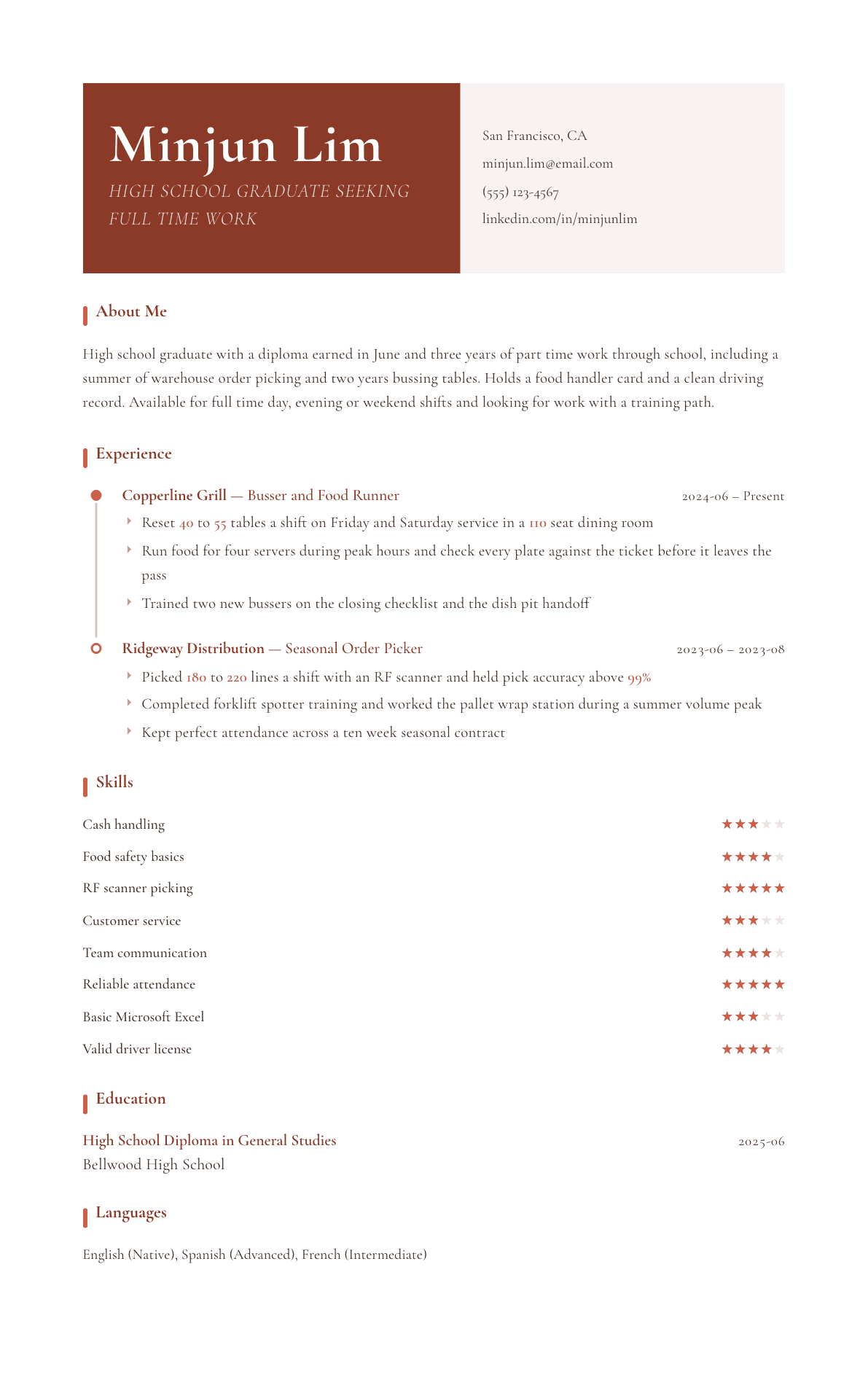
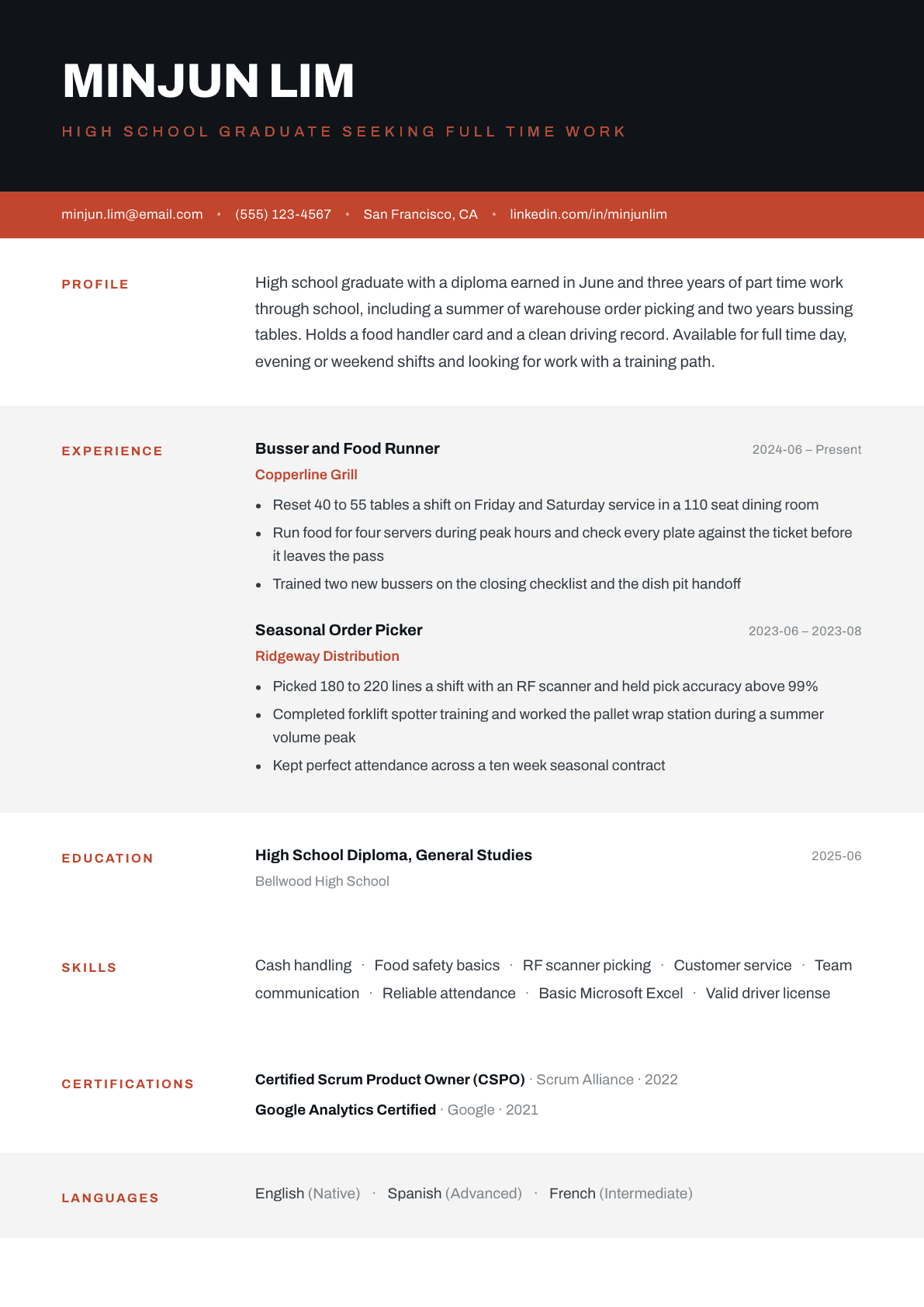
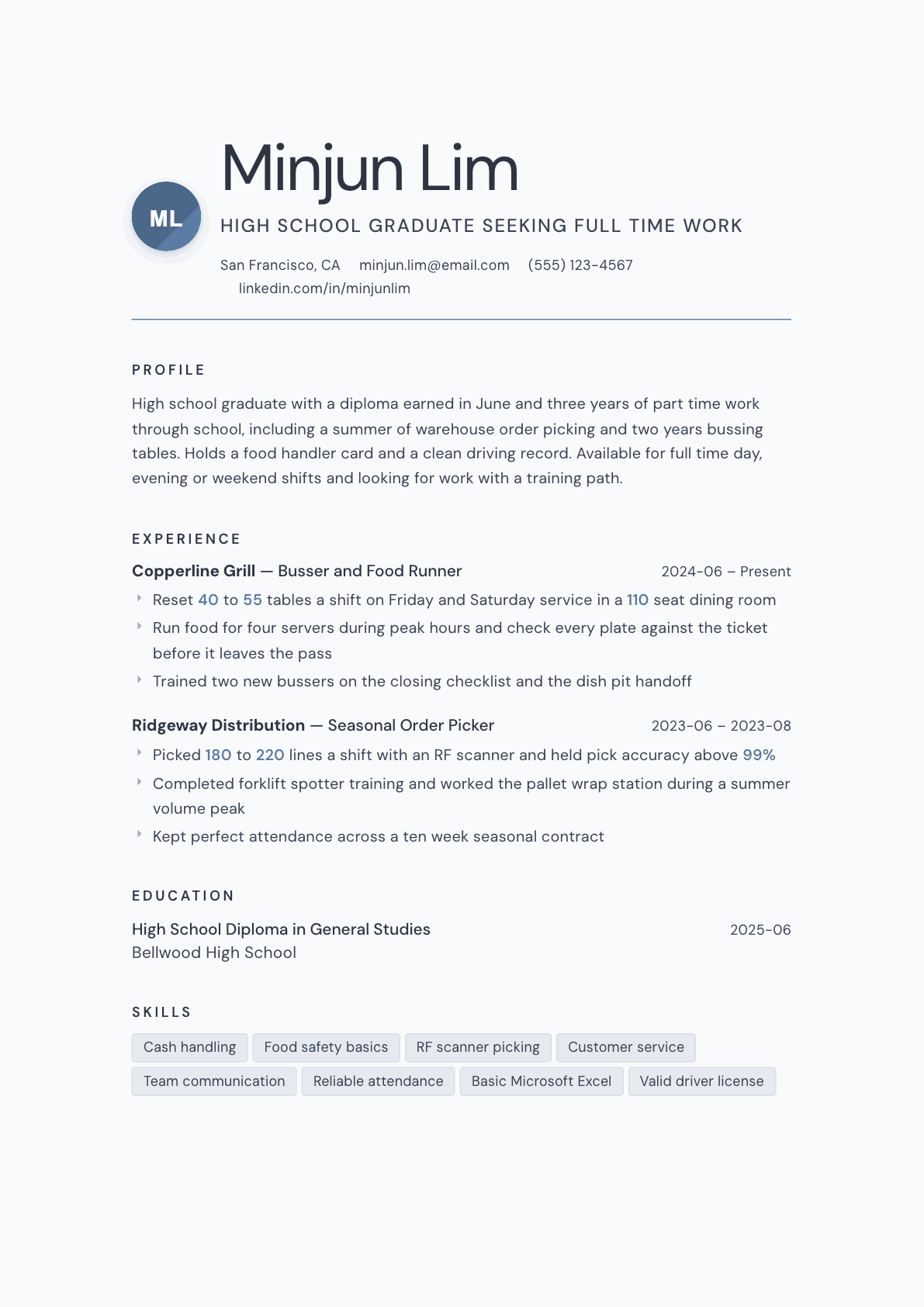
Example High School Graduate summary
High school graduate with a diploma earned this year and three years of part time work through school across restaurant service and seasonal warehouse shifts. Holds a food handler card and a valid driver license, picked more than 180 lines a shift with a scanner, and trained two new hires on closing duties. Available for full time days, evenings or weekends and looking for an employer that promotes from the floor.
Skills to list on a High School Graduate resume
- Cash handling
- Point of sale operation
- Customer service
- Food safety basics
- Stocking and inventory counts
- RF scanner picking
- Cleaning and closing procedures
- Team communication
- Time management
- Reliable attendance
- Basic Microsoft Excel
- Data entry
- Valid driver license
- Following written instructions
What actually gets this resume read
- Put your diploma and graduation month near the top, because an employer needs to know you have finished school.
- Turn school into evidence: attendance, a leadership role, a shop or accounting class that matches the job you want.
- Write your availability as real days and hours, since hiring managers screen first on whether you cover their open shifts.
- Count something in every job bullet, such as tables reset, orders picked or hours worked in a week.
- List any card or permit you already hold, such as a food handler card, a driver license or a forklift spotter card.
- Use a plain email address built from your name, and check that your voicemail greeting is set up and audible.
- Ask a teacher, coach or shift lead for a reference before you send the resume, and keep their details ready separately.
How to write a high school graduate resume
A high school graduate resume has one job: convince a hiring manager that you will show up, learn the task and stay long enough to be worth training. Nobody reading it expects a career history. They expect a diploma, a clear statement of when you can work, and enough evidence of responsibility that handing you a register drawer or a scanner gun does not feel like a gamble.
The graduates who get called back are not the ones with the fanciest layout. They are the ones who answered the three questions a shift manager has: are you finished with school, which shifts can you cover, and have you ever been accountable to someone outside your family. Answer those in the top third of the page and the rest of the sheet can be modest.
This guide is written for the graduate going straight into work rather than into a degree program. It covers where the diploma goes, how to turn school into evidence an employer respects, how to write part time and seasonal jobs so they carry weight, which certificates are worth listing, and how to handle the online application form that most of these jobs now sit behind.
Put the diploma and your availability where a shift manager looks first
Your diploma and the month you finished go near the top, right under a two line objective naming the kind of work you want. Managers hiring for full time floor and warehouse roles need to know that school is done, because a candidate still in class is a scheduling problem and one who has graduated is not. Say it plainly rather than leaving them to calculate it from a graduation date buried at the bottom.
Put availability in the same block. Write it as real days and hours, including whether you can take opening shifts, closing shifts, weekends and holidays, and whether you have transportation that works at those hours. In hourly hiring, availability decides more offers than any other line on the page, because the manager is filling a specific hole in a specific week.
- Objective line naming the job type: warehouse, retail floor, food service, apprenticeship or office support.
- Diploma with the school name and the month you graduated.
- Availability written as days and hours, plus openings, closings, weekends and holidays.
- Transportation and any driver license, since a shift that starts before the bus runs is a real constraint.
- Any card or permit you already hold, because a manager saves a training cost by hiring you.
Turn four years of school into evidence instead of a date
School is not just a credential here, it is your longest record of attendance and deadlines. Mine it. A perfect or near perfect attendance record is directly relevant to an employer whose biggest staffing problem is no shows. A vocational track in automotive, culinary, welding, accounting or computer support is a skills claim you can back up with the shop or lab hours behind it.
Leadership and team roles count when you write them as responsibilities rather than memberships. Team captain means you ran warmups and held teammates to a schedule. Yearbook editor means you chased deadlines from people who ignored you. Marching band means two hours after school four days a week for a whole season without missing one. Describe the commitment, and the employer hears reliability.
Skip the awards nobody outside school recognizes, and skip your grade point average unless it is strong and the job is office based. For most floor roles it is neutral information, and neutral information costs you space you need for availability and work history.
Write part time and seasonal work like it mattered
A summer in a warehouse and a year bussing tables are real jobs, so give them real bullets. Every bullet needs a number: tables reset in a shift, lines picked per hour, transactions handled, pallets wrapped, hours worked in a typical week. Numbers are what turn a teenager job into evidence that you have carried a workload.
Then add the two things managers care about beyond output. First, whether you stayed: give the start and end months and say if you were asked back for a second season. Second, whether anyone trusted you with more: opening or closing duties, cash handling, training a new hire, or being the one who covered the shift when somebody quit. Those are the details that promote a resume from acceptable to interesting.
Certificates, cards and the small things that make you cheaper to hire
A short list of cards and short courses does more for a graduate resume than any adjective. A food handler card lets a restaurant put you on the floor without waiting. A safety card, a forklift or spotter training record, a first aid course or a completed keyboarding certificate all remove a step the employer would otherwise pay for.
List them with the issuing body and the month you earned them, and keep them in one block so a manager can see the whole set. If you are partway through one, say so with the expected completion month rather than claiming it early, because these are the easiest things on your resume to verify.
- Food handler card for restaurants, grocery and catering work.
- Safety training cards for warehouse, construction and manufacturing applications.
- First aid or CPR training, which matters for childcare, recreation and fitness employers.
- Driver license, permit status and whether you have your own transportation.
- Short computer or software courses, listed with the platform and the finish month.
The application form is part of the resume now
Most hourly employers put your resume through a form before a human sees it, and the form asks for availability grids, start dates and previous employers with phone numbers. Fill every field, keep the dates on the form matching the dates on your resume exactly, and answer the availability grid honestly. A mismatch between the two documents is the most common reason a promising graduate application stalls.
Before you send anything, fix the small things that get judged silently: an email address built from your name, a voicemail greeting that is set up, a phone that is not full, and a file saved as your own name. Then keep a note of where and when you applied, because the follow up call a week later is what separates candidates who get interviews from candidates who wait.
High School Graduate resume summary examples
Diploma, no work history
High school graduate seeking full time work in retail or warehouse operations. Missed 3 days across four years of school, completed two years of vocational automotive coursework, and played a full varsity soccer season each year. Available for opening, evening and weekend shifts with my own transportation.
Diploma with part time work behind it
High school graduate with three years of part time work through school, including a summer picking 200 lines a shift in a distribution center and two years bussing in a 110 seat restaurant. Holds a food handler card and a valid driver license. Available full time, including weekends and holidays.
Graduate moving into a trade
High school graduate with a vocational welding track, 320 shop hours and a summer as a fabrication shop helper cutting stock and staging jobs. Passed the school shop safety assessment and worked a full season with no missed days. Seeking a first year apprenticeship with a structured training path.
Work experience bullets: before and after
Before: Worked at a restaurant as a busser.
After: Reset 40 to 55 tables a shift on Friday and Saturday service in a 110 seat dining room, and ran food for four servers during peak hours.
Table volume, the shifts and the room size show the actual pace you have already handled.
Before: Had good attendance in high school.
After: Missed 3 days across four years of high school while holding a part time job of 18 hours a week during the school year.
Attendance paired with a job proves stamina, which is exactly what an hourly manager is buying.
Before: Summer job in a warehouse.
After: Picked 180 to 220 lines a shift with an RF scanner across a ten week seasonal contract and was asked back for the following summer.
The rate, the contract length and the invitation back answer output and reliability at once.
Before: Was captain of the soccer team.
After: Captained a varsity soccer squad of 22, running warmups at 6 in the morning four days a week and covering for the coach at two away fixtures.
Describing the commitment and the early hours converts a title into evidence of showing up.
Before: Took automotive classes at school.
After: Completed two years of vocational automotive coursework, roughly 300 shop hours, covering brake service, oil and filter changes and basic diagnostic scanning.
Hours and named tasks let a service manager judge what you can already be assigned.
Hard skills
- Cash handling and register operation
- Point of sale systems
- Stocking, facing and inventory counts
- RF scanner order picking
- Food safety basics
- Cleaning and closing procedures
- Basic hand and power tool use
- Keyboarding and data entry
- Microsoft Excel basics
- Phone and counter customer service
Soft skills
- Reliable attendance across a full season
- Taking correction without repeating the mistake
- Working a shift alongside people much older than you
- Following a written checklist to the end
- Asking a question before guessing on an unfamiliar task
Certifications worth listing
- ServSafe Food Handler (National Restaurant Association)
- OSHA 10-Hour General Industry Card (OSHA Training Institute Education Centers)
- Adult and Pediatric First Aid, CPR and AED (American Red Cross)
Mistakes that cost high school graduate candidates the interview
- Hiding the graduation month at the bottom so a manager cannot tell whether you are still in class.
- Leaving availability off the page when it is the fact hourly employers screen on first.
- Writing school activities as memberships rather than as commitments with hours behind them.
- Stretching the font and margins to fill a page instead of adding one more honest detail.
- Using a nickname email address or leaving a voicemail box that is full when the callback comes.
- Listing a certificate you have not finished yet without saying when you expect to complete it.
- Sending the same resume to a warehouse and an office job when the two want opposite halves of your page.
High School Graduate resume questions
What do I put on a high school graduate resume if I never had a job?
Use school as your record. Attendance, vocational coursework with shop hours, a sports season, a club role you held, and any volunteering with a schedule. Present each one with dates and hours so it reads as commitment rather than as a list of interests.
Should I include my grade point average?
Include it only when it is strong and the job involves office work, records or an apprenticeship with classroom study. For most floor, warehouse and food service roles it is neutral, and the space is better spent on availability and work history.
How long should my resume be as a graduate with little work history?
One page, and it does not need to be a full one. A clean two thirds of a page that answers availability, diploma and responsibility reads better than a stretched page with wide margins and padded lines an employer can see through.
Do I list a job I only held for a few weeks?
List it if you left for a reason you can explain, such as a seasonal contract ending or a return to school. Leave it off if it was days long, because a very short entry raises a question you then have to spend interview time answering.
Is it still worth handing my resume in at the counter?
Yes for local employers, and it pairs well with the online form most of them also require. Apply online first so your record exists, then bring a printed copy in during a quiet hour and ask for the person who does the hiring by name.