Graduate Student Resume Examples: the lines they read
Turn a Graduate Student CV Into a Resume People Outside Read
By Mustafa Tarabya, founder of CVBooster · Published · Updated
Graduate student resume example covering research, teaching and funding, with a guide to cutting an academic CV down to two pages.
Sample resumes for a graduate student
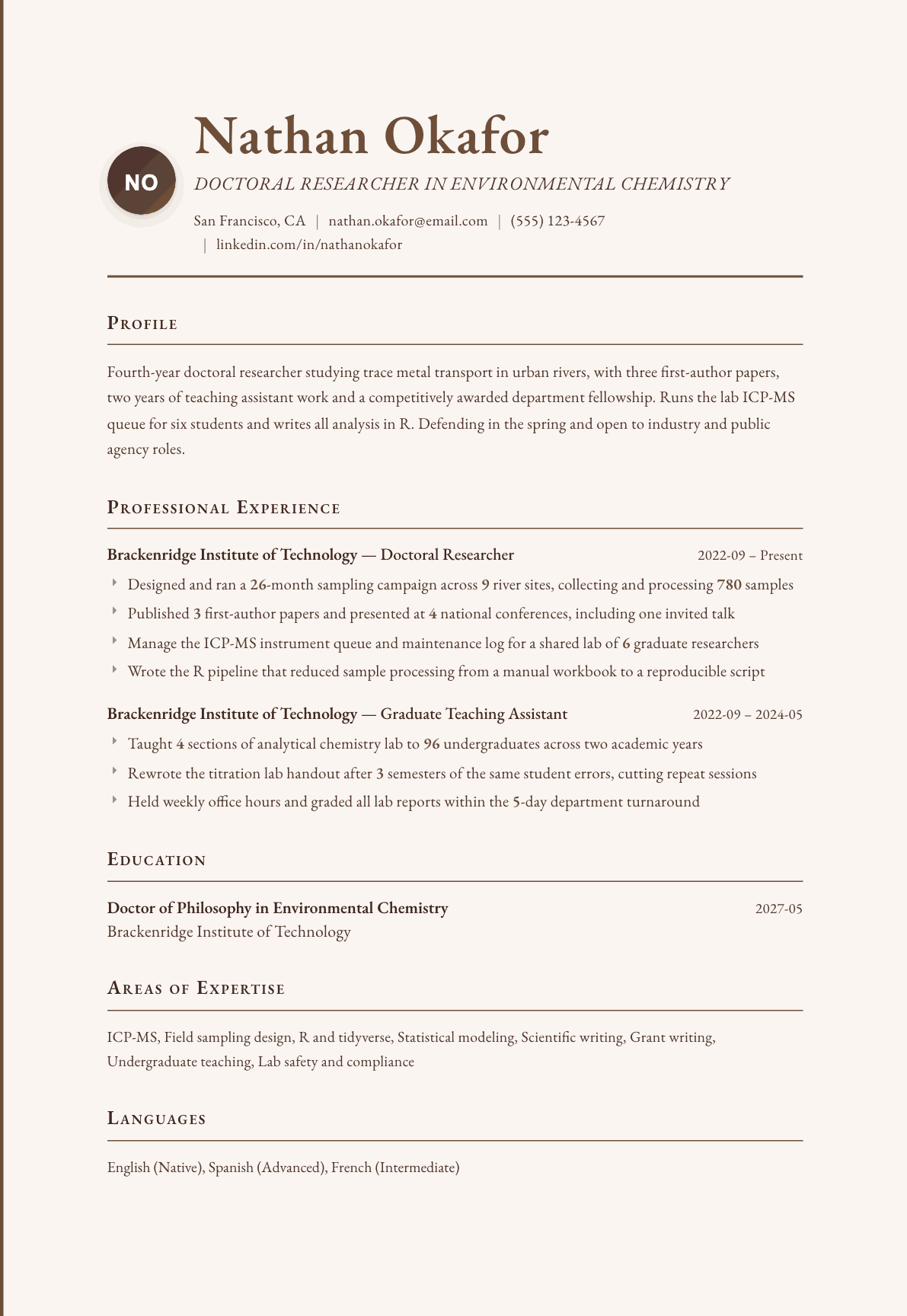
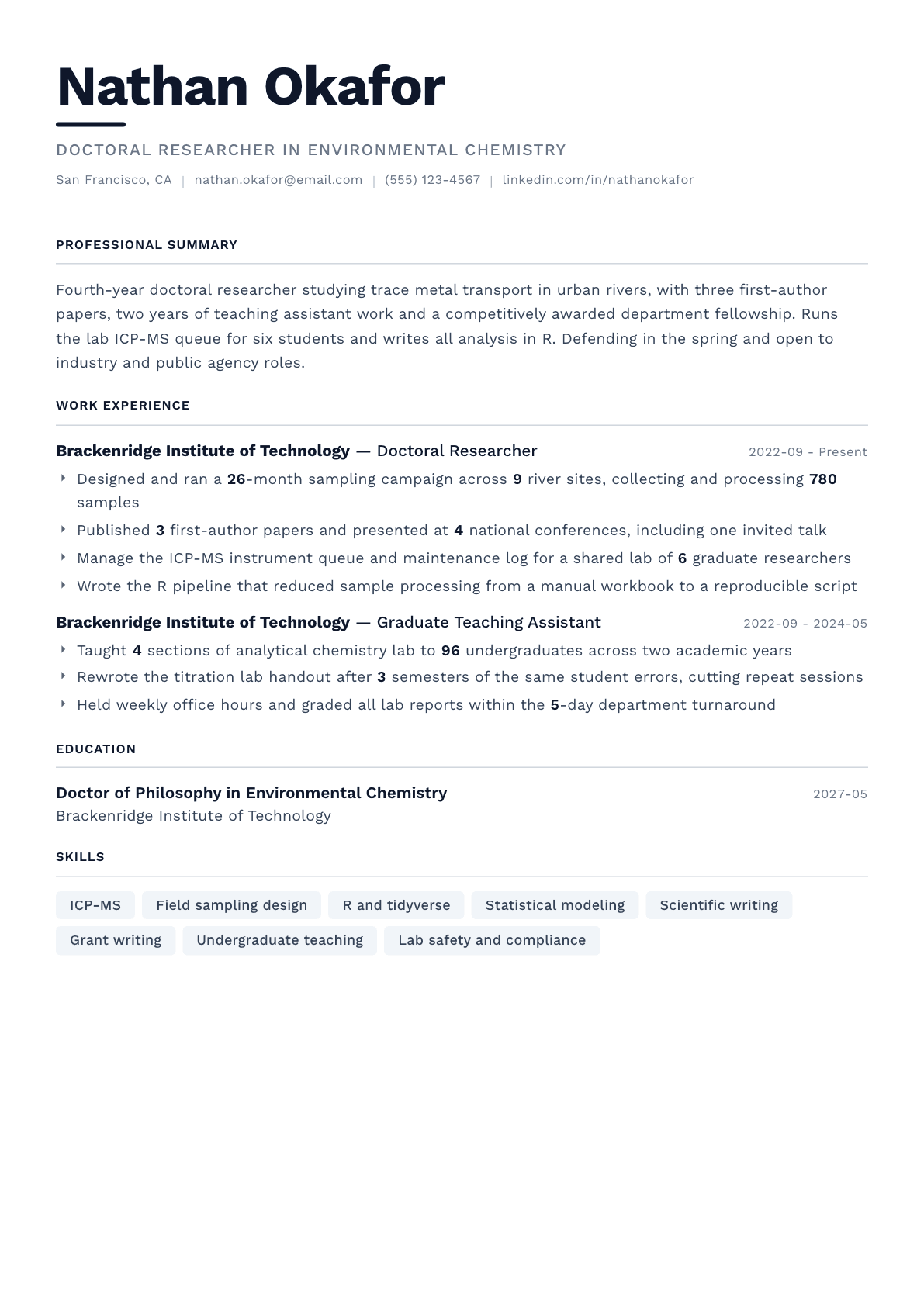
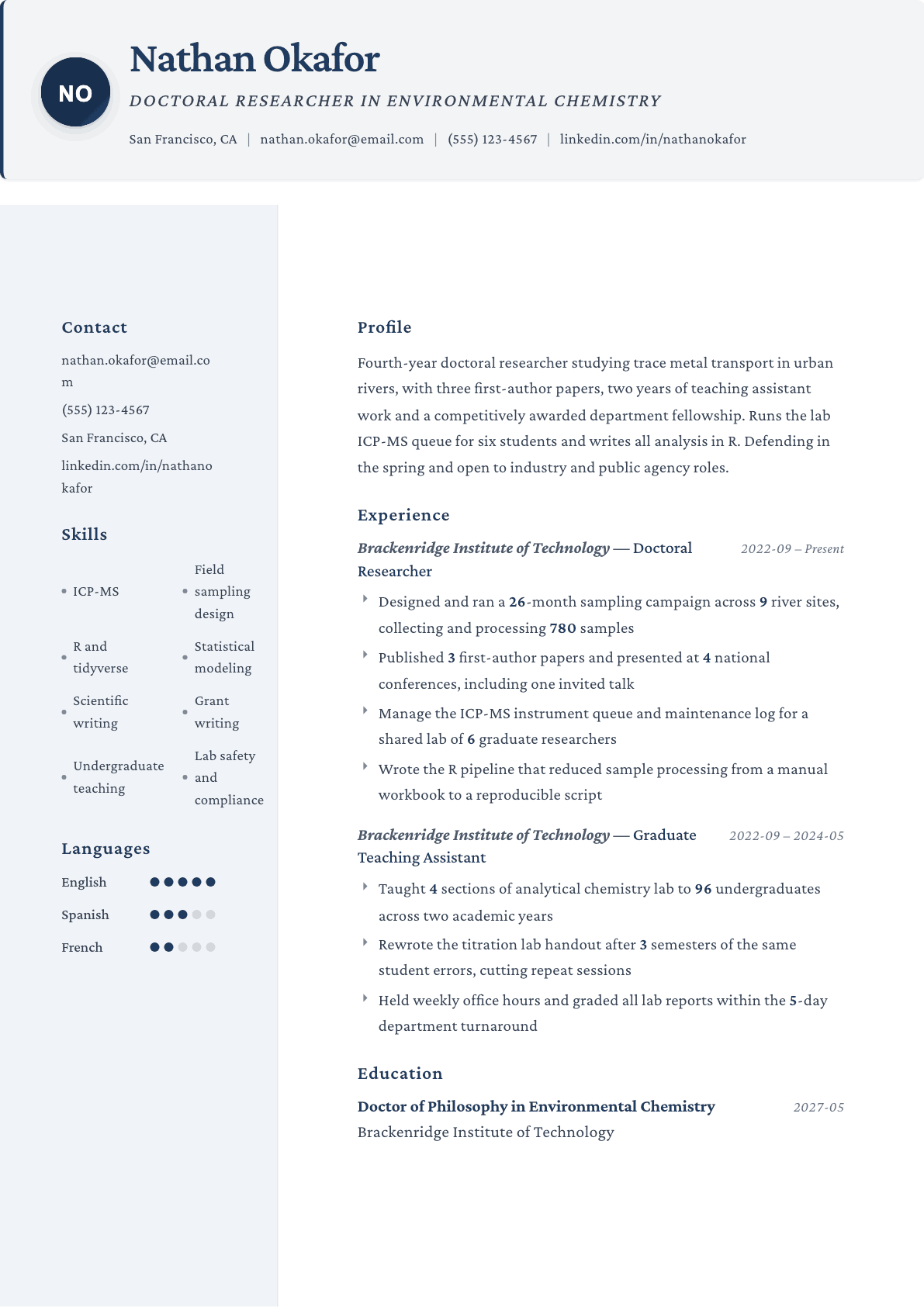
The same graduate student content laid out in three CVBooster templates, so you can see what the finished document looks like before you write a word.
Example Graduate Student summary
Fourth-year doctoral researcher in environmental chemistry defending in the spring, with a 26-month field campaign across nine sites and three first-author papers behind it. Runs the shared instrument queue for six researchers, built the lab reproducible analysis pipeline in R, and taught four undergraduate lab sections. Looking for analytical roles in industry or a public agency where method development sits at the center.
Skills to list on a Graduate Student resume
- Research design
- Quantitative analysis
- Statistical modeling in R
- Laboratory instrumentation
- Data management
- Scientific writing
- Peer review
- Grant and fellowship writing
- Conference presenting
- Teaching and mentoring
- Literature review
- Reproducible workflows
- Project scheduling
- Regulatory and safety compliance
What actually gets this resume read
- Decide first whether the reader wants a CV or a resume, because the two documents have opposite rules.
- Put your expected defense or completion date in the top block, since every reader wants to know when you are free.
- Translate research into a project with a scope, a method, a dataset size and a result someone can use.
- Name instruments, software and analysis languages, because those are the lines a hiring lab actually filters on.
- Keep publications to the ones that show the method you want to be hired for, and cut the rest for industry.
- Show funding and awards with the body that granted them, since that is how a committee reads competitiveness.
- Count teaching, mentoring and lab management as management experience, with the number of people involved.
How to write a graduate student resume
A graduate student writing a resume is usually converting a document built for a different audience. The academic curriculum vitae grows without limit and lists everything: every poster, every guest lecture, every committee. A resume outside the academy is a two-page argument that you can solve a defined problem on a schedule. Handing a hiring manager an eleven-page publication list is not thoroughness, it is a failure to translate.
The reader also changes shape depending on where you send it. A faculty search committee wants the full record with the fellowships and the teaching statement. A national lab wants the methods and the instruments. An industry team wants to know how large the dataset was, who else was involved, and what happened at the end. The same doctoral work supports all three descriptions, and the words are different in each.
This guide covers when to send a resume rather than a CV, how to write a dissertation as a project, what publications and funding are worth to a non-academic reader, why teaching and lab management are management experience, and the questions graduate students ask when they start applying before the defense.
Decide first: resume or curriculum vitae
Send a CV to academic positions, postdoctoral appointments, fellowships and most research council applications. Send a resume to companies, consultancies, public agencies and national laboratories, unless the posting explicitly asks for the longer document. Mixing them is the most common error a graduate student makes, and it reads as inexperience with the sector you are applying to.
The conversion is brutal and it should be. Two pages. Publications reduced to a count plus the three that show the method you want to be hired for. Conference talks collapsed into a single line. Committee service gone unless it involved a budget or a team. Teaching kept, because it is the closest thing on your record to managing people.
Keep the date you expect to finish visible at the top. A hiring manager cannot make an offer without a start date, and a graduate student whose completion date is unclear reads as a candidate who might still be writing in eighteen months.
- Expected defense or submission month, in the education block and near the top of the page.
- Advisor and department only on a CV, since an industry reader has no use for either.
- Publications: a total count, then the selected few that match the posting.
- Techniques, instruments and software given their own block, because that block is what gets filtered.
Write the dissertation as a project with a scope and a result
Describe your research the way a project manager would describe a delivery. What question, over what period, using what method, on what quantity of data or material, producing what conclusion. A reader outside your subfield cannot evaluate novelty, but she can evaluate that you designed a twenty-six month sampling campaign across nine sites and processed the resulting seven hundred and eighty samples yourself.
Strip the theoretical framing to one clause and spend the space on the operational facts instead: the sample size, the instrument time you booked, the failure you designed around, the pipeline you wrote so that the analysis could be rerun. Those are the details that let someone imagine you inside their team.
Name the moment something went wrong and what you did. Graduate research is largely troubleshooting, and a candidate who can describe a contamination problem, a failed run or a recruitment shortfall and the fix she implemented sounds like a colleague rather than a student.
Publications, funding and awards for a non-academic reader
Outside academia a publication is evidence of a completed piece of work that survived review, not a unit of currency. Give the count, then list the ones whose methods match the job. First authorship is worth stating plainly, because it tells a reader who drove the work. Journal prestige means very little to anyone who does not work in your field, so do not build the section around it.
Funding is different, and graduate students undersell it constantly. A competitively awarded fellowship or a travel grant you wrote yourself is a proposal that persuaded a panel to release money. Name the awarding body and the pool it came from. That is the closest analogue on your record to winning a bid, and technical managers read it that way.
- Number of peer-reviewed papers, with first-author count stated separately.
- Selected publications chosen for method overlap with the posting, not for impact.
- Fellowships and grants with the awarding body and the selection pool.
- Invited talks kept to one line, since a long conference list dilutes a two-page resume.
Teaching, mentoring and lab management are your people experience
A graduate student who has taught four laboratory sections has stood in front of a room and been responsible for the learning of nearly a hundred undergraduates. One who mentors two junior students has trained staff. One who manages a shared instrument queue has scheduled a contested resource across competing users and kept a maintenance record. Those are supervisory facts, and they belong on the page with numbers attached.
Write them in the language of the outcome rather than the duty. Rewriting a lab handout after three semesters of the same student error is a process improvement. Grading within the department turnaround every week is delivery against a service level. Neither sentence lies, and both are legible to a reader who has never set foot in a department.
Skills, tools and the vocabulary a filter matches on
Give instruments, analysis languages and platforms their own block near the top: the mass spectrometer or sequencer you run, the statistical environment you write in, the version control you use, the database you query. These are matched literally by screening tools, and a graduate student who writes strong quantitative background instead of naming the software will not surface in the search.
Add the compliance side where it applies, briefly. Human subjects training, animal handling approval, chemical hygiene, data protection for participant records. In regulated industries that line moves an application forward, and almost no academic resume includes it.
Graduate Student resume summary examples
First-year graduate student
First-year graduate student in environmental chemistry with a completed undergraduate thesis on stormwater runoff and two summers of field sampling. Trained on ICP-MS and writing analysis in R. Seeking a summer research placement in water quality where method development and field logistics sit together rather than apart.
Doctoral candidate, fourth year
Fourth-year doctoral researcher defending in spring, with a 26-month field campaign across nine river sites and three first-author papers behind it. Runs the shared instrument queue for six researchers, built the reproducible analysis pipeline in R, and taught four undergraduate laboratory sections across two years.
Finishing, moving to industry
Doctoral researcher submitting this term, with seven peer-reviewed papers, a competitively awarded department fellowship and two years supervising junior students in a shared analytical laboratory. Wrote the method now used by three groups for trace metal preparation. Targeting analytical development roles in industry or a public water agency.
Work experience bullets: before and after
Before: Conducted research for my dissertation.
After: Designed and ran a 26-month sampling campaign across 9 river sites, collecting and processing 780 samples and building the trace metal preparation method the group still uses.
Duration, sites and sample count turn an unmeasurable claim into a project with a scope.
Before: Published several papers in academic journals.
After: Published 3 first-author and 4 co-authored peer-reviewed papers, including the method paper adopted by two other laboratories in the department.
Separating first authorship from the total shows who drove the work, and adoption shows it was useful.
Before: Worked as a teaching assistant.
After: Taught 4 sections of analytical chemistry laboratory to 96 undergraduates across two academic years, and rewrote the titration handout after three semesters of the same recurring error.
Headcount plus a fix you made converts teaching into supervision and process improvement.
Before: Experienced with data analysis in R.
After: Wrote the R pipeline that replaced a manual spreadsheet workflow, cutting the processing of a 780-sample dataset from several days to a reproducible script run.
A named tool applied to a specific dataset with a before and after is what a technical reader can assess.
Before: Received a departmental fellowship.
After: Awarded a competitive department fellowship covering two years of stipend, selected from 34 applicants on a written proposal I authored.
The pool size and your authorship make it a persuasive win rather than an honorific.
Hard skills
- Research design and hypothesis testing
- Field and laboratory sampling protocols
- Analytical instrumentation
- Statistical modeling in R
- Python for data processing
- Reproducible analysis workflows
- Version control
- Scientific writing and peer review
- Grant and fellowship proposal writing
- Literature review and synthesis
- Undergraduate teaching and assessment
- Laboratory safety and compliance
- Conference presentation
- Shared instrument scheduling
Soft skills
- Long-horizon project discipline
- Troubleshooting when a method fails
- Mentoring junior researchers
- Explaining findings to a lay audience
- Working under an advisor with competing priorities
- Independent problem framing
Certifications worth listing
- Human Subjects Research, Social and Behavioral Basic Course (CITI Program)
- Carpentries Instructor Certification (The Carpentries)
Mistakes that cost graduate student candidates the interview
- Sending an eleven-page curriculum vitae to a company, which signals no familiarity with how that sector hires.
- Leaving the expected defense or submission month off the page, so no manager can build a start date around you.
- Describing the dissertation by its theoretical contribution rather than by its scope, method and dataset.
- Listing every conference poster and committee membership in a document that should be two pages.
- Writing strong quantitative skills instead of naming the instruments, packages and languages a filter searches for.
- Treating teaching and lab management as filler when they are the only supervisory experience on the record.
- Underselling a fellowship by naming the award without the awarding body or the pool it was won from.
Graduate Student resume questions
Should a graduate student send a resume or a curriculum vitae?
A curriculum vitae goes to academic and fellowship applications, a resume goes to companies, agencies and laboratories. When a posting is ambiguous, send a two-page resume and offer the full record on request. Sending the wrong document is read as unfamiliarity with the sector.
How do I list a dissertation that is not finished?
Give the working title, the method, the scope you have already completed, and the month you expect to defend or submit. Frame it as work in progress with a delivery date rather than as an open-ended commitment, because a hiring manager is planning around your availability.
Does my advisor belong on the page?
On an academic curriculum vitae, yes, because the committee may know the name. On an industry resume, no. The space is better spent on the method, the dataset and the result, none of which a corporate reader can infer from a professor she has never heard of.
How many publications should I list on a two-page resume?
Give the total count in one line, then select three or four whose methods match the posting. A reader outside the field cannot rank journals, so choose for relevance to the work you are applying to do and note first authorship explicitly.
Will leaving a program early hurt my resume?
Not if you present what was completed. List the years enrolled, the qualifying exams passed, the research produced and any master's degree awarded along the way. Employers care about demonstrated capability and a clear finish date, not about whether you stayed for the title.