Honors Student Resume Examples: the lines they read
An Honors Student Resume That Shows Work, Not Just Awards
By Mustafa Tarabya, founder of CVBooster · Published · Updated
Honors student resume example and guide to writing a thesis, research, Dean list awards and coursework as evidence a recruiter can use.
Sample resumes for a honors student
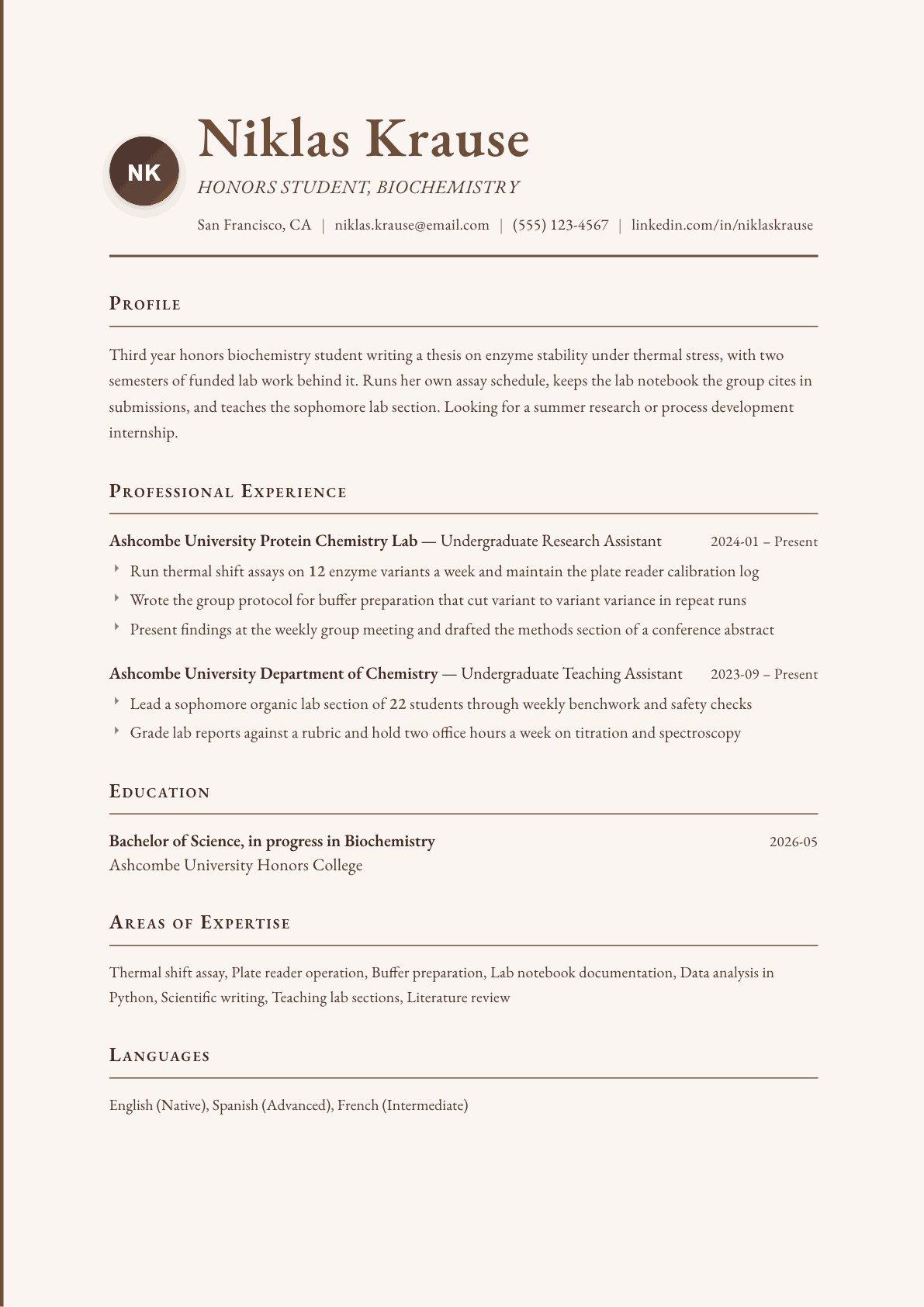
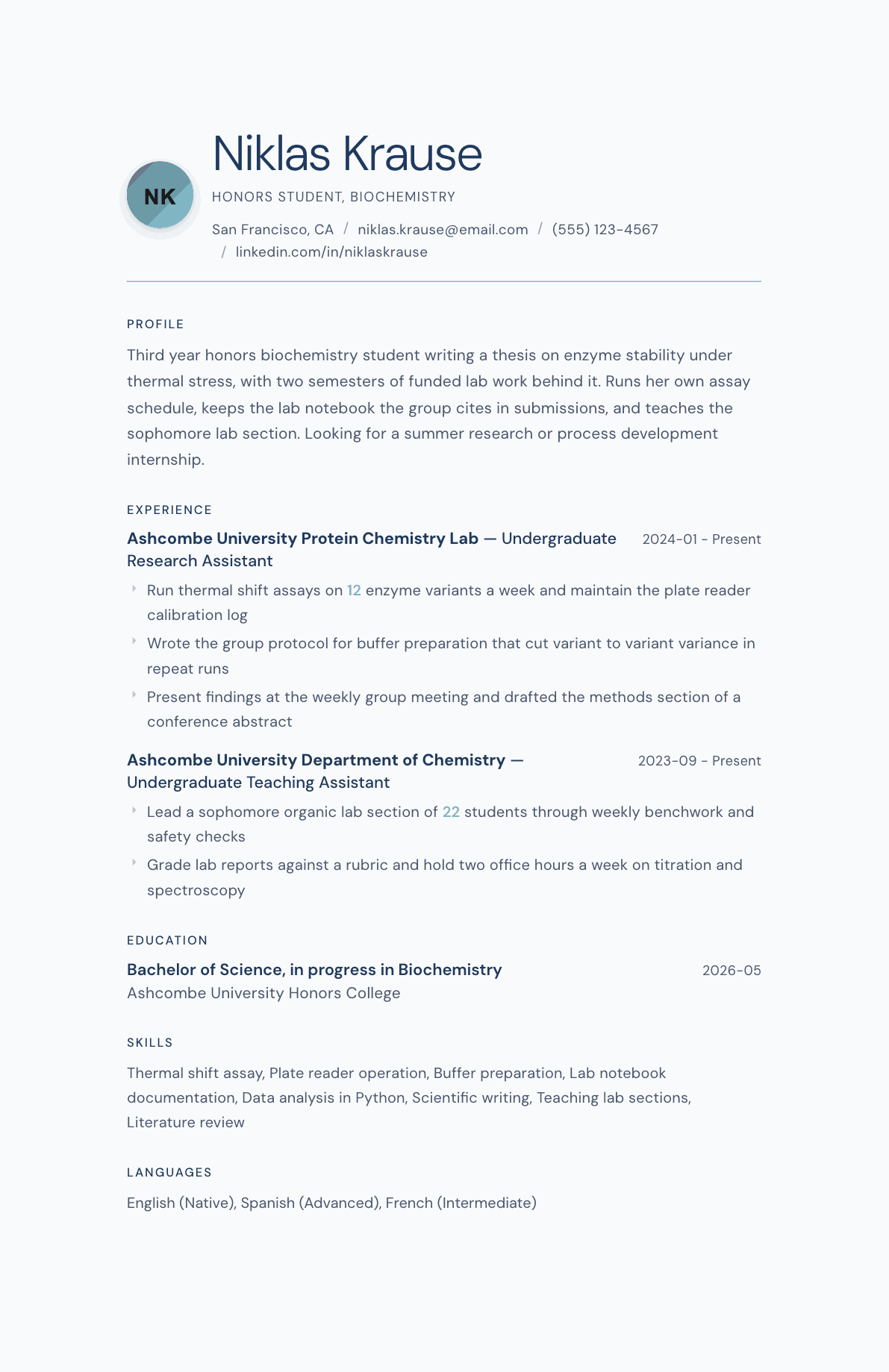
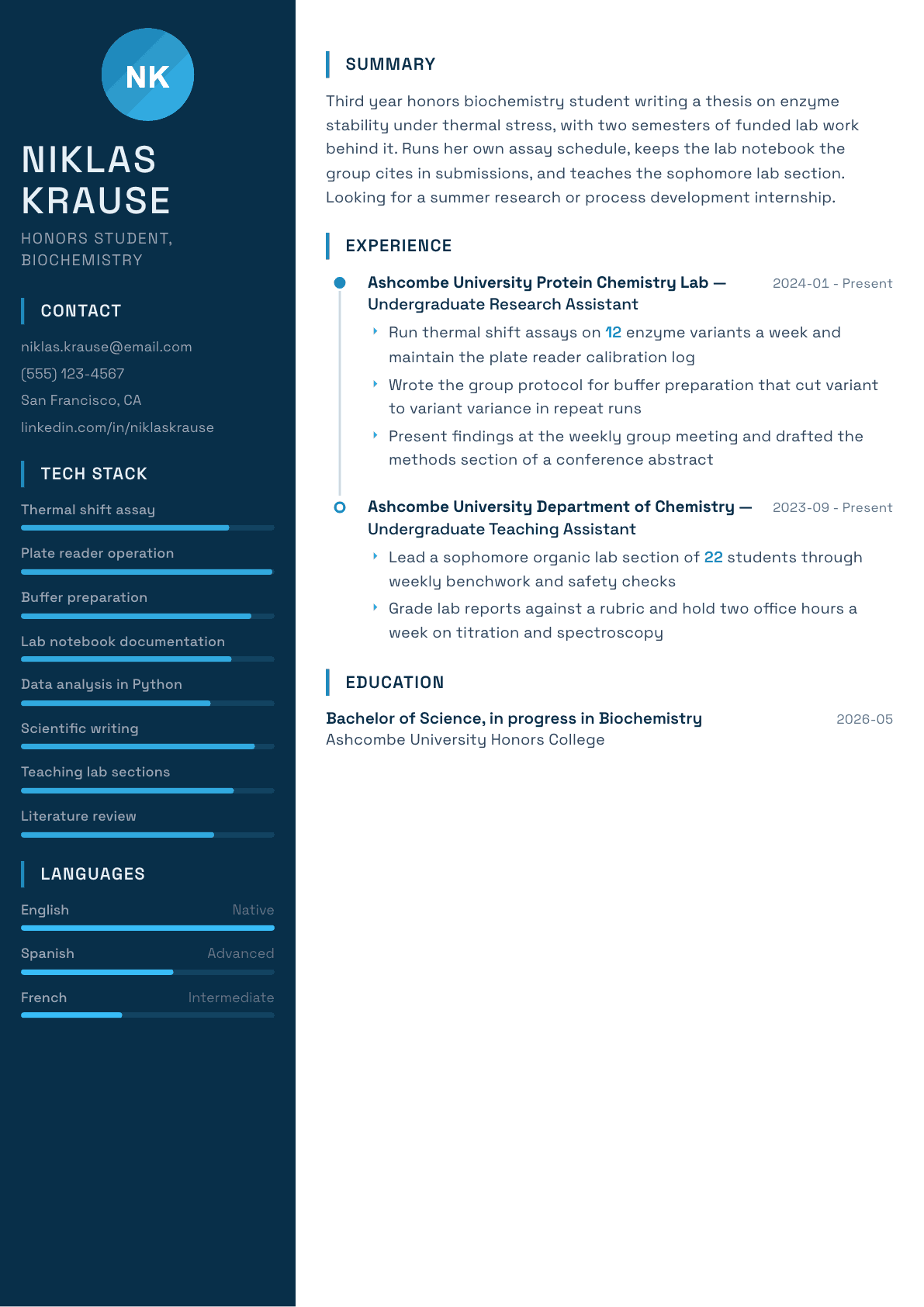
The same honors student content laid out in three CVBooster templates, so you can see what the finished document looks like before you write a word.
Example Honors Student summary
Honors biochemistry student in the third year of a thesis on enzyme stability under thermal stress, with two funded semesters of bench work and a protocol the group now uses as standard. Runs a weekly assay schedule alone, analyzes results in Python, and teaches a sophomore organic lab section of twenty two students. Seeking a summer research or process development internship where the work carries a real deadline.
Skills to list on a Honors Student resume
- Honors thesis research
- Experimental design
- Laboratory technique
- Data analysis
- Scientific writing
- Literature review
- Statistical software
- Presenting to a research group
- Teaching and grading
- Protocol documentation
- Grant and fellowship applications
- Peer review of student work
- Poster and abstract preparation
What actually gets this resume read
- Lead with the honors thesis question and what you actually did to answer it, not the honors program name.
- Give each award a one line reason it was given, because a recruiter cannot rank distinctions she has never heard of.
- Turn coursework into capability by naming the methods, instruments or datasets a class made you handle yourself.
- Keep the awards block short and put research, teaching and paid work above it where the reading eye lands first.
- Show one thing you finished and handed to somebody else, since a thesis in progress reads as promise and not proof.
- Name your advisor group and your role in it so a reader can tell independent work from following a protocol.
How to write a honors student resume
Honors students write the most decorated and least convincing resumes in the whole student pile. The page arrives loaded with distinctions, medals, societies and a grade point average in bold, and the recruiter reading it still cannot answer the only question she has: what has this person actually produced, alone, that somebody else depended on?
The problem is that academic honors are internal currency. Inside the university everybody knows what the departmental prize means and how hard the honors college admission was. Outside it, those names carry almost nothing, because the reader has no scale to place them on. Meanwhile the thesis, the funded lab semester and the section you taught, which are genuinely comparable to work, get one line each near the bottom.
This guide inverts that. It covers how to write the thesis as a project with a client and a deadline, how to give an award a single line of context so it lands, how to turn graded coursework into demonstrable method, and how to keep the page a resume rather than the academic curriculum vitae your advisor will encourage you to build.
Format: research and work above awards, always
One page, and the ordering decision is the whole game. Contact details, a short summary, then research or project work, then teaching and paid employment, then education with the honors designation attached, then a compact awards block. Putting honors above output is the single most common structural error on these pages.
Keep the honors designation inside the education entry rather than giving it a section of its own. Honors college, honors track, thesis with distinction: those belong on the same lines as the degree, where a reader interprets them as a description of the program rather than as an achievement list competing with your work.
- Summary that names your research question and your method in the first sentence, not your grade point average.
- Research entries formatted like jobs: group, advisor role, dates, and bullets describing what you ran.
- Awards block near the bottom, each with a five-word reason it exists.
- Skills organized by what you can operate, from instruments to statistical packages, rather than by course.
The thesis is a project, so describe it as one
A thesis has everything a hiring manager recognizes: a defined question, a scope negotiated with somebody more senior, a method chosen under constraints, a schedule that slipped, and a deliverable presented to a committee that could reject it. Write it in that order and it reads as project ownership. Write it as a title and a subject area and it reads as homework.
Be explicit about the parts that were yours. Honors research usually sits inside a larger group effort, and recruiters have learned to be careful with students who describe the whole lab in the first person. Name the assays, the datasets, the archives or the interviews you personally handled, and mention the piece you inherited from somebody else without embarrassment.
Include a constraint. A sample that arrived late, an instrument that failed midway, an archive that would only release half the material. What you did next is the closest thing an undergraduate has to a story about working around a problem, and it is what an interviewer will ask about.
Making an award mean something to a reader outside the university
Every award gets one line, and that line contains the reason rather than the ceremony. A departmental prize awarded to one graduating student in the major says something. The same prize named without context says nothing at all. Selection detail is what converts an internal honor into an external signal.
Cut the ones that do not survive that test. Semester honor rolls, membership in a society you joined by paying dues, and certificates of participation crowd out the two or three distinctions that genuinely differentiate you. A shorter awards block where every entry explains itself outperforms a long one nobody parses.
Grade point average goes in the education entry, once, if it is strong. It does not go in the summary, it does not go in bold, and it does not go next to your name. Recruiters who care will find it, and the ones who do not will read a headline number as a candidate with nothing better to lead with.
Turning coursework into capability
Course titles are useless on their own because the same title means different things at different schools. What transfers is method. A seminar becomes evidence when it says you built a coding scheme and applied it to a body of primary sources. A statistics sequence becomes evidence when it names the models you fitted and the software you fitted them in.
Pick at most four courses that gave you a skill you could use tomorrow, and write each as a capability with the artifact attached: the dataset cleaned, the model built, the paper you wrote, the presentation you defended. Then delete the rest of the transcript from the page, because a full course list makes a reader do work you should have done for them.
- Method over title: the technique, the tool and the material you applied it to.
- One artifact per course, and only courses where an artifact exists.
- Software and instruments named exactly, since those are the searchable terms.
- Group projects labeled with your section, never with the collective result.
Resume, not curriculum vitae, and the keywords in between
An academic curriculum vitae grows forever and lists everything. A resume for an internship, a fellowship or a first job is one page and argues a case. Honors students get pushed toward the first by faculty advisors, then send it to employers who expect the second. Keep both files, and know which one you are sending.
For industry applications, mirror the vocabulary of the posting: data analysis, experimental design, technical writing, stakeholder presentation, project scoping, literature review. For fellowship and graduate applications, the emphasis flips toward the research question, the methods and the advisor relationship. The underlying content is the same, and only the ordering and the top third change.
Honors Student resume summary examples
Second year, applying for a first research post
Second-year honors psychology student with a completed methods sequence and one semester assisting on a memory study, running participant sessions and cleaning response data in R. Strong on protocol adherence and consent handling. Seeking a summer research assistantship where the work involves live data collection.
Thesis year
Honors biochemistry student in the thesis year, studying enzyme stability under thermal stress across 12 variants, with two funded semesters of bench work behind it. Wrote the buffer protocol the group now uses as standard, analyzes results in Python, and teaches a sophomore organic lab section of 22 students.
Graduating with distinction
Graduating honors history student defending a thesis built on 40 archival case files and 14 oral history interviews, presented at two undergraduate conferences. Reads two research languages, built the project coding scheme, and worked three years in the university archive processing collections for public access.
Work experience bullets: before and after
Before: Wrote an honors thesis in biochemistry.
After: Designed and ran a thesis study on enzyme stability across 12 variants, scheduling my own assay weeks and defending the method to a three-member committee.
Scope, ownership of the schedule and a defense make it a project instead of a paper title.
Before: Received the Dean's List and a departmental award.
After: Awarded the departmental prize in chemistry, given to one graduating student in the major each year for research quality.
One award with its selection basis outweighs a list of honors a reader cannot rank.
Before: Assisted a professor with laboratory research.
After: Ran thermal shift assays on 12 enzyme variants a week, maintained the plate reader calibration log, and rewrote the buffer preparation protocol after tracing run-to-run variance to inconsistent mixing.
A named technique, a maintenance duty and a diagnosed problem show independent work.
Before: Took advanced statistics and data analysis courses.
After: Fitted mixed-effects models in R on a 3000-row longitudinal dataset for the methods seminar, then presented the results and the model assumptions to the class.
The model, the tool, the data size and the presentation replace an unverifiable course title.
Before: Was a teaching assistant for an undergraduate class.
After: Led a sophomore organic lab section of 22 students through weekly benchwork and safety checks, graded reports against a shared rubric, and held two office hours a week.
Section size, safety responsibility and a grading standard turn a title into a workload.
Hard skills
- Research design and scoping
- Literature review and synthesis
- Quantitative analysis in R or Python
- Statistical modeling
- Laboratory or archival technique
- Data cleaning and documentation
- Academic and technical writing
- Poster and conference presentation
- Grant and fellowship application writing
- Teaching and rubric-based grading
- Protocol writing and version control
Soft skills
- Defending a method choice to somebody more senior
- Working alone for weeks between check-ins
- Rescoping when the data does not arrive
- Explaining specialist work to a general audience
- Handling a rejected draft without stalling the project
Mistakes that cost honors student candidates the interview
- Leading with the grade point average and the honors college name instead of the research the honors track produced.
- Listing awards without the selection basis, leaving a reader unable to tell a national prize from a semester honor roll.
- Claiming the whole laboratory or project team's output in the first person and getting caught in the interview.
- Sending an academic curriculum vitae to an employer who asked for a one-page resume.
- Pasting the transcript onto the page as a course list rather than choosing four courses with an artifact each.
- Describing the thesis only by its title and field, which reads as a subject you studied rather than work you delivered.
Honors Student resume questions
Where do honors and awards belong on a resume?
In a compact block near the bottom, with the honors designation itself folded into the education entry. Research, teaching and paid work go above them. The awards support your case, they are not the case, and a reader who meets them first will treat the page as a trophy shelf.
Should an honors student send a resume or a curriculum vitae?
A one-page resume for internships, industry roles and most fellowships, and a curriculum vitae only when a graduate program or an academic post asks for one. Keep both maintained. The mistake is sending the four-page academic version to a recruiter who allots your page thirty seconds.
How do I write an honors thesis that is not finished yet?
Write it in the present tense with the question, the method, the sample or source base, and the stage you have reached. Give the defense month. An honest in-progress description with real detail is far stronger than waiting until it is done or inflating it into a completed study.
Do employers outside academia care about honors research?
They care about what the research required of you: framing a question, choosing a method under constraints, working unsupervised, handling a setback and presenting to people who could reject the work. Write those elements plainly and the subject matter stops being the point.
Should I list my honors society memberships?
Only societies with selective admission, and only if you held a role or ran something inside them. A membership obtained by paying a fee after clearing a grade threshold adds nothing and pushes a real achievement off the page. Officer positions with a budget or an event are worth keeping.