Graduate School Applicant Resume Examples: free score
Graduate School Applicant Resume That Reads as Research Readiness
By Mustafa Tarabya, founder of CVBooster · Published · Updated
Graduate school applicant resume example covering research methods, posters, teaching support and advisor fit, with a guide to the academic format.
Sample resumes for a graduate school applicant
The same graduate school applicant content laid out in three CVBooster templates, so you can see what the finished document looks like before you write a word.
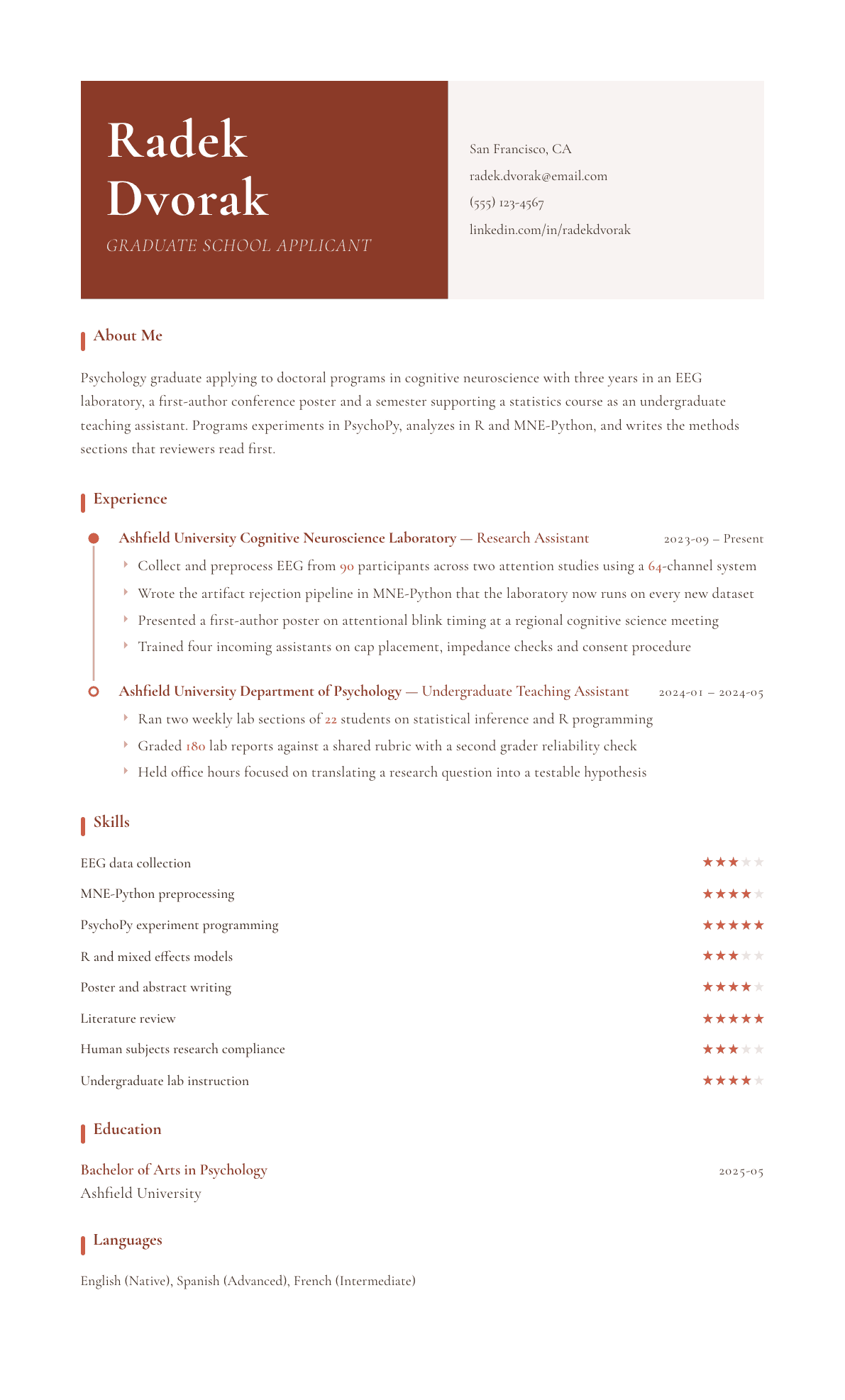
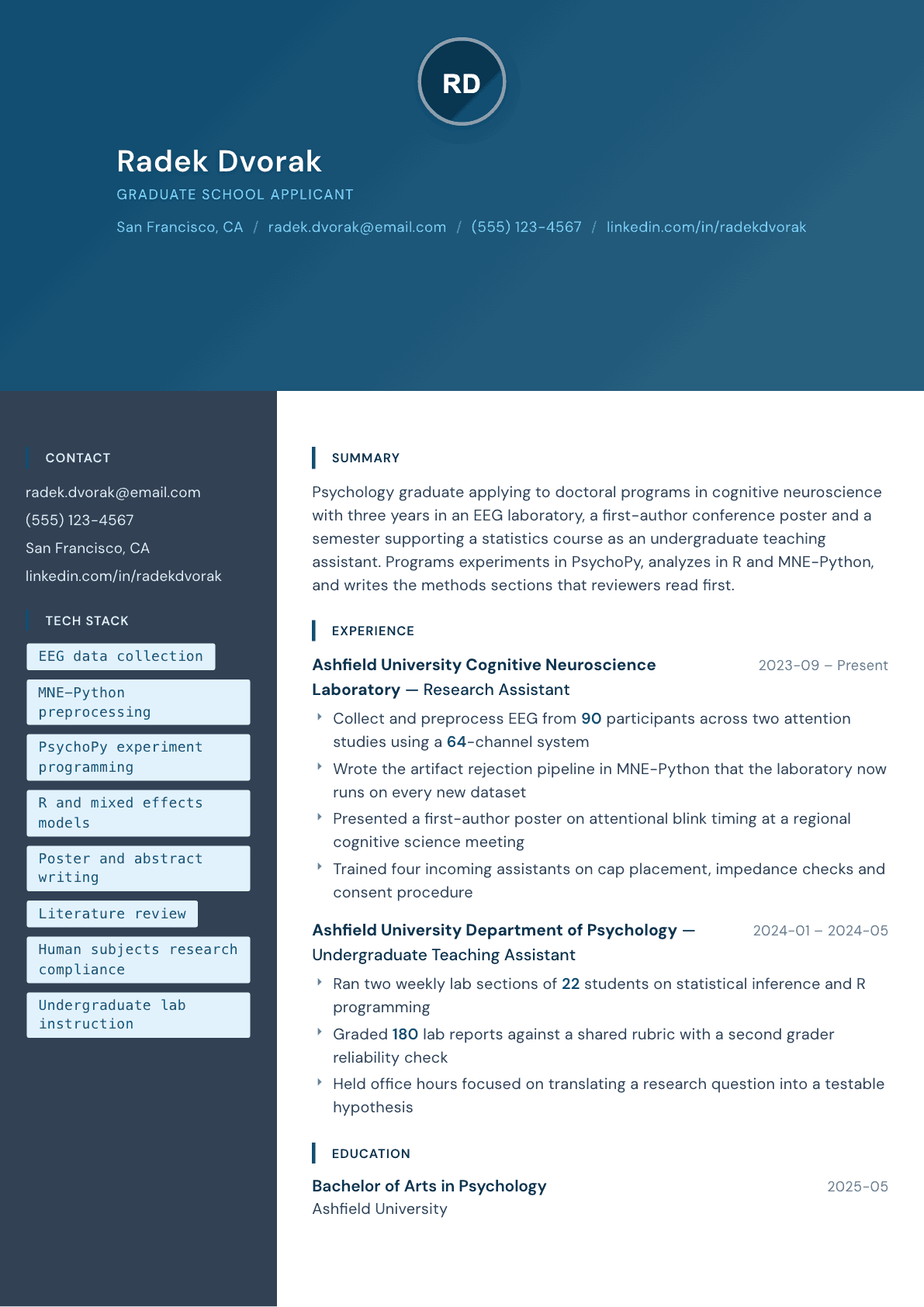
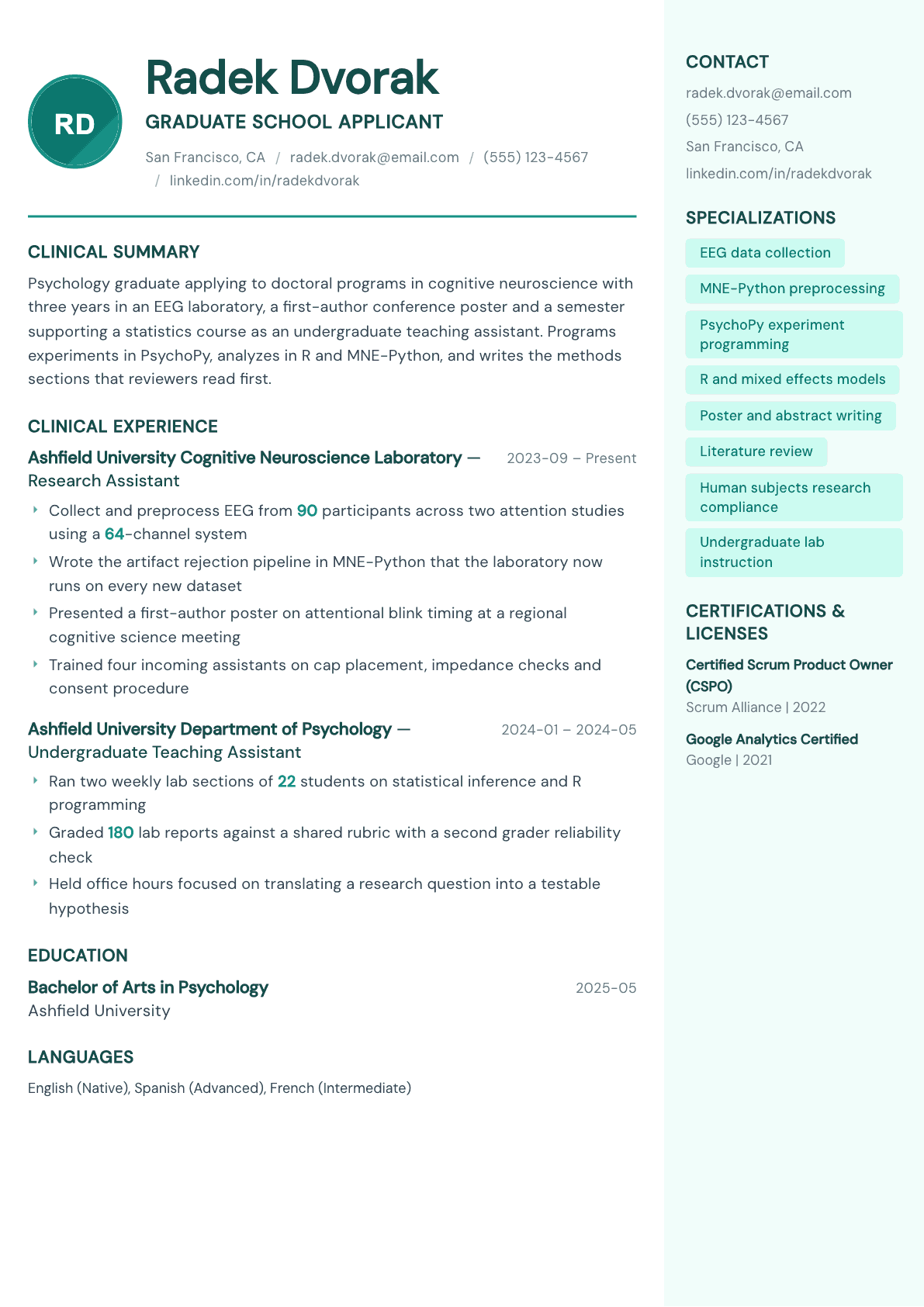
Example Graduate School Applicant summary
Graduate school applicant with a psychology degree and three years in a cognitive neuroscience laboratory collecting and preprocessing EEG data from ninety participants. Wrote the artifact rejection pipeline the laboratory now uses, presented a first-author poster at a regional meeting, and supported two statistics lab sections as a teaching assistant. Applying to doctoral programs in attention and working memory research.
Skills to list on a Graduate School Applicant resume
- Experimental design
- Data collection protocols
- Statistical analysis in R
- Python for data pipelines
- Literature review and synthesis
- Poster and abstract preparation
- Manuscript drafting
- Human subjects research compliance
- Reference management software
- Laboratory training and onboarding
- Teaching assistantship support
- Rubric-based grading
- Grant and fellowship applications
- Conference presentation
What actually gets this resume read
- Put research first and employment second, because the faculty reader is looking for method exposure before job titles.
- Name the methods, instruments and analysis packages you have hands on, not the topic of the laboratory alone.
- List posters and papers in full citation style with authors in order, including work under review.
- Give participant counts, session counts or dataset sizes so a reviewer can judge the scale you have handled.
- Include teaching and mentoring, since assistantship funding decisions weigh classroom support experience.
- Add conference travel awards, research grants and honors thesis work with the awarding department named.
- Tailor the research section toward the advisor you are applying to work with, keeping the rest unchanged.
How to write a graduate school applicant resume
The reader of a graduate school application resume is usually a faculty member deciding whether to spend five years supervising you. She is not scanning for polish. She is looking for method exposure, for whether you have handled real data or real archival material, for whether you finish things, and for whether your interests overlap with hers enough that the fit paragraph in your statement is credible.
That reader also has a specific allergy. Applicants send a job resume dressed up with a research line at the bottom, and it signals that the applicant does not yet know what academic work looks like. A graduate application page is closer to a short academic curriculum vitae: research first, presentations and publications in citation form, teaching and mentoring next, and paid employment last unless it is the research job funding your application.
This guide covers the ordering faculty readers expect, how to describe methods and outputs so they carry weight, three summaries across an undergraduate applying straight through, a research assistant applying after a gap and an applicant returning from industry, and the questions that come up when the page has to support a fit argument.
Format: research first, employment last, two pages allowed
Order the sections by what a faculty reader values: education, research experience, presentations and publications, teaching and mentoring, technical skills, awards and funding, then other employment and service. Two pages is normal here, and cutting a real research assistantship to hit one page hurts you.
Put your degree, institution, expected or completed graduation, and thesis or capstone title in the education block. A named thesis title is one of the cheapest ways to communicate a research interest, and it invites a reader who works in that area to keep reading.
- Education entry with thesis or honors project title, advisor name where the field expects it, and graduation month.
- Research entries naming the laboratory or group, the principal investigator, your dates and your own method.
- Presentations and publications in full citation form with author order preserved and status labeled.
- Awards, fellowships and travel grants with the awarding body, since funding history predicts funding success.
Research entries: your hands, your data, your analysis
The most common weakness is describing the group instead of yourself. A faculty reader already knows what a cognitive neuroscience laboratory does. She wants to know what you ran: the participants you recruited and consented, the instrument you were trained on, the preprocessing pipeline you wrote, the archive you coded, the interviews you transcribed and analyzed, the model you fit.
Give the scale. Participant counts, sample counts, records coded, interviews conducted, datasets merged. Scale tells a reader what kind of project you can be trusted with in a first year, and it also tells her whether you have hit the point where data gets messy, which is where real training happens.
Name the outcome even when it is not a publication. A pipeline the laboratory still runs, a codebook adopted by the group, a cleaned dataset used by two other students, a poster at a campus symposium. These are legitimate research outputs and undergraduates are rarely expected to have more.
Presentations, publications and honest status labels
List every item in the citation style of your field, with your position in the author list unchanged. Label status precisely: published, in press, under review, in preparation, presented. Faculty readers are unforgiving about inflated status, and a manuscript listed as under review that has not been submitted is the kind of thing that ends an application.
Conference posters count, including regional and undergraduate research conferences. Give the meeting name, the location type and the year in your citation, and note whether the abstract was refereed. If you gave a talk rather than a poster, say so, since spoken presentations are read as a stronger signal of ownership.
- Full citations with author order intact and status labeled honestly.
- Posters and talks distinguished from each other, with the meeting named.
- Any preprint with the repository named, since some fields treat that as a real output.
- Thesis and capstone listed with the advisor and the argument in one clause.
Teaching, mentoring and the assistantship question
Most doctoral funding involves teaching, so a department reads teaching experience as a practical question about whether you can be put in front of a section in your first semester. Undergraduate teaching assistantships, laboratory section leadership, grading with a rubric, tutoring and workshop facilitation all belong here with section sizes and course titles.
Mentoring belongs here too. Training new laboratory members on a protocol, supervising a summer student, or running an onboarding sequence shows that you can transfer method to another person, which is exactly what a supervisor will ask you to do in year three. Give the number of people and the sequence you used.
Tailoring to the advisor without rewriting the page
Applications go to specific people, not to departments, and the page should be reordered accordingly. Move the research entry that touches your target advisor closest to the top of its section, and make sure the method she uses appears in your technical skills block using her vocabulary rather than a synonym.
Keep the technical skills honest and specific: the statistical environment, the packages, the instruments, the languages, the archives, the field methods, the compliance training. Faculty readers use that block as a shortlist of things to ask about in the interview, and a term you cannot discuss for two minutes is a liability rather than a keyword.
Graduate School Applicant resume summary examples
Undergraduate applying straight through
Psychology senior applying to doctoral programs in cognitive neuroscience, with three years in an EEG laboratory collecting from 90 participants and a first-author poster at a regional cognitive science meeting. Wrote the artifact rejection pipeline the laboratory now runs, and supported two statistics lab sections as a teaching assistant.
Applying after a research gap year
Full-time research coordinator applying to doctoral programs after two years managing recruitment and data collection for two funded studies. Runs the consent process, maintains the analysis pipeline in R, and coauthored a conference abstract on attention and sleep restriction. Completed human subjects research training and holds a departmental research award.
Returning from industry
Applicant returning to academic research after four years as a data scientist, applying to doctoral programs in computational social science. Built production models on survey and behavioral data, published an internal methods report, and has since coauthored a preprint with a former thesis advisor while auditing two graduate methods courses.
Work experience bullets: before and after
Before: Worked in a neuroscience research lab.
After: Collected and preprocessed EEG from 90 participants across two attention studies on a 64-channel system, running cap placement, impedance checks and the consent process independently.
Participant count, equipment and the specific procedures you ran alone show trained hands rather than proximity.
Before: Helped analyze data for the lab.
After: Wrote the artifact rejection pipeline in MNE-Python that the laboratory now applies to every new dataset, and documented it so incoming assistants can run it without supervision.
An adopted artifact with documentation is a research output even when no paper came from it.
Before: Presented my research at a conference.
After: Presented a first-author poster on attentional blink timing at a regional cognitive science meeting, with a refereed abstract and a follow-up analysis requested by two attendees.
Author position, refereed status and what came of the presentation give a faculty reader something to weigh.
Before: Was a teaching assistant for a statistics class.
After: Ran two weekly lab sections of 22 students on statistical inference and R programming, and graded 180 lab reports against a shared rubric with a second-grader reliability check.
Section size, content and grading process answer the department question about first-semester teaching readiness.
Before: Trained new students in the lab.
After: Trained 4 incoming research assistants through a shadow, supervised and independent sequence covering cap placement, impedance checking and consent, then audited their first sessions.
A named training sequence with an audit step shows you can transfer method, which is what supervision requires.
Hard skills
- Experimental design and protocol writing
- Participant recruitment and consent procedure
- Statistical analysis in R
- Python for data pipelines
- Mixed effects and regression modeling
- Instrument operation and calibration
- Qualitative coding and codebook development
- Literature review and synthesis
- Manuscript and abstract drafting
- Reference management software
- Human subjects research compliance
- Teaching assistantship and rubric grading
Soft skills
- Finishing a long project with no immediate deadline on it
- Reporting a result that undercuts the hypothesis you liked
- Explaining a method to someone about to run it alone
- Taking a supervisor edit that removes your favorite paragraph
- Keeping a laboratory notebook someone else could follow
Certifications worth listing
- Human Subjects Research Training (CITI Program)
- Responsible Conduct of Research (CITI Program)
Mistakes that cost graduate school applicant candidates the interview
- Sending a job resume with a research line appended instead of ordering the page the way a faculty reader reads it.
- Describing what the laboratory studies while never naming the method you personally ran.
- Labeling a manuscript as under review when it has not actually been submitted anywhere.
- Cutting a real research assistantship to force the page down to one sheet.
- Leaving teaching and mentoring off, when assistantship funding decisions depend on exactly that evidence.
- Listing software and instruments you could not discuss for two minutes in an interview.
- Using one identical page for every program instead of reordering toward the advisor you named in the statement.
Graduate School Applicant resume questions
Should a graduate school applicant send a resume or an academic curriculum vitae?
Send whatever the program asks for by name, and make the content academic either way. For an applicant with no publication record the two documents look nearly identical, so the real work is ordering research above employment rather than choosing a label.
What goes on the page if I have no publications?
Almost no undergraduate applicant has them. Posters, campus symposium talks, an honors thesis, a pipeline or codebook adopted by your group, and a cleaned dataset others use are all legitimate outputs that faculty readers weigh in place of authorship.
How do I present work experience that has nothing to do with research?
Keep it, briefly, at the bottom. A faculty reader understands that people work to pay for school, and a long retail or service job shows persistence. One line each with dates is enough, and it also closes any chronological gap.
Should I name my target advisor on the resume?
No, that belongs in the statement of purpose. What the resume should do instead is put the research entry closest to her work at the top of the section and carry her methodological vocabulary in your skills block, so the fit claim is supported by evidence.
How do I write about research that failed or was abandoned?
Describe the method you ran and the reason the project stopped, whether recruitment fell short, funding ended or the effect did not replicate. Faculty readers have all lived through that, and a candid entry reads as research maturity rather than as a weak record.