Undergraduate Research Assistant Resume Examples: free
Write an Undergraduate Research Assistant Resume a PI Will Read
By Mustafa Tarabya, founder of CVBooster · Published · Updated
Undergraduate research assistant resume example, keyword list and writing guide covering lab techniques, protocols, posters and faculty references.
Sample resumes for a undergraduate research assistant
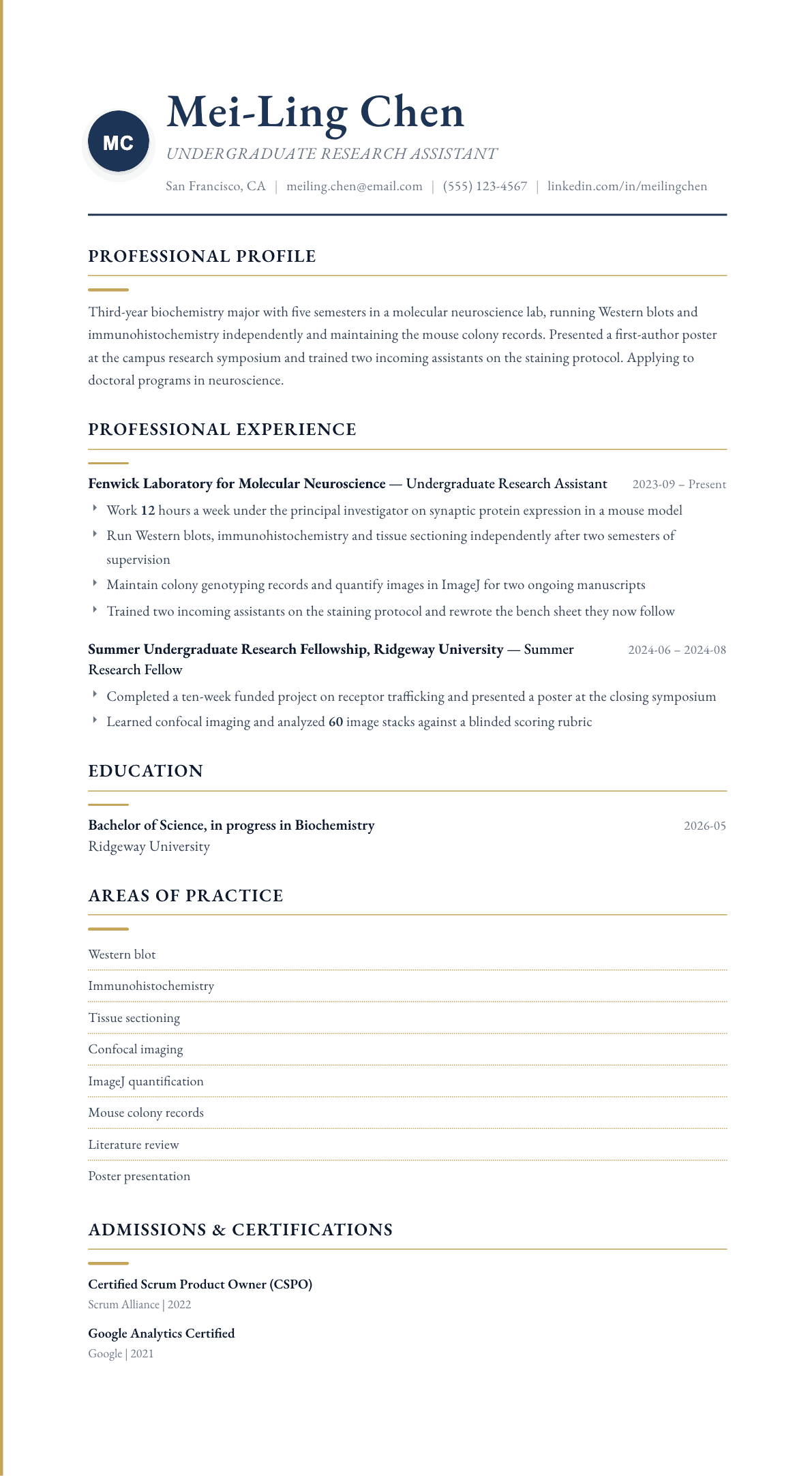
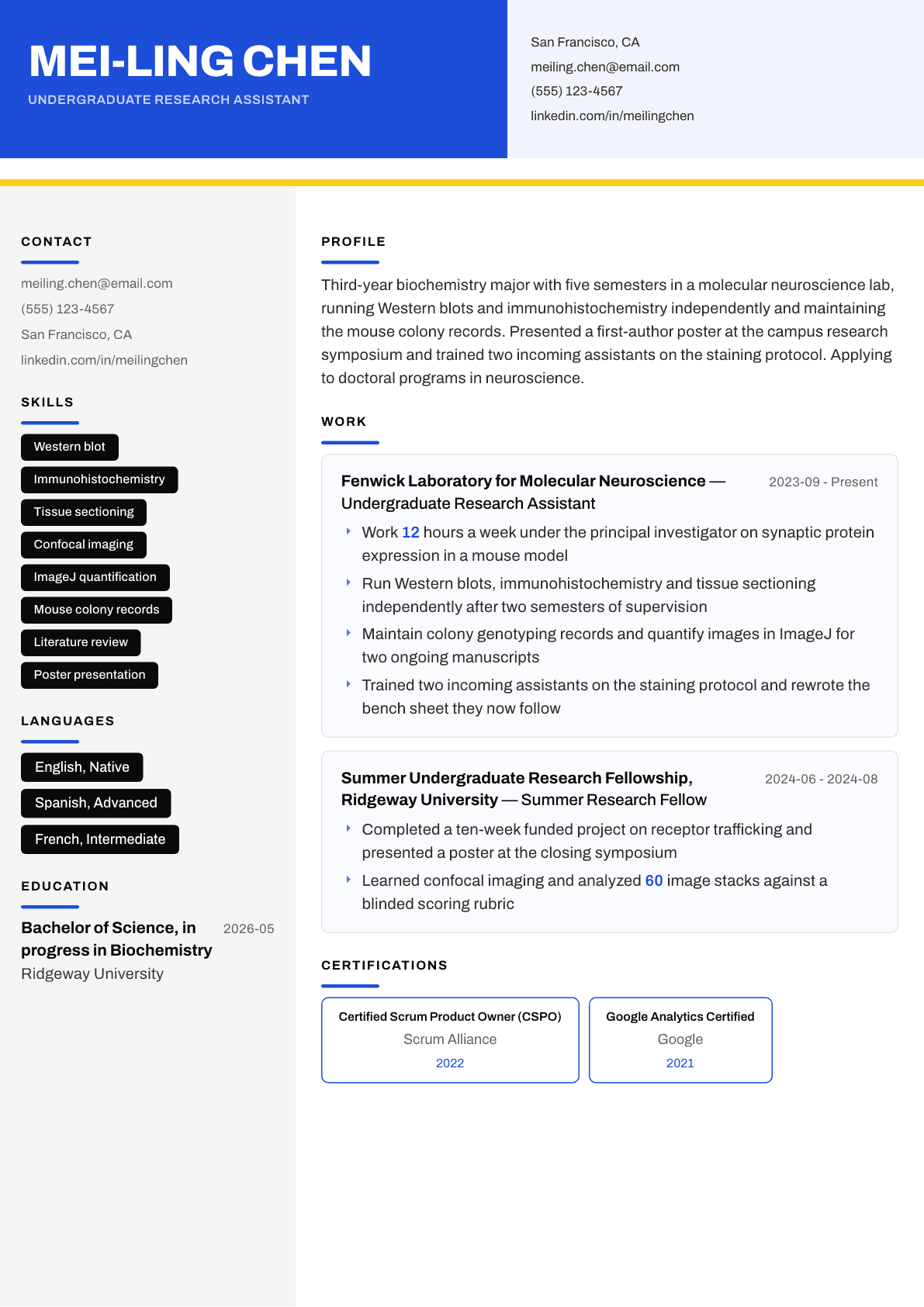
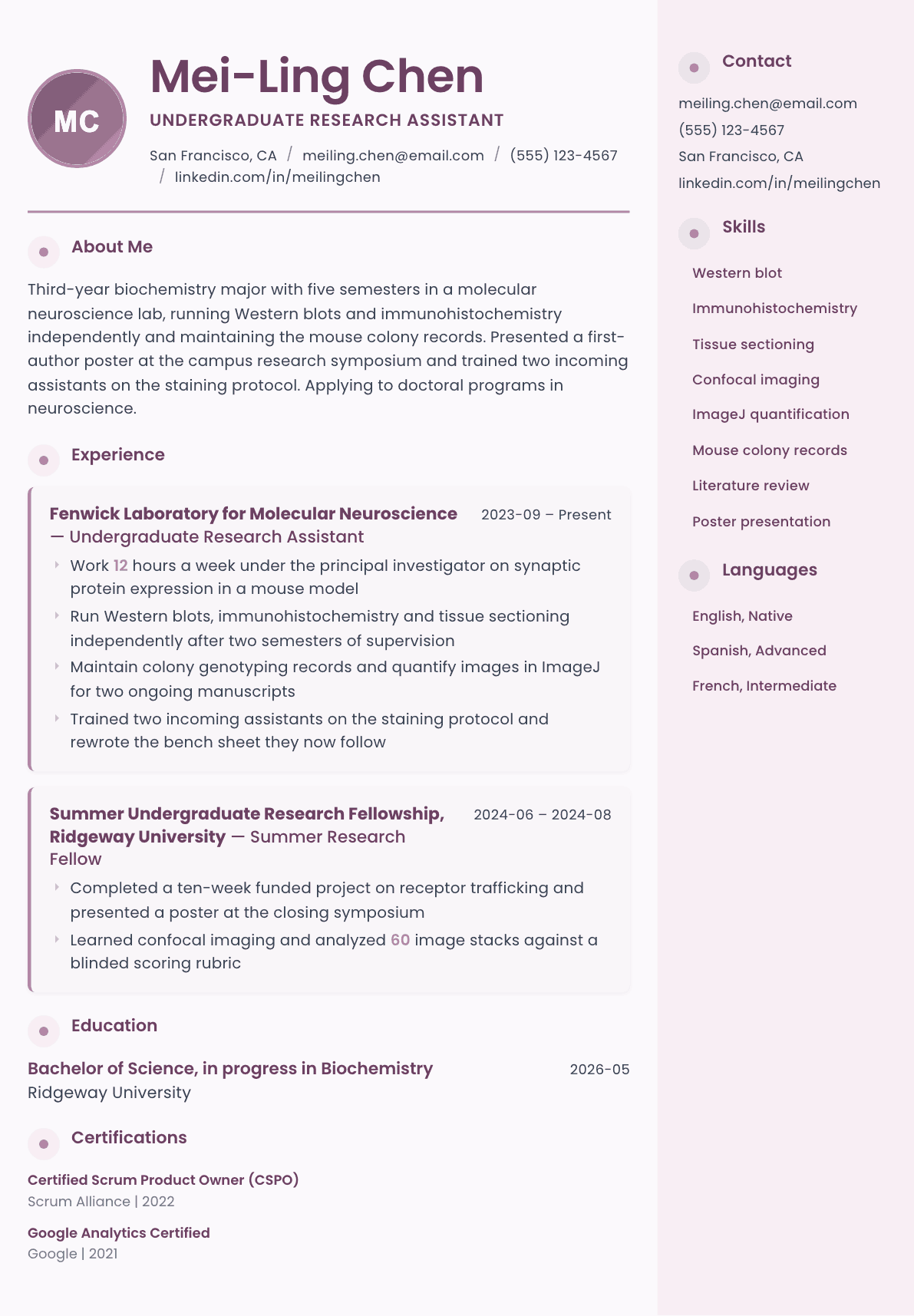
The same undergraduate research assistant content laid out in three CVBooster templates, so you can see what the finished document looks like before you write a word.
Example Undergraduate Research Assistant summary
Biochemistry undergraduate with five semesters in a molecular neuroscience laboratory, running Western blots, immunohistochemistry and tissue sectioning independently and quantifying images in ImageJ for two active manuscripts. Presented a poster from a ten-week funded summer fellowship and trained two incoming assistants on the staining protocol. Applying to doctoral programs and seeking a technician position in the interim.
Skills to list on a Undergraduate Research Assistant resume
- Experimental protocol execution
- Western blot and gel electrophoresis
- Immunohistochemistry staining
- Cell culture technique
- Tissue sectioning and mounting
- Confocal and fluorescence microscopy
- ImageJ and image quantification
- Laboratory notebook discipline
- Data entry and record keeping
- Literature search and citation management
- Poster design and presentation
- Statistical analysis in R
- Animal colony record keeping
- Laboratory safety compliance
What actually gets this resume read
- Name the laboratory, the principal investigator and the research question rather than writing assisted with research.
- Separate the techniques you run alone from the ones you still perform under supervision, and say so.
- Give hours per week and semesters served, since a principal investigator is buying continuity above all else.
- List posters, symposium talks and any authorship in a dedicated section with venue names and dates.
- Record your training compliance modules, because a lab cannot let you touch a protocol without them.
- Ask the principal investigator before naming unpublished project titles, and describe the area instead if asked.
How to write a undergraduate research assistant resume
A principal investigator reading an undergraduate application is doing a cost calculation. Training a new pair of hands costs a graduate student weeks of supervision, reagents and a share of the lab's attention, and most undergraduates leave before that investment pays back. So the question behind every line of the resume is simple: how long will you stay, and how quickly will you become useful.
That reframes what belongs on the page. Grade point average matters less than most applicants assume, and continuity matters far more. Semesters served in one laboratory, hours per week, techniques you now run without supervision and training modules already completed all speak directly to the calculation. A student who has been in the same lab for five semesters and trained the two people who came after her is a different proposition from one listing six unrelated activities.
This guide covers naming the lab and the research question properly, splitting techniques by supervision level, presenting posters and authorship, handling unpublished work you may not describe, and turning an undergraduate research record into a doctoral application or a technician job.
Name the laboratory, the investigator and the question
Write the entry the way the field writes it: the laboratory name, the institution, the principal investigator, your title and the date range. Then one line on the research question, phrased so a scientist outside the subfield can follow it. Assisted with ongoing research tells a reader nothing, while a line on synaptic protein expression in a mouse model places the work immediately.
State hours per week and semesters served, and keep both honest. Twelve hours a week across five semesters is a substantial commitment and reads as one. Padding it invites a question in an interview that you cannot answer, because a working scientist knows how long a blot takes.
- Laboratory name, institution, principal investigator and your title.
- A one-line research question in plain language, with the model system.
- Hours per week and the number of semesters, including summers separately.
- Funding source when the position was funded, such as a named fellowship or a work-study line.
- Your role in relation to the group: whether you support a graduate student or run your own aim.
Split techniques by what you run alone and what you run supervised
The techniques section is the part a principal investigator reads closest, and the useful version separates independent work from supervised work. Running Western blots and immunohistochemistry end to end after two semesters is a concrete, checkable claim. Listing a dozen methods with no supervision level attached reads as a syllabus rather than a skill set.
Include the whole workflow, not just the glamorous step. Solution preparation, sample logging, sectioning and mounting, microscope time, image quantification, and the record keeping that ties a sample to a result. Undergraduates who describe only the assay tend to be the ones who cannot find a specimen from three months ago, and investigators know it.
Name the analysis tools too. Image quantification software, statistical work in R or a comparable package, reference management, and the electronic notebook system the lab uses. Analysis capability is the most common gap in an undergraduate profile, so evidence of it stands out.
- Independent techniques, with the number of semesters you have run each unsupervised.
- Supervised techniques, named honestly with who supervises them.
- Sample handling and record keeping: logging, storage, chain of custody within the lab.
- Analysis: image quantification, statistical software, blinded scoring where applicable.
- Instrumentation you are trained and booked on, such as a confocal or a plate reader.
Posters, authorship and the work you cannot describe yet
Give presentations and publications a dedicated section in the field's citation style, with the venue and date. A poster at a campus symposium counts, and so does an abstract at a regional meeting. Undergraduates routinely leave these off because they feel minor, but they are direct evidence that you can package a result for an audience, which is a large part of what research training produces.
Be scrupulous about authorship. List an author position only where it has been agreed, mark anything under review as under review with the journal only if the group is comfortable naming it, and never list a manuscript in preparation as though it were published. The field is small and this is checked.
For unpublished projects, ask the principal investigator what you may describe before the resume leaves your hands. Where a title is sensitive, describe the area and your technical contribution instead. A student who handles this correctly is telling a future supervisor something valuable about how they will handle the lab's unpublished data.
Training, compliance and the credentials that let you touch the work
Laboratories cannot let an untrained student near a protocol, so completed training is not administrative trivia, it is the thing that lets you start in week one instead of week five. List the human subjects or animal care modules you have completed, laboratory safety training, bloodborne pathogen or chemical hygiene training and any instrument-specific certification the institution requires.
Where you have worked under a protocol approved by an institutional review board or an animal care and use committee, say so plainly. Understanding that work happens under an approved protocol, and that deviations get reported, is a maturity signal that separates a trained undergraduate from an enthusiastic one.
- Human subjects or animal research training modules, with the completion date.
- Laboratory safety, chemical hygiene and biosafety level training.
- Instrument training records and booking privileges.
- Experience working under an approved protocol and reporting deviations.
- Confidentiality obligations where the work involves participant data.
Aiming the page at a doctoral application or a technician job
These two destinations want different emphases from the same record. A doctoral application rewards intellectual ownership: the question you asked, the hypothesis you tested, the literature you read, the presentation you gave and the reason you want this field rather than another. A technician application rewards throughput and reliability: how many samples you process, how consistently, and how well you keep records.
Both are reading for continuity. Staying in one laboratory for years, taking on the training of newer students and writing the bench sheet that outlasts you are the strongest signals an undergraduate can send, because they are the only evidence available that you will still be there when the investment pays back.
Undergraduate Research Assistant resume summary examples
First semester in a lab
Second-year biology major in a first laboratory placement, working 8 hours a week on media preparation, sample logging and supervised cell culture. Completed institutional laboratory safety and animal care training in 2025. Seeking to continue through the summer and take on an independent aim.
Three semesters in
Biochemistry undergraduate with five semesters in a molecular neuroscience laboratory, running Western blots, immunohistochemistry and tissue sectioning independently and quantifying images in ImageJ for two active manuscripts. Trained two incoming assistants on the staining protocol and rewrote the bench sheet they follow.
Senior year with an independent project
Senior thesis student holding an independent aim on receptor trafficking, with a first-author poster presented at a regional meeting in 2025 and a contributing author position on a manuscript under review. Runs confocal imaging and blinded scoring, and manages the colony genotyping records for the group.
Work experience bullets: before and after
Before: Assisted a graduate student with research in a biology lab.
After: Work 12 hours a week in a molecular neuroscience laboratory on synaptic protein expression in a mouse model, supporting two aims under the principal investigator and a fourth-year graduate student.
The hours, the question and the reporting line let a scientist picture exactly where you sat in the group.
Before: Experienced in Western blotting and immunohistochemistry.
After: Run Western blots and immunohistochemistry end to end, from lysate preparation through imaging, after two semesters of supervised practice, and section tissue on a cryostat independently.
Naming the full workflow and the point at which supervision ended makes the capability claim checkable.
Before: Helped analyze the data for the project.
After: Quantified 60 confocal image stacks in ImageJ against a blinded scoring rubric, and produced the figure panels used in two ongoing manuscripts.
Volume, method and the blinding show real analytical work rather than assistance with someone else's numbers.
Before: Trained new students in the lab.
After: Trained two incoming undergraduate assistants on the staining protocol and rewrote the one-page bench sheet the group now uses for every run.
A durable artifact plus a trainee count proves you know the protocol well enough to teach it.
Before: Presented a poster at a symposium.
After: Presented a first-author poster on receptor trafficking at the campus research symposium in 2025 following a ten-week funded summer fellowship.
Author position, topic, venue and the funded program behind it turn a line into a verifiable credential.
Hard skills
- Experimental protocol execution
- Western blot and gel electrophoresis
- Immunohistochemistry and staining
- Cell culture and sterile technique
- Cryostat sectioning and mounting
- Confocal and fluorescence microscopy
- ImageJ quantification
- Statistical analysis in R
- Laboratory notebook discipline
- Sample logging and storage records
- Animal colony and genotyping records
- Literature search and citation management
- Poster design and scientific presentation
- Solution and reagent preparation
Soft skills
- Repeating a failed run without losing patience
- Asking a graduate student a question at the right moment
- Keeping records someone else can follow months later
- Working to a protocol rather than to intuition
- Fitting bench hours around a course schedule
Certifications worth listing
- Human Subjects Research, Biomedical (CITI Program)
- Responsible Conduct of Research (CITI Program)
- Working with the IACUC (CITI Program)
Mistakes that cost undergraduate research assistant candidates the interview
- Writing assisted with research rather than naming the laboratory, the investigator and the question.
- Listing a dozen techniques with no indication of which ones you can run without supervision.
- Leaving off hours per week and semesters served, the two facts that answer the continuity question.
- Omitting posters and abstracts because they felt too small to count as scientific output.
- Claiming an author position that has not been agreed, or listing a draft manuscript as published.
- Describing an unpublished project title without asking the principal investigator first.
- Ignoring the analysis side entirely, which is the most common gap in an undergraduate profile.
Undergraduate Research Assistant resume questions
How much lab experience do I need before applying to a research position?
None for a first placement. Investigators taking on beginners are buying availability and reliability, so lead with your hours, your course background and any completed safety training rather than techniques you have not yet learned.
Should I list techniques I have only performed once?
List them under supervised or exposure, never among the methods you run independently. Investigators test technique claims quickly, and an honest split makes the rest of the list far more believable.
How do I include a poster or an abstract on my resume?
Give presentations their own section in the citation style your field uses, with all authors in order, the title, the venue and the date. A campus symposium poster counts, and it is direct evidence you can package a result.
Can I write about a project that has not been published yet?
Ask the principal investigator first. Where the title is sensitive, describe the research area and your technical contribution without the specific finding. Handling it that way signals that you can be trusted with unpublished data.
What matters most to a principal investigator reviewing an undergraduate application?
Continuity and reliability above everything. Semesters you can commit, hours per week, a completed training record and evidence that you stayed somewhere long enough to become useful outweigh a slightly higher grade average.