Fundraising Manager Resume Examples: what gets the call
Raise the Bar with a Fundraising Manager Resume
By Mustafa Tarabya, founder of CVBooster · Published · Updated
Create a fundraising manager resume that demonstrates your major gifts, event planning, and donor cultivation expertise.
Sample resumes for a fundraising manager
The same fundraising manager content laid out in three CVBooster templates, so you can see what the finished document looks like before you write a word.
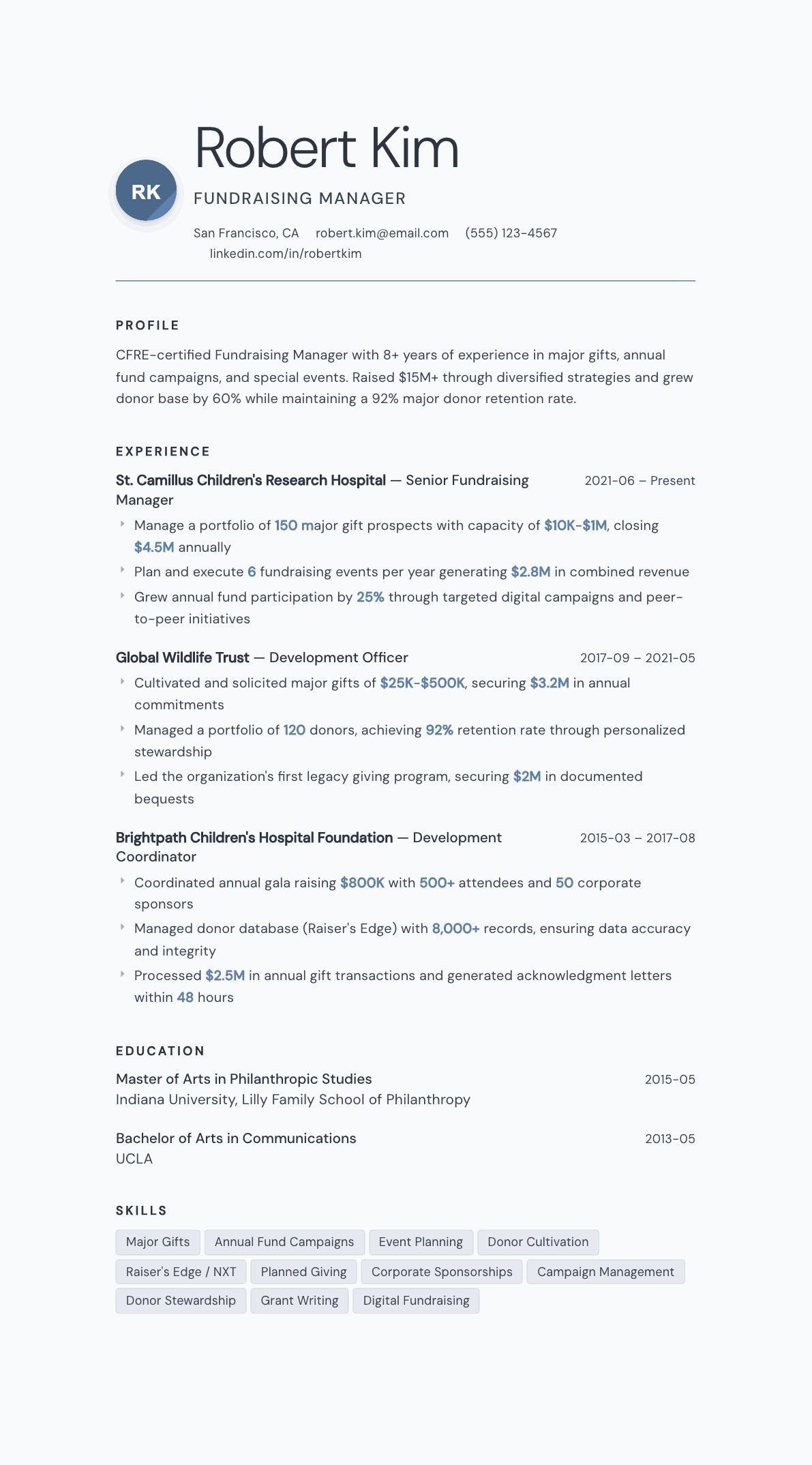
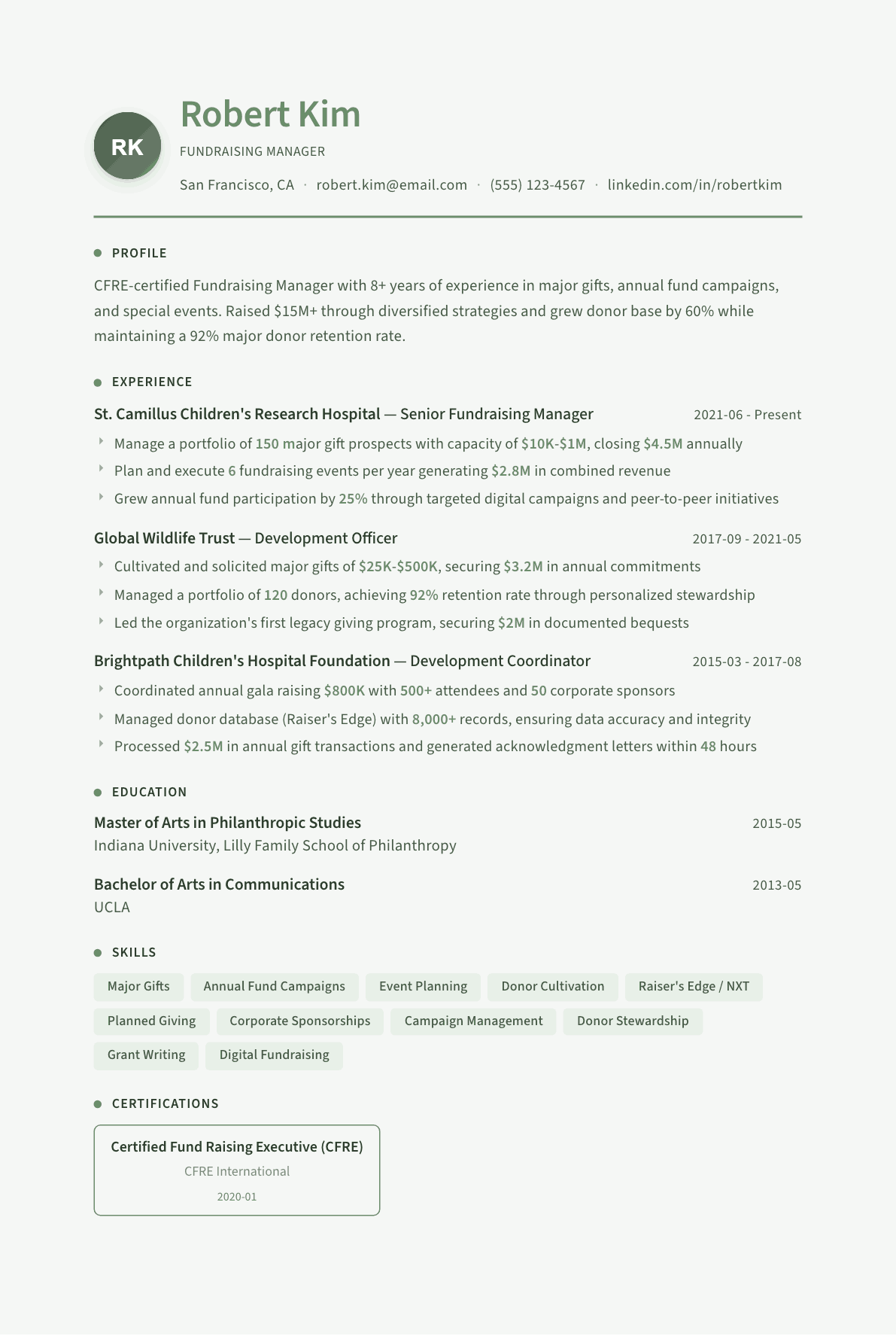
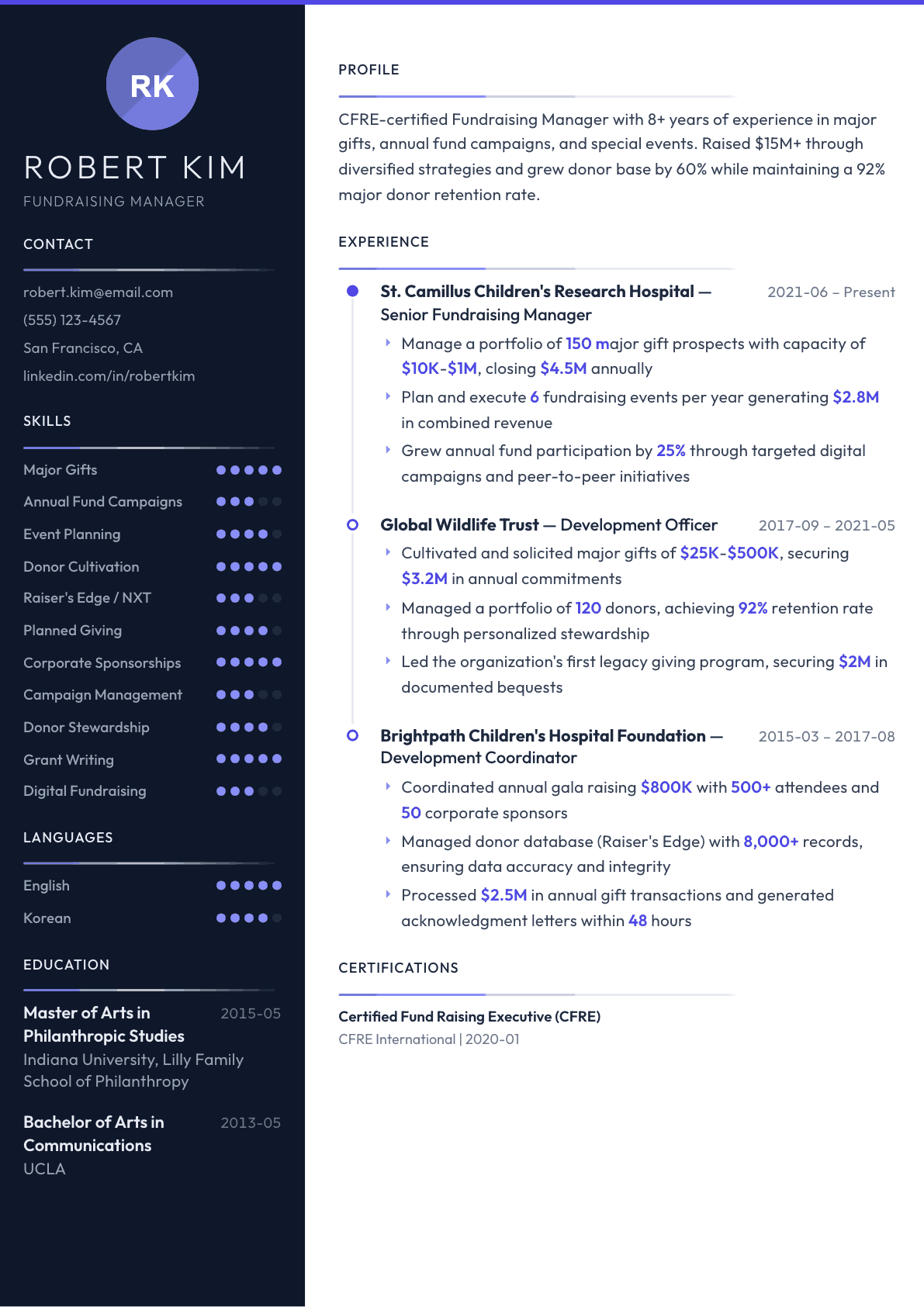
Example Fundraising Manager summary
CFRE-certified Fundraising Manager with 8 years of experience raising $15M+ through major gifts, events, and annual fund campaigns. Maintains a 92% major donor retention rate with a portfolio of 150+ prospects. Seeking a director of development role.
Skills to list on a Fundraising Manager resume
- Major Gift Fundraising
- Annual Fund Management
- Event Planning
- Donor Cultivation & Stewardship
- Raiser's Edge / Salesforce
- Planned Giving
- Corporate Sponsorships
- Capital Campaigns
- Digital Fundraising
- Grant Writing
- Board Development
- Prospect Research
- Donor Analytics
- Peer-to-Peer Campaigns
What actually gets this resume read
- Lead with total dollars raised and your personal solicitation track record.
- Include your CFRE certification prominently. It is the recognized standard in fundraising.
- Quantify donor metrics: portfolio size, retention rate, average gift size, donor base growth.
- Highlight diverse fundraising channels: major gifts, annual fund, events, digital, planned giving.
- List fundraising CRM experience: Raiser's Edge, DonorPerfect, Bloomerang, Salesforce NPSP.
- Show event management skills with specific revenue generated and attendance numbers.
How to write a fundraising manager resume
A fundraising manager sits between the strategy and the execution, and the resume has to prove both hands work. The hiring chief development officer wants a manager who can carry gift conversations personally, run an appeal calendar that actually goes out on time, and keep a gala or a peer-to-peer event from eating the whole year for a small net.
Most fundraising manager resumes read like an event program: names of galas, names of campaigns, names of committees. What is missing is the arithmetic that a development leader lives by. Cost to raise a dollar. Net rather than gross. Response rate on the appeal. Average gift and where it moved. Renewal rate for last year's donors. Those numbers are what turn a list of activities into a manager.
This guide walks through the sections, the metrics to attach to each revenue stream, summaries from a first management role through a manager who runs a full program, and rewrites that make an event or an appeal legible to someone who has run one.
Format: one to two pages organized by revenue stream
Keep it to one page under five years and two after. Inside each job, group bullets by revenue stream rather than by chronology: individual giving, events, corporate and sponsorship, and stewardship. A reader hiring for an events-heavy role can then find the events block instantly instead of reading everything.
Open each job with a one-line scope: the organization type, the contributed revenue in your area, the size of the donor file, and who you supervised, including any coordinators, interns or volunteer committees.
- Header: name, credentials such as CFRE, city, phone, email.
- Order: summary, experience by stream, systems, education, credentials, volunteer leadership.
- Group bullets by stream so a reader can find the part of the job they are hiring for.
Summary: the streams you run and the file you know
Name the streams you personally manage and the size of the donor file behind them. A manager who runs a mailed and emailed annual appeal to a file of eighteen thousand names is doing a different job from one who manages forty corporate sponsors, and hiring managers are filling one of those shapes.
If you hold a portfolio, say the gift range. Manager titles cover everything from a coordinator with a fancier name to a frontline fundraiser with a hundred prospects, and the range is the fastest way to place yourself.
Events: net, not gross, and what happened to the attendees after
Event bullets fail when they report gross revenue and attendance and stop. Report the net, the expense ratio, sponsorship secured against the sponsorship goal, and how many attendees became donors afterward. A gala that raises well and converts nobody is a treadmill, and every development leader has been on one.
Show the operational side too, because that is what the manager actually does: vendor contracts and deposits, run of show, auction and paddle raise structure, volunteer committee management, table captain recruitment, and the post-event acknowledgment timeline. If you moved a peer-to-peer or a giving day online, name the platform and the fundraiser recruitment number.
- Net revenue and expense ratio, alongside gross.
- Sponsorship secured versus goal, and renewal rate of sponsors.
- Attendee-to-donor conversion after the event.
- Committee and table captain recruitment numbers.
- Platform used for peer-to-peer or a giving day, and fundraisers recruited.
Annual giving: response rate, average gift, renewal
For appeals, give the number of pieces mailed, the segments, the response rate, the average gift and the renewal rate for the prior year's donors. Then say what you tested. A manager who ran an A and B test on the ask string or the outer envelope and can report which won is showing a discipline most small shops never build.
Sustainer programs deserve their own bullets. Report the number of monthly donors, the monthly value, the attrition rate and how you recover failed card charges, because recurring revenue is the line every leader is trying to grow and card failures quietly erode it.
Systems, stewardship and the unglamorous half
Name the database you can build a query in, not the ones you have seen: Raiser's Edge NXT, Salesforce Nonprofit Success Pack, Bloomerang, Little Green Light, DonorPerfect, Neon. Add the peer-to-peer and payment platforms, the email tool, and any wealth screening you have run.
Then show stewardship, which is where retention is actually made. Acknowledgment turnaround in days, tribute and memorial gift handling, pledge reminders, impact reporting to restricted donors, and the donor-level segmentation that decides who gets a call rather than a letter.
Fundraising Manager resume summary examples
First management role
Fundraising manager with 3 years in annual giving for an arts nonprofit, running 4 appeals a year to a file of 9,000 donors and managing a spring benefit that netted above goal twice. Grew the monthly sustainer program from 60 to 210 donors.
Six years in
Fundraising manager with 6 years across individual giving and events, carrying a 70-prospect portfolio in the low five figures while managing a gala, a giving day and a peer-to-peer ride. Lifted donor renewal from 48% to 61% by rebuilding acknowledgment and mid-level stewardship.
Full program manager
CFRE-certified fundraising manager with 10 years leading individual, event and corporate revenue for a health nonprofit, supervising 3 staff and a 20-member volunteer committee. Cut event expense ratio by a third while growing net, and built a sustainer program past 900 donors.
Work experience bullets: before and after
Before: Planned and executed the annual gala.
After: Managed a 450-guest annual benefit end to end: secured 22 sponsors against a goal of 18, held the expense ratio at 24%, and converted 63 first-time attendees into annual fund donors within 90 days.
Sponsors against goal, expense ratio and post-event conversion are the three numbers an event is actually judged on.
Before: Sent out fundraising appeals to donors.
After: Built a 4-appeal calendar segmented into 6 audiences, mailed to a file of 9,000 with a matched email series, and lifted response rate from 3.1% to 4.4% after testing two ask strings.
Segments, volume, a tested variable and a response rate change turn mailing into program management.
Before: Grew monthly giving.
After: Grew the sustainer program from 60 to 210 monthly donors through a dedicated landing page and an upgrade ask at year end, and recovered 40% of failed card charges with a 3-touch retry sequence.
The acquisition path and the card recovery detail show you understand where recurring revenue leaks.
Before: Managed corporate sponsorships.
After: Rebuilt the sponsorship deck into 4 tiers with defined benefits, renewed 17 of 20 sponsors, and added 6 new partners by pitching employee volunteer days alongside the check.
Tier structure, renewal count and a named acquisition tactic prove sponsorship work rather than order taking.
Before: Thanked donors and sent acknowledgments.
After: Cut acknowledgment turnaround from 21 days to 3 by rebuilding letter templates by gift level in Raiser's Edge NXT, and added a volunteer call program for every first-time gift above a set threshold.
Turnaround time and a named system change make stewardship a measurable operation instead of a courtesy.
Hard skills
- Annual fund appeals and segmentation
- Donor renewal and retention analysis
- Event budgeting and expense ratios
- Sponsorship packaging and renewal
- Peer-to-peer and giving day campaigns
- Monthly sustainer programs
- Moves management for a small portfolio
- Raiser's Edge NXT queries and reports
- Bloomerang and DonorPerfect
- Gift processing and acknowledgment workflow
- Direct mail production and vendor management
- Email fundraising and landing pages
Soft skills
- Volunteer committee management
- Vendor negotiation
- Calm under event pressure
- Donor conversation
- Attention to gift detail
- Deadline discipline
Certifications worth listing
- Certified Fund Raising Executive (CFRE) (CFRE International)
- Certified Special Events Professional (CSEP) (International Live Events Association)
Mistakes that cost fundraising manager candidates the interview
- Reporting gross event revenue with no expenses, when the person hiring you thinks in net.
- Listing appeals by season without response rates, average gift or renewal, which are the only comparable numbers.
- Describing a database as a skill when you have only entered gifts and never built a query or a segment.
- Padding the resume with committee names and honorary chairs instead of what you recruited and managed.
- Ignoring stewardship, which is where retention is won and where most small shops are visibly broken.
- Claiming a portfolio without naming the gift range, so a reader cannot tell a frontline role from a coordinator role.
Fundraising Manager resume questions
Should a fundraising manager resume lead with events or with individual giving?
Lead with whichever the posting emphasizes and keep both visible. Read the job description for where the revenue pressure sits. If it names a signature event three times, your event block belongs first in every job.
How do I show results when my organization is small and the numbers are modest?
Use rates and ratios rather than totals. Response rate, renewal rate, expense ratio, sustainer growth and acknowledgment turnaround are scale-independent, and a manager who improved those at a small shop reads as capable at a larger one.
Is the CFRE worth pursuing at the manager level?
It is optional and requires documented experience and education hours plus an exam, but it does distinguish you in a crowded applicant pool and some postings list it as preferred. Many managers pursue it while in the role rather than before.
How do I describe fundraising results when someone else closed the gifts?
Describe the part you owned: the pipeline you built, the proposals you drafted, the visits you scheduled, the materials that carried the ask. Development leaders can tell the difference and they respect precision more than an inflated attribution.
What belongs in a fundraising manager skills section?
The database you can query, the email and payment platforms, the peer-to-peer tool, and the specific program mechanics such as segmentation, moves management and pledge administration. Leave out generic teamwork claims and prove those inside the bullets instead.
Related resume examples
- Development Director Resume example
- Grant Writer Resume example
- Executive Director (Nonprofit) Resume example
- Executive Director Resume example
- COO Resume example
- Startup Founder Resume example