Product Analyst Resume Examples: the lines they read
Build a Product Analyst Resume Around Decisions You Changed
By Mustafa Tarabya, founder of CVBooster · Published · Updated
A product analyst resume example with funnel analysis, experiment work, SQL keywords, and a guide to writing analytics experience for product teams.
Sample resumes for a product analyst
The same product analyst content laid out in three CVBooster templates, so you can see what the finished document looks like before you write a word.
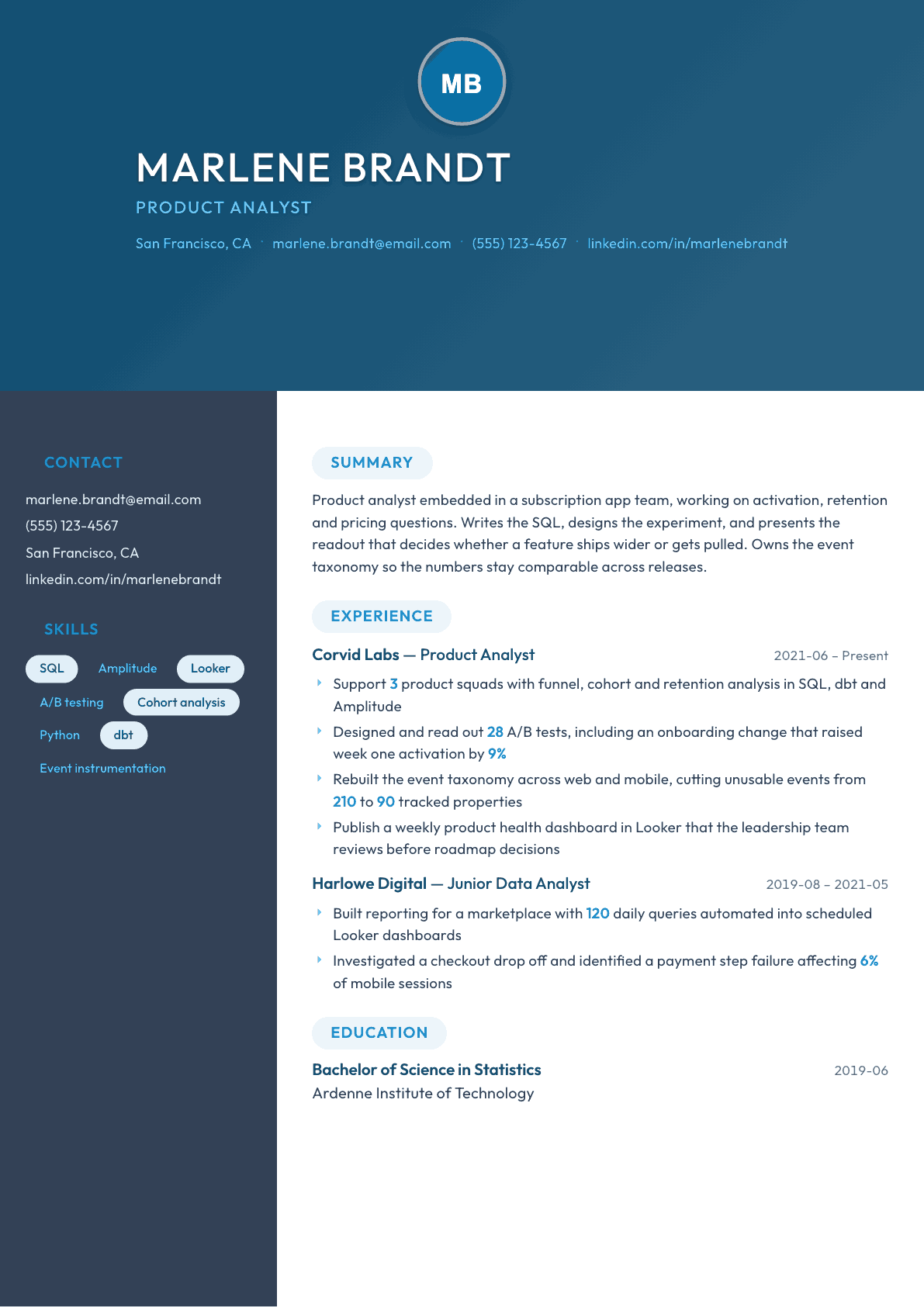
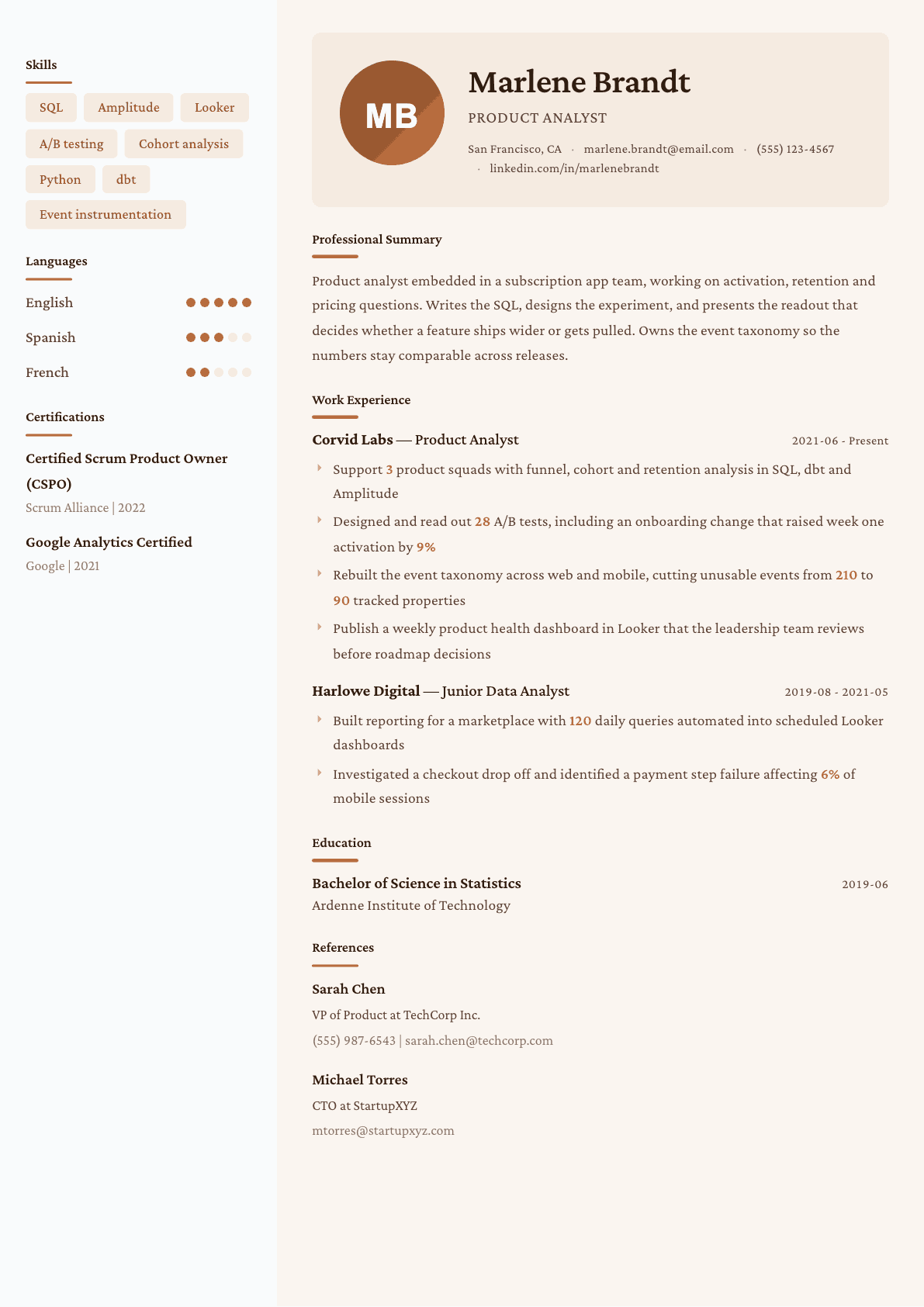
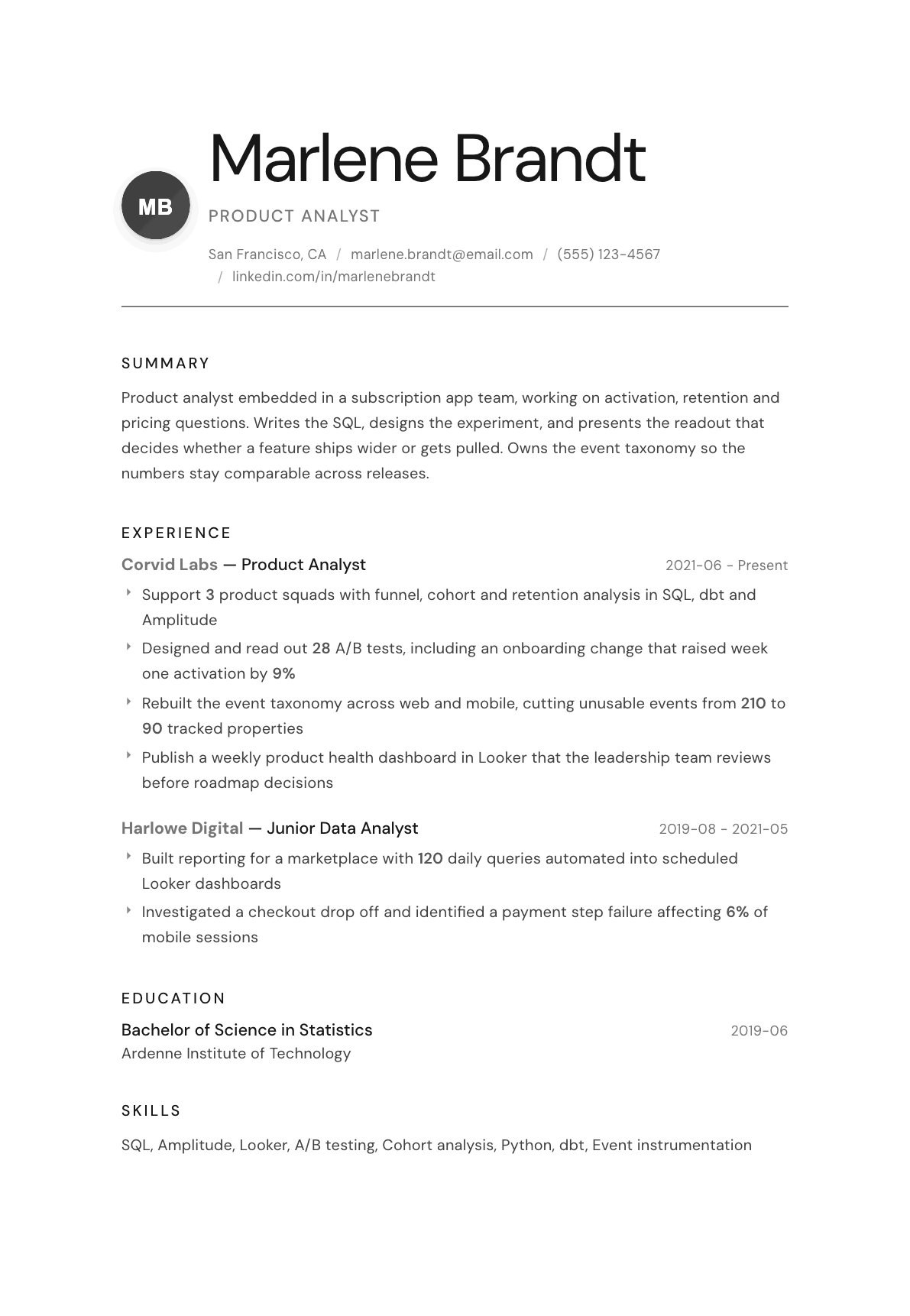
Example Product Analyst summary
Product analyst with four years supporting subscription app squads on activation, retention and pricing. Writes the SQL, designs the experiment and presents the readout that decides a launch, including an onboarding test that raised first week activation. Rebuilt an event taxonomy across web and mobile so releases stayed comparable. Looking for a senior product analytics role that owns a full metric area.
Skills to list on a Product Analyst resume
- SQL
- Product analytics
- A/B testing
- Funnel analysis
- Cohort and retention analysis
- Event instrumentation
- Experiment design
- Amplitude
- Mixpanel
- Looker
- dbt
- Python
- Dashboard design
- Metric definition
- Stakeholder communication
What actually gets this resume read
- Lead every bullet with the decision your analysis changed rather than with the chart or dashboard you produced.
- Name your analytics stack precisely, because product teams screen for SQL plus a specific event analytics platform.
- Show experiment volume and rigor together: tests read out, how you set power, and how often results were inconclusive.
- Mention event instrumentation and taxonomy work, since data quality ownership is what separates analysts from reporters.
- Give the product context in each role: the funnel stage, the user type, and the metric the team was accountable for.
- Keep one line on how you communicate findings, whether written readouts, weekly reviews or self serve dashboards.
How to write a product analyst resume
A product analyst is hired to make a product team less wrong. The screener, usually an analytics lead or a head of product, is reading for three things: can you write the query yourself, do you understand how the product creates value, and can you tell a room of engineers and designers something they did not want to hear. Dashboards built is not evidence of any of those.
The common weakness in product analyst resumes is reporting language. Bullets describe deliverables: built a dashboard, produced a weekly report, maintained tracking. Every one of those hides the interesting part, which is the decision on the other side. A feature that got cut, an onboarding step that got removed, a pricing test that ended early: those are the sentences that get an interview.
This guide covers how to structure the page around decisions rather than deliverables, how to write experiment work so a rigorous reader trusts it, how much data engineering to claim, and the questions analysts ask when moving from business intelligence into product analytics.
Format: one page, stack visible, product context under every role
One page holds almost every product analyst career under eight years. Put a compact technical stack line high on the page covering query language, transformation layer, product analytics platform and visualization tool. Analytics leads scan for that combination before they read anything else, because it decides how long onboarding takes.
Under each job title, add a product context line: what the product is, who uses it, the business model and the metric the team was accountable for. Activation on a freemium mobile app and renewal on an enterprise contract are completely different analytical worlds, and your bullets only make sense inside that context.
- Stack line: SQL, dbt or equivalent, event platform, visualization tool, language for modeling.
- Product context: product, user, model, team metric.
- Section order: summary, stack, experience, projects if relevant, education.
Experience: lead with the decision, follow with the analysis
Invert the way you naturally write. Instead of describing the analysis and ending with what happened, open the bullet with the outcome and let the method follow. The reader can then stop after the first clause and still know why the bullet is on the page.
Cover the range of question types a product analyst handles, because breadth is what makes you staffable. Funnel and drop off analysis, cohort retention, feature adoption, segmentation, pricing and packaging analysis, forecasting, and root cause investigation on a metric that moved unexpectedly are the standard set. Two or three of these done well beats a list of all of them claimed shallowly.
Include at least one investigation bullet. The analyst who found the payment failure behind a checkout drop, or the tracking bug behind a fake retention spike, is the analyst product managers trust, because it shows you check the data before you present it.
- Funnel, retention, adoption, segmentation, pricing, forecasting.
- One investigation where you found a cause nobody had suspected.
- One case where the analysis argued against something the team wanted to do.
Experimentation: volume plus rigor, never volume alone
Say how many tests you designed and read out, and then show the rigor. Sample size planning, minimum detectable effect, guardrail metrics, test duration rules, and how you treated inconclusive results are the details that separate an analyst who runs experiments from one who reads dashboards after a release.
Be honest about inconclusive tests. A resume claiming that every experiment produced a lift reads as either selective or unrigorous. Writing that a share of tests were flat and that you established a rule for when to stop is a credibility signal to anybody who has run a real testing program.
If your company runs an experimentation platform, name it, and say whether you configured assignment and metrics or only analyzed the output.
Data quality and instrumentation: claim what you actually did
Product analysts increasingly own the event taxonomy, and it is worth its own bullets. Describe the tracking plan you wrote, the properties you standardized, the events you retired, and how you validated new instrumentation before a release rather than after. This is the work that keeps a metric comparable across versions, and product leaders feel its absence painfully.
Be precise about the boundary between you and data engineering. Claiming pipeline ownership you did not have collapses in a technical interview. Writing that you built dbt models on top of ingested event data, or that you specified events and verified them with engineers, is both defensible and more useful to a reader deciding what to hire around you.
- Tracking plan authorship and event naming standards.
- Validation of instrumentation before release.
- Transformation models you own, and where the engineering boundary sits.
Product Analyst resume summary examples
First analytics role
Data analyst with two years supporting a marketplace product, writing SQL for funnel and cohort reporting and automating recurring queries into scheduled dashboards. Investigated a checkout drop off and traced it to a payment step failing on 6% of mobile sessions. Moving into a dedicated product analyst role.
Embedded with squads
Product analyst supporting three squads on a subscription app, covering activation, retention and pricing questions in SQL, dbt and Amplitude. Designed and read out 28 experiments, including an onboarding change that raised week one activation by 9%, and rebuilt the event taxonomy so releases stayed comparable.
Lead product analyst
Lead product analyst owning the metric framework for a consumer subscription business and mentoring two analysts. Built the retention model used in quarterly planning, set the experimentation standard covering power and guardrails, and reduced the time from question asked to answer delivered from a week to two days.
Work experience bullets: before and after
Before: Built dashboards for the product team.
After: Built a weekly product health dashboard in Looker covering activation, retention and feature adoption for three squads, which leadership now reviews before every roadmap prioritization session.
The rewrite names the tool, the metrics, the audience and the recurring decision the dashboard feeds.
Before: Ran A/B tests on the onboarding flow.
After: Designed and read out 28 experiments across onboarding and paywall placement, setting sample size and guardrail metrics in advance, and stopped four tests early after guardrails moved against us.
Volume plus method plus a stopped test reads as real experimentation rather than dashboard watching.
Before: Analyzed user retention.
After: Analyzed cohort retention by acquisition channel and found that one paid channel retained at half the rate of the others past week four, which moved budget away from it in the next planning cycle.
It names the cut, the finding and the budget decision that followed rather than the topic of the analysis.
Before: Improved data quality in the product.
After: Rebuilt the event taxonomy across web and mobile, retiring unused events and standardizing 90 tracked properties, then added a pre release validation step so new events were checked before launch.
The strong version shows what changed in the data and the process that keeps it from decaying again.
Before: Worked with product managers on feature analysis.
After: Partnered with two product managers on a feature adoption review that showed a heavily requested feature was used by a small share of accounts, and the team removed it from the roadmap.
An analysis that reversed a plan is the clearest possible proof of influence.
Hard skills
- SQL
- Product analytics platforms such as Amplitude and Mixpanel
- A/B testing and experiment design
- Funnel and drop off analysis
- Cohort and retention analysis
- Event instrumentation and tracking plans
- dbt transformation models
- Looker and Tableau
- Python for analysis
- Statistical inference
- Metric definition and governance
- Segmentation analysis
Soft skills
- Clear written readouts
- Skepticism about your own numbers
- Pushing back on stakeholders
- Translating questions into analyses
- Working inside squad rituals
Certifications worth listing
- Google Data Analytics Professional Certificate (Google)
- Microsoft Certified: Power BI Data Analyst Associate (Microsoft)
- Tableau Desktop Specialist (Salesforce)
Mistakes that cost product analyst candidates the interview
- Writing deliverables instead of decisions, so every bullet ends at the dashboard.
- Claiming a long list of tools with no depth shown in any of them.
- Reporting only successful experiments, which reads as selective to anyone who has run a testing program.
- Overstating ownership of pipelines that data engineering actually built and maintained.
- Leaving out the product and business model, without which the metrics have no meaning.
- Using percentages with no baseline, so a large sounding lift could be two users out of ten.
Product Analyst resume questions
What is the difference between a product analyst and a data analyst?
A product analyst sits inside a product team and answers questions about user behavior, features and pricing. A data analyst is often organization wide and serves finance, marketing and operations. The tooling overlaps, the stakeholders and the question types do not.
How much SQL do I need to show on a product analyst resume?
Enough to make clear you write your own queries against event and transaction tables. Mention window functions, cohort construction or funnel logic in context rather than claiming advanced SQL as a bare label.
Should I include experiments that produced no result?
Yes, framed properly. Saying a set of tests came back flat and describing the stopping rule you introduced shows judgment. Interviewers who run experimentation programs know that most tests do not win.
Do I need Python for a product analyst role?
Not everywhere. Many postings run on SQL and a product analytics platform. Python helps for cohort modeling, forecasting and anything statistical beyond a standard test, and it widens the roles you can apply for.
How do I show impact when the product manager made the final call?
Write the analysis and the decision it informed in the same bullet, without claiming the decision was yours. Phrases like the team removed the feature after this review credit the analysis honestly and read stronger than an inflated claim.
Related resume examples
- Data Analyst Resume example
- Business Analyst Resume example
- Product Manager Resume example
- Growth Manager Resume example
- Operations Analyst Resume example
- Data Analytics Consultant Resume example