Digital Marketing Manager Resume Examples: free score
Market Your Skills with a Digital Marketing Resume
By Mustafa Tarabya, founder of CVBooster · Published · Updated
Digital marketing resume guide with a written-out specialist sample, channel and budget bullets, three summaries by level and the keywords to use.
Sample resumes for a digital marketing manager
The same digital marketing manager content laid out in three CVBooster templates, so you can see what the finished document looks like before you write a word.
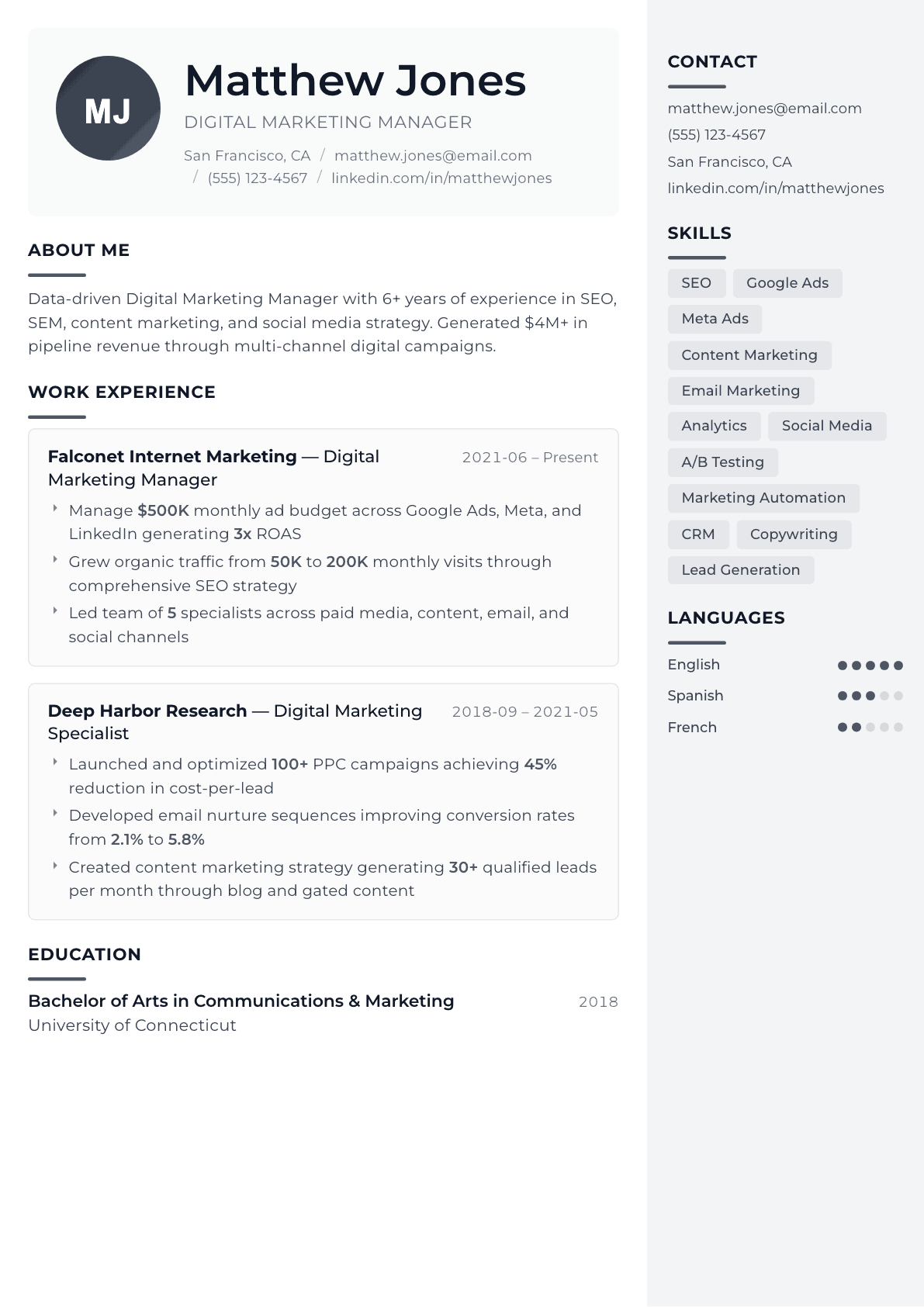
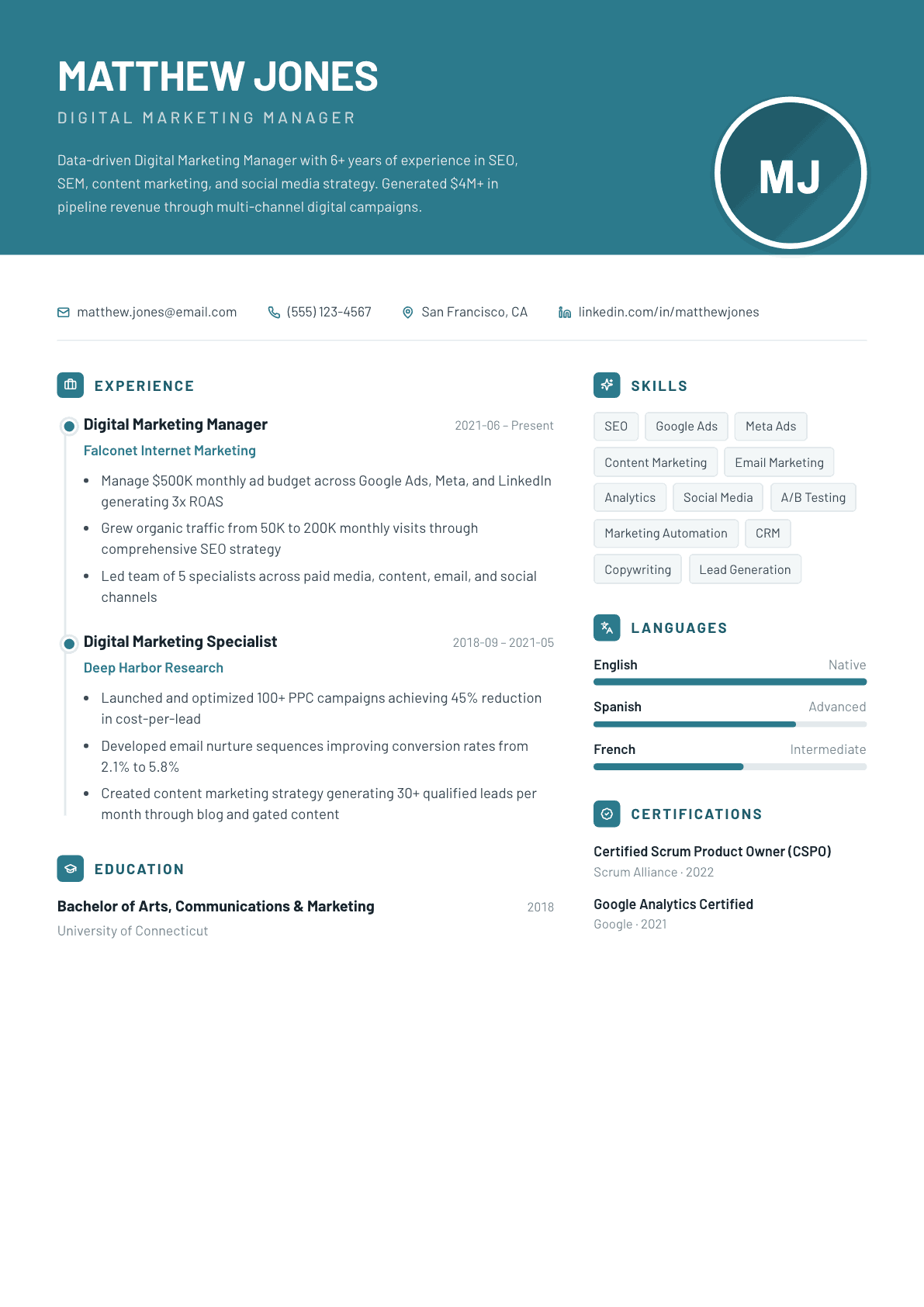
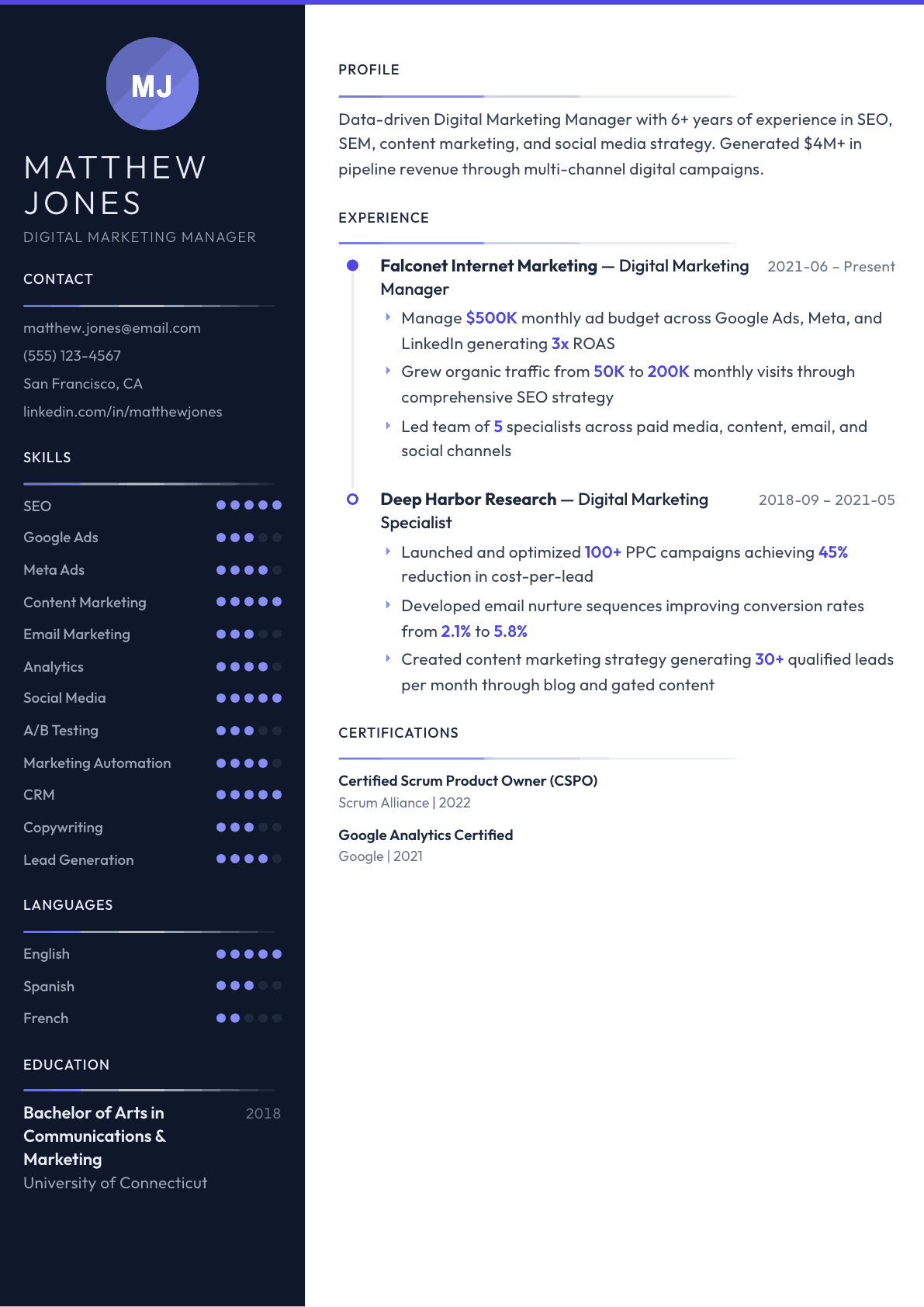
Example Digital Marketing Manager summary
Digital marketing manager, 6 years, running a $500K monthly ad budget across Google, Meta and LinkedIn at 3x return and leading five specialists. Took organic traffic from 50K to 200K monthly visits, and previously cut cost per lead 45% across 100 paid campaigns.
Skills to list on a Digital Marketing Manager resume
- SEO
- Google Ads
- Meta Ads
- Content Marketing
- Email Marketing
- Analytics
- Social Media
- A/B Testing
- Marketing Automation
- CRM
- Copywriting
- Lead Generation
What actually gets this resume read
- Lead with ROI and revenue metrics, not just impressions or clicks.
- Show budget management experience and ROAS/CPA achievements.
- List specific platforms and tools (Google Ads, HubSpot, Mailchimp).
- Include both B2B and B2C experience if applicable.
- Highlight team leadership and cross-functional collaboration.
How to write a digital marketing manager resume
A digital marketing manager resume is read by someone who has been burned before. Marketing directors see a steady supply of applicants who list ten channels, claim growth on all of them, and turn out in the interview to have briefed an agency and forwarded a dashboard. The screen is therefore built to separate operators from coordinators: which channels did you personally run, what budget did you hold, what did you decide when performance dropped, and what evidence do you have that anything you did affected revenue rather than impressions.
The second filter is business model. Paid acquisition for a low-price consumer product, demand generation for a long enterprise sales cycle, and lead generation for a local service business are three different disciplines that share vocabulary. A hiring manager reads for the model they run, so a resume that never names the buying cycle, the average order value band or the sales motion is difficult to place.
This guide covers the section order this role expects, how to present channel ownership and budget honestly, three summaries from a first manager job to a team lead, before-and-after bullets, and the questions digital marketers ask when their best results came from a team effort.
Format: one to two pages with a channel and budget block
One page under seven years, two beyond that. Directly under the summary, add a channel and scope block that a manager can read in five seconds: the channels you own, the monthly budget band you have managed, the business model, and the team or agencies you direct. Without it the reader has to infer your level from job titles that mean different things at different companies.
Keep the layout plain and single column. Applications for this role often pass through an applicant tracking system before a human reads them, and the parsers that handle marketing requisitions routinely scramble two-column files, dropping the dates that prove tenure.
- Header: name, title, city, email, LinkedIn.
- Scope block: channels owned, monthly or annual budget band, business model, team and agency scope.
- Sections in this order: summary, scope, experience, skills and platforms, certifications, education.
- Use one bullet per role for what you inherited, so growth numbers have a visible baseline.
Summary: model, channels, budget, and the number you own
Three lines. State the business model, the channels you run yourself, the budget scale, and the metric you are accountable for, whether that is cost per acquisition, return on ad spend, qualified pipeline, or subscriptions started. Data-driven as an opening adjective is empty; every applicant says it.
If you are moving between models, say so and name the transferable mechanics. A manager moving from consumer paid social to business demand generation should talk about audience testing, creative iteration and measurement rather than pretending to have run an enterprise motion.
Experience: own the channel, show the decision, name the outcome
Each role needs the context first: the company, what it sells, the model, and what marketing looked like when you arrived. Then bullets that go channel by channel with a decision inside each one. Reallocating budget away from a channel that stopped converting, rebuilding an account structure, killing a campaign type, moving from broad to intent-based targeting, changing the offer on a landing page.
Be precise about what you ran versus what you managed. Writing that you managed a paid search account through a rebuild of the campaign structure is a different claim from managing an agency that rebuilt it, and both are respectable. Managers screen hard for inflated ownership because it is discovered in the first technical question.
Then connect to revenue where you honestly can. Cost per acquisition and return on ad spend are strong when the denominator is named. Leads alone are weak unless you say what share became qualified or closed, because a manager who has been sent a pile of unqualified leads reads volume claims with suspicion.
Measurement, testing and the stack you actually operate
Say how you measure, since attribution is the recurring argument in this job. Name the analytics platform, the attribution view you work from, the conversion tracking you set up, and how you handle the gap between platform-reported conversions and the numbers in the CRM. A manager who can discuss that gap plainly stands out immediately.
Show a testing habit with structure: what you test, how often, how you decide a test is finished, and an example where the losing variant taught you something. Landing pages, creative, audiences, bids, offers and messages are all fair game, but a resume that claims constant testing without one worked example is not convincing.
- Advertising platforms: search, social, display, video, retail media, and the account structures you built.
- Analytics and tracking: web analytics, tag management, conversion setup, dashboards you maintain.
- Automation and CRM: the marketing automation platform, lead scoring, routing rules, campaign attribution.
- Search and content: keyword research, on-page work, technical fixes you requested, content briefs you commissioned.
Keywords, certifications and what to leave out
Mirror the posting vocabulary once in the scope block and once inside a real accomplishment: paid search, paid social, search engine optimization, marketing automation, lead generation, demand generation, conversion rate optimization, return on ad spend, cost per acquisition, customer acquisition cost, campaign management. Do not build a keyword block; the human reader arrives right after the software.
Platform certifications are cheap to earn and therefore weak on their own, but they belong in a short section because some recruiters filter on them. What is not worth space: a skills bar chart, a list of every tool you have logged into once, and channel claims you cannot defend in a fifteen-minute technical conversation.
Digital marketing resume sample for a specialist moving up
The same rules hold for a digital marketing resume below the manager title: name the channels you ran yourself, the budget band and the number you were judged on. If your results were never measured cleanly, describe the decision and the test instead of inventing a figure, because the interviewer will ask how the number was calculated.
Here is a digital marketing resume written out for a specialist applying for a first manager role. The person and companies are invented.
- Header: Jordan Ellis, Digital Marketing Specialist, city, email, portfolio link, LinkedIn.
- Summary: Digital marketing specialist with three years running paid search and paid social for a direct to consumer home goods brand. Owns a monthly budget in the low five figures, the weekly test plan and the report the founder reads every Monday. Ready to lead a small team.
- Experience: Digital Marketing Specialist, a home goods brand. Rebuilt the paid search account around product categories and brought cost per acquisition under target within two quarters; runs two creative tests a week on paid social and retires losing ads on a fixed rule; set up the welcome email flow in Klaviyo.
- Earlier role: Marketing Coordinator, a regional credit union. Scheduled social posts, built landing pages in the website builder and took over the monthly newsletter.
- Skills and certifications: Google Ads, Meta Ads Manager, Google Analytics, Klaviyo, Looker Studio, Google Ads Search certification.
Digital Marketing Manager resume summary examples
First manager role
Digital marketing specialist stepping into a manager role for a direct to consumer brand, running paid search and paid social on a monthly budget in the low five figures. Rebuilt the search account into intent-based campaigns, cut cost per purchase by 26% in a quarter, and owns the weekly performance review with the founder.
Six years in
Digital marketing manager with six years in business software, owning paid search, paid social, search optimization and marketing automation, and directing one specialist and a paid media agency. Grew marketing sourced pipeline by 70% over four quarters while holding cost per qualified lead flat and rebuilding lead scoring with sales.
Team lead across markets
Senior digital marketing manager leading a team of four across three markets and two languages, accountable for an annual media budget in the mid seven figures. Consolidated four agency relationships into one, moved reporting onto a single attribution view agreed with finance, and improved return on ad spend from 2.4 to 3.6.
Work experience bullets: before and after
Before: Managed digital marketing campaigns across multiple channels.
After: Owned paid search, paid social and display for a subscription product on a monthly budget in the low six figures, running the accounts directly and briefing one design partner.
Naming the channels, the budget band and what you personally operated stops the reader guessing your real level.
Before: Increased website traffic significantly.
After: Grew non-branded organic entrances by 64% in three quarters by rebuilding twelve product pages around the questions in paid search query reports and fixing the internal linking to them.
A mechanism plus a bounded time frame turns a traffic claim into evidence of how you work.
Before: Generated more leads for the sales team.
After: Raised monthly qualified leads from 90 to 210 while cutting cost per qualified lead by a third, after moving budget out of broad display into intent-based search and gating only the two assets sales asked for.
Qualification and cost make lead volume meaningful, and the mechanism shows the decision behind the number.
Before: Worked with an agency on paid media.
After: Set the quarterly media plan and testing roadmap for the paid agency, reviewed account structure and search terms monthly, and moved 30% of budget between channels mid-quarter when purchase costs rose.
Agency management becomes a skill when the reader sees what you directed and the intervention you made.
Before: Ran A/B tests to improve conversion.
After: Ran a landing page test program of two tests a month with a fixed sample threshold, and lifted checkout starts by 19% after replacing a long form with a two-step flow.
Cadence, a stopping rule and one concrete winner prove a real testing practice rather than an intention.
Hard skills
- Paid search
- Paid social
- Search engine optimization
- Conversion rate optimization
- Marketing automation
- Email campaign management
- Web analytics and tag management
- Attribution reporting
- Budget planning and pacing
- Landing page testing
- Audience segmentation
- Agency and vendor management
- Campaign reporting dashboards
- Lead scoring and routing
Soft skills
- Prioritizing a fixed budget
- Explaining results to non-marketers
- Working with sales on quality
- Deciding when to stop a test
- Vendor negotiation
- Comfort with being measured
Certifications worth listing
- Google Ads Search Certification (Google Skillshop)
- Google Analytics Certification (Google Skillshop)
- Meta Certified Digital Marketing Associate (Meta Blueprint)
- HubSpot Inbound Marketing Certification (HubSpot Academy)
Mistakes that cost digital marketing manager candidates the interview
- Listing ten channels with no indication of which ones you personally operated and which an agency ran.
- Reporting impressions, clicks and followers, none of which a marketing director is measured on.
- Claiming lead growth without a qualification rate, which reads as volume the sales team quietly ignored.
- Leaving the budget scale off, so a manager cannot tell whether you have run thousands or millions.
- Skipping the starting point, which makes every growth percentage impossible to judge.
- Using a two-column template that scrambles in the parsers most marketing requisitions run through.
- Filling the skills section with platform logos instead of the decisions you made inside those platforms.
Digital Marketing Manager resume questions
What metrics should a digital marketing manager put on a resume?
Use the metrics your target company is judged on: cost per acquisition, return on ad spend, qualified pipeline, conversion rate and revenue contribution. Always give a baseline and a time window, and avoid impressions, clicks and follower counts unless the role is genuinely awareness-led.
Should I list Google Ads and analytics certifications?
Yes, in a short section near the end. They are easy to earn so they will not win an interview on their own, but some recruiters filter on them and their absence can look odd on an otherwise paid-media-heavy resume.
How do I show impact when marketing did not own revenue?
Report the metric you did own and the handoff around it. Qualified leads accepted by sales, pipeline created within a stated window, or cost per acquisition against a target all work, provided you name the source system and who agreed the definition.
How specific should I be about budget on a resume?
Use a band rather than an exact figure: a monthly budget in the low six figures, or an annual media budget in the mid seven figures. That gives the reader the scale they need without exposing numbers your former employer treats as confidential.
How do I write a digital marketing resume without clear metrics?
Report what was measured, even if it is small: tests run, conversion rate on a landing page you built, email list growth or leads passed to sales. Where nothing was measured, describe the decision and the method and name the tool. A small real number beats a large one you cannot explain in the interview.