Civil Service Judgement Test: 8 Questions and Answers
By Mustafa Tarabya, founder of CVBooster · Published · Updated
14 min read
There are no published civil service situational judgement test answers, because you rate four actions per scenario rather than pick one. The constraint that changes everything is the rating scale: you judge each action on its own, and more than one action can share a rating. The official rules are on the gov.uk guidance page Preparing for the Civil Service Judgement Test, checked in September 2026. Below are eight original scenarios in the real format, each with four options, a most and least effective call, and the reasoning for every option. Written by Mustafa Tarabya, who hired for his own company, read every application himself and now writes CVBooster's guides.
What the test scores
The Preparing for the Civil Service Judgement Test guidance defines the test in one sentence.
Quoted: "The Civil Service Judgement Test (CSJT) is an online situational judgement test. It measures your ability to demonstrate judgement and decision-making regarding specific Civil Service Behaviours, which have been selected as important for success in your chosen job." (gov.uk)
Two facts follow from that. You are scored against behaviours, not against a personal opinion. And you are scored at the grade you applied for, because gov.uk states: "You will only be presented with scenarios that are relevant to the job level you have applied for."
The shape of the test is also published. "There are three scenarios for each behaviour, and each scenario asks you to rate four actions."
Worked scenario 1: Making effective decisions, EO
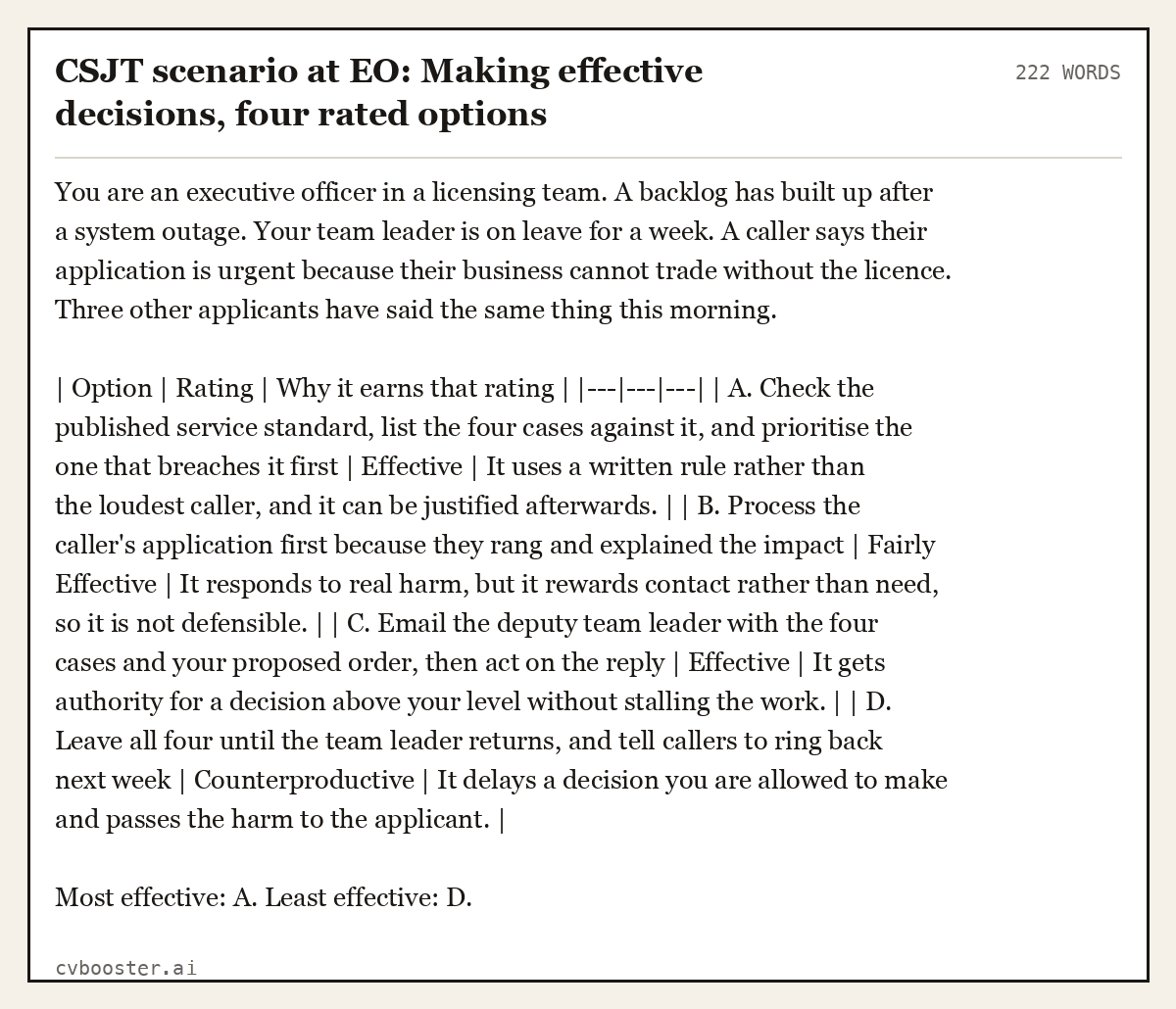
CSJT scenario at EO: Making effective decisions, four rated options (222 words)
You are an executive officer in a licensing team. A backlog has built up after a system outage. Your team leader is on leave for a week. A caller says their application is urgent because their business cannot trade without the licence. Three other applicants have said the same thing this morning.
| Option | Rating | Why it earns that rating | |---|---|---| | A. Check the published service standard, list the four cases against it, and prioritise the one that breaches it first | Effective | It uses a written rule rather than the loudest caller, and it can be justified afterwards. | | B. Process the caller's application first because they rang and explained the impact | Fairly Effective | It responds to real harm, but it rewards contact rather than need, so it is not defensible. | | C. Email the deputy team leader with the four cases and your proposed order, then act on the reply | Effective | It gets authority for a decision above your level without stalling the work. | | D. Leave all four until the team leader returns, and tell callers to ring back next week | Counterproductive | It delays a decision you are allowed to make and passes the harm to the applicant. |
Most effective: A. Least effective: D.
The behaviour being tested is defined on gov.uk as: "Use evidence and knowledge to support accurate, expert decisions and advice. Carefully consider alternative options, implications and risks of decisions." Option A is the only one where the evidence is the published standard. Option C rates as highly because escalating with a proposal is still a decision. For the written version of this behaviour, see the Making Effective Decisions civil service example.
The four ratings and how the marking works
The scale is fixed and gov.uk publishes both the labels and their meanings.
| Rating | Official definition (gov.uk) |
|---|---|
| Counterproductive | "An unacceptable action that would make the situation worse." |
| Ineffective | "A poor action that would not help the situation." |
| Fairly Effective | "A useful action that would be of some help to the situation." |
| Effective | "A good action that would help to resolve the situation." |
The instruction that catches most candidates out is also quoted: "When reviewing an action, look at it independently from the others. Do not assume that only one action is either effective or ineffective - you can rate more than one action the same."
Tip: read each option as if it were the only thing you did. That is how it is rated.
The test also has a first part. Gov.uk says it asks "about your typical behaviour and preferences at work" and calls it a self-assessment that forms a stated share of the overall score. Answer it honestly, because gov.uk warns "you may be asked about them at interview".
The behaviours the test maps to
Every scenario is written against one of the nine behaviours in Success Profiles: Civil Service behaviours. The definitions below are quoted from that page. Read them before you sit the test.
| Behaviour | Definition quoted from gov.uk |
|---|---|
| Seeing the big picture | "Understand how your role fits with and supports organisational objectives." |
| Changing and improving | "Seek out opportunities to create effective change and suggest innovative ideas for improvement." |
| Making effective decisions | "Use evidence and knowledge to support accurate, expert decisions and advice." |
| Leadership | "Show pride and passion for public service. Create and engage others in delivering a shared vision." |
| Communicating and influencing | "Communicate purpose and direction with clarity, integrity and enthusiasm." |
| Working together | "Form effective partnerships and relationships with people both internally and externally." |
| Developing self and others | "Focus on continuous learning and development for self, others and the organisation as a whole." |
| Managing a quality service | "Deliver service objectives with professional excellence, expertise and efficiency." |
| Delivering at pace | "Take responsibility for delivering timely and quality results with focus and drive." |
The full grade-by-grade wording sits in the civil service behaviours framework, and in the Success Profiles: Civil Service Behaviours PDF on assets.publishing.service.gov.uk.
Worked scenarios 2 to 8
Scenario 2: Working together, EO
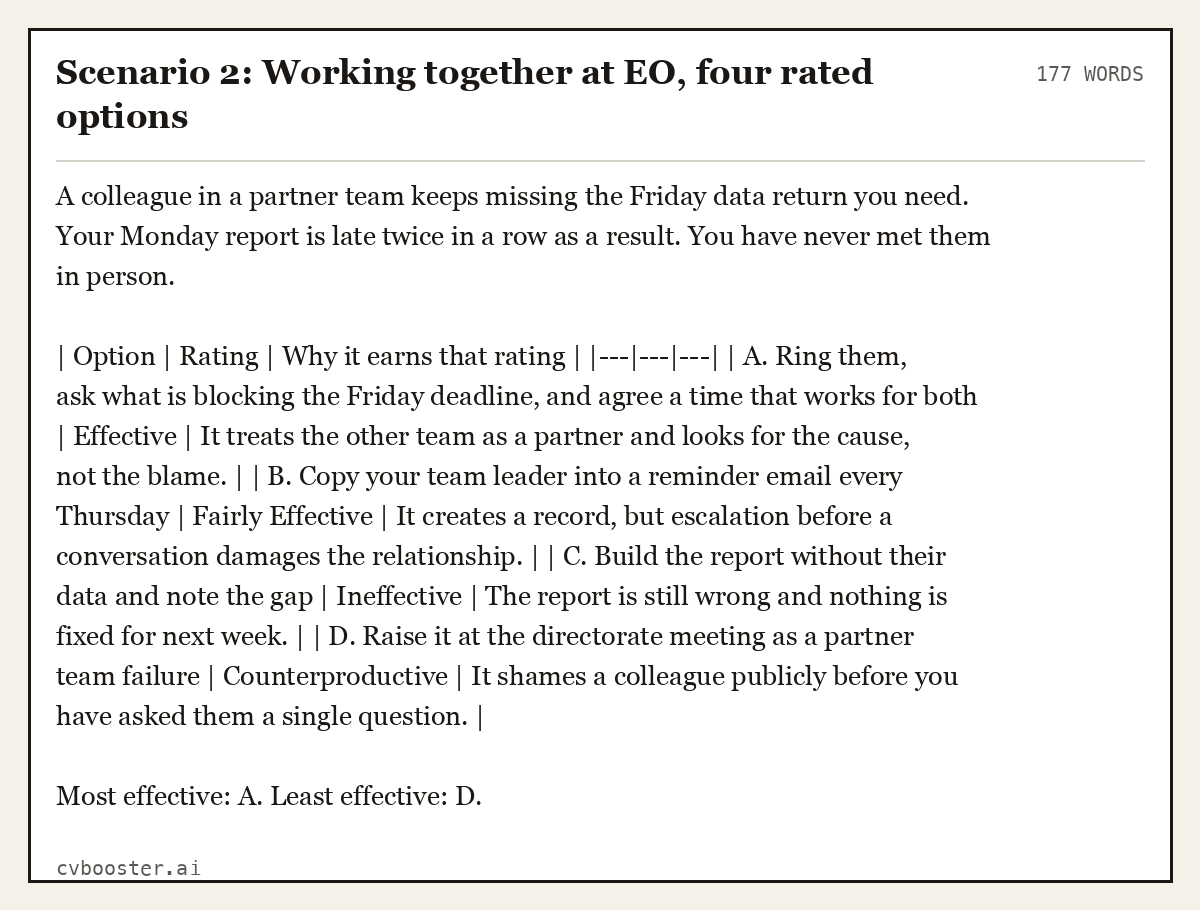
Scenario 2: Working together at EO, four rated options (177 words)
A colleague in a partner team keeps missing the Friday data return you need. Your Monday report is late twice in a row as a result. You have never met them in person.
| Option | Rating | Why it earns that rating | |---|---|---| | A. Ring them, ask what is blocking the Friday deadline, and agree a time that works for both | Effective | It treats the other team as a partner and looks for the cause, not the blame. | | B. Copy your team leader into a reminder email every Thursday | Fairly Effective | It creates a record, but escalation before a conversation damages the relationship. | | C. Build the report without their data and note the gap | Ineffective | The report is still wrong and nothing is fixed for next week. | | D. Raise it at the directorate meeting as a partner team failure | Counterproductive | It shames a colleague publicly before you have asked them a single question. |
Most effective: A. Least effective: D.
The indicator quoted from gov.uk is "form effective partnerships and relationships with people both internally and externally". Compare the written version in the Working Together civil service example.
Scenario 3: Managing a quality service, HEO
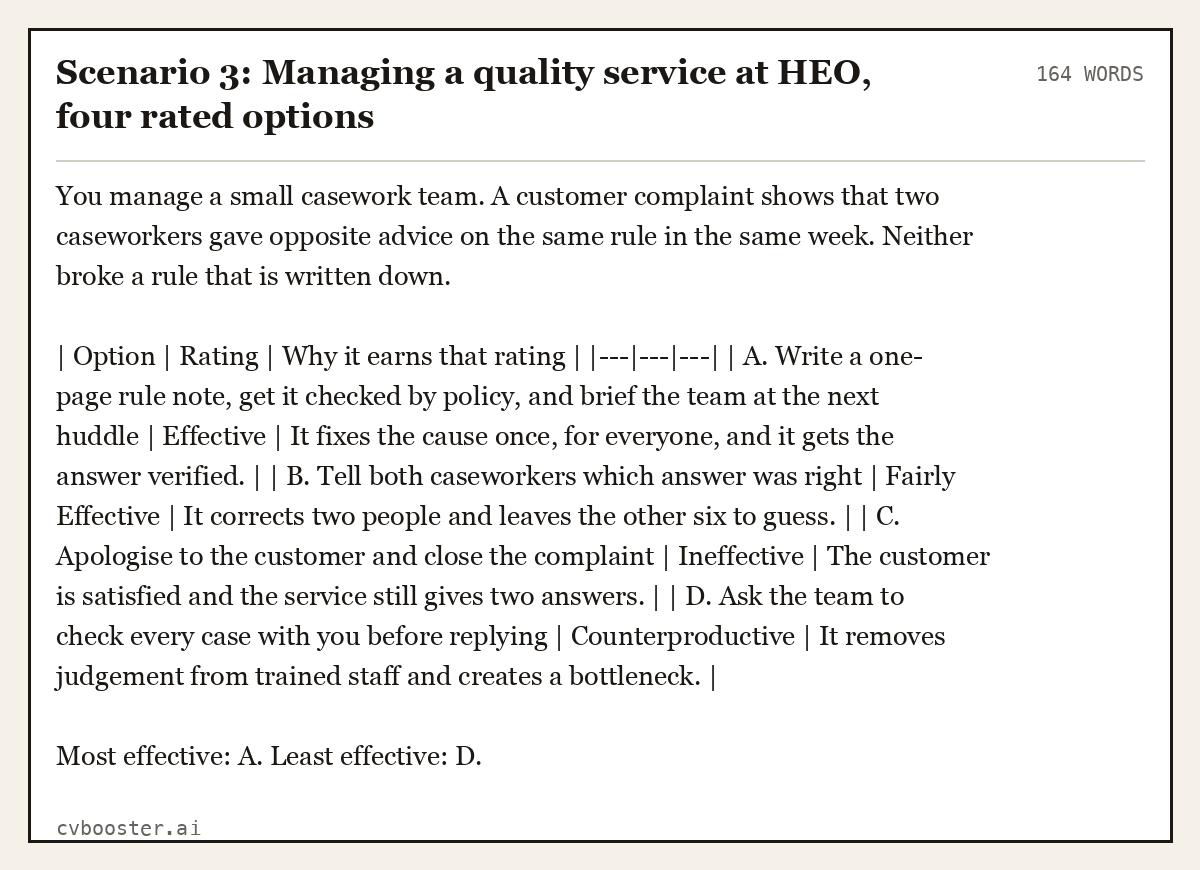
Scenario 3: Managing a quality service at HEO, four rated options (164 words)
You manage a small casework team. A customer complaint shows that two caseworkers gave opposite advice on the same rule in the same week. Neither broke a rule that is written down.
| Option | Rating | Why it earns that rating | |---|---|---| | A. Write a one-page rule note, get it checked by policy, and brief the team at the next huddle | Effective | It fixes the cause once, for everyone, and it gets the answer verified. | | B. Tell both caseworkers which answer was right | Fairly Effective | It corrects two people and leaves the other six to guess. | | C. Apologise to the customer and close the complaint | Ineffective | The customer is satisfied and the service still gives two answers. | | D. Ask the team to check every case with you before replying | Counterproductive | It removes judgement from trained staff and creates a bottleneck. |
Most effective: A. Least effective: D.
Gov.uk defines the behaviour as "deliver service objectives with professional excellence, expertise and efficiency, taking account of diverse customer needs". See also the Managing a Quality Service example.
Scenario 4: Delivering at pace, EO
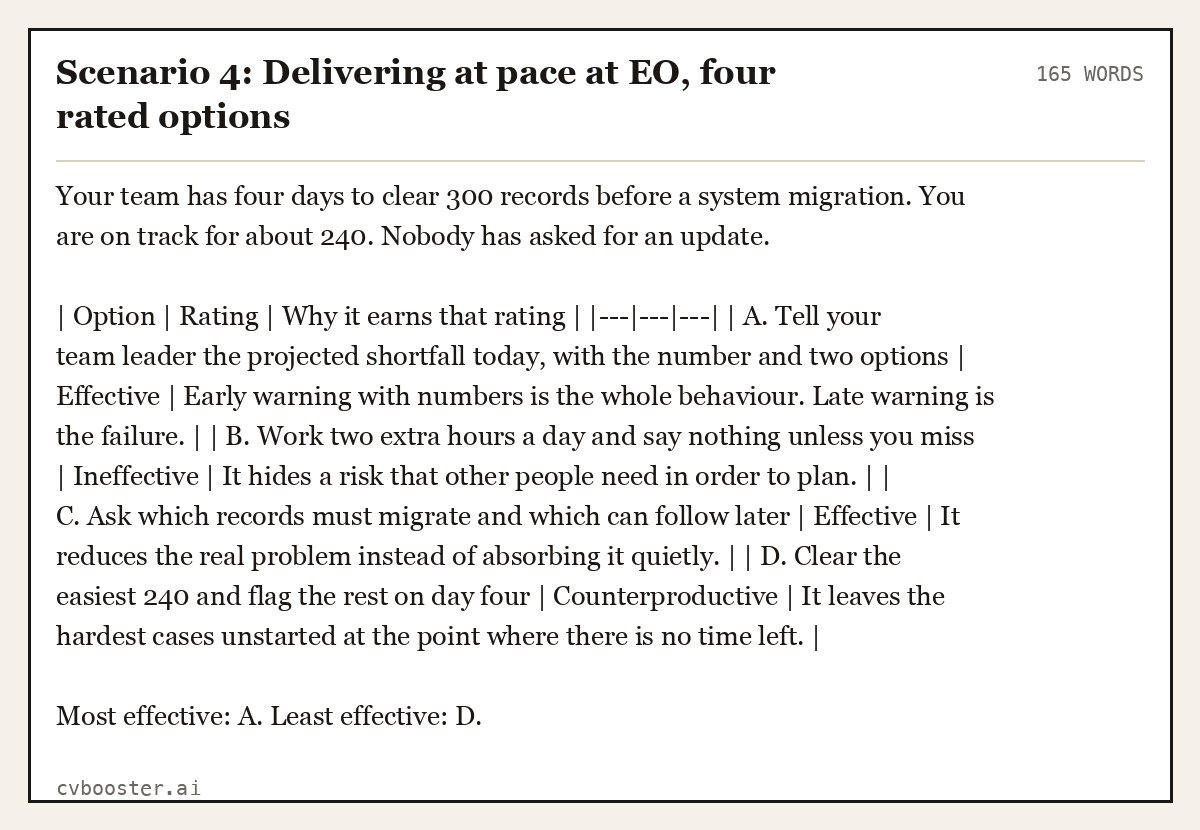
Scenario 4: Delivering at pace at EO, four rated options (165 words)
Your team has four days to clear 300 records before a system migration. You are on track for about 240. Nobody has asked for an update.
| Option | Rating | Why it earns that rating | |---|---|---| | A. Tell your team leader the projected shortfall today, with the number and two options | Effective | Early warning with numbers is the whole behaviour. Late warning is the failure. | | B. Work two extra hours a day and say nothing unless you miss | Ineffective | It hides a risk that other people need in order to plan. | | C. Ask which records must migrate and which can follow later | Effective | It reduces the real problem instead of absorbing it quietly. | | D. Clear the easiest 240 and flag the rest on day four | Counterproductive | It leaves the hardest cases unstarted at the point where there is no time left. |
Most effective: A. Least effective: D.
The behaviour is "take responsibility for delivering timely and quality results with focus and drive". More on this in the Delivering at Pace example.
Scenario 5: Communicating and influencing, HEO
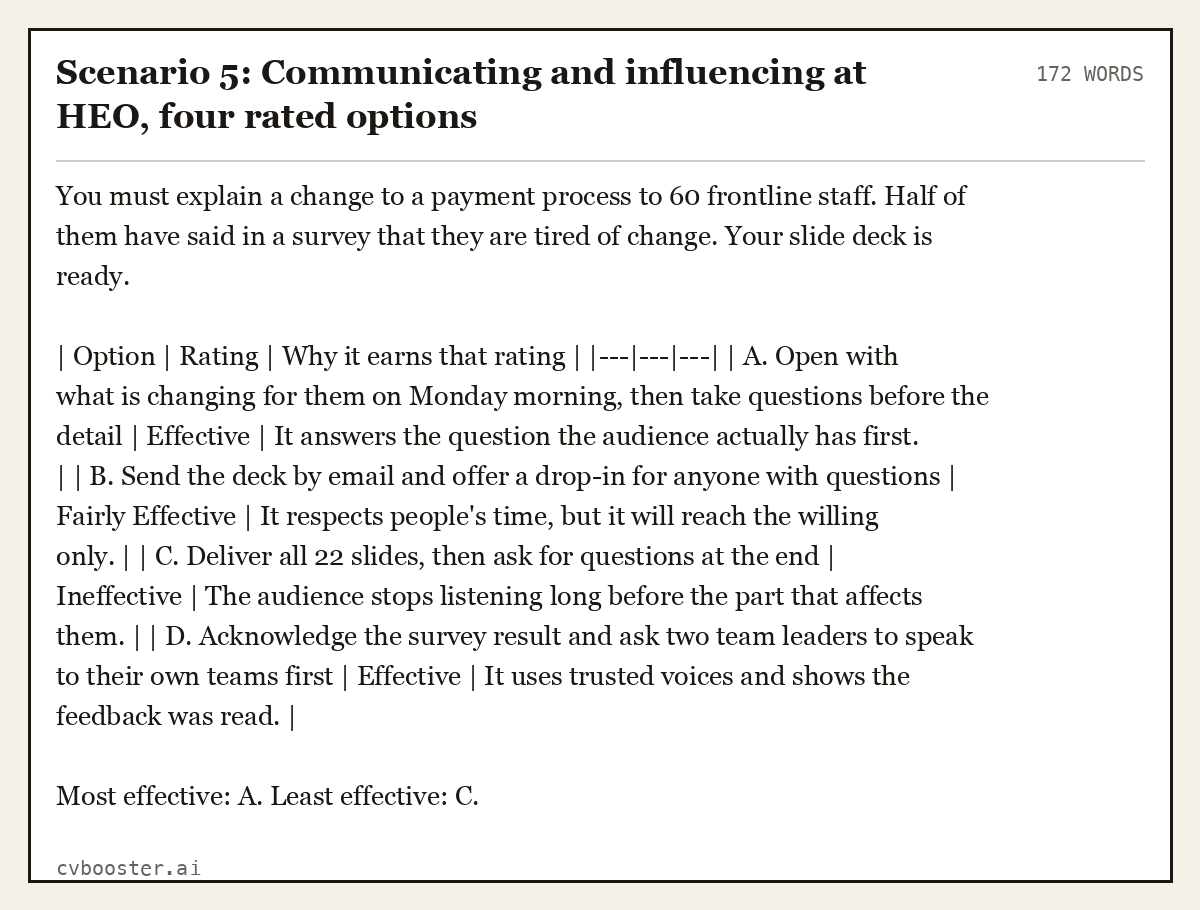
Scenario 5: Communicating and influencing at HEO, four rated options (172 words)
You must explain a change to a payment process to 60 frontline staff. Half of them have said in a survey that they are tired of change. Your slide deck is ready.
| Option | Rating | Why it earns that rating | |---|---|---| | A. Open with what is changing for them on Monday morning, then take questions before the detail | Effective | It answers the question the audience actually has first. | | B. Send the deck by email and offer a drop-in for anyone with questions | Fairly Effective | It respects people's time, but it will reach the willing only. | | C. Deliver all 22 slides, then ask for questions at the end | Ineffective | The audience stops listening long before the part that affects them. | | D. Acknowledge the survey result and ask two team leaders to speak to their own teams first | Effective | It uses trusted voices and shows the feedback was read. |
Most effective: A. Least effective: C.
The gov.uk definition is "communicate purpose and direction with clarity, integrity and enthusiasm. Respect the needs, responses and opinions of others". The written version is in the Communicating and Influencing example.
Scenario 6: Changing and improving, EO
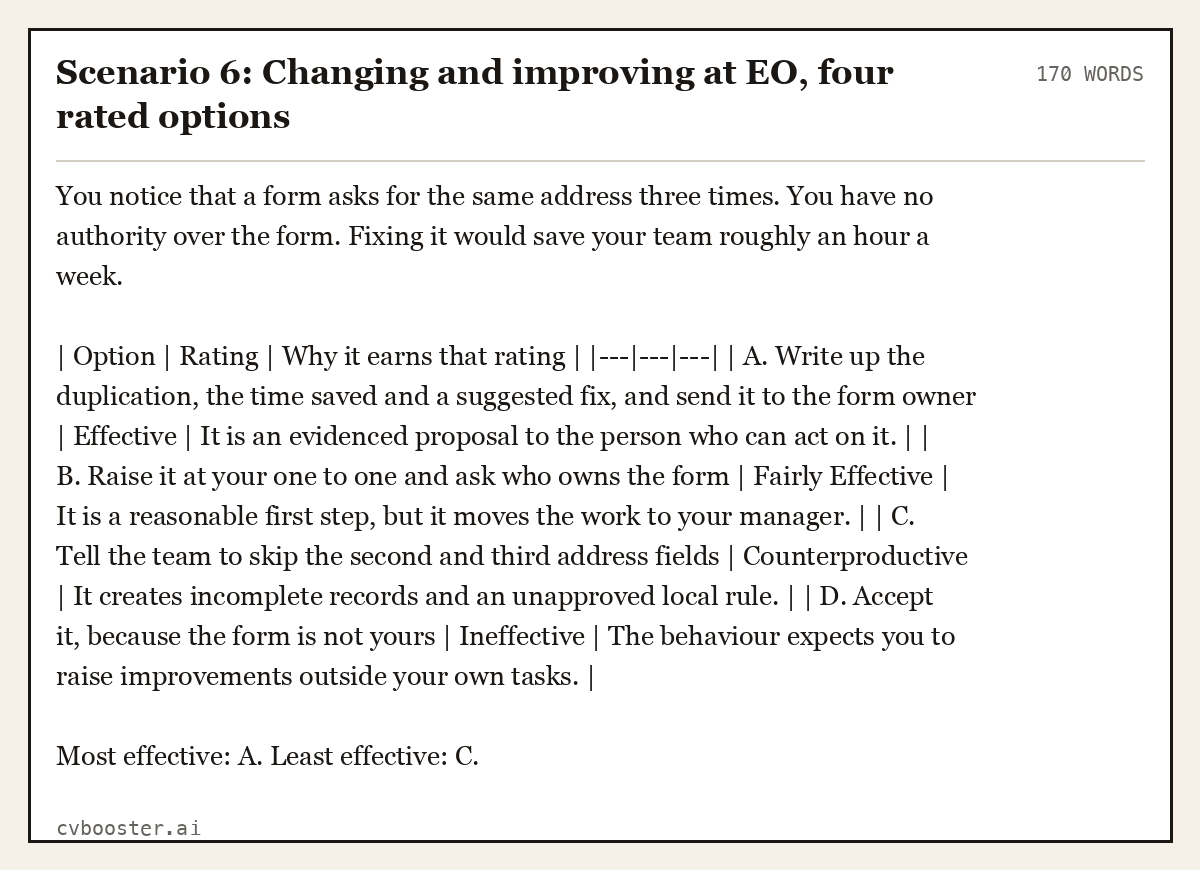
Scenario 6: Changing and improving at EO, four rated options (170 words)
You notice that a form asks for the same address three times. You have no authority over the form. Fixing it would save your team roughly an hour a week.
| Option | Rating | Why it earns that rating | |---|---|---| | A. Write up the duplication, the time saved and a suggested fix, and send it to the form owner | Effective | It is an evidenced proposal to the person who can act on it. | | B. Raise it at your one to one and ask who owns the form | Fairly Effective | It is a reasonable first step, but it moves the work to your manager. | | C. Tell the team to skip the second and third address fields | Counterproductive | It creates incomplete records and an unapproved local rule. | | D. Accept it, because the form is not yours | Ineffective | The behaviour expects you to raise improvements outside your own tasks. |
Most effective: A. Least effective: C.
Gov.uk asks you to "seek out opportunities to create effective change and suggest innovative ideas for improvement".
Scenario 7: Seeing the big picture, HEO
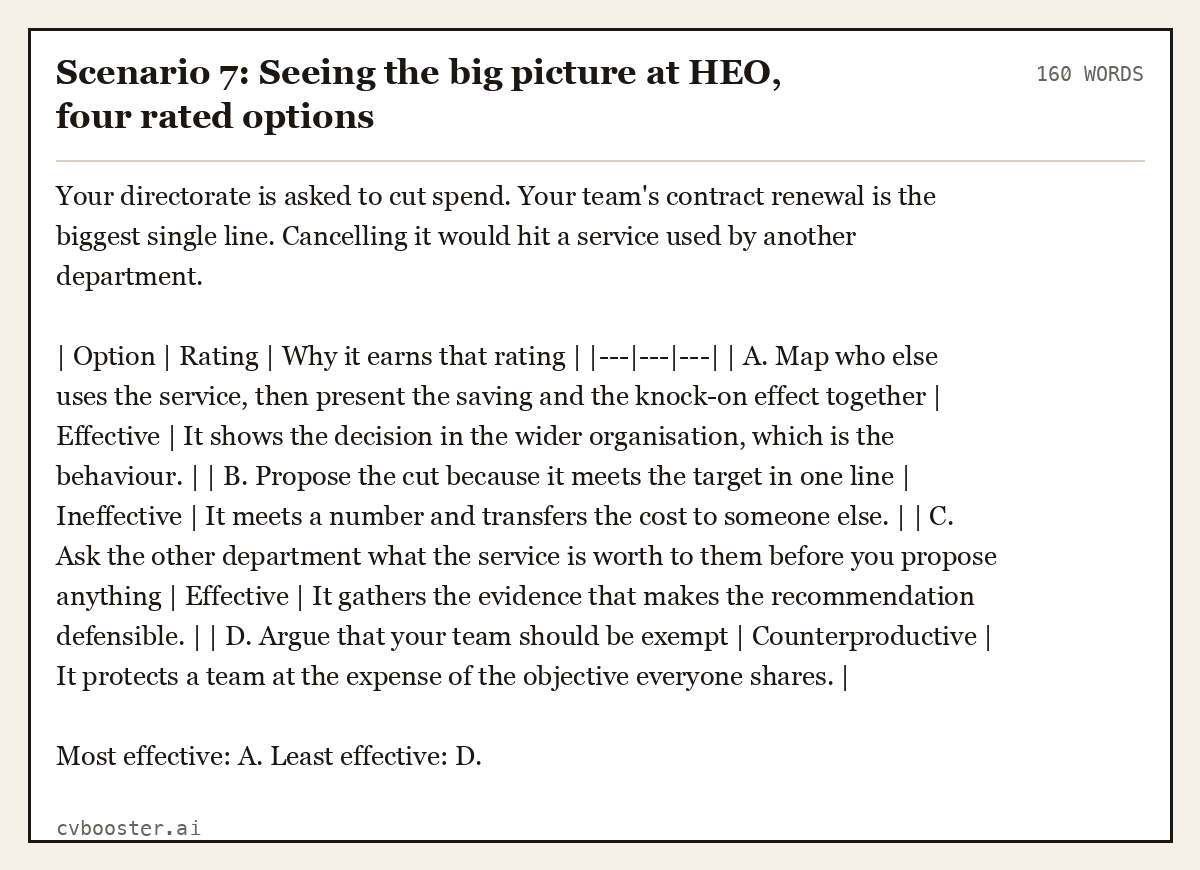
Scenario 7: Seeing the big picture at HEO, four rated options (160 words)
Your directorate is asked to cut spend. Your team's contract renewal is the biggest single line. Cancelling it would hit a service used by another department.
| Option | Rating | Why it earns that rating | |---|---|---| | A. Map who else uses the service, then present the saving and the knock-on effect together | Effective | It shows the decision in the wider organisation, which is the behaviour. | | B. Propose the cut because it meets the target in one line | Ineffective | It meets a number and transfers the cost to someone else. | | C. Ask the other department what the service is worth to them before you propose anything | Effective | It gathers the evidence that makes the recommendation defensible. | | D. Argue that your team should be exempt | Counterproductive | It protects a team at the expense of the objective everyone shares. |
Most effective: A. Least effective: D.
The behaviour is "understand how your role fits with and supports organisational objectives. Recognise the wider Civil Service priorities and ensure work is in the national interest". See the Seeing the Big Picture example.
Scenario 8: Developing self and others, HEO
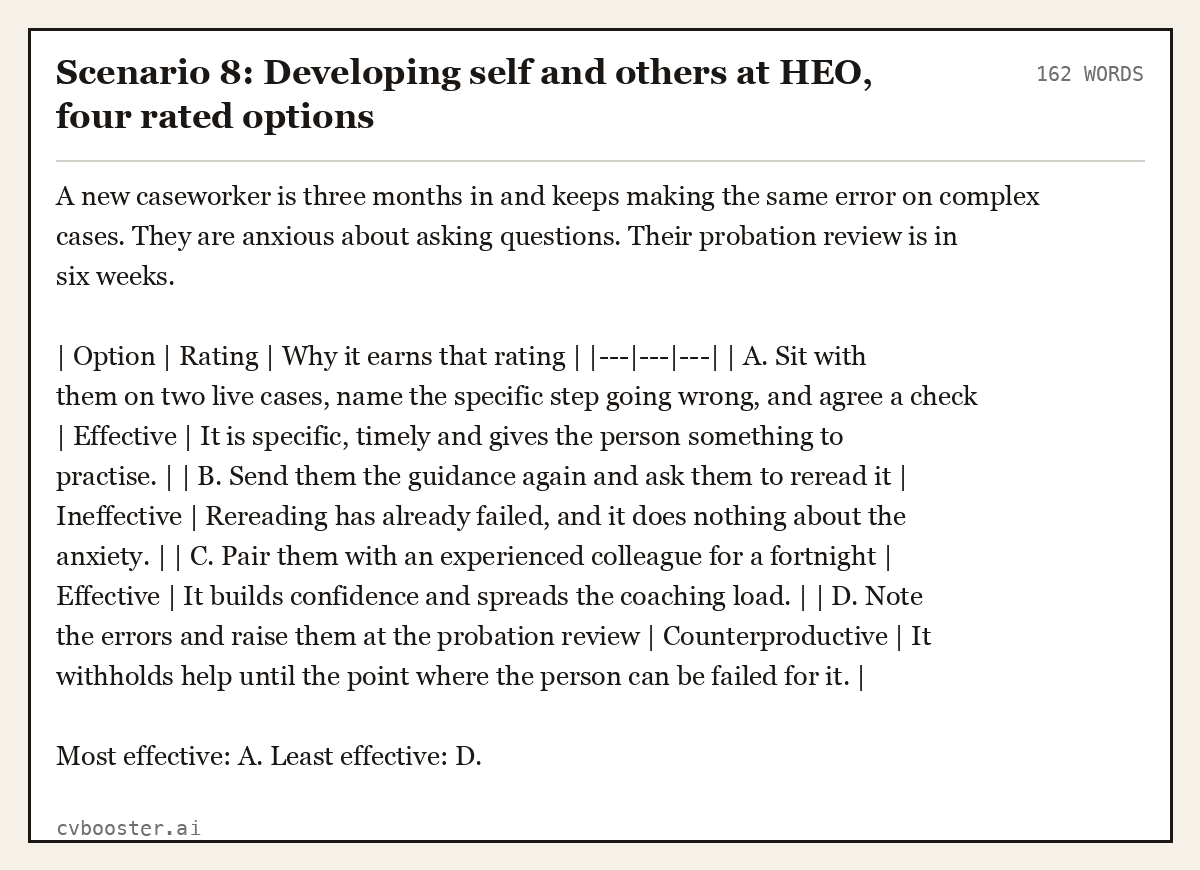
Scenario 8: Developing self and others at HEO, four rated options (162 words)
A new caseworker is three months in and keeps making the same error on complex cases. They are anxious about asking questions. Their probation review is in six weeks.
| Option | Rating | Why it earns that rating | |---|---|---| | A. Sit with them on two live cases, name the specific step going wrong, and agree a check | Effective | It is specific, timely and gives the person something to practise. | | B. Send them the guidance again and ask them to reread it | Ineffective | Rereading has already failed, and it does nothing about the anxiety. | | C. Pair them with an experienced colleague for a fortnight | Effective | It builds confidence and spreads the coaching load. | | D. Note the errors and raise them at the probation review | Counterproductive | It withholds help until the point where the person can be failed for it. |
Most effective: A. Least effective: D.
Gov.uk defines this as "focus on continuous learning and development for self, others and the organisation as a whole".
What the Civil Service Code adds to your judgement
Several scenarios turn on standards that are written down in the Civil Service Code. If an option breaks one of them, it cannot be effective.
- Integrity. The Code says you must "deal with the public and their affairs fairly, efficiently, promptly, effectively and sensitively, to the best of your ability". An option that parks a citizen's case indefinitely fails this.
- Honesty. You must "set out the facts and relevant issues truthfully, and correct any errors as soon as possible". Any option that hides a slipping deadline fails this.
- Objectivity. You must "take decisions on the merits of the case" and must not "ignore inconvenient facts or relevant considerations". Deciding by who complained loudest fails this.
- Impartiality. You must "carry out your responsibilities in a way that is fair, just and equitable". Exempting your own team fails this.
The answer patterns that lose ratings
- Rating every reasonable option as Effective. The scale has four points and the middle two exist for a reason.
- Assuming only one option can be Effective. Gov.uk explicitly says more than one can share a rating.
- Choosing the option that avoids conflict. Avoiding a conversation is usually Ineffective, not neutral.
- Escalating first. Escalation with a proposal rates well. Escalation instead of thinking does not.
- Answering as the person you want to be. The first section is self-assessment and gov.uk says you may be asked about it at interview.
- Rushing. Gov.uk says "the test is not timed" and that "most people take between two and four minutes to answer one scenario".
Before the real test, take the practice version. Gov.uk says "the practice test is not scored" and that it "is designed to show you the look and feel of the real test". Then read the civil service success profiles guide so you know which behaviours your advert names.
Frequently asked questions
How do you pass the Civil Service situational judgement test?
Rate each action independently against the behaviour named in your advert, not against each other. Read the four rating definitions on gov.uk first, use the full scale, and judge every option as if it were the only thing you did. Answer the self-assessment section honestly, because gov.uk says you may be asked about it at interview. Take the free practice test before the real one.
What are the questions and answers for the Civil Service situational judgement test?
The real questions are not published and sharing them would be a breach of test conditions. Gov.uk says your answers "should be your own" and that hiring managers may ask you to retake the test under supervision. What is published is the format: three scenarios per behaviour, four actions each, rated from Counterproductive to Effective. The eight scenarios above are written in that format.
What is the best way to answer a situational judgement test?
Work out which behaviour the scenario is testing, then rate each action against that behaviour's published wording. Effective actions gather evidence, involve the right person and can be justified afterwards. Counterproductive actions cause avoidable harm, hide information or take a decision away from someone entitled to make it. Do not rush, because the test is not timed.
What is a good score on the situational judgement test for Civil Service?
There is no fixed good score, because the pass mark is set per job. Gov.uk states that "the recruiter will look at all applicant scores to decide what the job's pass mark will be" and that the mark can be raised. It also warns that "meeting the minimum test requirements for a job level is no guarantee of an invite to continue the selection process".
More in this series: Civil Service applications
- Civil Service Behaviours Framework: All 9, Level by Level
- Civil Service Behaviours: 9 Examples, One Per Behaviour
- Civil Service Success Profiles: the Five Elements, Explained
- Communicating and Influencing: 4 Civil Service Examples
- Delivering at Pace: 4 Civil Service Examples, EO to G7
- Making Effective Decisions: 4 Civil Service Examples
- Managing a Quality Service: 4 Worked Examples, EO to G7
- Seeing the Big Picture Civil Service Example: AO to G7
- Working Together Civil Service Example: AO to Grade 7
Related articles
- Changing and Improving Civil Service Example: AO to G7
- Civil Service Behaviours Framework: All 9, Level by Level
- Civil Service Success Profiles: the Five Elements, Explained
- Communicating and Influencing: 4 Civil Service Examples
More articles
- Civil Service Strengths Examples: 10 Worked Answers
- Clearances on an Australian Resume: WWCC, Police, Visa
Looking for a worked example for your job title? Browse the resume examples by job title.