Football Coach Resume Examples: the lines they read
Football Coaches Resumes: A Coaching Resume Sample for Every Staff Level
By Mustafa Tarabya, founder of CVBooster · Published · Updated
A football coach resume sample with real season results, position coaching detail, keywords and a step by step guide to every section.
Sample resumes for a football coach
The same football coach content laid out in three CVBooster templates, so you can see what the finished document looks like before you write a word.
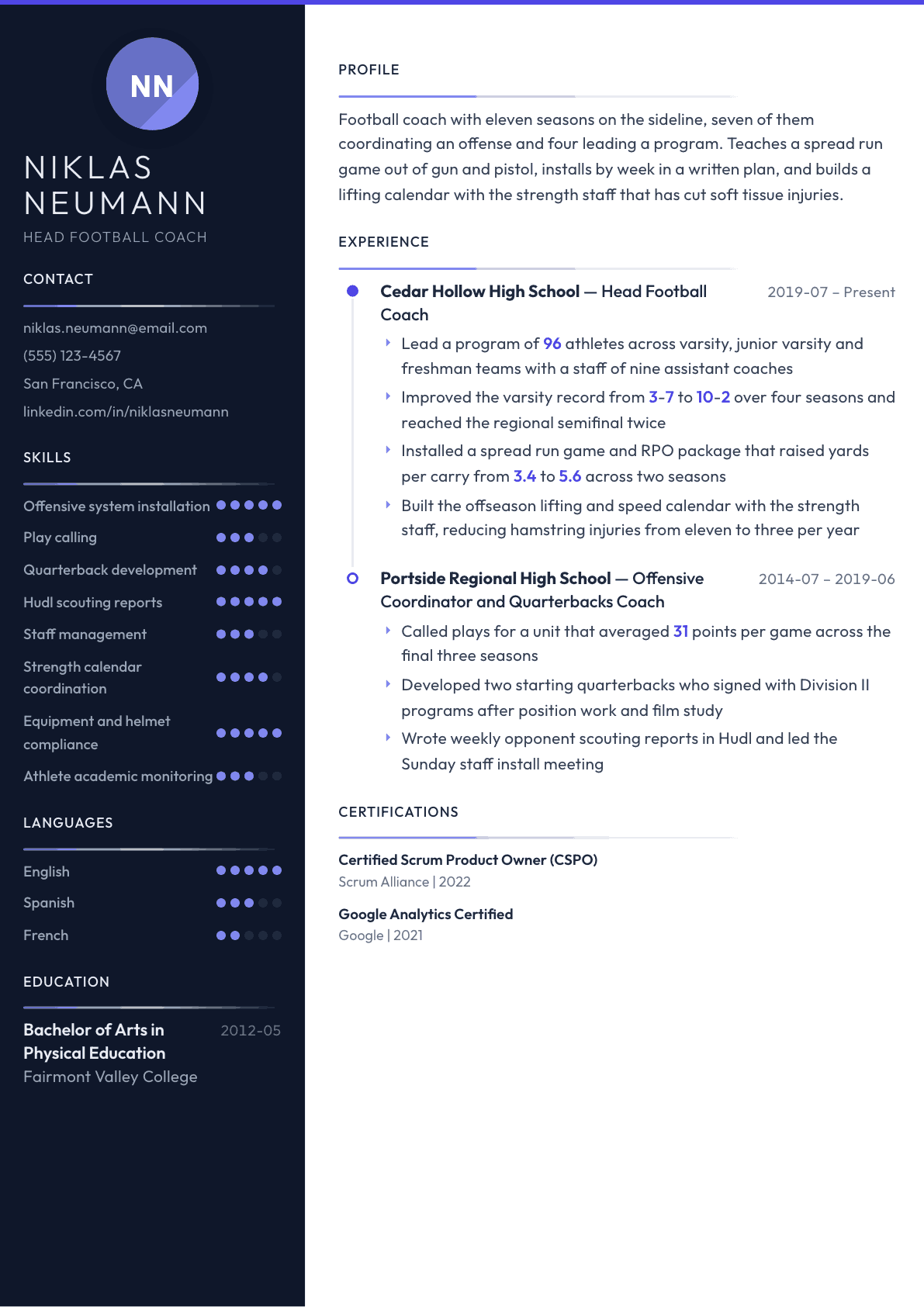
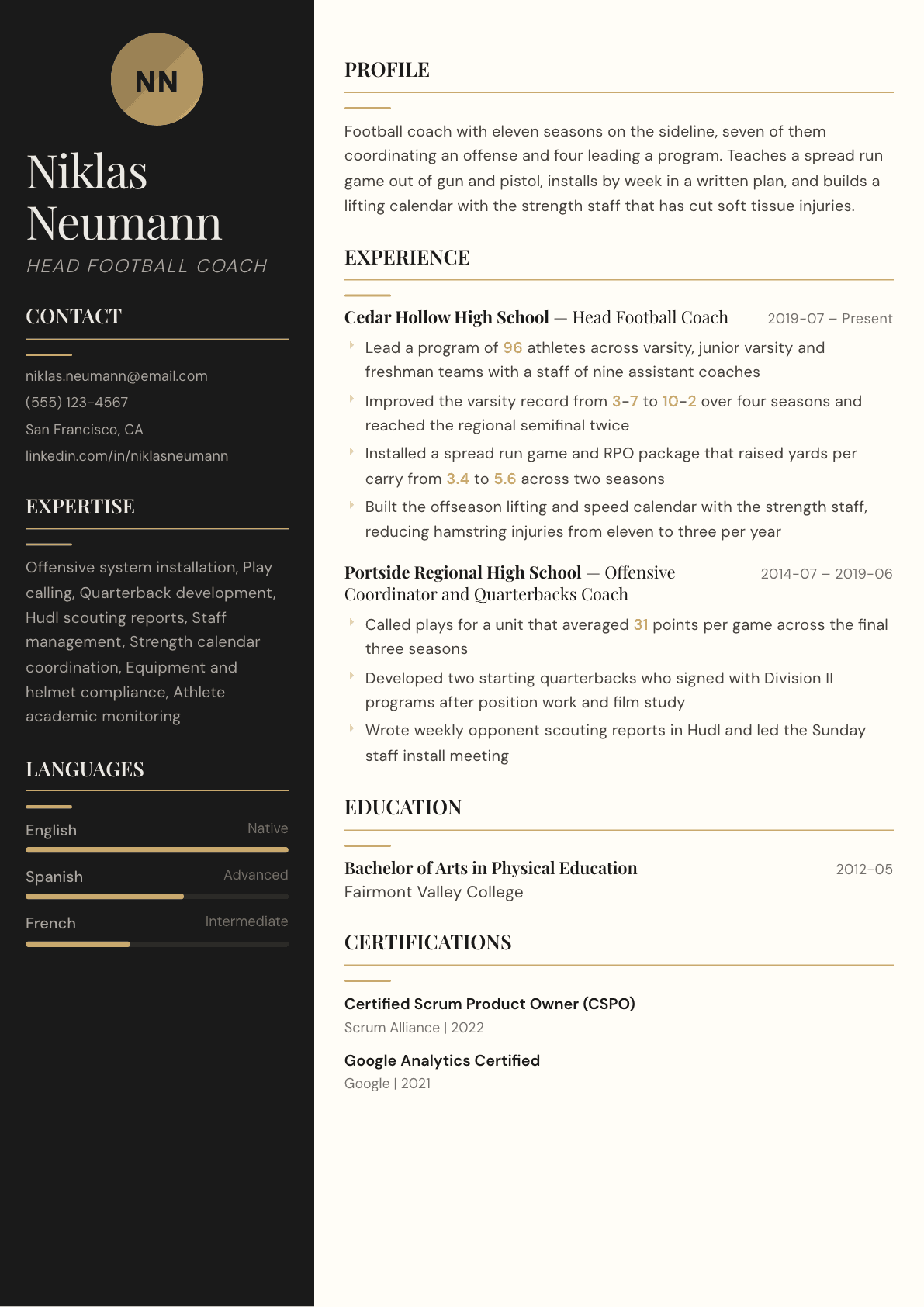
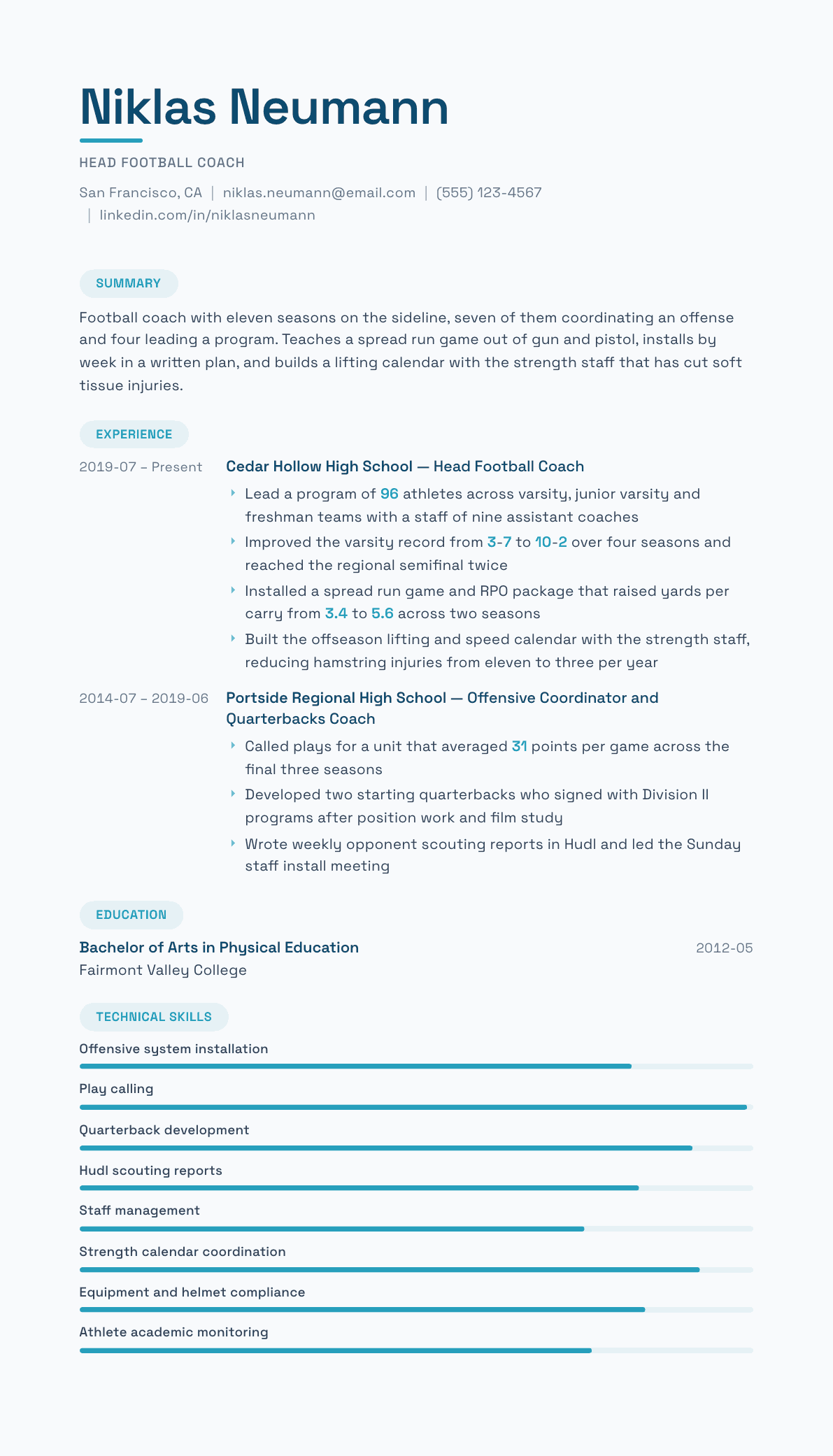
Example Football Coach summary
Football coach with ten seasons of high school experience, five as an offensive coordinator and three as a head coach leading a program of ninety athletes and a staff of eight. Installs a spread run game with an RPO package, writes weekly scouting reports, and shares the offseason lifting calendar with the strength staff. Holds first aid, CPR and concussion certification, and wants a program that will build from the youth level up.
Skills to list on a Football Coach resume
- Offensive scheme design
- Defensive scheme design
- Play calling
- Position coaching
- Weekly install planning
- Opponent scouting
- Film study and video review
- Special teams coordination
- Strength and speed programming
- Injury prevention protocols
- Staff development
- Recruiting communication
- Equipment compliance
- Booster and community relations
What actually gets this resume read
- Open each coaching job with the level, roster size and staff size, then the record and playoff results by season.
- Say which side of the ball you coach and which positions you have taught, since staffs hire for a specific room.
- Name your scheme in the words other coaches use: spread, wing-T, four-three, quarters, RPO, so the fit is obvious.
- Show helmet fitting, heat acclimatization and concussion protocol work, because safety compliance is a hiring gate.
- Add the teaching subject or building duty you can cover, as most football jobs are paired with a school contract.
- Keep college placements, all-state selections and offseason participation numbers together so growth is easy to read.
How to write a football coach resume
Football hiring is a staff decision. A head coach reads your resume looking for the room you can take over tomorrow, an athletic director reads it for compliance and community fit, and both of them are talking to people who already know your name. The page has to survive all three of those readings without a single vague line.
The most common failure is writing about football rather than about your football. Sentences about toughness, culture and accountability appear on every application in the folder. What does not appear on every application is the scheme you install, the position group you have taught, the record of the unit you were responsible for, and the offseason plan you own.
This guide sets out the sections a football staff expects, in order, with a football coaching resume written out line by line for an assistant coach, example summaries for a position coach, a coordinator and a head coach, five before and after bullets, and the questions coaches ask most when the coaching carousel opens.
Format: role, level and unit before anything else
Reverse chronological, with each entry labeled by the job you actually held. Offensive coordinator, defensive line coach, special teams coordinator, head coach. A resume that lists a school and a set of duties without naming the title forces the reader to reconstruct your career, and busy staffs do not reconstruct.
Group the coaching history separately from teaching, weight room supervision or administration. Football coaches move often and carry long histories, so use season labels rather than month ranges and let the reader count years at a glance.
- Header: name, city and state, phone, email, and whether you hold a teaching certification.
- Coaching history block with title, school, level, unit and season span.
- A results line per stop: record, conference finish, playoff round, unit ranking within the conference.
- Then teaching or building duties, education, certifications, and coaching references with their current titles.
Summary: side of the ball, scheme, and what you are hired to fix
Three or four lines. Name the side of the ball, the positions you have coached, the scheme family, and the specific problem you solve. Coaches hire for a hole in the staff, so a summary that says you can coach anything reads as though you have mastered nothing.
If you are moving up from position coach to coordinator, or coordinator to head coach, write the summary in terms of the next job. Say that you already write the weekly install, run the Sunday staff meeting or manage the offseason calendar, because those are the head coach tasks a committee cares about.
Experience: the unit you owned and what it did
Give the program size, staff size and level in the first line of every entry, then the unit results. A defensive coordinator should show what the defense gave up before and after. An offensive line coach should show sacks allowed, yards per carry or the number of linemen who moved on to play in college. A reader wants a number attached to the room you were responsible for.
Then write the process. Weekly install schedule, how you script practice, how the scouting report reaches players, how you handle a short week after a Thursday game. This is the part that persuades a head coach you can run a room without supervision.
Every football job carries duties beyond the whitespace of the field: equipment inventory, helmet reconditioning, heat acclimatization plans, transportation, youth camp, the summer weight room. List them. A staff hires the coach who already knows the July calendar.
Scheme language and player development
Write scheme in the words other coaches use, because vocabulary is how a staff checks fit in ten seconds. Spread, wing-T, pistol, gun run, air raid concepts, RPO tags, quarters coverage, four-three under, three-four odd stack, tite front, fire zone pressure. Say which of them you have installed and which you have only coached inside.
Player development belongs in numbers and names of positions rather than adjectives. Quarterbacks developed, linemen who added a rep on the platform lifts, defensive backs who went from a losing record on deep balls to a unit that took the ball away. Add the college placements with the level, because families in the community count them.
- Scheme installed versus scheme coached inside, stated plainly.
- Weekly rhythm: install day, scout day, walkthrough, scripted periods.
- Video workflow: cut ups, tagging, individual reels, opponent breakdown turnaround.
- Offseason: lifting phases, speed work, seven on seven, lineman challenge, camp schedule.
Safety, certification and compliance
Football carries more safety compliance than any other school sport, so put the credentials where they cannot be missed. Coaching education, concussion recognition, first aid and CPR, and heat illness prevention are baseline. Add tackling certification if you hold one, along with the practice contact limits you enforce.
Say who fits helmets in your program, how you log contact minutes, how you run acclimatization week and what your return to play chain looks like with the athletic trainer. Districts have been asked all these questions by parents, and a coach who answers them on paper is a lower risk hire.
Football coaching resume sample, with the posting keywords in place
Most football coaches' resumes that circulate as samples are a list of schools and a paragraph about culture. Postings repeat a narrow set of terms instead: program development, student athlete supervision, practice planning, film study, offseason conditioning, community relations, and the coordinator or position title. Use the exact phrasing from the posting once in the summary and once inside a coaching entry, then let the rest of the page be football.
Here is the top half of one written out for an invented assistant, Marcus Bell, applying for a varsity coordinator job. Short lines with a number in them travel better around a staff room than long paragraphs, and every line below names a title, a unit or a duty.
- Header: Marcus Bell, Tulsa, OK, phone, email. State teaching certificate, health and physical education.
- Summary: Defensive line coach and run defense coordinator, six seasons on varsity staffs. Installs a tite front with fire zone pressure, scripts the defensive periods of practice, and runs the offseason lineman program.
- Coaching history line: Defensive Line Coach and Run Defense Coordinator, Riverside High School, varsity, four seasons.
- Result line: Defense allowed fewer rushing yards per game in each of the last three seasons, and two linemen signed to play in college.
- Process line: Builds the weekly scouting report and opponent cut ups, and teaches the Wednesday install to the scout team.
- Duty line: Fits helmets with the athletic trainer, logs contact minutes, and runs the summer weight room three mornings a week.
- Certifications line: concussion recognition, first aid and CPR, heat illness prevention, tackling certification.
Football Coach resume summary examples
First position coach job
Two-year volunteer assistant seeking a paid linebackers job. Coaches the freshman defense, cuts opponent film for the varsity staff and supervises the summer weight room. Holds coaching education, concussion and CPR certification and can cover a physical education classroom.
Coordinator
Offensive coordinator with six seasons calling plays for a spread run game, averaging 31 points per game across the last three years. Writes the weekly install, leads the Sunday staff meeting and has developed two quarterbacks into college signees. Looking for a coordinator role at a program with a year round weight program.
Head coach
Head football coach with eleven seasons on staff and five leading a program of ninety athletes and nine assistants. Improved a varsity record from 3-7 to 10-2 across four years, built the offseason calendar with the strength staff and rebuilt the youth feeder league. Seeking a program ready to invest in facilities.
Work experience bullets: before and after
Before: Coached the offensive line and helped the running game.
After: Coached the offensive line through four seasons and raised yards per carry from 3.4 to 5.6 while cutting sacks allowed from 34 to 12, using a gap scheme install and daily indy footwork work.
Two unit numbers plus the technical work behind them make the room measurable.
Before: Ran the offseason program.
After: Built the offseason calendar with the strength staff across four phases, tracked platform lifts for 96 athletes and moved offseason participation from 41 to 88 players.
Structure, headcount and a participation change turn a duty into evidence of program building.
Before: Focused on player safety.
After: Enforced a contact minute log across all three levels, ran acclimatization week with the athletic trainer and cut in-season hamstring injuries from eleven to three per year.
The safety claim is anchored to a written practice and an injury count.
Before: Broke down film every week.
After: Produced an opponent breakdown by Sunday morning covering formation tendency, down and distance and red zone calls, then delivered a one-page sheet to each position group Monday.
A named deliverable and a deadline show a coach who owns a weekly process.
Before: Helped players earn scholarships.
After: Placed fourteen players on college rosters across five seasons by maintaining recruiting film, writing evaluations for college staffs and hosting three junior days each spring.
Placement counts with the recruiting work attached read as a repeatable system.
Hard skills
- Offensive scheme installation
- Defensive front and coverage design
- Play calling and game management
- Position group instruction
- Weekly install and practice scripting
- Opponent tendency breakdown
- Special teams coordination
- Strength and speed phase planning
- Contact limit and acclimatization compliance
- Equipment and helmet reconditioning
- Recruiting evaluation and film
- Staff scheduling and clinic planning
Soft skills
- Staff room leadership
- Sideline decision making
- Community and booster relations
- Discipline consistency
- Delegation to assistants
- Player trust and retention
Certifications worth listing
- Fundamentals of Coaching (National Federation of State High School Associations)
- Concussion in Sports (National Federation of State High School Associations)
- Heat Illness Prevention (National Federation of State High School Associations)
- USA Football Certified Coach (USA Football)
- Adult First Aid, CPR and AED (American Red Cross)
Mistakes that cost football coach candidates the interview
- Listing schools and seasons without naming the position held at each stop.
- Claiming a scheme you have only watched, which collapses in the first interview question about install order.
- Leaving out the unit result, so a coordinator candidate never shows what the offense or defense actually did.
- Writing a culture paragraph that could belong to any candidate in the folder.
- Ignoring the offseason, which is where most of a football program is actually built.
- Omitting the teaching certification or building duty when the job is posted as a combined contract.
- Sending the same page to a head coach opening and a position opening instead of rewriting the summary for each.
Football Coach resume questions
What should football coaching resumes include, and how long should they be?
A header with your teaching certification, a summary naming side of the ball and scheme, a coaching history with title, level and seasons, a results line per stop, duties, and safety certifications. One page fits a first position job; two pages once you have coordinated or spent more than five seasons on staff.
Should I list my own playing career?
One short block near the bottom with the level and years. It matters to a reader who wants to know your background, but it should never take more room than the coaching history, and it stops being relevant after your fourth season on a staff.
How do I show scheme knowledge without giving away my playbook?
Name the scheme family and two or three concepts you install, along with how the install week is ordered. That is enough for a staff to check fit, and no coordinator expects a candidate to attach the full call sheet to an application.
Do youth and middle school football jobs belong on the resume?
Yes, especially if you built the feeder program or wrote the youth curriculum. Head coach searches increasingly ask who can align the whole pipeline, and youth work is proof you understand what arrives at the high school door.
How should I handle a losing record on a football resume?
Report it, then show what moved. Participation numbers, offseason attendance, injury reduction, academic eligibility and college placements are all real progress that a record does not capture, and hiding the record damages trust more than the losses do.
Related resume examples
- Sports Coach Resume example
- Athletic Trainer Resume example
- Assistant Coach Resume example
- Head Coach Resume example
- Student Athlete Resume example
- Baseball Coach Resume example