Insulation Installer Resume Examples: what gets the call
Write an Insulation Installer Resume Builders Take Seriously
By Mustafa Tarabya, founder of CVBooster · Published · Updated
An insulation installer resume sample with R-value, air sealing and mechanical insulation keywords, plus a full guide to writing each section.
Sample resumes for a insulation installer
The same insulation installer content laid out in three CVBooster templates, so you can see what the finished document looks like before you write a word.
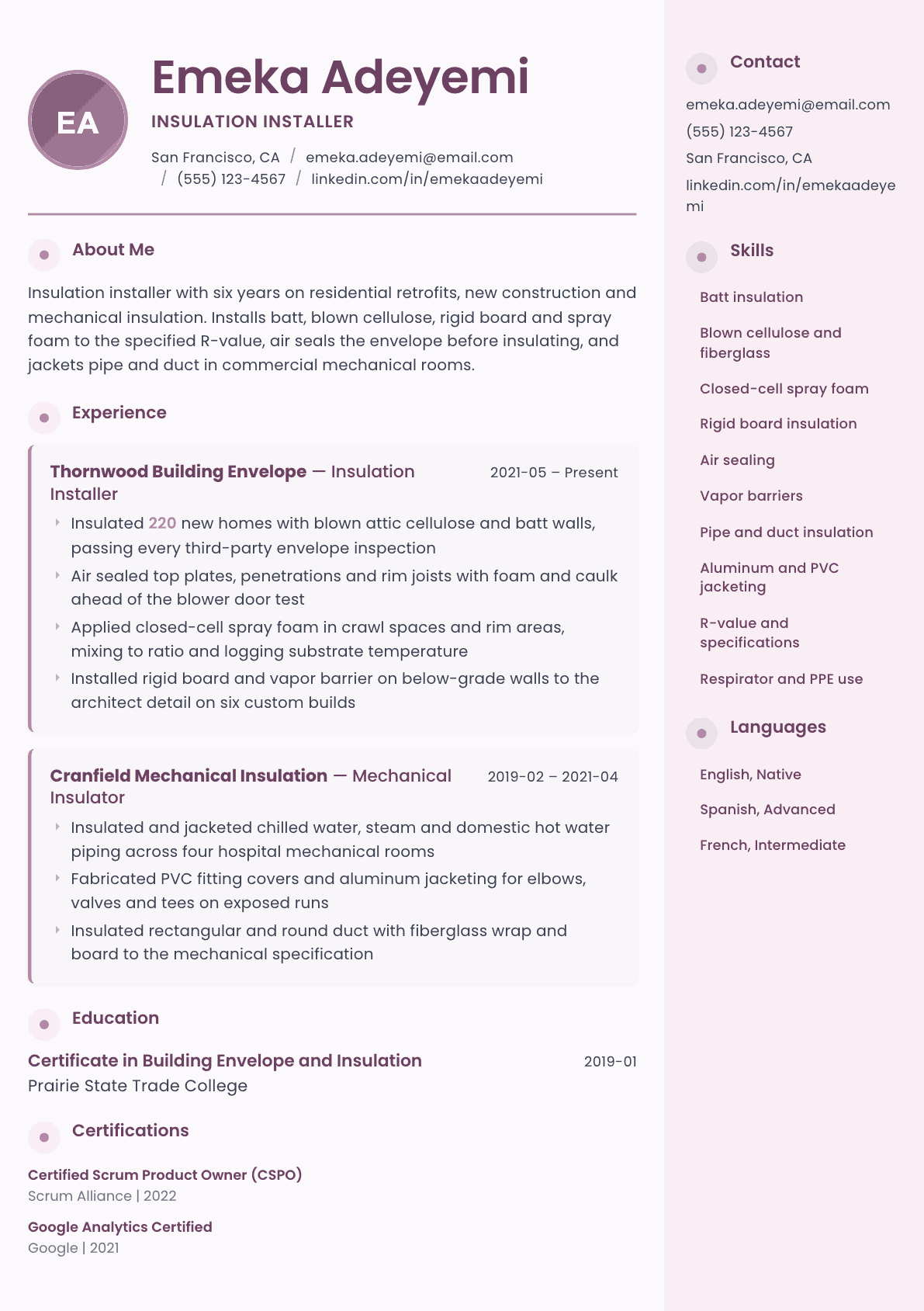
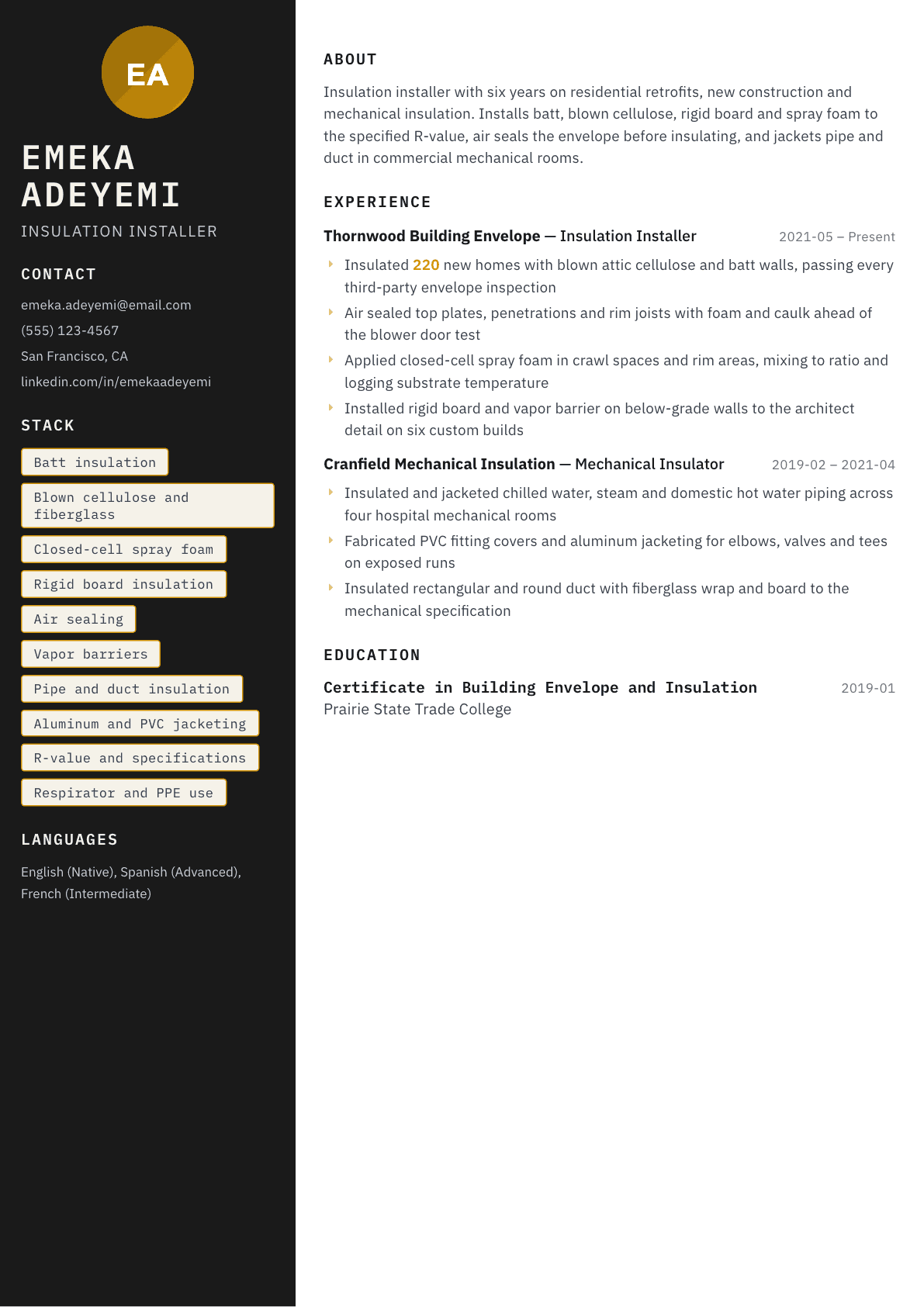
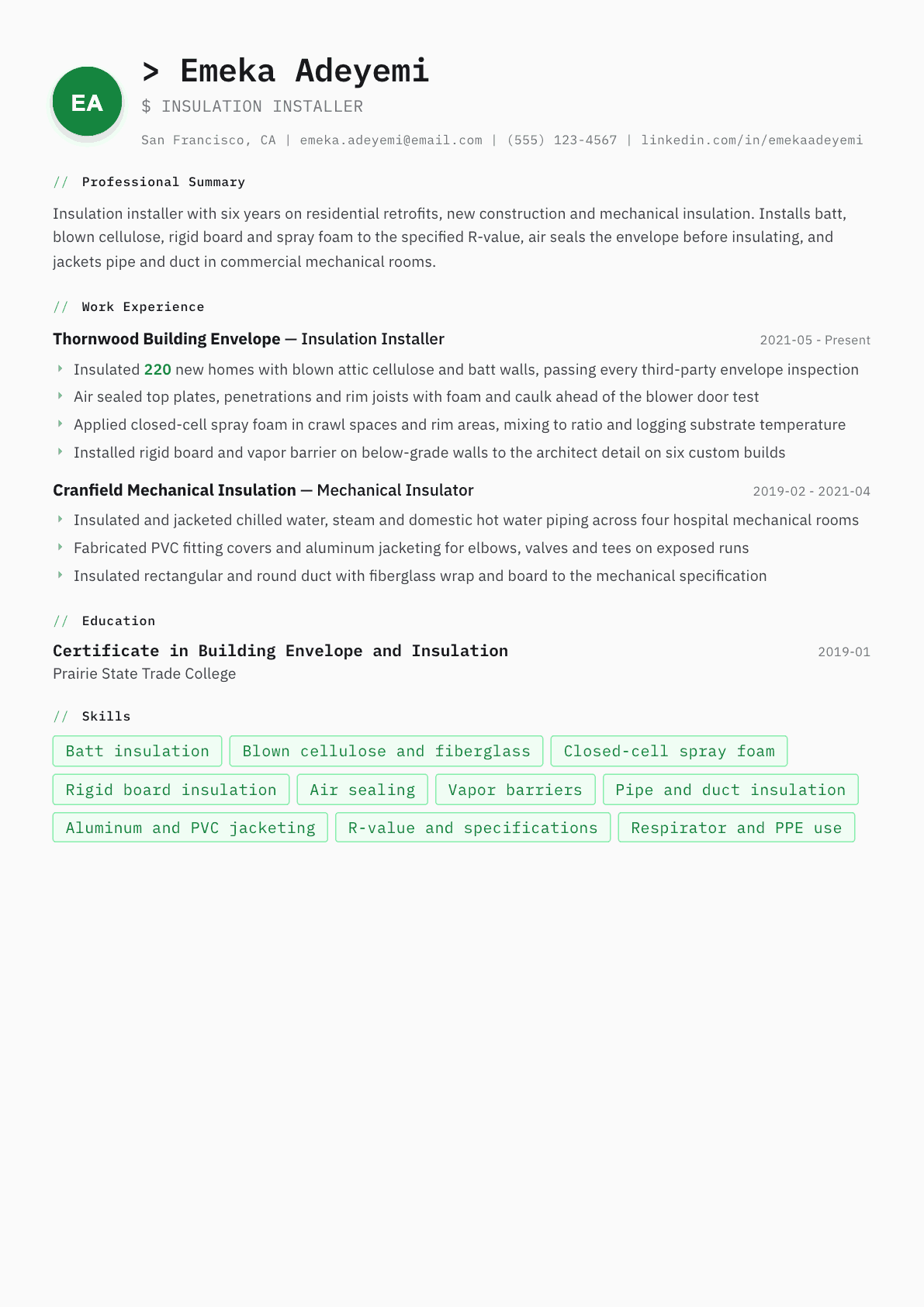
Example Insulation Installer summary
Insulation installer with six years across new residential construction, retrofits and commercial mechanical insulation. Installs batt, blown cellulose, rigid board and closed-cell spray foam to specified R-values, and air seals penetrations before the envelope is tested. Fabricates jacketing for pipe and duct in mechanical rooms, and works safely in attics and crawl spaces year round.
Skills to list on a Insulation Installer resume
- Batt and roll insulation
- Blown-in cellulose
- Dense pack insulation
- Closed-cell spray foam
- Open-cell spray foam
- Rigid foam board
- Air sealing and caulking
- Vapor and air barriers
- Attic and crawl space work
- Pipe insulation and jacketing
- Duct wrap and board
- R-value specifications
- Blower door coordination
- Fire-stopping around penetrations
- Respirator and fall safety
What actually gets this resume read
- Say which insulation types you install, because batt, blown, rigid board, spray foam and mechanical are separate trades.
- Reference R-values and the code path or program the job followed, since inspectors verify assemblies against them.
- Show air sealing work as its own line, because envelope testing fails on leaks long before it fails on R-value.
- Separate mechanical insulation from building insulation, as jacketing pipe and duct calls for different fabrication skill.
- Give house counts or square footage so a production builder can match you to the pace their schedule needs.
- Name the protective equipment and confined space training you hold, since attics and crawl spaces are the workplace.
How to write a insulation installer resume
Insulation is judged after the fact, by a blower door reading, an infrared camera or an inspector with a depth ruler in an attic. That is the frame a hiring manager brings to your resume: he is not asking whether you can staple a batt, he is asking whether the buildings you insulate pass the test they are measured against.
The other question is which branch you belong to. Batt and blown residential work, spray foam, rigid board on the exterior envelope, and mechanical insulation on pipe and duct are four different scopes with different equipment, training and hazards. Companies bid them separately, and they hire separately too.
This guide walks through the sections in the order an insulation contractor reads them, gives summaries at three stages, rewrites five weak bullets into ones a foreman would believe, and answers the questions installers ask when they sit down to write.
Format: one page, scope named before anything else
One page, reverse-chronological, plain layout. In the first two lines name the insulation types you install and the settings: new residential construction, retrofit and weatherization, commercial envelope, or mechanical rooms and industrial piping. That is the filter every reader applies first.
Add the practical facts under your contact details. Whether you have your own respirator fit test, whether you can work in attics and crawl spaces, whether you hold a driving license for a rig or trailer, and how far you travel. Those lines answer questions that would otherwise become a phone call.
- Header: name, trade, city and state, phone, email, travel radius, driving endorsements.
- Order: summary, insulation types, work history with project counts, testing and safety training.
- Newer installers list the training program and their crew leads above the work history.
Summary: materials, assemblies and the test that followed
Name the materials in the first sentence: fiberglass batt, blown cellulose, dense pack, open and closed cell spray foam, mineral wool, rigid foam board, and pipe and duct insulation. Then name the assemblies: attics, walls, rim joists, crawl spaces, below-grade walls, roof decks, mechanical rooms.
Finish with what happened after you left. Passing envelope inspections, blower door results the builder was aiming for, or infrared scans is the strongest single thing an insulation installer can put on a page, because it converts your work from a claim into a measured outcome.
Experience: counts, R-values and air sealing
Give house counts, square footage or linear feet of pipe per project. Production builders schedule by houses per week, so a count tells them immediately whether you can hold their pace. On commercial work, square footage of board or wall area serves the same purpose.
Then treat air sealing as its own bullet rather than folding it into insulating. Top plates, penetrations, rim joists, can lights, duct chases and the transition between attic and wall are the leaks that ruin a test result no matter how deep the insulation is. An installer who writes about air sealing separately is telling a builder he understands the difference between R-value and performance.
On spray foam, name the equipment, the ratio and the conditions you monitor: substrate temperature, ambient temperature, lift thickness and cure between passes. Foam is the material most likely to be applied wrong, and describing your process is how you show you apply it right.
- House counts, square footage or linear feet, tied to the project type.
- The R-values or assemblies specified and how you verified depth or thickness.
- Air sealing performed before insulating, and the test the building faced afterward.
- On mechanical work, the systems insulated and the jacketing you fabricated.
Mechanical insulation is a separate trade, so write it separately
If you have insulated pipe and duct, give it its own block. Name the systems: chilled water, steam and condensate, domestic hot water, refrigerant lines, rectangular and round duct, and equipment such as tanks and heat exchangers. Then name the materials and the jacketing.
Fabrication is the skill here. Fitting covers on elbows, valves and tees, aluminum or stainless jacketing with proper laps and banding, vapor barriers on cold systems, and removable blankets on equipment that needs service access. A mechanical contractor reads that section for craft, because a badly jacketed elbow is visible for the life of the building.
Keywords an insulation contractor searches for
Match the vocabulary in the postings: insulation installer, batt insulation, blown cellulose, dense pack, closed cell spray foam, open cell foam, mineral wool, rigid board, continuous insulation, air sealing, air barrier, vapor barrier, R-value, attic and crawl space, blower door, thermal bypass, pipe insulation, duct wrap, jacketing, fire stopping. Use only the ones that describe real work.
Insulation Installer resume summary examples
Insulation helper
Insulation helper with a year on residential crews installing fiberglass batts, blowing attic cellulose and handling site setup. Trained on depth markers, baffle installation and basic air sealing with foam and caulk. Comfortable working in attics and crawl spaces and fit tested for respirator use.
Five years in
Insulation installer with five years on production housing and retrofit work, insulating around two hundred homes a year with batt walls and blown attics. Air seals penetrations and rim joists ahead of blower door testing, sprays closed cell foam in crawl spaces, and passes third-party envelope inspections.
Crew lead and mechanical insulator
Insulation crew lead with eleven years across building envelope and mechanical insulation. Runs a four-person crew on commercial fit-outs, fabricates jacketing for chilled water and steam piping in hospital plant rooms, and holds a building analyst credential for diagnostic and retrofit work.
Work experience bullets: before and after
Before: Installed insulation in new houses.
After: Insulated 220 new homes a year with blown attic cellulose and batt wall systems, passing every third-party envelope inspection on the first visit.
The house count sets your pace and the inspection outcome proves the work was measured rather than merely completed.
Before: Sealed up gaps before insulating.
After: Air sealed top plates, duct chases, can lights and rim joists with foam and caulk before insulating, so the building met the builder blower door target.
Naming the specific leak points and the test that followed shows you understand why air sealing decides the result.
Before: Sprayed foam insulation.
After: Applied closed cell spray foam in crawl spaces and rim areas, checking substrate and ambient temperature, holding lift thickness and logging ratio each day.
Foam fails when it is applied outside its conditions, so listing the checks marks you as an applicator rather than a sprayer.
Before: Insulated pipes in mechanical rooms.
After: Insulated and jacketed chilled water, steam and domestic hot water piping across four hospital mechanical rooms, fabricating PVC fitting covers for every elbow and valve.
The systems and the fabrication detail show mechanical insulation craft, which is a separate skill from building envelope work.
Before: Followed the plans on commercial jobs.
After: Installed rigid board and vapor barrier on below-grade walls to the architect detail, holding fastener pattern and lap direction as drawn on six custom builds.
Referring to the detail drawing and what you held to it shows a reader you build assemblies rather than approximate them.
Hard skills
- Fiberglass batt and roll installation
- Blown-in cellulose and fiberglass
- Dense pack wall insulation
- Closed cell spray foam application
- Open cell spray foam application
- Mineral wool and rigid board
- Continuous exterior insulation
- Air sealing and caulking
- Air and vapor barrier installation
- Attic baffles and ventilation detail
- Crawl space encapsulation
- Pipe insulation and fitting covers
- Duct wrap and duct board
- Aluminum and PVC jacketing
- Fire stopping at penetrations
Soft skills
- Working in confined and hot spaces
- Careful cleanup in occupied homes
- Coordination with framers and mechanical trades
- Following a detail drawing exactly
- Consistency across repeated units
Certifications worth listing
- Building Analyst Technician (Building Performance Institute)
- Envelope Professional (Building Performance Institute)
- OSHA 10-Hour Construction (OSHA Outreach Training Program)
Mistakes that cost insulation installer candidates the interview
- Writing installed insulation with no material named, which leaves a contractor unable to tell batt work from foam work.
- Folding air sealing into insulating, when air leakage is the reason most envelope tests fail and deserves its own line.
- Omitting the inspection or test that followed your work, which is the only external proof an installer can offer.
- Treating mechanical insulation as the same trade as envelope work, when jacketing and fabrication are judged on craft.
- Skipping spray foam process details, so a reader has no way to know whether you understand temperature and lift limits.
- Leaving out respirator fit testing and confined space training when attics and crawl spaces are the daily workplace.
Insulation Installer resume questions
What should an insulation installer resume lead with?
The materials you install and the settings you install them in, in the first two lines. Batt, blown, foam, rigid board and mechanical insulation are separate scopes, and a contractor filters resumes on that distinction before reading anything else.
How do I prove my work performs and not just that I did it?
Tie your work to the check that followed. Passing envelope inspections, hitting a builder blower door target, or clean infrared scans all turn your installation into a measured result. That evidence is rare on insulation resumes and it stands out immediately.
Do I need a certification to install spray foam?
Manufacturers and contractors generally expect documented training before you run a rig, because foam applied outside its temperature and thickness limits fails expensively. List any manufacturer training and safety credentials you hold, along with your respirator fit testing.
How do I write about mechanical insulation experience?
Give it a separate block and name the systems: chilled water, steam, condensate, domestic hot water and duct. Then describe the fabrication, since fitting covers, jacketing laps and vapor barriers on cold systems are what a mechanical contractor judges you on.
Is house count worth putting on the resume?
Yes, especially for production builder work where the schedule is measured in homes per week. A yearly or weekly count tells a scheduler whether you can hold their pace, and it is the closest thing this trade has to a production figure.
Related resume examples
- HVAC Technician Resume example
- Roofer Resume example
- Drywall Installer Resume example
- HVAC Installer Resume example
- Framer Resume example
- Glazier Resume example