Production Supervisor Resume Examples: read this first
Build a Production Supervisor Resume That Commands Attention
By Mustafa Tarabya, founder of CVBooster · Published · Updated
Create a production supervisor resume highlighting your leadership, lean manufacturing skills, and production KPI achievements.
Sample resumes for a production supervisor
The same production supervisor content laid out in three CVBooster templates, so you can see what the finished document looks like before you write a word.
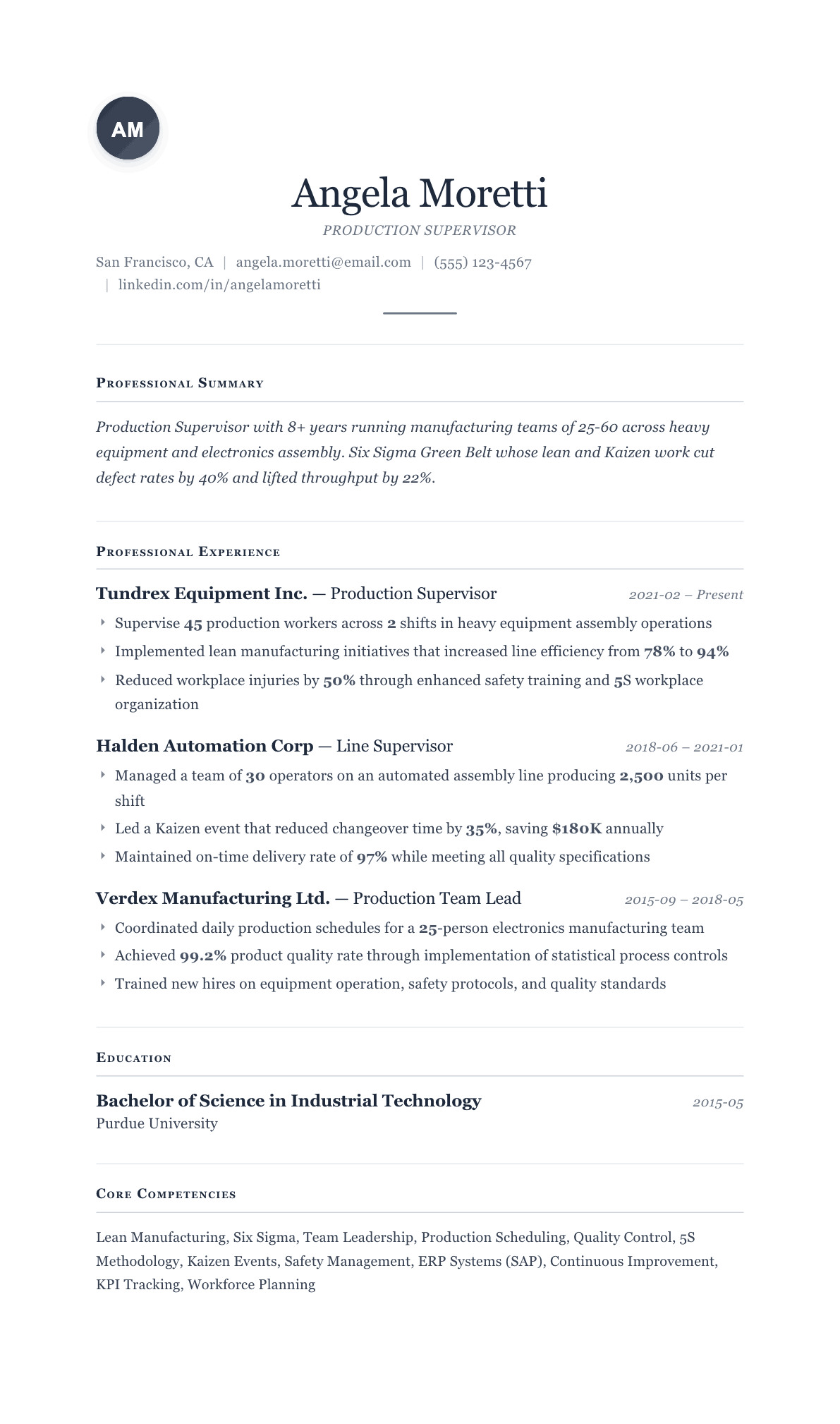
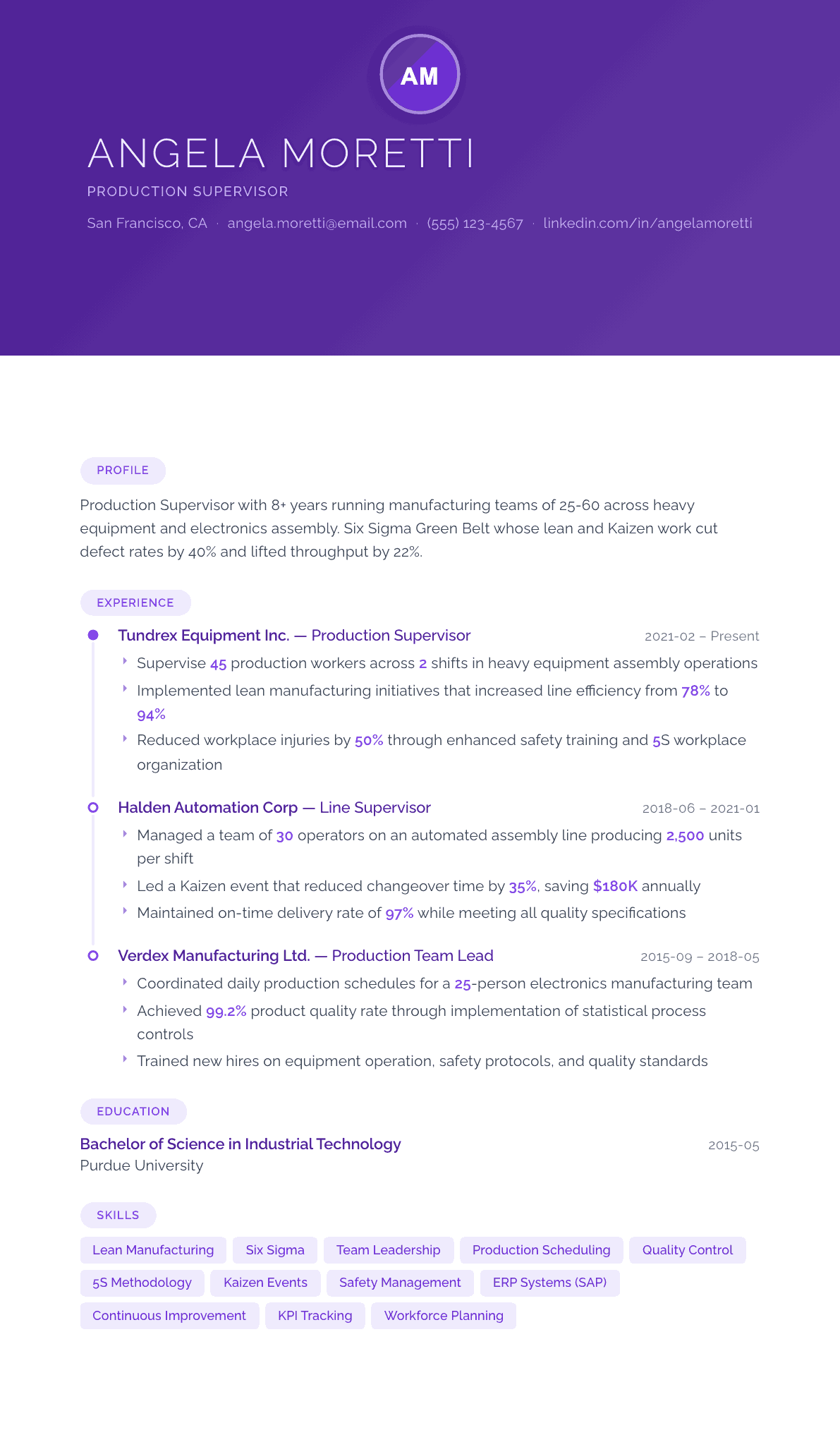
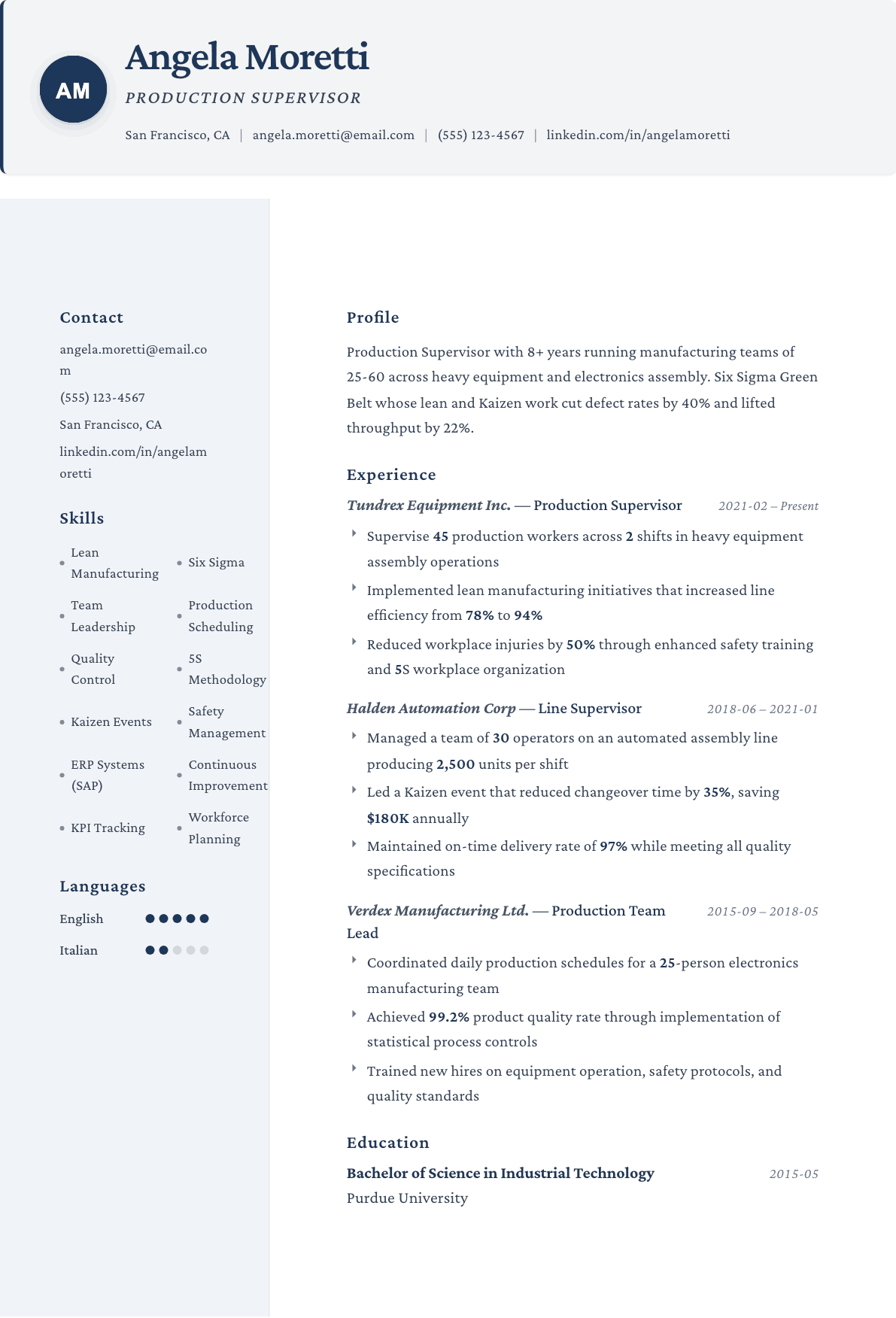
Example Production Supervisor summary
Production Supervisor with 8 years leading assembly teams of up to 60 across two shifts. Six Sigma Green Belt who raised line efficiency by 20%, cut defects by 40%, and halved recordable injuries. Looking for a plant supervisor role in a lean facility.
Skills to list on a Production Supervisor resume
- Lean Manufacturing
- Six Sigma
- Kaizen
- 5S Methodology
- Production Scheduling
- Quality Assurance
- Team Leadership
- Safety Management
- ERP Systems (SAP)
- Continuous Improvement
- KPI Management
- Inventory Control
- Root Cause Analysis
- Workforce Planning
- Budget Management
What actually gets this resume read
- Quantify your team size, production volumes, and efficiency improvements with specific numbers.
- Highlight lean manufacturing credentials (Six Sigma, Kaizen, 5S). These are top ATS keywords for this role.
- Show leadership impact: mention safety record improvements, turnover reduction, and training programs.
- Include ERP/MES system experience (SAP, Oracle, Plex) to demonstrate technical management skills.
- Emphasize both people management and process optimization to appeal to hiring managers.
- Mention any cost savings achieved through waste reduction, process improvement, or efficiency gains.
How to write a production supervisor resume
A production supervisor resume is judged on two axes at once: can you hold a line to schedule and quality, and can you keep a crew of hourly operators showing up and working safely. Plant managers have hired supervisors who were brilliant with numbers and lost the floor, and supervisors the crew loved who missed every delivery date. The resume that gets an interview shows both sides on the same page.
The reader is usually a plant or operations manager who knows exactly which numbers a supervisor owns: output against plan, scrap and first pass yield, overall equipment effectiveness, changeover time, labor hours per unit, absenteeism and turnover, and recordable injuries. If your bullets do not touch those, the reader cannot tell whether you ran a line or watched one.
This guide covers the section order manufacturing hiring managers expect, how to write the shift and span of control detail, how to handle continuous improvement credentials without overselling them, three summaries from lead through plant supervisor, before and after bullets, and the questions supervisors ask when they rewrite their resume.
Format: one page under ten years, two after, numbers early
Reverse chronological, single column, no charts or rating bars. Manufacturing recruiters use applicant tracking systems that mishandle graphics, and plant managers print resumes. Under your name give city and state and your willingness to work nights or rotating shifts, because a large share of supervisor openings are second and third shift and the honest answer saves everyone a week.
Section order: header, summary, experience, continuous improvement and systems, education and certifications. Unlike credential driven trades, the supervisor resume leads with experience, because the span of control and the products you ran are the qualification.
- Under each job put a scope line: product, process type, shift, number of direct reports, number of lines or cells, and the units or volume per shift.
- Name the environment: discrete assembly, machining, injection molding, food and beverage with its own audit regime, pharmaceutical under good manufacturing practice, or process chemical.
- State whether the workforce was union or non union, since grievance handling and contract awareness are real supervisory skills.
Scope: span of control is the first thing read
A supervisor of eight operators on one cell and a supervisor of sixty across two shifts are doing different jobs. Give the number of direct reports, whether you had leads reporting to you, the number of lines or work centers, and the shift pattern. Add the volume in the unit the industry uses, whether that is units per shift, cases per hour, tons per day or boards per week.
Then say what you actually owned. Some supervisors own the schedule, some receive it from planning. Some own maintenance calls and some route them. Some sign timecards, approve overtime, run discipline and hire. Spell out which of those were yours, because that list is how a plant manager decides whether you step into their job or up into it.
Results: the metrics a plant manager verifies
Write results in the language of the plant. Schedule attainment and on time delivery, first pass yield and scrap rate, overall equipment effectiveness and its three parts, downtime minutes and top loss reasons, changeover time, labor efficiency, and inventory or work in process levels. Pair each number with the mechanism that moved it, since an improvement with no method behind it reads as something that happened near you rather than because of you.
Safety and people metrics carry equal weight for a supervisor. Recordable and lost time incidents, near miss reporting rates, absenteeism, turnover, overtime hours, and the number of operators you cross trained all describe whether the line will still be running in six months. Many supervisor resumes list only throughput, which reads to an experienced plant manager as half a job.
Continuous improvement: claim only what you led
Lean and Six Sigma language is heavily searched and heavily inflated. Be precise about your role. Attending a kaizen event, facilitating one, and chartering a project with a defined problem statement are three different levels of involvement, and interviewers ask which one it was within the first ten minutes.
Name the tools you personally used and what came out of them: standard work and work instructions you wrote, a layered process audit you ran, a five why or fishbone on a specific defect, a value stream map that led to a layout change, single minute exchange of die work on a specific press, or a control plan you maintained. One documented example beats a list of acronyms.
Belt certifications belong in the education and certification section with the issuing body. If your green belt came from an employer program rather than a professional body, say so plainly. Employers know the difference and they respect the honesty.
Systems, audits and keywords
List the enterprise and shop floor systems you touched daily and what you did in them: production reporting and confirmations, labor entry, work order management, downtime coding, quality holds and nonconformance records. Name any manufacturing execution or maintenance system by product name, because plants search for the ones they run.
Audit and standard exposure is a screening keyword in regulated plants. Quality management system audits, food safety schemes, good manufacturing practice, hazard analysis, and customer audits all appear in postings. Only claim the ones you sat in and say what you were responsible for during them.
Production Supervisor resume summary examples
Moving up from lead
Production lead with 4 years in electronics assembly, stepping into supervision after covering the shift supervisor role for 8 months. Runs daily start up meetings for 18 operators, owns downtime coding and hourly output tracking, and trained on standard work and 5S.
Shift supervisor
Production supervisor with 7 years running second shift in a machining and assembly plant, currently 34 operators across 5 cells. Raised schedule attainment from 82% to 96% by rebalancing the cells and standardizing changeovers, with two consecutive recordable free years.
Senior or area supervisor
Senior production supervisor with 12 years in food manufacturing, responsible for 3 packaging lines, 62 employees across two shifts and 4 leads. Owns schedule attainment, labor cost per case and line changeovers, and has led plant readiness for customer and food safety audits.
Work experience bullets: before and after
Before: Supervised production employees on the manufacturing floor.
After: Supervised 34 operators and 2 leads across 5 machining cells on second shift, owning the daily schedule, overtime approval, attendance and progressive discipline.
Headcount, structure, shift and the decisions you actually signed define the job, which supervised employees never does.
Before: Improved production efficiency.
After: Raised overall equipment effectiveness on the primary press from the low seventies to the high eighties by attacking the top two downtime codes, adding a tool change checklist and moving preventive maintenance to the weekend.
Naming the loss codes and the three specific actions shows the reader how you got the number rather than that you claimed it.
Before: Focused on workplace safety.
After: Ran a weekly walkthrough with two operators, closed out near miss reports within the shift, and rebuilt the machine guarding checklist after a pinch point finding, ending the year with no recordable injuries.
A repeatable practice and a specific corrective action make the safety result believable.
Before: Reduced employee turnover on my shift.
After: Cut voluntary turnover on night shift by rewriting the 30 day onboarding, pairing every new hire with a trained buddy, and posting a cross training matrix so operators could see the path to a higher rate.
Three concrete retention mechanisms let a plant manager judge whether the approach would work in their plant.
Before: Involved in continuous improvement projects.
After: Facilitated a kaizen on changeover for a two cavity mold, timing every step, converting internal work to external and cutting the average changeover from 40 minutes to 15 with new standard work posted at the press.
Facilitated is honest about your role, and the method and the posted standard work show the change was made permanent.
Hard skills
- Production scheduling and schedule attainment
- Overall equipment effectiveness tracking
- Downtime coding and loss analysis
- Standard work and work instructions
- Changeover reduction
- 5S and visual management
- Root cause analysis
- Statistical process control
- Preventive maintenance coordination
- Labor planning and cross training matrices
- Enterprise resource planning transactions
- Quality holds and nonconformance handling
Soft skills
- Holding a crew accountable without losing it
- Shift handover discipline
- Coaching operators through change
- Calm escalation during a line stop
- Difficult conversations on attendance
Certifications worth listing
- Certified Six Sigma Green Belt (CSSGB) (American Society for Quality)
- Certified Six Sigma Black Belt (CSSBB) (American Society for Quality)
- Certified in Planning and Inventory Management (CPIM) (Association for Supply Chain Management)
- Certified Manager of Quality/Organizational Excellence (American Society for Quality)
- OSHA 30-Hour General Industry Outreach Training (OSHA Training Institute)
Mistakes that cost production supervisor candidates the interview
- Leaving out headcount, shift and number of lines, which are the three facts a plant manager needs before reading anything else.
- Reporting improvement numbers with no mechanism, so an interviewer cannot tell your work from a good quarter.
- Listing only throughput and quality while ignoring safety, attendance and turnover, which is half the supervisor job.
- Inflating a role in a kaizen or a belt project, a claim that collapses under two follow up questions.
- Describing the plant instead of your span: the company made components is not a bullet about you.
- Hiding whether the workforce was union, when grievance and contract experience is a screening factor for many plants.
Production Supervisor resume questions
How do I move from operator or lead to production supervisor on paper?
Show supervision you already did informally: covering the supervisor on vacation, running start up meetings, training new operators, coding downtime, approving small schedule changes. Put a scope line under the lead job with the number of people you directed and the lines you covered.
Which metrics belong on a production supervisor resume?
Schedule attainment, first pass yield or scrap, overall equipment effectiveness or downtime, changeover time, labor efficiency, recordable injuries, absenteeism and turnover. Pick the three your plant tracked most closely and pair each with the change you made to move it.
Do I need a Six Sigma belt to be considered?
Not usually for a first supervisor role, though many postings list it. A documented improvement project with a problem statement, a method and a sustained result carries more weight in an interview than a certificate with nothing behind it. Get both if you can.
How do I write a supervisor resume when changing industries?
Keep the span of control, the metrics and the people practices in front, since those transfer directly. Translate the product language into general terms, then name the regulated or audited environments you have worked in, because audit discipline transfers across food, medical device and aerospace plants.
Should I mention that I supervised a union workforce?
Yes. Say the union, the size of the represented group, and what you handled: grievance steps, steward conversations, contract based overtime and seniority rules. Plants with represented workforces screen for it, and plants without one still read it as evidence you can document and follow process.
Related resume examples
- Construction Manager Resume example
- CNC Machinist Resume example
- Welder Resume example
- Manufacturing Supervisor Resume example
- Brewer Resume example
- Quality Assurance Resume example