Code Enforcement Officer Resume Examples: free ATS score
Write a Code Enforcement Officer Resume That Holds Up at Hearing
By Mustafa Tarabya, founder of CVBooster · Published · Updated
Code enforcement officer resume example, keywords and a guide to case volume, notices of violation, abatement and hearing testimony.
Sample resumes for a code enforcement officer
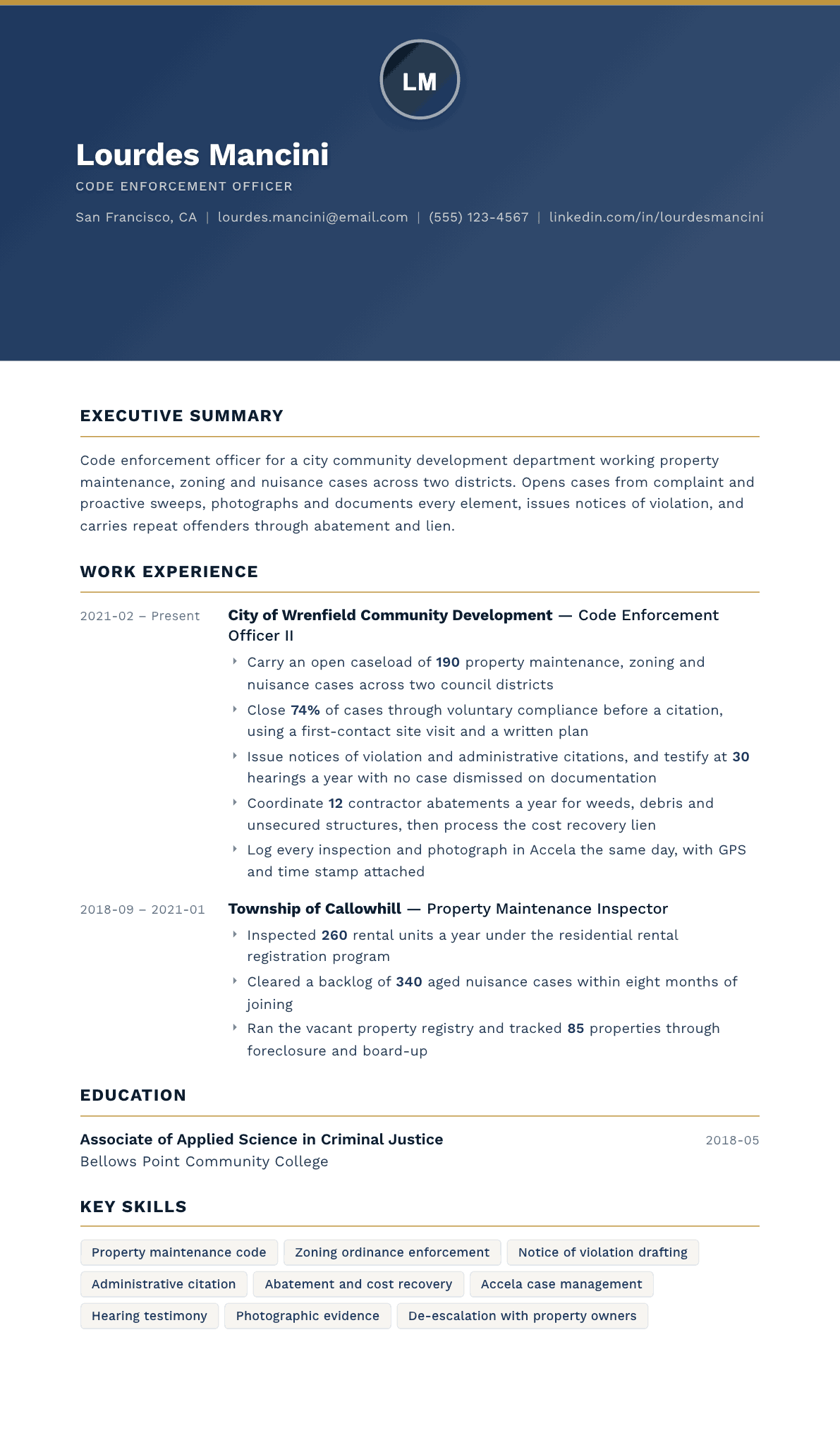
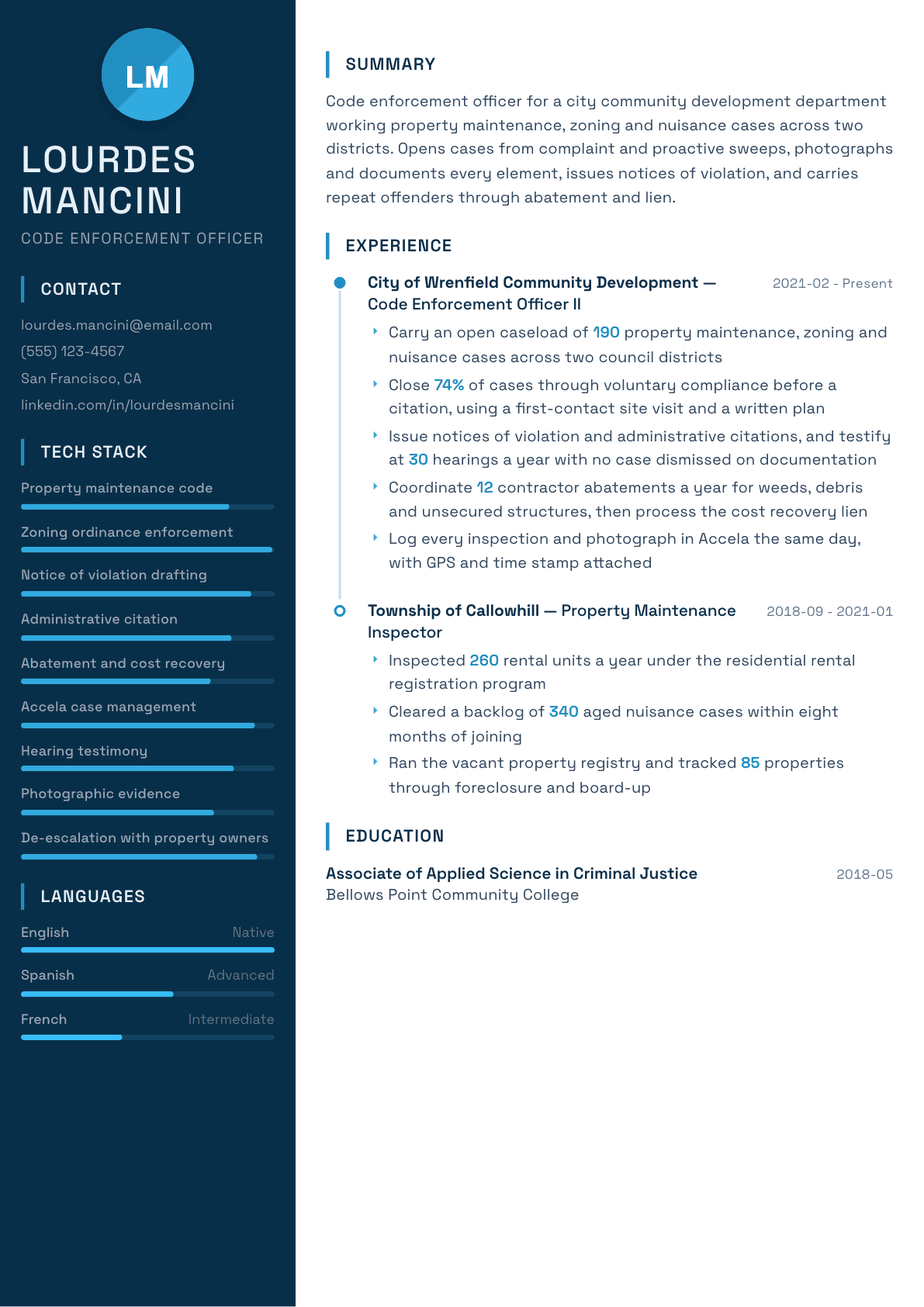
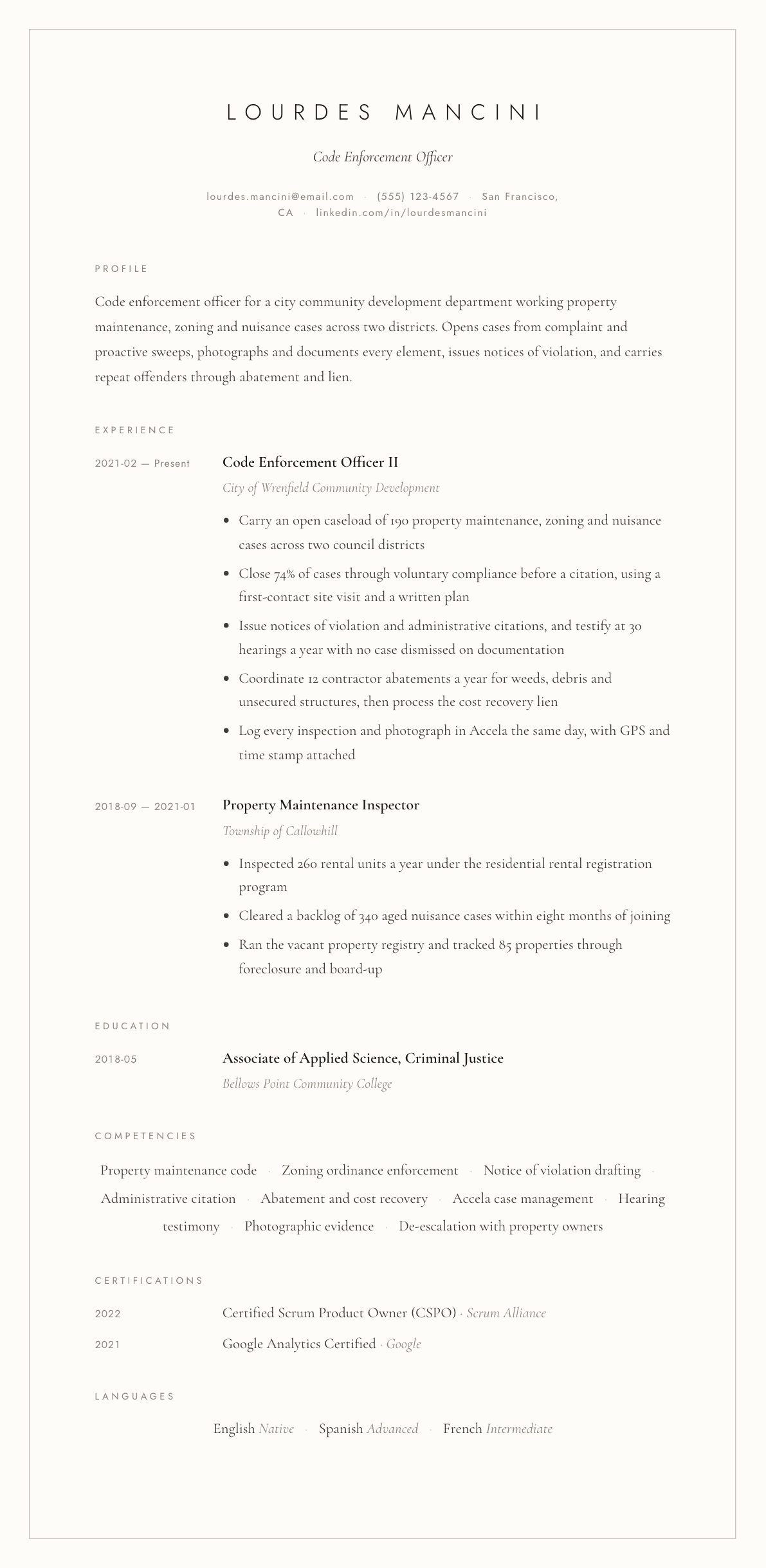
The same code enforcement officer content laid out in three CVBooster templates, so you can see what the finished document looks like before you write a word.
Example Code Enforcement Officer summary
Code enforcement officer with six years across a township and a city community development department, carrying an open caseload of 190 property maintenance, zoning and nuisance cases. Resolves most cases through voluntary compliance, documents every element in Accela the same day, testifies at administrative hearings without a dismissal on the record, and manages contractor abatement through cost recovery lien.
Skills to list on a Code Enforcement Officer resume
- Property maintenance code enforcement
- International Property Maintenance Code
- Zoning ordinance enforcement
- Nuisance and blight abatement
- Notice of violation drafting
- Administrative citation issuance
- Rental registration inspection
- Vacant property registry
- Cost recovery and lien filing
- Administrative hearing testimony
- Photographic and field documentation
- Complaint intake and triage
- Proactive district sweeps
- Accela case management
- Conflict de-escalation
What actually gets this resume read
- Give your open caseload and the code chapters you enforce, since property maintenance and zoning are separate skills.
- Show your voluntary compliance rate, because a city would rather fix a property than win a citation.
- Describe your documentation habit in detail, as most dismissed cases fail on photographs and service, not on merit.
- Name your case management system, because Accela, Energov and Cityworks each carry their own workflow.
- Put hearing testimony on the page with the count, since a supervisor needs officers who can hold a record.
- List abatement and lien work, which shows you can carry a stubborn case to the end rather than reopening it.
- Include any ICC or state code enforcement certification with the issuing body written out in full.
How to write a code enforcement officer resume
A community development manager hiring a code enforcement officer is hiring a record. Every case that ends in a citation, an abatement or a lien has to be documented well enough that a hearing officer or a judge can follow it without the officer standing there explaining. The resume that gets an interview shows both that you close cases and that your files hold.
Applications usually fail by describing the job as driving around looking for violations. Code enforcement is casework: intake, first contact, notice, compliance period, re-inspection, citation, hearing, abatement, cost recovery. Each stage has a legal requirement attached, and an officer who can name them all is worth more than one who can only spot tall grass.
This guide covers the format a city expects, how to write caseload and compliance into bullets, three summaries at different stages, before and after examples, and the questions officers ask when they move from a township to a city or into a supervisory role.
Format: one to two pages, codes enforced and caseload up front
Reverse chronological with a code block under the summary. Property maintenance, zoning, nuisance, rental registration, sign, vehicle abatement and vacant property are separate ordinance areas, and a city hiring for a rental inspection program needs to see that word rather than infer it.
Municipal recruitments are commonly scored against posted qualifications, sometimes with a supplemental questionnaire attached. Write so each qualification has an obvious match, and keep formatting simple enough to survive an applicant system that strips layout.
- Employer line: jurisdiction type, the districts or beats you covered, and whether the work was complaint driven or proactive.
- Code block: each ordinance area you enforced, plus the model code the jurisdiction adopted.
- A code enforcement resume gives open caseload and annual case closures separately, because the two measure different things.
- Name the case management system, since Accela, Energov and Cityworks each carry a different workflow.
Summary: caseload, compliance rate, enforcement reach
Open with the caseload you carry and the ordinance areas in it, then the voluntary compliance rate, then how far you have carried cases: citations, hearings, abatements, liens. That order matches how a manager thinks about the job, from workload to results to escalation.
Voluntary compliance belongs high because it is what a city council actually wants. Citations generate complaints to elected officials and abatements cost money, so an officer who resolves most cases with a site visit and a written plan is solving the political problem as well as the code one.
Experience: intake, notice, compliance, escalation
Begin each job with case origin and volume. Complaint driven cases, proactive sweeps and referrals from building, fire, police or the health department are different work, and a manager building a proactive program wants an officer who has run sweeps rather than only responded to calls.
The notice stage carries the legal weight. Describe how you draft a notice of violation: the code section cited, the specific condition, the corrective action required, the compliance deadline and the method of service. Service is where cases die, so if you have handled personal service, certified mail, posting and service on an out of state owner, say it plainly.
Compliance and re-inspection bullets should carry numbers. How many cases closed voluntarily, what your average time to compliance looks like, how you handle a partial correction, and what triggers escalation in your jurisdiction. Any officer can describe a violation, but describing the decision to escalate is what shows judgment.
Finish with the escalation chain. Administrative citations, hearing testimony, contractor abatement, board up and secure orders, cost recovery liens and referrals to the city attorney belong in their own bullets with counts. A case carried to a lien is a case an officer did not abandon, and managers notice that.
Documentation, safety and the field reality
Documentation is the technical core of the role, so treat it as a skill rather than an afterthought. Same day photograph upload with time and location data, measured observations, contact logs, and narrative entries written the way a hearing officer reads them are all worth a bullet. When a case is dismissed, it is almost always documentation and not the merits.
Safety and de-escalation also belong on the page. Officers knock on doors of people in the worst week of their lives, work alone in unfamiliar neighborhoods, and sometimes meet hostility. Mention any training in de-escalation, defensive tactics, or officer safety, and mention how you coordinate with police when a contact turns unsafe.
Keywords, certification and the path upward
Match the posting vocabulary: notice of violation, administrative citation, compliance deadline, abatement, imminent hazard, substandard structure, nuisance, blight, receivership, lien, hearing officer. Where the posting names its own municipal code chapter, reference the equivalent area you have worked.
Certification carries real weight in this field. Property maintenance and housing inspector certifications from the International Code Council and state code enforcement officer certifications are common minimum qualifications, and holding one alongside a zoning or building credential is what moves an officer toward a supervisor or building inspector track.
- State whether you carry a vehicle, work a beat, or handle both office and field duty.
- Include after hours and weekend sweep work if your jurisdiction runs it, since coverage is often the hiring driver.
- Note any experience with receivership, demolition or dangerous building cases, which few officers have.
- List languages you use in the field, because a notice explained in a residents language gets corrected faster.
Code Enforcement Officer resume summary examples
First enforcement seat
Criminal justice graduate with two years as a property maintenance inspector for a township, inspecting 260 rental units a year under the rental registration program and clearing a backlog of 340 aged nuisance cases. Trained on the property maintenance code and field documentation. Seeking a city code enforcement officer role.
Four years on a caseload
Code enforcement officer carrying 190 open property maintenance, zoning and nuisance cases across two council districts. Closes 74% of cases through voluntary compliance after a first contact site visit and written plan, logs all field evidence in Accela the same day, and testifies at 30 administrative hearings a year.
Senior officer
Senior code enforcement officer handling dangerous building and vacant property cases, coordinating contractor abatement and cost recovery liens, and preparing referrals for the city attorney. Reviews peer case files before citation, runs proactive district sweeps, and trains new officers on notice drafting, service methods and hearing preparation.
Work experience bullets: before and after
Before: Investigated code violations reported by residents.
After: Carried an open caseload of 190 property maintenance, zoning and nuisance cases across two council districts, opened from complaint intake and monthly proactive sweeps.
Caseload size, ordinance areas and the two case origins show a real assignment rather than an activity.
Before: Issued notices to property owners.
After: Drafted notices of violation citing the code section, the observed condition, the required correction and the compliance deadline, and completed service by personal contact, posting or certified mail with proof retained.
Naming the elements of a notice and the service methods addresses the exact point where cases get dismissed.
Before: Achieved a high compliance rate.
After: Closed 74% of cases through voluntary compliance before any citation, using a first contact site visit and a written correction plan agreed with the owner.
The figure plus the method explains how compliance was achieved instead of asserting the outcome.
Before: Attended hearings for enforcement cases.
After: Testified at 30 administrative hearings a year on property maintenance and nuisance cases, with no case dismissed on documentation or service grounds.
Hearing volume and a documentation outcome prove the case files hold under challenge.
Before: Handled properties that were cleaned up by the city.
After: Coordinated 12 contractor abatements a year for overgrowth, debris and unsecured structures, then prepared the cost recovery lien package for filing against each property.
Abatement counts and the cost recovery step show a case carried all the way to closure.
Hard skills
- Property maintenance code enforcement
- Zoning ordinance enforcement
- Nuisance and blight abatement
- Notice of violation drafting and service
- Administrative citation issuance
- Rental registration inspection
- Vacant and dangerous building cases
- Contractor abatement coordination
- Cost recovery and lien filing
- Administrative hearing testimony
- Field photography and evidence handling
- Complaint intake and case triage
- Proactive district sweeps
- Case management system record keeping
Soft skills
- Staying calm at a door where the reception is hostile
- Firmness without contempt toward owners in hard circumstances
- Consistent treatment across neighborhoods with unequal resources
- Written clarity a hearing officer can follow unaided
- Judgment about when a case needs escalation and when it needs time
Certifications worth listing
- Property Maintenance and Housing Inspector Certification (International Code Council)
- Zoning Inspector Certification (International Code Council)
- Certified Code Enforcement Officer (CCEO) (American Association of Code Enforcement)
Mistakes that cost code enforcement officer candidates the interview
- Counting inspections performed while never stating how many cases actually reached compliance.
- Skipping the service method on notices, when improper service is the most common reason a case fails.
- Writing enforcement as adversarial when a manager is hiring for voluntary compliance first.
- Omitting the case management system, which is a practical screening filter in most municipal recruitments.
- Leaving abatement and lien work off the page, so the resume stops at the citation stage.
- Failing to mention field safety and de-escalation training, which matters to any manager who has lost an officer to a bad contact.
Code Enforcement Officer resume questions
What certification should a code enforcement officer get first?
A property maintenance and housing inspector certification is usually the most portable starting point because it maps to the ordinance area most officers work daily. Add a zoning inspector certification next if your jurisdiction assigns zoning cases to enforcement staff.
Does police or military experience help in code enforcement?
It helps with report writing, testimony, de-escalation and comfort in unpredictable field contacts, all of which transfer directly. Keep it on the page, but pair it with ordinance knowledge so a manager does not assume you will treat the work as law enforcement.
How do I describe cases I could not resolve?
Describe what you did and where the case stands. A property in probate, an out of state owner or a case awaiting city attorney action is not a failure, and showing that you tracked it through the obstacle demonstrates the persistence the job requires.
Should I include a voluntary compliance rate if my agency does not track one?
Estimate carefully and say how you arrived at it, or describe the pattern instead. Saying most cases close after a first site visit and written plan, with citations reserved for repeat conditions, communicates the same thing without inventing a figure.
How do I move from code enforcement into building inspection?
Add code council certifications in a building trade discipline and get any plan review or construction exposure you can inside your current role. Then rewrite your resume around technical code knowledge rather than case volume, since building departments hire on certification first.
Related resume examples
- Building Inspector Resume example
- Health Inspector Resume example
- Zoning Administrator Resume example
- City Clerk Resume example
- Child Support Officer Resume example
- Food Safety Inspector Resume example