Home Health Aide Resume Examples: the lines they read
Home Health Aide Resume and Home Care Aide Resume Samples
By Mustafa Tarabya, founder of CVBooster · Published · Updated
Home care aide resume samples for agency, dementia, hospice and lead aide work, plus a home health aide resume with ADL care, visit notes and client types.
Sample resumes for a home health aide
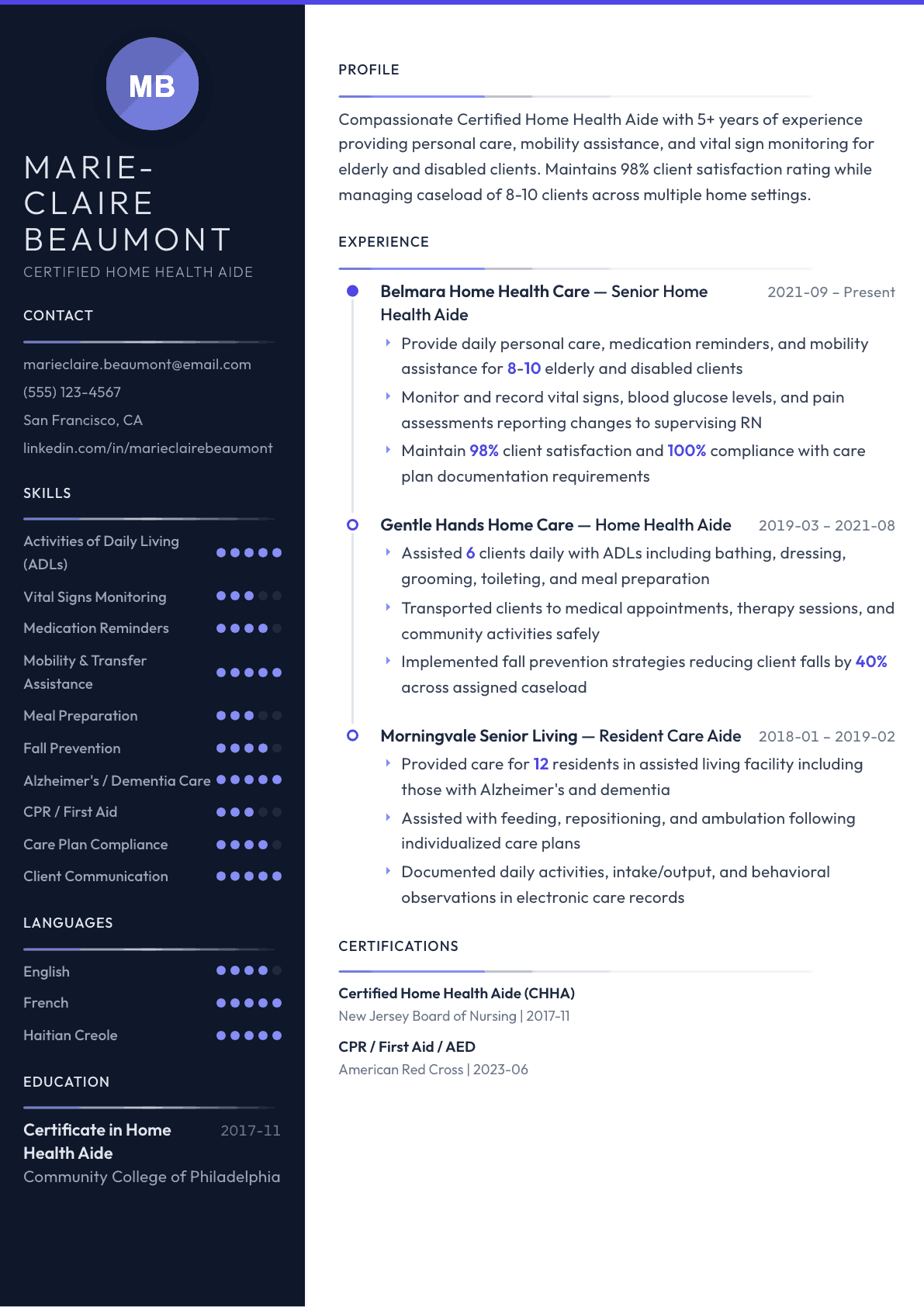
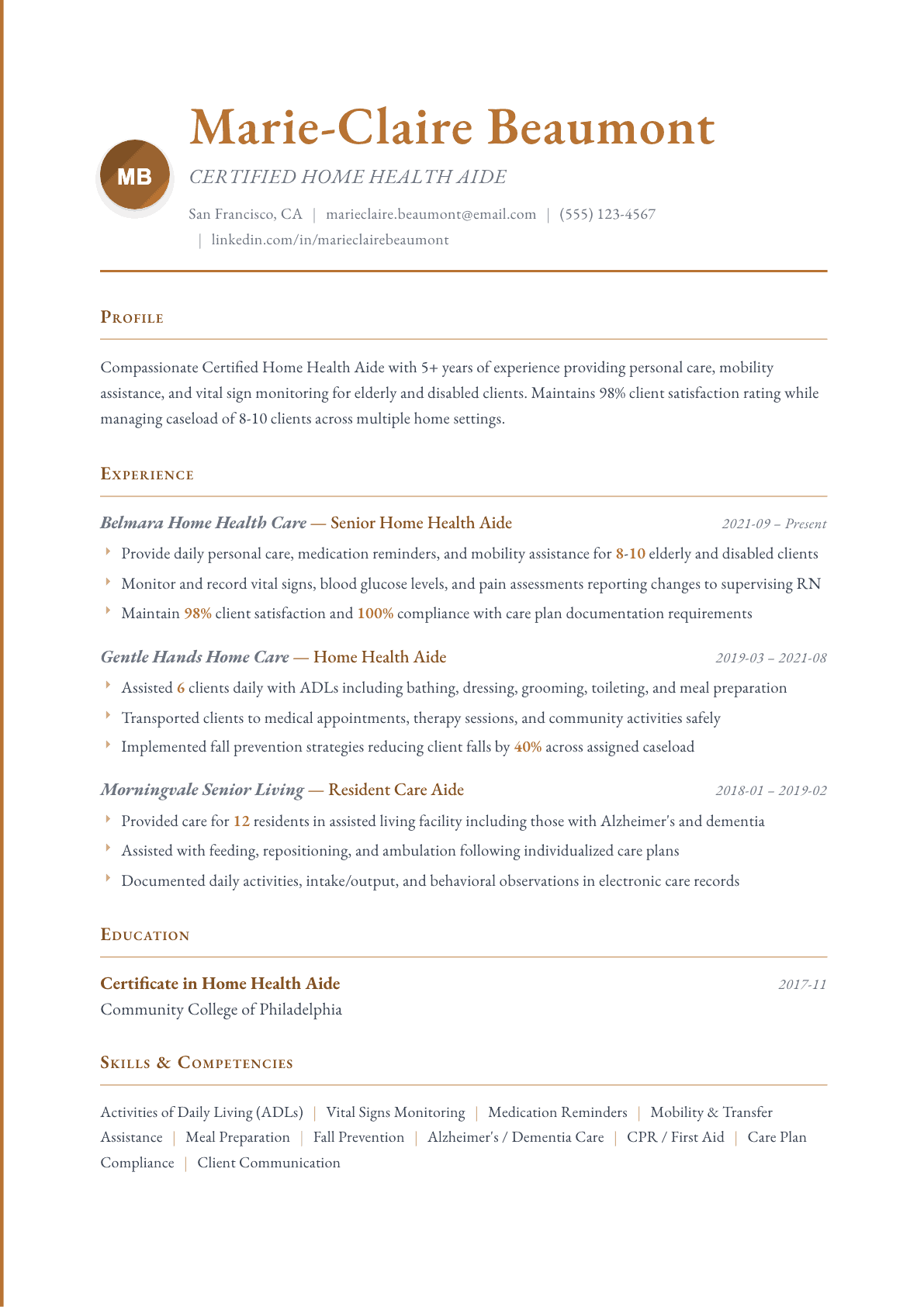
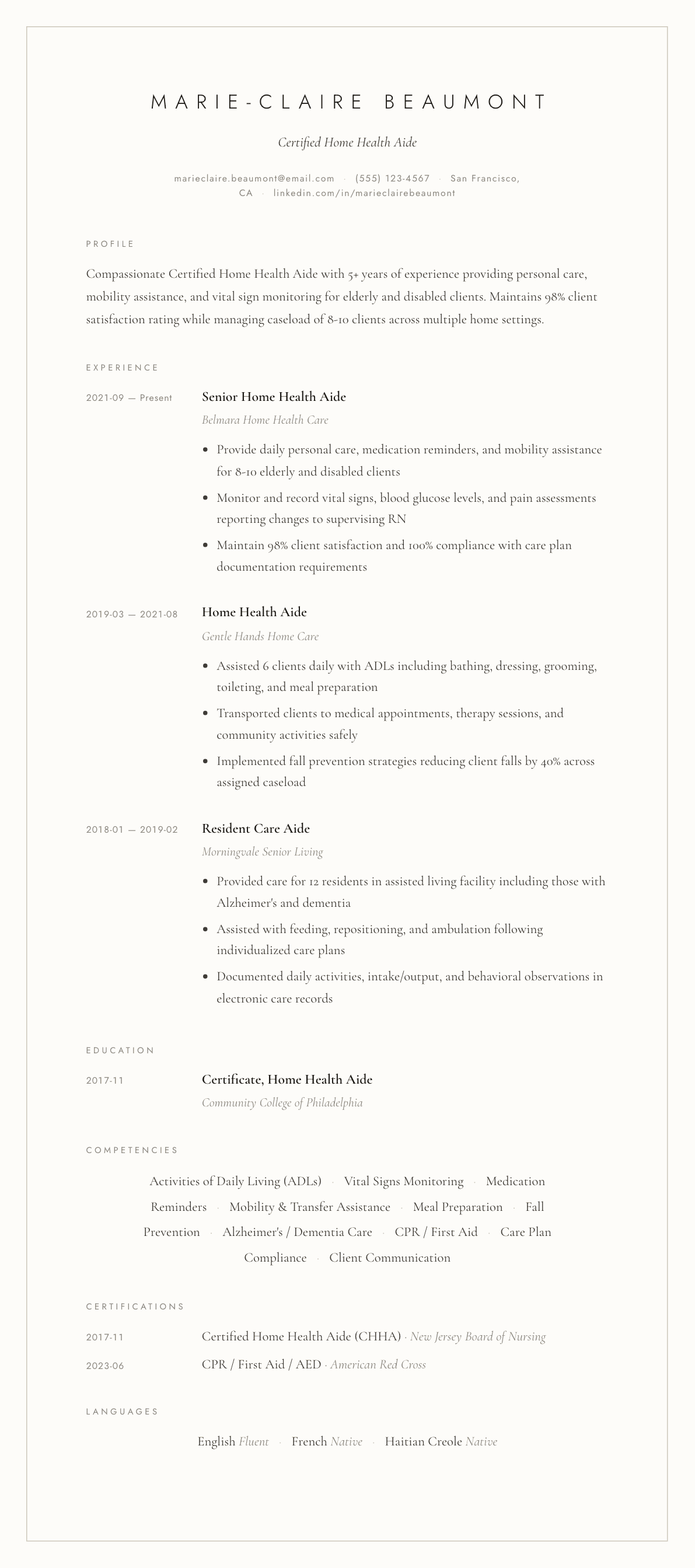
The same home health aide content laid out in three CVBooster templates, so you can see what the finished document looks like before you write a word.
Example Home Health Aide summary
Certified Home Health Aide with 5 years of experience providing personal care and vital sign monitoring for 8-10 elderly and disabled clients. Maintains 98% satisfaction rating with expertise in ADLs, fall prevention, and dementia care.
Skills to list on a Home Health Aide resume
- Personal Care / ADLs
- Vital Signs Monitoring
- Medication Management
- Mobility & Transfer Assistance
- Meal Preparation & Nutrition
- Fall Prevention
- Alzheimer's & Dementia Care
- CPR / First Aid
- Care Plan Documentation
- Client Communication
- Infection Control
- Compassionate Patient Care
What actually gets this resume read
- Highlight your certification and state registration. Most states require HHA certification.
- Quantify your caseload and client satisfaction ratings to demonstrate reliability.
- Include specific ADL skills: bathing, dressing, transfers, feeding, medication reminders.
- Mention specialized care experience: Alzheimer's, dementia, post-surgical, wound care.
- Show safety accomplishments like fall prevention metrics or zero-incident records.
How to write a home health aide resume
A home health aide resume is usually read by a staffing coordinator or a nurse supervisor at an agency who has an unfilled case in front of her and a family waiting. She is checking three things: whether your training and competency evaluation meet the state requirement, whether you can get to the client, and whether the client types you have handled match the case she needs to fill today.
That last point is where most aide resumes lose. Dementia care, hoyer and mechanical lift transfers, hospice and end of life support, bariatric clients, tracheostomy or feeding tube households, and pediatric cases all require different comfort levels, and an agency will not risk a placement on a guess. Naming the client types you have supported is the single biggest improvement most aide resumes can make.
HHA is the abbreviation most agencies use, and every HHA sample resume below follows the same order. This guide covers four home care aide resume samples by setting, what agencies and private families look for, how to write personal care and documentation work so it is credible, three summaries covering a newly certified aide through to a lead aide, and the mistakes that keep otherwise strong applications sitting in the queue.
Format: one page, certification and availability on the first screen
Keep it to one page. Reverse chronological, plain type, no graphics, since agencies often scan or retype the file into their scheduling system. Put a short block under the summary with the essentials a coordinator needs before she can consider you: your home health aide or certified nursing assistant credential with the state, completed training hours, current CPR and first aid, tuberculosis screening and immunization status, driver license and reliable transportation, and whether you can transport clients in your own vehicle.
Availability belongs on the page. Days, evenings, overnights, weekends, live in, and the geographic area or counties you cover. Coordinators fill cases by availability first, so an aide who states it plainly moves ahead of one whose availability has to be discovered by phone.
- Header: name with certification, city and state, phone, email.
- Order: summary, certification and clearances, availability and coverage area, caregiving experience, training, skills, languages.
- Aides new to paid work list family caregiving with the duties, hours per week and duration, and label it clearly as personal caregiving.
Summary: client types, caseload, and setting
Two or three sentences. Name the settings you have worked in, private homes, assisted living, group homes or memory care, the number of clients you carry, and the conditions you are experienced with. Dementia, stroke recovery, Parkinson disease, diabetes, chronic obstructive pulmonary disease, mobility limitations and end of life care are all recognizable to a coordinator.
Do not open with compassionate and caring. Every applicant writes it and it decides nothing. Replace it with the specific proof: years with dementia clients, safe transfer experience, or a record of long client placements without a request for change.
Experience: duties, but with the details that matter
Head each job with the employer type and your caseload: agency with the number of clients, private family, or facility with the resident count and unit type. Then write bullets covering the four parts of the work: personal care and activities of daily living, mobility and transfers, household and meal support, and observation with reporting.
Transfers deserve their own bullet because they are the largest safety risk in the job. Say which equipment you have used, mechanical lift, sit to stand lift, gait belt, slide board, walker or wheelchair, and whether you worked one aide or two aide transfers. Agencies match this against the equipment already in the client home.
Observation and reporting is the part aides most often leave out and supervisors most value. Vital signs, blood glucose checks, weight, intake and output, skin checks for pressure injuries, appetite and mood changes, medication reminders within the scope your state allows, and how you escalated a change to the supervising nurse.
Home care aide resume samples: four aides by setting
Home care aide, home health aide and personal care aide are often posted for the same visit work, though agencies use home care aide most for non medical support and home health aide for Medicare certified agency work. Use the exact title from the posting and the credential name your state uses. The four samples below are invented and show the headline, the summary line and the strongest bullet for each setting.
- New aide, agency visits: Headline: Home Care Aide, state training completed, CPR certified. Summary: Provides bathing, dressing, meal preparation and light housekeeping for four to six clients a week across two zip codes. Best bullet: Kept a perfect on time record for the first six months of hourly visits, with every visit note entered in the agency app before leaving the home.
- Dementia and memory care, private family: Headline: Home Care Aide, dementia care, live in and overnight shifts. Summary: Supports one client with moderate dementia on a fixed daily routine, medication reminders and safe walking. Best bullet: Built a picture based daily schedule with the family that cut evening agitation episodes the family had been logging each week.
- Hospice and end of life support: Headline: Home Health Aide, hospice team, comfort care. Summary: Provides personal care, repositioning and family respite for hospice clients under the direction of the visiting nurse. Best bullet: Reported a change in breathing and skin color to the case nurse within minutes, which led to a same day visit and an adjusted comfort plan.
- Lead aide, mixed caseload: Headline: Lead Home Care Aide, 12 client caseload, mechanical lift trained. Summary: Covers open shifts, orients new aides in client homes and completes transfer and bathing for bariatric and post surgical clients. Best bullet: Oriented nine new aides to client homes in one year, with no transfer injuries reported on any of their cases.
Documentation, care plans and scope of practice
Agencies are surveyed on documentation, so an aide who documents reliably is worth more than one who does not. Say what you charted, whether on paper or in an electronic visit verification application, whether you completed visit notes at the point of care, and whether your notes were ever cited in a survey or audit.
Show that you understand scope. Aides remind, they do not administer, unless a state specific delegation allows it and a nurse has trained and delegated the task. Writing that you followed the plan of care and reported changes to the supervising nurse tells a coordinator you will not create liability, which is exactly what she is screening for.
Reliability, retention and the qualities agencies actually pay for
The two problems agencies have are call outs and client requests for a different aide. Anything on your resume that speaks to reliability and client retention is valuable: length of your longest continuous placement, attendance record, willingness to take last minute coverage, and clients or families who requested you specifically.
Languages spoken are worth their own line, since many placements depend on communicating with the client and family in their own language. Add cultural or dietary experience if it fits the population the agency serves, such as kosher or halal meal preparation.
Home Health Aide resume summary examples
Newly certified
Certified Home Health Aide with 75 hours of state approved training and a passed competency evaluation, plus three years of unpaid caregiving for a grandparent with dementia. CPR and first aid current, reliable vehicle, and available for weekday day shifts across two counties.
Five years with an agency
Certified Home Health Aide with five years supporting eight to ten agency clients weekly in private homes, including dementia, stroke recovery and hospice cases. Experienced with mechanical lift transfers, blood glucose checks and electronic visit verification, with a two year placement as the longest continuous case.
Lead aide
Senior Home Health Aide with eleven years across agency and assisted living settings, now mentoring six new aides through their first placements. Handles complex dementia and end of life cases, trains staff on two person transfers, and has covered 40 emergency shifts in the past year.
Work experience bullets: before and after
Before: Helped clients with daily living activities.
After: Supported eight to ten clients weekly with bathing, dressing, grooming, toileting and incontinence care, following each written plan of care and adjusting for dementia related resistance.
The caseload, the named tasks and the plan of care show scope and volume that helping with daily living hides.
Before: Assisted with moving and walking.
After: Performed one and two person transfers using a mechanical lift, sit to stand lift and gait belt for clients with limited weight bearing, with no client falls across five years of placements.
Naming the equipment and the safety record answers the risk question an agency asks before every placement.
Before: Reported changes to the nurse.
After: Recorded vital signs, blood glucose readings and weekly weights, and escalated a sudden appetite loss and swelling to the supervising nurse, leading to a same day medication review.
A concrete escalation with an outcome proves observation skill that a general reporting claim only asserts.
Before: Prepared meals and did light housekeeping.
After: Planned and cooked meals for a low sodium cardiac diet and a pureed texture diet, managed grocery shopping on a household budget, and kept laundry, linens and bathroom safety in order.
Naming the therapeutic diets converts routine housekeeping into clinically relevant support.
Before: Was reliable and rarely missed work.
After: Held a two year continuous placement with one family and covered 40 last minute shifts for other aides, with two families requesting me by name after temporary coverage.
Reliability becomes evidence when it is measured in placement length, coverage shifts and client requests.
Hard skills
- Activities of daily living support
- Bathing, dressing and grooming assistance
- Incontinence and toileting care
- Mechanical and sit to stand lift transfers
- Gait belt and ambulation assistance
- Vital sign measurement
- Blood glucose monitoring
- Skin and pressure injury checks
- Medication reminders
- Therapeutic meal preparation
- Range of motion exercises
- Electronic visit verification documentation
- Infection control and hand hygiene
Soft skills
- Dementia communication techniques
- Patience with resistant care
- Family communication
- Dependability and punctuality
- Respect for client privacy
- Calm response to emergencies
Certifications worth listing
- Home Health Aide Certification (State approved training program)
- Certified Nursing Assistant (CNA) (State nurse aide registry)
- CPR and AED for the Professional Rescuer (American Red Cross)
- First Aid Certification (American Red Cross)
- Basic Life Support (BLS) (American Heart Association)
- Certified Dementia Practitioner (CDP) (National Council of Certified Dementia Practitioners)
Mistakes that cost home health aide candidates the interview
- Leaving out certification hours, the state and the competency evaluation, which are the first requirements a coordinator has to verify.
- Not stating availability and coverage area, when cases are matched on those before anything else is considered.
- Writing provided compassionate care with no client types, no caseload and no setting behind it.
- Skipping transfer equipment, so an agency cannot safely match you to a client who needs a mechanical lift.
- Omitting observation and reporting duties, which are the part of the job supervising nurses depend on most.
- Hiding years of unpaid family caregiving instead of listing it with hours, duration and the conditions involved.
- Implying you administered medications when your state permits only reminders, which raises a scope of practice concern immediately.
Home Health Aide resume questions
Does unpaid family caregiving count as experience?
Yes, when you present it properly. List it as personal caregiving with the relationship, the duration, hours per week, the conditions you managed, and the specific tasks such as transfers, bathing, medication reminders and appointment transport. Agencies accept it, especially alongside a completed training program.
What certifications does a home health aide need on the resume?
Your state approved training hours and passed competency evaluation, plus current CPR and first aid. Add certified nursing assistant registry status if you hold it, along with tuberculosis screening, immunization records and background clearance, since agencies must document all of these before a placement.
Is a home care aide resume different from a home health aide resume?
The structure is the same: credential and availability at the top, client types and caseload in the summary, then visits written with numbers. The difference is emphasis. A home care aide page leads with personal care, companionship and household support, while a home health aide page adds vital signs and work under a nurse care plan.
Should I list the client names or families I worked for?
No. Use the agency name where you were employed, or write private family with the city and dates for direct hire work. Naming clients breaches their privacy, and an agency reading it will assume you would be equally careless with their own clients.
What does a good HHA sample resume include?
In order: name, city and how far you can travel, your training or certification and state registry status, a summary naming client types and weekly visit load, then each job with client types, visits per week and the ADL care you gave, and finally CPR and any dementia or hospice training. A written out bullet: Supported 6 clients a week across two towns, including 2 with dementia and 1 using a hoyer lift, with visit notes completed in the agency app before leaving each home. Coming from a facility, list the residents you cared for the same way.