Certified Nursing Assistant Resume Examples: free score
Certified Nursing Assistant Resume Samples, With or Without Experience
By Mustafa Tarabya, founder of CVBooster · Published · Updated
Certified nursing assistant resume examples plus a nurse assistant resume sample with no experience: registry details, clinical placement and skills.
Sample resumes for a certified nursing assistant
The same certified nursing assistant content laid out in three CVBooster templates, so you can see what the finished document looks like before you write a word.
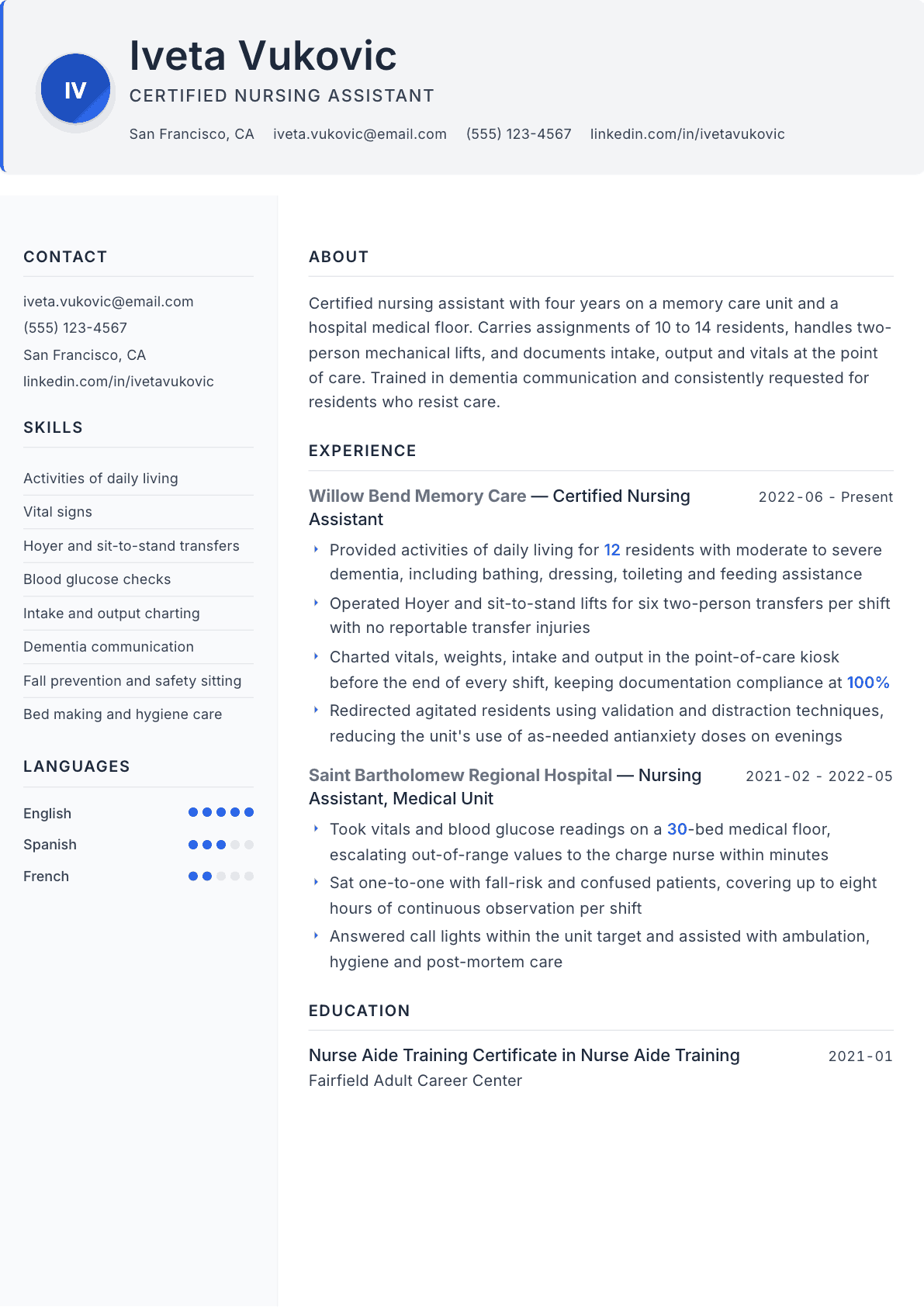
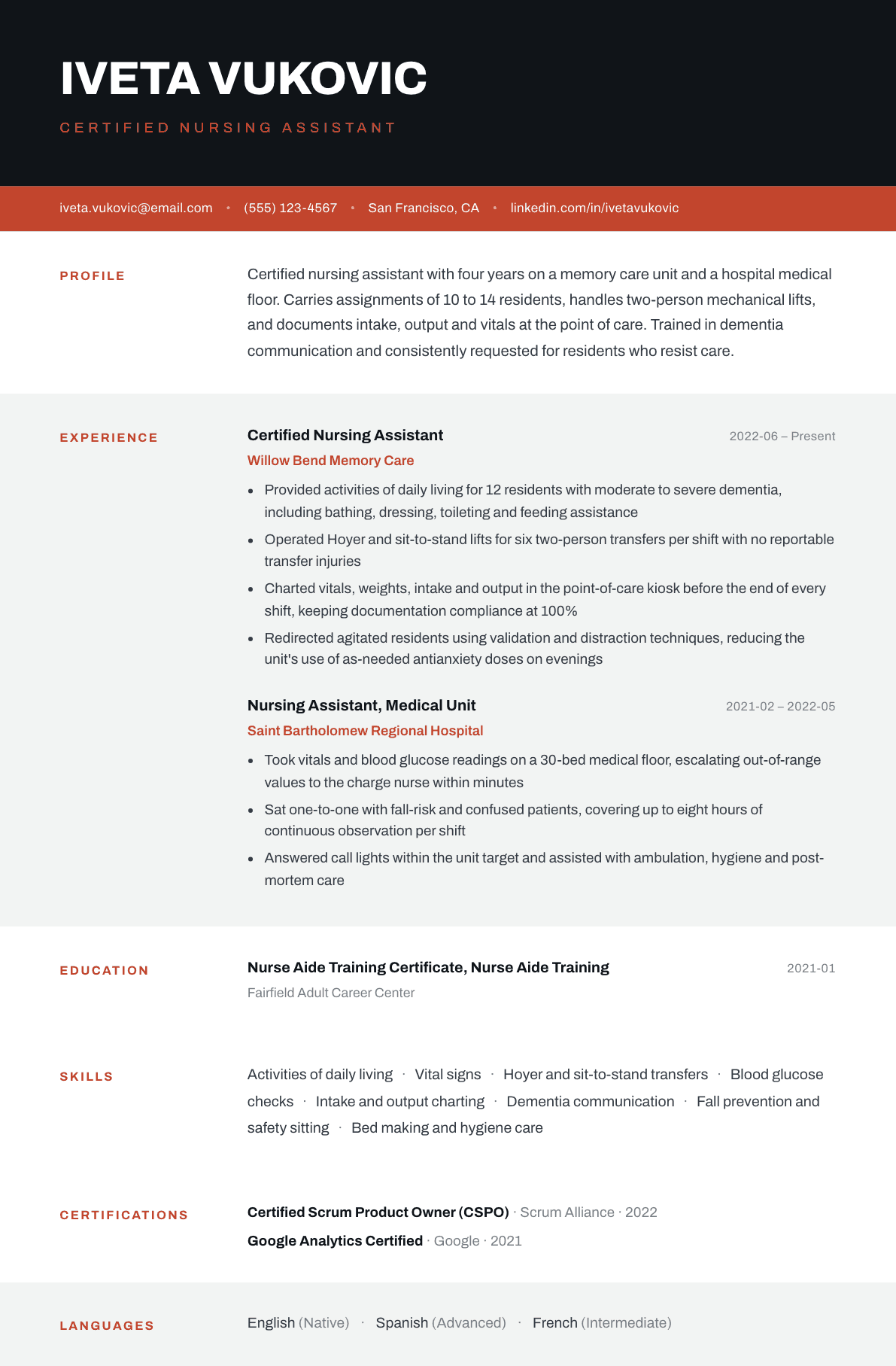
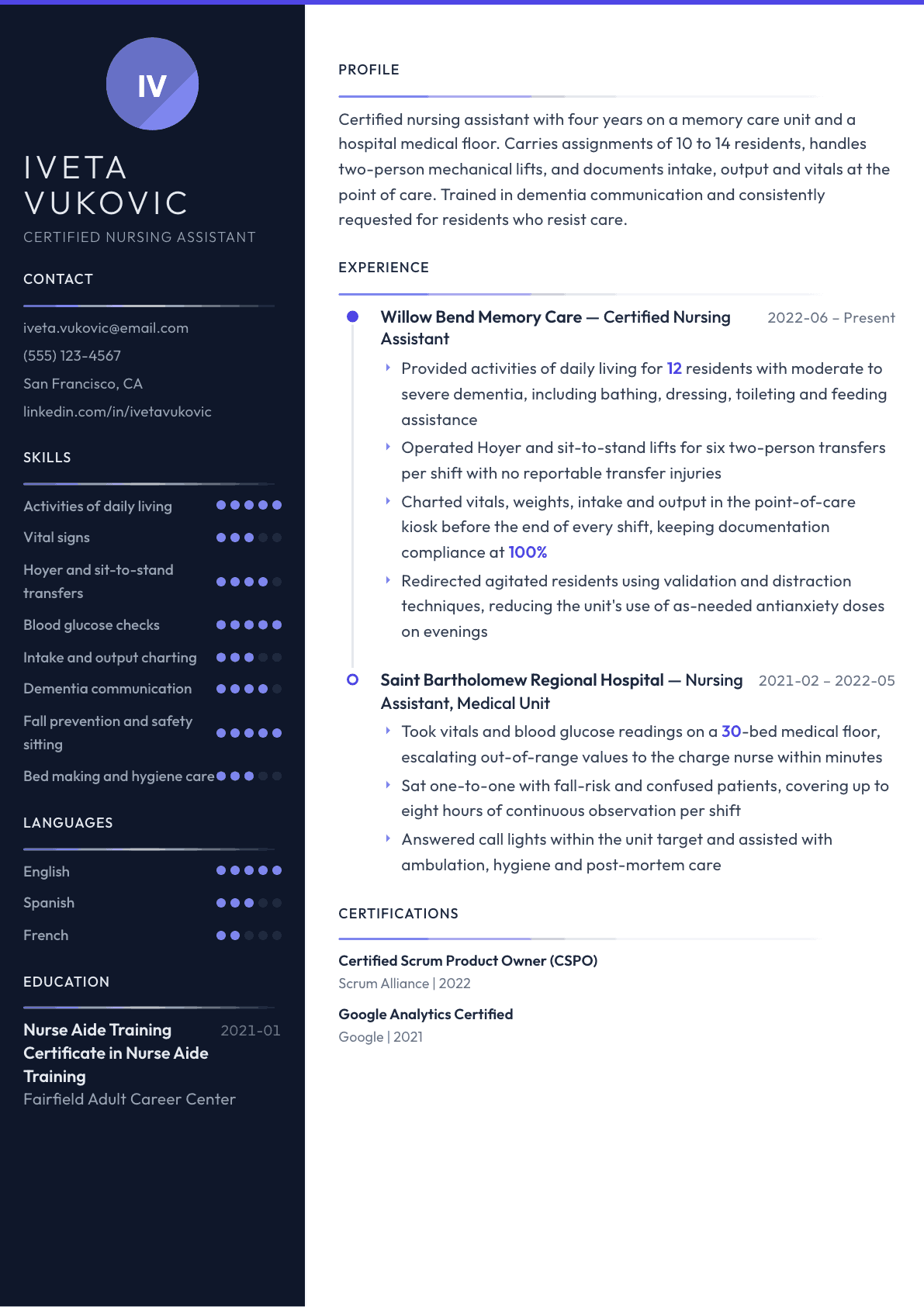
Example Certified Nursing Assistant summary
Certified nursing assistant with four years across memory care and an acute medical floor. Handles assignments of 12 residents, leads two-person mechanical transfers, and charts vitals, weights and intake at the point of care before the end of shift. Trained in dementia communication and often assigned residents who refuse care from others. Looking for a hospital telemetry unit with a path into an LPN program.
Skills to list on a Certified Nursing Assistant resume
- Activities of daily living
- Vital signs measurement
- Patient transfers and mechanical lifts
- Bathing and personal hygiene
- Feeding assistance
- Intake and output tracking
- Blood glucose monitoring
- Fall prevention
- Dementia and behavior redirection
- Range of motion exercises
- Catheter and ostomy care support
- Point-of-care documentation
- Infection control and PPE
- Turning and repositioning schedules
What actually gets this resume read
- Put your state nurse aide registry number and expiration on the resume so a recruiter can verify you without emailing first.
- State how many residents or patients you carried per shift, because that single number sets a manager's expectations.
- Name the lift equipment you are trained on: Hoyer, sit-to-stand, ceiling lift, gait belt, slide board.
- Say which settings you have worked: memory care, skilled nursing, hospital medical floor, home care, or hospice.
- Add any additional aide credentials such as medication aide, restorative aide or dementia practitioner in their own section.
- Show reliability with concrete facts, such as perfect attendance or years of consistent night and weekend coverage.
How to write a certified nursing assistant resume
Hiring for aide positions moves faster than almost any other role in health care, and that speed shapes what a certified nursing assistant resume has to do. The scheduler or unit manager reading it is trying to answer three questions in under a minute: is this person on the state registry and in good standing, how many residents can they carry, and will they show up on the shift nobody else wants. A resume that answers those three plainly gets a phone call the same afternoon.
The mistake most aides make is writing the job description instead of their own record. Bathing, dressing, toileting and vital signs appear on every application in the pile. What does not appear on every application is the resident count, the lift equipment, the unit type, the years of steady night coverage and the point-of-care system the facility already uses.
This guide walks through the registry block, the experience section, the equipment and setting details managers scan for, a complete nurse assistant resume with no experience written out line by line for newly certified aides, and the questions aides ask most often, including how to move from a nursing home to a hospital and how to position an aide job as a step toward a nursing license.
Registry and credential block: put it above the fold
Under your contact line, give a short block with the certification title, the state registry that lists you, your certificate number if you wish, and the expiration or renewal month. Facilities are legally required to verify registry status before your first shift, so a manager who can confirm it from the page itself moves you forward faster than one who has to email and wait.
Add any second credential in the same block: medication aide, restorative aide, dementia practitioner training, phlebotomy, or a current basic life support card. Those are the credentials that separate two otherwise identical aide resumes, and they raise the pay band in many buildings.
- Name, credential, city and state, phone, email.
- Registry block: state, status, renewal month, additional aide credentials.
- Sections in order: summary, certifications, experience, education and training, skills.
- Include shift availability if you are open to nights, weekends or doubles.
Summary: setting, assignment size, and what you are known for
Two or three lines. Name the settings you have worked, the years, how many residents or patients you carry per shift, and one thing you do that not everyone does. A certified nursing assistant who says she carries twelve residents on a memory care unit and is routinely assigned the residents who refuse care from others has described a real person, not a job posting.
If you are new, use the summary to say what your training program covered and how many clinical hours you completed. A candidate with no paid experience who names a 75-hour training program and a long-term care clinical placement still reads as prepared.
Experience: census, ratio, equipment, and the shift you held
Every job gets the facility type, the unit, the bed count and the number of residents in your own assignment. There is a large difference between eight residents on a hospital medical floor and sixteen on a night shift in long-term care, and only you can tell the reader which one you did.
Then write bullets around the parts of the work that vary between buildings: mechanical lift equipment and whether transfers are one or two person, feeding assistance for residents at aspiration risk, restorative and range of motion programs, one-to-one observation for fall or elopement risk, hospice comfort care, and the point-of-care charting kiosk you documented in. Vitals and hygiene can appear, but they should never be the whole list.
Reliability is a legitimate bullet in this field because staffing is the constant problem. Consistent night coverage, years without an attendance issue, or regularly picking up short-notice shifts is worth one line, stated as fact rather than as a promise.
Skills: the physical work, the safety work, the documentation
Group your skills so a reader can scan them. Direct care covers activities of daily living, bathing, oral care, incontinence care, feeding assistance and ambulation. Safety covers gait belts, Hoyer and sit-to-stand lifts, ceiling lifts, slide boards, fall precautions, bed and chair alarms, and personal protective equipment. Monitoring covers vital signs, weights, blood glucose checks where your state permits, and intake and output.
Name the electronic system by product name if you know it, such as PointClickCare, MatrixCare or an Epic bedside kiosk. Documentation compliance is audited in every building, and an aide who already charts in the same system needs less orientation.
Education, training hours and the path forward
List the nurse aide training program, the provider and the completion date, along with the clinical hours if the program stated them. High school or an equivalency goes below that in one line. Nobody expects a degree here, and padding this section only costs you space.
If you are enrolled in a practical or registered nursing program, put it in education with the expected completion. Many long-term care and hospital employers run tuition support and actively prefer aides who intend to keep going, so this is an advantage rather than a liability.
Nurse assistant resume with no experience: a full sample
A nurse assistant resume with no experience still fills one page, because the training program, the clinical placement and the work you did before health care are all real evidence. Put the registry line first, then a two-line summary that reads like this: Newly certified nursing assistant, state registry active, 40 clinical hours on a long-term care hall, available nights and weekends. That one line answers the three questions a scheduler asks before she reads anything else. The sample below is for a newly certified aide applying to a long-term care facility. The person and the places are invented, so swap in your own program, your own clinical site and your own hours.
Notice what carries the page: the registry line at the top, the clinical placement written like a job, and earlier retail work cut down to the parts a nurse manager cares about, which are reliability, pace and staying calm with people who are upset.
- Header: Danielle Okafor, Certified Nursing Assistant. City and state, phone, email. Listed on the state nurse aide registry, active, renewal month stated. Basic Life Support, current.
- Summary: Newly certified nursing assistant who completed a state-approved nurse aide training program with a long-term care clinical placement. Practiced gait belt and sit-to-stand transfers, vital signs, incontinence care and feeding assistance under the supervision of a licensed nurse. Available for evenings, nights and weekends.
- Clinical placement, Maple Court Nursing and Rehabilitation: assigned four residents per shift on a long-term care hall under a licensed nurse; assisted with morning care, bathing and dressing; recorded vital signs, intake and output for the nurse to review; reported a new red area on a resident's heel to the charge nurse the same shift.
- Skills check-off: every required skill signed off by the program instructor, including handwashing, ambulation with a gait belt, bed bath, catheter care support, blood pressure and positioning in bed.
- Previous work, Cashier, Harlow Street Grocery: closing shifts four nights a week; ran the line through the evening rush; asked by the manager to train two new cashiers on the register.
- Education and training: nurse aide training program, community college continuing education department, completion month stated; high school diploma.
- Skills: activities of daily living, vital signs, gait belt transfers, sit-to-stand lift, intake and output, infection control and PPE, conversational Spanish.
Certified Nursing Assistant resume summary examples
Newly certified
Newly certified nursing assistant with 75 hours of classroom training and 40 clinical hours completed on a long-term care unit. Comfortable with gait belts, sit-to-stand transfers, vital signs and incontinence care. Available for evenings, nights and weekends, and looking for a building with a strong buddy shift orientation.
Four years in
Certified nursing assistant with four years split between a memory care unit and a hospital medical floor. Carries assignments of 12 residents, leads two-person Hoyer transfers, and completes vitals, weights and intake charting at the point of care before end of shift. Trained in dementia communication and behavior redirection.
Lead aide
Lead certified nursing assistant with nine years in skilled nursing, currently coordinating aide assignments for a 60-bed unit on nights. Trains new hires through their buddy shifts, runs the restorative walking program, and holds medication aide and dementia practitioner credentials alongside a clean registry record.
Work experience bullets: before and after
Before: Assisted residents with daily living activities.
After: Provided activities of daily living for 12 residents with moderate to severe dementia, including bathing, dressing, toileting and full feeding assistance at every meal.
The assignment size and the acuity of the population tell a manager whether you can hold her hardest hallway.
Before: Helped move patients safely.
After: Operated Hoyer and sit-to-stand lifts for six two-person transfers per shift, with no reportable transfer injury to a resident or myself across three years.
Naming the equipment and the injury record turns a safety claim into a verifiable track record.
Before: Took vital signs and reported abnormal results.
After: Recorded vitals and blood glucose readings on a 30-bed medical floor and escalated out-of-range values to the charge nurse within minutes of the reading.
The unit size and the escalation speed show judgment, not just the mechanical act of taking a measurement.
Before: Sat with confused patients.
After: Covered one-to-one observation for fall-risk and delirious patients for up to eight continuous hours per shift, keeping the patient oriented and calling for help before any attempt to climb out of bed.
Duration and purpose make it clear this was skilled safety work rather than passive sitting.
Before: Charted care in the computer.
After: Documented vitals, weights, intake, output and completed care tasks in the point-of-care kiosk before the end of every shift, keeping the unit documentation audit clean.
Timing and audit outcome address the exact compliance problem nurse managers chase every month.
Hard skills
- Activities of daily living
- Vital signs measurement
- Hoyer and sit-to-stand transfers
- Gait belt ambulation
- Blood glucose checks
- Intake and output tracking
- Turning and repositioning schedules
- Catheter and ostomy care support
- Feeding assistance and aspiration precautions
- Point-of-care documentation
- Infection control and PPE
- Range of motion and restorative programs
Soft skills
- Dementia communication
- Patience under repetition
- Reporting changes to the nurse
- Team coverage and float willingness
- Family reassurance
- Physical stamina across a full shift
Certifications worth listing
- Certified Nursing Assistant (CNA) (State nurse aide registry)
- Basic Life Support (BLS) (American Heart Association)
- Certified Medication Aide (State board of nursing)
- Certified Dementia Practitioner (CDP) (National Council of Certified Dementia Practitioners)
Mistakes that cost certified nursing assistant candidates the interview
- Copying the job description of an aide instead of describing your own assignment size, unit and equipment.
- Leaving the registry state and renewal month off, which forces the manager to verify before she can even call you.
- Skipping the setting, so a reader cannot tell whether you worked hospital, skilled nursing, memory care, home care or hospice.
- Listing only vitals and hygiene when your real value is lifts, one-to-one observation and behavior redirection.
- Hiding a nursing program in progress, when most employers treat it as a reason to invest in you.
- Filling a second page with unrelated retail and food service jobs instead of one tight line each.
Certified Nursing Assistant resume questions
How do I move from a nursing home to a hospital aide job?
Lead with the parts of long-term care that match acute care: vitals and blood glucose checks, one-to-one observation, two-person transfers, and how fast you escalate abnormal findings. Then add any telemetry, phlebotomy or patient care technician training you have completed.
How do I write a resume for a nursing assistant with no experience?
Treat the clinical placement as your first job. Put your registry status and renewal month at the top, a summary naming the training program and clinical placement, the placement written like a job with the residents you were assigned and the tasks you did under supervision, your skills check-off, and earlier work shown for reliability. Keep it to one page.
Should I mention my shift availability?
Yes, when you are genuinely flexible. Night, weekend and double coverage is the hardest thing for a scheduler to fill, so an explicit line saying you are available for those shifts often moves your file to the top of the stack.
How many residents should I say I care for?
Give the honest number for your usual assignment and note the shift, because ratios differ sharply between days, evenings and nights. If your assignment varied, state a range and name the unit type so the reader can judge the workload fairly.
Does a certified nursing assistant resume need a summary?
A short one helps, because it lets you state setting, assignment size and availability before the reader reaches your job history. Keep it to two or three lines and cut every adjective that could describe any applicant in the pile.