Medical Social Worker Resume Examples: read this first
Bridge Healthcare and Humanity with a Medical Social Worker Resume
By Mustafa Tarabya, founder of CVBooster · Published · Updated
Build a medical social worker resume showcasing your discharge planning expertise, psychosocial assessments, and advocacy for patients navigating complex healthcare systems.
Sample resumes for a medical social worker
The same medical social worker content laid out in three CVBooster templates, so you can see what the finished document looks like before you write a word.
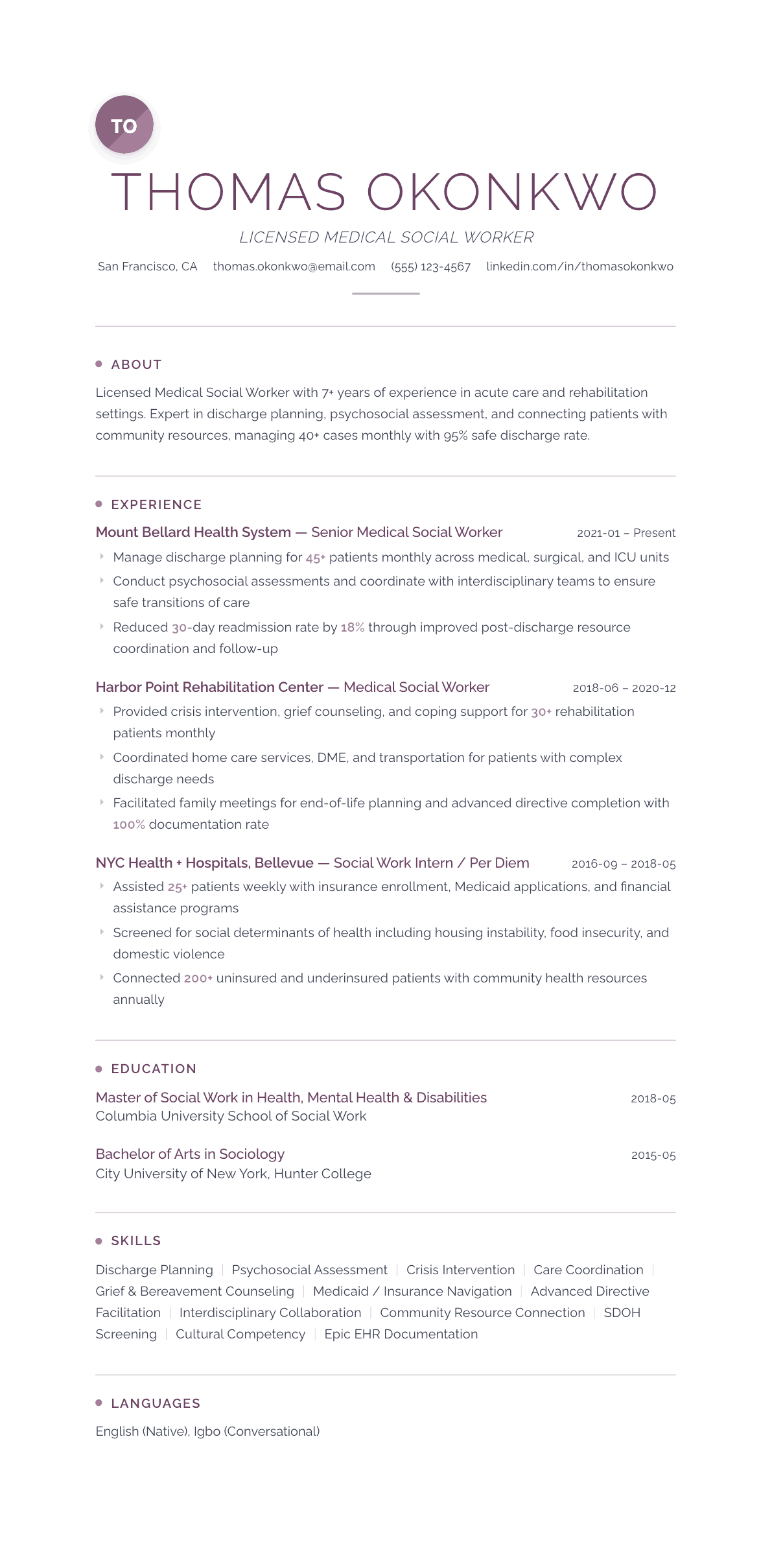
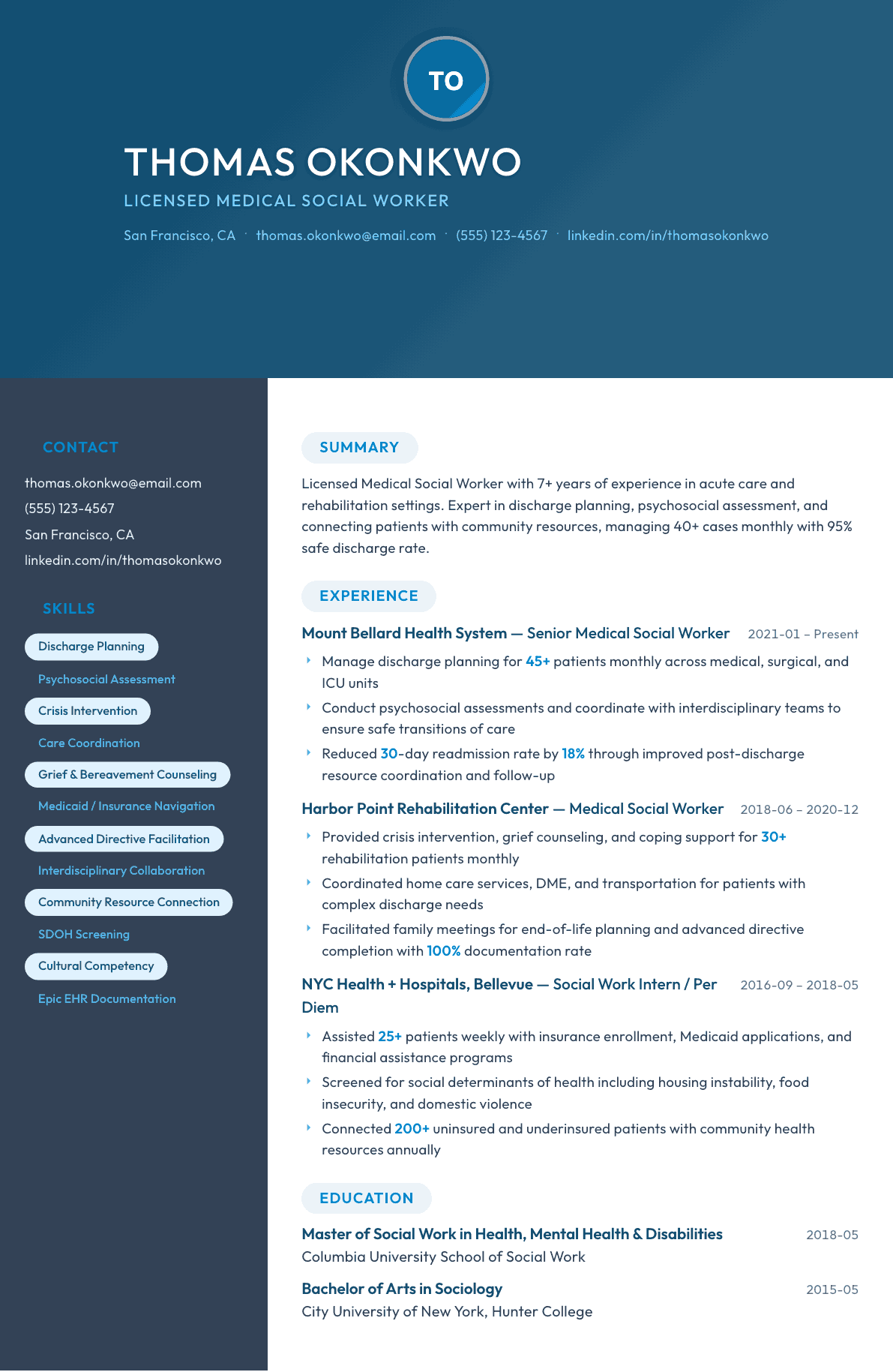
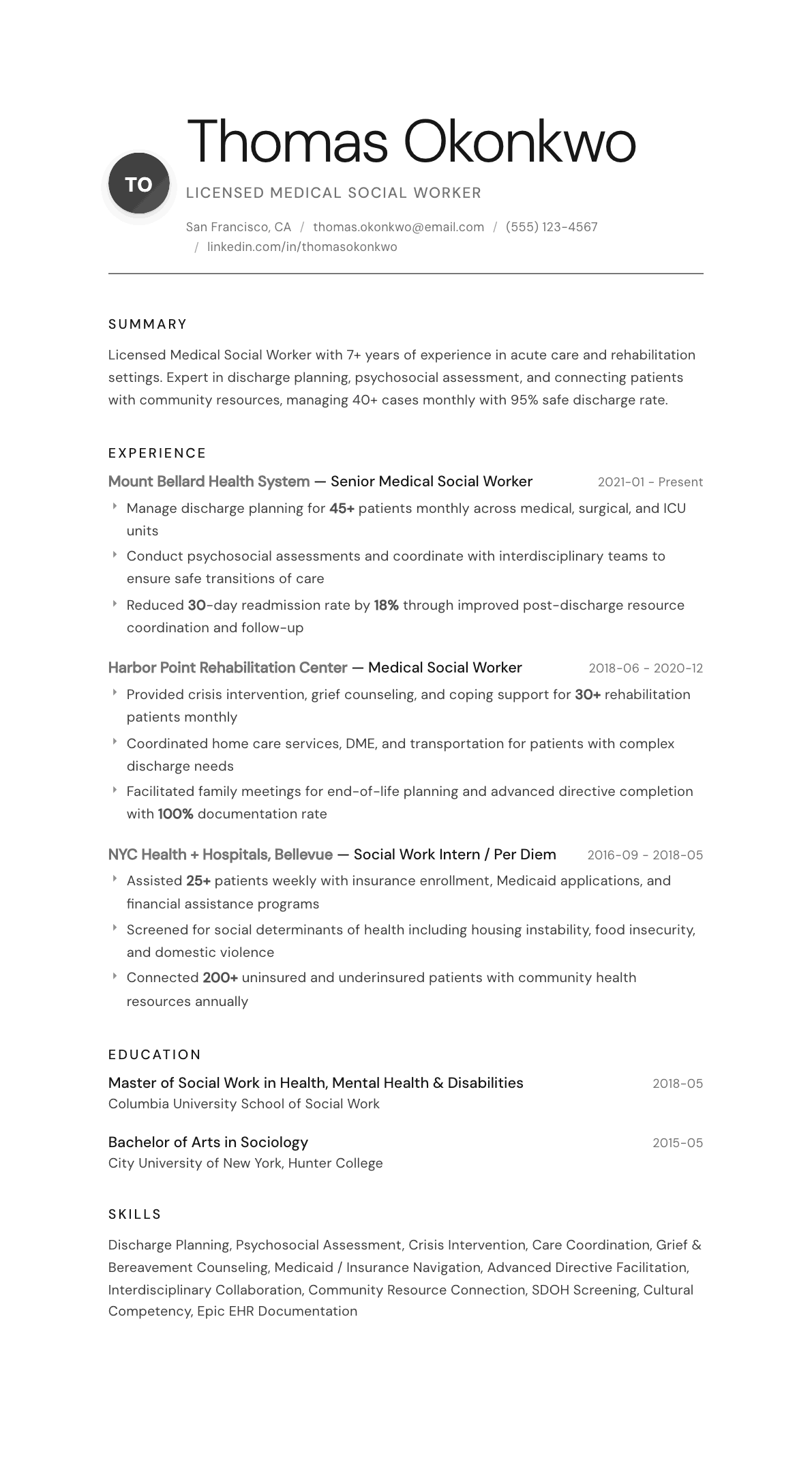
Example Medical Social Worker summary
Licensed Medical Social Worker with 7 years of acute care experience managing 40+ cases monthly. Reduced readmissions by 18% through comprehensive discharge planning and community resource coordination with 95% safe discharge rate.
Skills to list on a Medical Social Worker resume
- Discharge Planning
- Psychosocial Assessment
- Crisis Intervention
- Care Coordination
- Grief Counseling
- Medicaid / Insurance Navigation
- Advanced Directives
- Interdisciplinary Teams
- Community Resources
- SDOH Screening
- Cultural Competency
- EHR Documentation
What actually gets this resume read
- Include your license type (LCSW, LMSW, LSW) and state. This is the most critical credential.
- Quantify caseload size and discharge outcomes: safe discharge rate, readmission reduction.
- Highlight psychosocial assessment, crisis intervention, and care coordination as core competencies.
- Mention SDOH screening and community resource knowledge to show whole-person care approach.
- Include interdisciplinary collaboration experience with physicians, nurses, and case managers.
How to write a medical social worker resume
A medical social worker resume is read by a director of case management or a social work supervisor who needs to know four things fast: the license and its state, the setting, the caseload you carry, and whether you can discharge a complex patient safely without a manager standing over you. Hospitals hire for throughput and safety at the same time, and the resume has to speak to both.
The mistake most candidates make is writing a clinical therapy resume for a job that is really about assessment, resources and transitions of care. In an acute hospital the work is psychosocial assessment, discharge planning against a length of stay clock, family meetings, guardianship and capacity issues, substance use referrals, adult and child protective reporting, and finding a skilled nursing bed on a Friday afternoon. Name that work.
This guide covers the section order case management leaders expect, how to present licensure at each stage from an associate license to a clinical one, how to write caseload and discharge outcomes honestly, and the questions social workers ask when moving between hospital, hospice, dialysis and outpatient settings.
Format: license first, setting in every job line
Reverse chronological, one page under five years and two pages after. Put the license immediately after your name in the state abbreviation and license form your board uses, then repeat it in a licensure section with the state and the expiration.
Every position needs its setting spelled out in the header line, because the same title means different work in different buildings. An acute care hospital, an inpatient rehabilitation facility, hospice, dialysis, home health, a federally qualified health center and an outpatient oncology clinic all hire from this title and none of them are interchangeable.
- Header: name with credential, city and state, phone, email, and the state or states you are licensed in.
- Sections in this order: summary, licensure, clinical and case management experience, field placements for new graduates, education, skills and training.
- Name your supervision status when it is relevant: hours accrued toward clinical licensure and whether you are under board approved supervision.
Summary: setting, population, caseload, license stage
Three lines. State the license, the years, the setting, the patient population and the monthly or daily caseload. "Licensed social worker with six years in acute care, covering medical, surgical and intensive care units with a caseload near forty five patients a month" is a complete picture of what you can absorb.
If you are working toward clinical licensure, say how many supervised hours you have and when you expect to sit for the exam. Supervisors plan staffing around that timeline and would rather read it than ask.
Experience: assessment, planning, and the discharge itself
Structure each role around the arc of a case. Psychosocial assessment and screening for social determinants of health, then interdisciplinary rounds and care planning, then the discharge or transition, then the follow up. Reviewers want to see that you own the whole arc rather than one slice of it.
Write the difficult work explicitly, because that is what distinguishes an experienced medical social worker: capacity and guardianship referrals, patients without a payer or a home to return to, mandated reporting for abuse and neglect, behavioral health holds, substance use treatment placement, advance directive and goals of care conversations, and end of life planning with families who disagree.
Discharge outcomes belong here, but describe them the way a hospital measures them: readmission within thirty days, avoidable delay days, discharges to a lower level of care, and the rate at which planned discharges happen on the day they were planned. Avoid claiming a safe discharge rate you never measured.
Resources and systems: the practical half of the job
Name the resource networks you can work: Medicaid and Medicare eligibility, Medicare Savings Programs, disability applications, charity care and financial assistance, durable medical equipment vendors, home health agencies, skilled nursing and long term acute care placement, transportation, housing programs, food assistance and shelter systems, and community behavioral health.
Say which electronic health record you document in and which case management module, because Epic, Cerner and a placement platform such as an electronic referral system are the daily tools. Add any screening or assessment instruments you use routinely and any interpretation service or language capability, since language access is a real hiring factor in many hospitals.
Keywords the posting will repeat
Case management postings recycle a narrow set of phrases: psychosocial assessment, discharge planning, transitions of care, interdisciplinary team, utilization review, length of stay, social determinants of health, crisis intervention, advance directives, mandated reporting, motivational interviewing, and patient advocacy. Use the posting wording once in the skills block and once where you demonstrate it.
Utilization review is the phrase candidates most often skip. If you have worked alongside utilization review nurses on level of care, observation status or an appeal, say so, because departments that combine case management and social work hire for that overlap.
Medical Social Worker resume summary examples
Newly licensed graduate
Recently licensed social worker with a clinical concentration and two field placements totaling more than 1,100 hours in a public hospital and a rehabilitation center. Experienced in psychosocial assessment, benefits enrollment and community referral, and seeking an acute care position with discharge planning responsibility.
Six years in acute care
Licensed medical social worker with six years across medical, surgical and intensive care units, carrying about forty five discharge planning cases a month. Handles guardianship referrals, mandated reporting and goals of care meetings, and serves as the unit resource for uninsured and unhoused patients.
Clinical lead or supervisor
Clinically licensed social worker with twelve years in hospital case management, now supervising a team of five across two units and providing board approved supervision to two associates. Owns readmission reduction work and the placement relationships with fourteen skilled nursing and home health partners.
Work experience bullets: before and after
Before: Provided social work services to hospital patients.
After: Carried roughly forty five discharge planning cases a month across medical, surgical and intensive care units in a large urban hospital, from admission assessment through post-discharge follow up.
Caseload, unit mix and the span of the case tell a supervisor exactly what you can absorb.
Before: Completed patient assessments.
After: Completed psychosocial assessments within twenty four hours of admission, screening for housing instability, food insecurity, caregiver strain and intimate partner violence, and documenting each in the care plan.
A timeliness standard and the specific domains screened show a real assessment practice.
Before: Worked to reduce readmissions.
After: Cut thirty day readmissions on the heart failure service by scheduling follow up before discharge, arranging home health on the same day, and calling every patient within seventy two hours.
Naming the three interventions makes the outcome attributable to you rather than to the hospital.
Before: Helped families with end-of-life decisions.
After: Facilitated goals of care meetings for families of critically ill patients alongside the intensive care team, and documented completed advance directives and health care proxies before transfer or discharge.
The setting, the team and the documented artifact turn a sensitive claim into verifiable practice.
Before: Connected patients to community resources.
After: Enrolled uninsured patients in Medicaid and hospital financial assistance, arranged durable medical equipment and transportation, and maintained a working referral list across shelters, food programs and community behavioral health.
Named programs prove you can actually move a patient rather than hand over a pamphlet.
Hard skills
- Psychosocial assessment
- Discharge planning and transitions of care
- Crisis intervention
- Medicaid and Medicare benefits navigation
- Skilled nursing and home health placement
- Advance directives and goals of care planning
- Mandated reporting
- Motivational interviewing
- Substance use screening and referral
- Interdisciplinary rounds
- Epic and Cerner documentation
- Social determinants of health screening
Soft skills
- Boundary setting under pressure
- Family conflict mediation
- Advocacy with payers
- Cultural humility
- Sustained composure with grief
- Clear interdisciplinary communication
Certifications worth listing
- Licensed Clinical Social Worker (LCSW) (State social work licensing board)
- Certified Social Worker in Health Care (C-SWHC) (National Association of Social Workers)
- Certified Case Manager (CCM) (Commission for Case Manager Certification)
- Advanced Certified Hospice and Palliative Social Worker (ACHP-SW) (National Association of Social Workers credentialing center)
- Academy of Certified Social Workers (ACSW) (NASW credentialing program)
Mistakes that cost medical social worker candidates the interview
- Writing a psychotherapy resume for a hospital case management job, so the reader never sees discharge planning or resource work.
- Leaving the license state and expiration off, which stops a file that human resources cannot verify.
- Omitting the caseload, so a supervisor cannot judge whether you have carried her volume.
- Skipping the setting, when hospice, dialysis, home health and acute care are different jobs with the same title.
- Claiming a safe discharge or readmission figure that was never measured rather than describing what you actually did.
- Hiding field placements as a new graduate when those hours are the only clinical evidence available.
- Listing resource navigation as a phrase with no named programs behind it.
Medical Social Worker resume questions
Do I need a clinical license to work as a medical social worker?
Many hospital positions accept a bachelor or master level license for discharge planning and resource work, while clinical roles that include therapy or independent assessment require the clinical license. State your current license and the supervised hours you have accrued toward the next one.
How do I show caseload on a hospital social work resume?
Give the number of active cases or new assessments per month, the units covered and the acuity. A supervisor comparing candidates wants to know whether forty five complex discharges a month is normal for you or a stretch.
Should I include my field placements?
Yes if you graduated within two years or are changing settings. Give the agency, the population, the hours and the tasks you performed independently. Remove them once you have a year or more of licensed practice in the same setting.
How do I move from outpatient behavioral health into a hospital role?
Lead with assessment, crisis work and resource navigation, then name any experience with discharge coordination, benefits enrollment or interdisciplinary rounds. Hospital hiring managers worry that outpatient clinicians will not keep pace with a length of stay clock, so address speed directly.
What outcomes can a medical social worker put on a resume?
Use measures your department already tracks: readmission within thirty days, avoidable delay days, discharges completed on the planned day, advance directive completion, and successful placements into skilled nursing or home health. Never invent a rate you did not see reported.