Patient Care Technician Resume Examples: free ATS score
PCT Resume Sample and Patient Care Technician Resume Examples
By Mustafa Tarabya, founder of CVBooster · Published · Updated
A PCT resume sample, patient care technician resume examples, and a patient care associate job description for a resume turned into bullets.
Sample resumes for a patient care technician
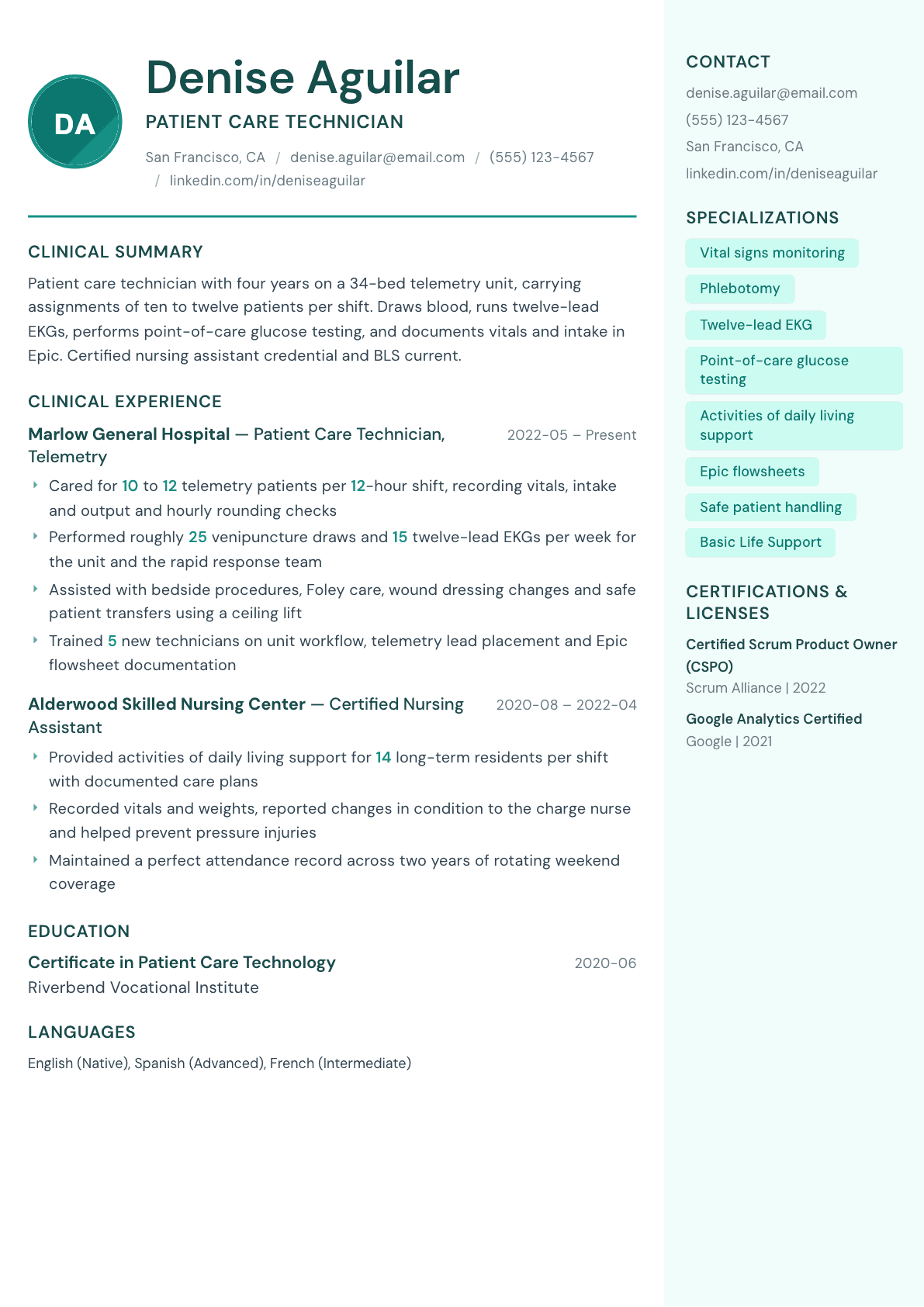
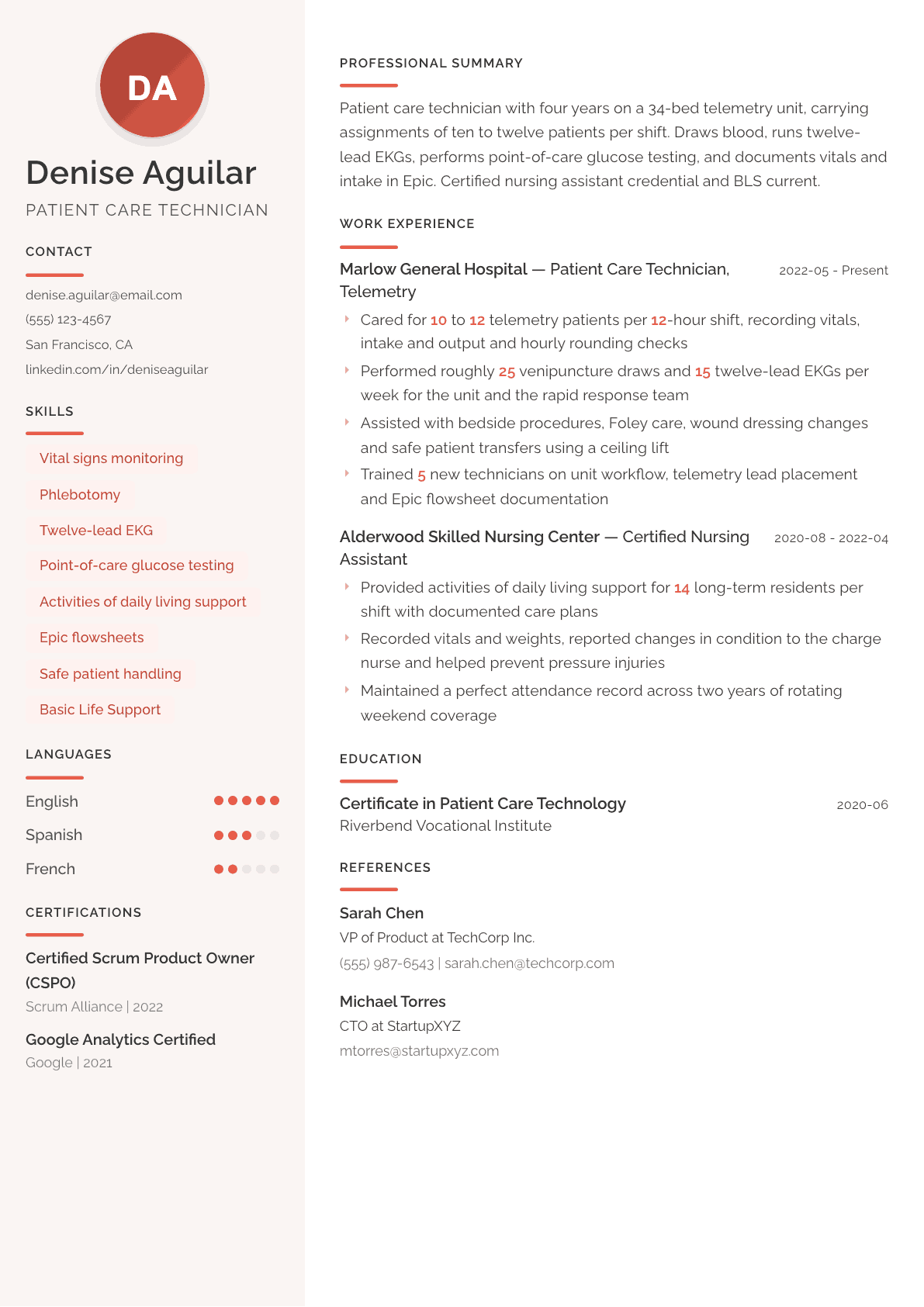
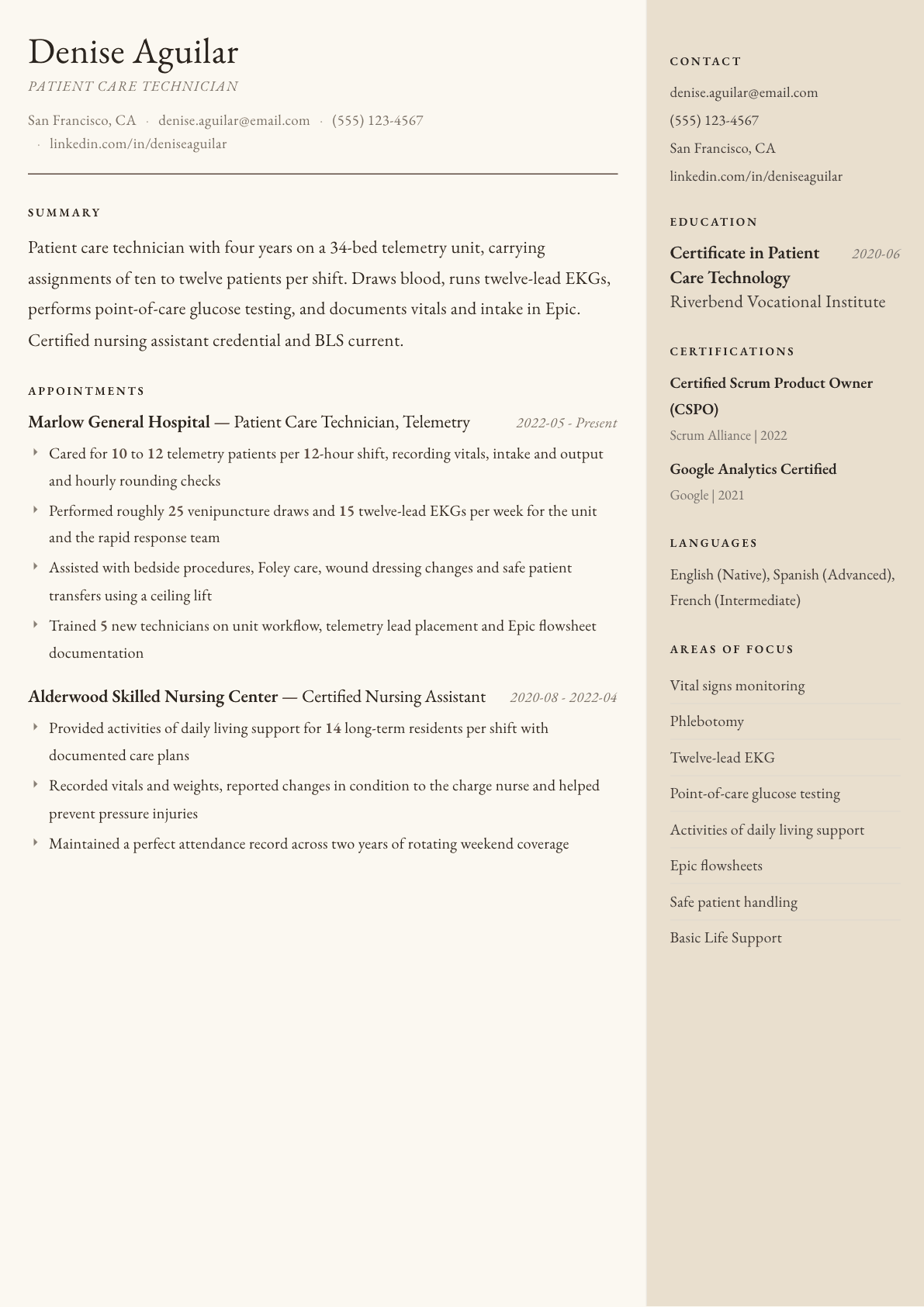
The same patient care technician content laid out in three CVBooster templates, so you can see what the finished document looks like before you write a word.
Example Patient Care Technician summary
Patient care technician with four years on an adult telemetry unit, carrying up to twelve patients per twelve-hour shift. Performs venipuncture draws, twelve-lead EKGs and point-of-care glucose checks, assists with Foley and wound care, and charts vitals and intake in Epic. Holds a current certified nursing assistant credential and BLS, and precepts new technicians on the unit.
Skills to list on a Patient Care Technician resume
- Vital signs monitoring
- Phlebotomy and venipuncture
- Twelve-lead EKG
- Telemetry lead placement
- Point-of-care glucose testing
- Intake and output recording
- Foley catheter care
- Wound dressing assistance
- Activities of daily living support
- Safe patient handling and lifts
- Fall prevention and hourly rounding
- Infection control
- Epic flowsheet documentation
- Basic Life Support
What actually gets this resume read
- Name the unit type and the number of patients you carry per shift, because that defines the job for a manager.
- List phlebotomy, EKG and point-of-care testing separately, since not every technician is trained in all three.
- State your certified nursing assistant or patient care technician credential with the state or issuing body.
- Show documentation skill by naming the flowsheets and electronic record you charted vitals and intake in.
- Include safe patient handling equipment you have used, as hospitals track lift injuries closely.
- Add any precepting of new technicians, because it signals readiness for a lead or charge technician posting.
How to write a patient care technician resume
A nurse manager hiring a patient care technician is filling a specific gap on a specific unit. She wants to know how many patients you can carry, whether you can draw blood and run a twelve-lead without calling someone, and whether your documentation shows up in the chart before the nurse needs it. Those are the questions the resume has to answer on the first read.
The role also varies more by setting than the shared title suggests. A technician on a telemetry floor, one in dialysis, one in an emergency department and one in a skilled nursing facility do overlapping but genuinely different work with different certification expectations. Naming the unit type is the single most useful edit most technicians can make.
Most postings shorten the title to PCT, and a PCT resume is read the same way. Many hospitals call the same job patient care associate or patient care assistant, so the advice here covers those titles too. This guide covers the section order hospital recruiters expect, a PCT resume sample you can copy line by line, how to describe patient load and skills without listing tasks every technician performs, which credentials to surface, and the questions technicians ask when they are moving from long-term care into an acute hospital job.
Format: one page, with the unit named in the job title
One page, reverse-chronological. Write the job title with the unit attached, so it reads as patient care technician, telemetry, or patient care technician, emergency department. Certifications go in their own block near the top with the issuing body and the expiration, because a lapsed credential is the fastest rejection there is.
Avoid columns and icons. Hospital applicant tracking parsers commonly read a two-column resume out of order and drop the dates, and a technician resume that loses its employment dates gets treated as a gap.
- Header: name, credentials such as CNA or PCT, city and state, phone, email.
- Section order: summary, certifications, clinical skills, experience, education.
- Context line per employer: unit type, bed count, shift length and typical patient assignment.
Patient load: the number that defines the job
Give the unit bed count and the number of patients in your assignment per shift, together with the shift length. Ten patients on a twelve-hour telemetry shift and sixteen residents on an eight-hour long-term care shift are different workloads, and a manager reading the pair can immediately picture your day.
Add the population: postoperative, cardiac, geriatric, dialysis, psychiatric, pediatric. Population tells the reader which risks you are used to managing, and it is the detail that makes a transfer between settings believable.
Clinical skills: separate what you can do unsupervised
Phlebotomy, twelve-lead electrocardiograms, point-of-care glucose testing, Foley care, wound dressing assistance, specimen collection and telemetry lead placement are the skills that raise a technician above a bedside assistant. List each one you perform independently, and give a weekly volume for the ones you do often, because a technician drawing 25 sticks a week is a different hire from one who draws occasionally.
Do not spend bullets on activities every technician performs. Bathing, feeding and ambulation belong in a compact activities of daily living line, not in three separate bullets that push your procedural skills onto the second page.
- Skills performed independently, with weekly or shift volume where it exists.
- Equipment you are checked off on, including lifts, telemetry boxes and glucose meters.
- Specimen handling and any point-of-care testing you run and document.
Patient care associate job description for a resume, turned into bullets
A patient care associate job description lists duties: vital signs, activities of daily living, specimen collection, charting, safety rounds. Copying that list onto your resume tells a manager nothing she did not already write herself. Keep the duty, then add the unit, the patient count and what happened because you did it well. The pairs below show the change, and the charting and safety work that follows is where most associates leave value out.
Charting is a real part of the job and most technician resumes skip it. Name the electronic record and the flowsheets you complete: vitals, intake and output, hourly rounding, restraint checks, fall risk and skin assessments. A technician whose documentation is timely and complete saves the nurse an hour a shift, and managers know it.
Safety work deserves its own bullet. Fall prevention rounding, bed alarms, sitter coverage, safe patient handling equipment and infection control practice are all measured on hospital units, so describe your part in them rather than claiming that you value safety.
- Job description: obtains and records vital signs. Resume: Recorded vitals and blood glucose every four hours for 10 to 12 patients on a 32-bed telemetry unit and reported out-of-range values to the nurse at once.
- Job description: collects specimens as ordered. Resume: Performed venipuncture and collected urine and stool specimens for morning labs, labeled at the bedside with two patient identifiers.
- Job description: assists patients with activities of daily living. Resume: Bathed, fed and repositioned post-surgical patients on a two-hour turning schedule, using a ceiling lift for dependent transfers.
- Job description: maintains a safe environment. Resume: Completed hourly rounding and bed alarm checks on a high fall-risk hallway and covered sitter shifts for confused patients.
- Job description: documents care in the medical record. Resume: Charted vitals, intake and output and rounding flowsheets in Epic before each handoff to the nurse.
Certifications and the move between settings
List the certified nursing assistant credential with the state registry, the patient care technician certificate with its issuing body, phlebotomy or electrocardiogram certificates where you hold them, and current Basic Life Support with the expiration. Hospitals verify these before an offer, so accuracy matters more than length.
If you are moving from long-term care into an acute hospital, lead the summary with the transferable clinical skills and the patient load you carried, then name the acute skills you already have. A manager will overlook missing telemetry experience for a candidate who can draw blood, chart cleanly and hold sixteen residents without dropping a vital sign.
PCT resume sample: the full page in order
PCT is how most hospital postings shorten patient care technician, so use both forms once: the full title in your headline and PCT in the summary or a job title. Applicant tracking searches often run on the abbreviation, while the nurse manager reading the page wants the full title and the unit.
The sample below is for a technician with two years on a medical surgical floor applying to a telemetry unit. Keep the same order whatever your setting, and swap in your own unit, patient load and procedures.
- Headline: Patient Care Technician (PCT), medical surgical unit, CNA, BLS, phlebotomy and EKG certified.
- Summary: PCT with two years on a 32 bed medical surgical unit, caring for up to 12 patients per shift on days and nights. Draws labs, runs 12 lead EKGs and point of care glucose checks, and charts vitals and intake and output in the electronic record.
- Experience bullet: Performed venipuncture and blood culture collection for up to 15 patients per shift under the unit protocol, with specimens labeled at the bedside.
- Experience bullet: Ran 12 lead EKGs on admission and on nurse request, and reported abnormal vitals and rhythm changes to the assigned nurse right away.
- Experience bullet: Completed hourly rounding, fall precautions and bed alarm checks for high risk patients, and helped with turns, ambulation and transfers using lift equipment.
- Credentials block: CNA with state registry number, PCT certificate and issuing body, phlebotomy and EKG certificates, BLS with expiration month.
Patient Care Technician resume summary examples
Newly certified
Newly certified nursing assistant with a completed patient care technology certificate covering phlebotomy, electrocardiography and point-of-care testing, plus 120 supervised clinical hours in a skilled nursing facility. Current Basic Life Support certification and seeking a first acute care technician role on a medical or telemetry unit.
Two years in long-term care
Certified nursing assistant with two years supporting 14 long-term residents per shift, recording vitals and weights, documenting care plans and reporting changes in condition to the charge nurse. Trained in safe patient handling and pressure injury prevention, and moving into acute hospital patient care technician work.
Four years, telemetry
Patient care technician with four years on a 34-bed telemetry unit carrying 10 to 12 patients per twelve-hour shift. Performs about 25 venipuncture draws and 15 twelve-lead studies weekly, assists with bedside procedures and Foley care, and precepts new technicians on unit workflow and Epic flowsheets.
Work experience bullets: before and after
Before: Provided care for patients on a busy hospital unit.
After: Cared for 10 to 12 telemetry patients per twelve-hour shift on a 34-bed unit, recording vitals, intake and output and hourly rounding checks for a mixed cardiac and postoperative population.
Assignment size, shift length, bed count and population let a manager judge the workload you already carry.
Before: Drew blood and performed EKGs as needed.
After: Performed roughly 25 venipuncture draws and 15 twelve-lead studies per week for the unit and the rapid response team, labeling and transporting specimens under unit protocol.
Weekly volume and the rapid response coverage show independent skill rather than occasional assistance.
Before: Helped nurses with patient transfers and equipment.
After: Assisted with bedside procedures, Foley care and dressing changes, and completed safe transfers using a ceiling lift after equipment competency check-off.
Naming the procedures and the competency check-off proves the skills were verified, not just observed.
Before: Documented patient information in the computer.
After: Charted vitals, intake and output, hourly rounding and skin checks in Epic flowsheets each shift, completing entries before the nurse assessment window closed.
The specific flowsheets and the timing expectation show documentation that supports the nurse rather than trails it.
Before: Trained new staff members on the unit.
After: Precepted five new technicians on unit workflow, telemetry lead placement and flowsheet documentation, and served as their first-shift resource through orientation.
Trainee count and named training content turn informal help into a described precepting responsibility.
Hard skills
- Vital signs monitoring
- Phlebotomy and venipuncture
- Twelve-lead electrocardiography
- Telemetry lead placement
- Point-of-care glucose testing
- Intake and output recording
- Foley catheter care
- Wound dressing assistance
- Specimen collection and labeling
- Safe patient handling equipment
- Fall prevention rounding
- Epic flowsheet documentation
Soft skills
- Calm handling of confused patients
- Clear reporting to the charge nurse
- Physical stamina across long shifts
- Respectful bedside manner
- Teamwork with nursing staff
- Prioritizing competing call lights
Certifications worth listing
- Certified Nursing Assistant (CNA) (State nurse aide registry)
- Certified Patient Care Technician/Assistant (CPCT/A) (National Healthcareer Association)
- Certified Phlebotomy Technician (CPT) (National Healthcareer Association)
- Certified EKG Technician (CET) (National Healthcareer Association)
- Basic Life Support (BLS) (American Heart Association)
Mistakes that cost patient care technician candidates the interview
- Leaving the unit type and bed count off the resume, so a manager cannot tell dialysis experience from telemetry experience.
- Filling bullets with bathing, feeding and ambulation while the phlebotomy and electrocardiogram skills sit unmentioned.
- Listing certifications without the issuing body or the expiration, which slows verification and raises doubt.
- Skipping documentation entirely, when charting timeliness is one of the things nurses complain about most.
- Using a designed two-column layout that hospital parsers read out of order and strip dates from.
- Writing assisted nurses as a duty instead of naming the procedures, equipment and check-offs behind it.
Patient Care Technician resume questions
What is the most important detail on a PCT or patient care technician resume?
The unit type paired with your patient assignment per shift. Everything else on the page is interpreted through it, because a manager is deciding whether your current workload resembles the one waiting on their floor.
Do I need to be a certified nursing assistant for this role?
Most hospitals require an active nurse aide certification or an equivalent patient care technician credential, and many add phlebotomy or electrocardiogram training. List each with the issuing body and expiration, since credentials are verified before any offer is made.
How do I move from a nursing home to a hospital technician job?
Lead with resident load, vitals documentation and change of condition reporting, then surface every acute skill you already hold such as phlebotomy or glucose testing. Managers hire for trainability on telemetry when the clinical fundamentals are clearly there.
What does a good PCT resume sample include?
A headline with the title and the unit, a two sentence summary with patient load and shift pattern, bullets for procedures such as blood draws and EKGs, safety work like fall precautions, a credentials block with expiration dates, and one compact line for daily living support, which every technician provides.
How do I use a patient care associate job description for my resume?
Take each duty from the posting and rewrite it as something you did: name the unit, the number of patients, the equipment or system, and the result. Keep the same nouns the posting uses, such as vital signs, specimen collection and activities of daily living, so the applicant tracking system matches them, but never paste the duty list unchanged.