Workforce Planning Analyst Resume Examples: free score
Write a Workforce Planning Analyst Resume Built on Headcount Numbers
By Mustafa Tarabya, founder of CVBooster · Published · Updated
A workforce planning analyst resume example with the headcount and attrition models hiring managers check, ATS keywords and a full writing guide.
Sample resumes for a workforce planning analyst
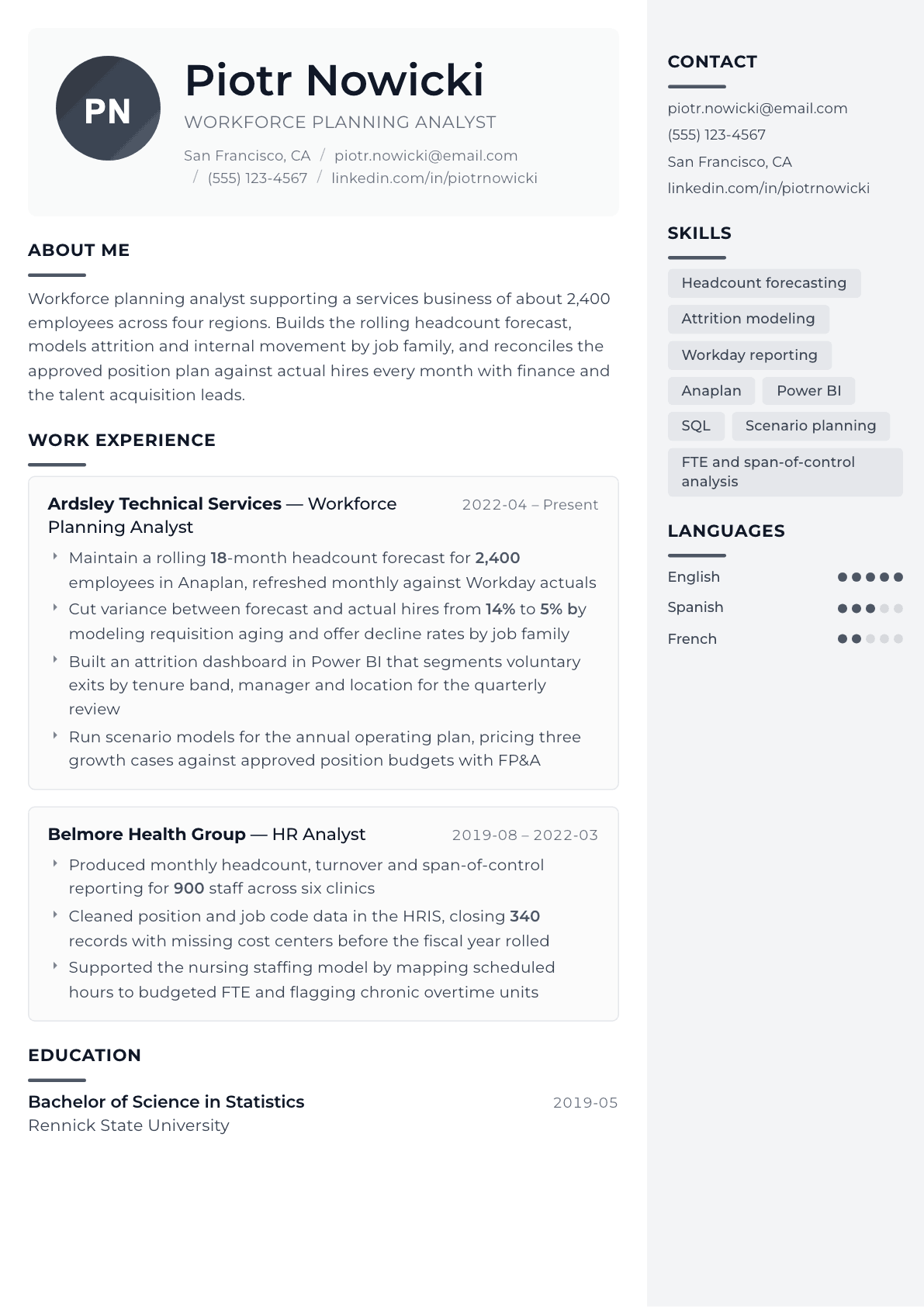
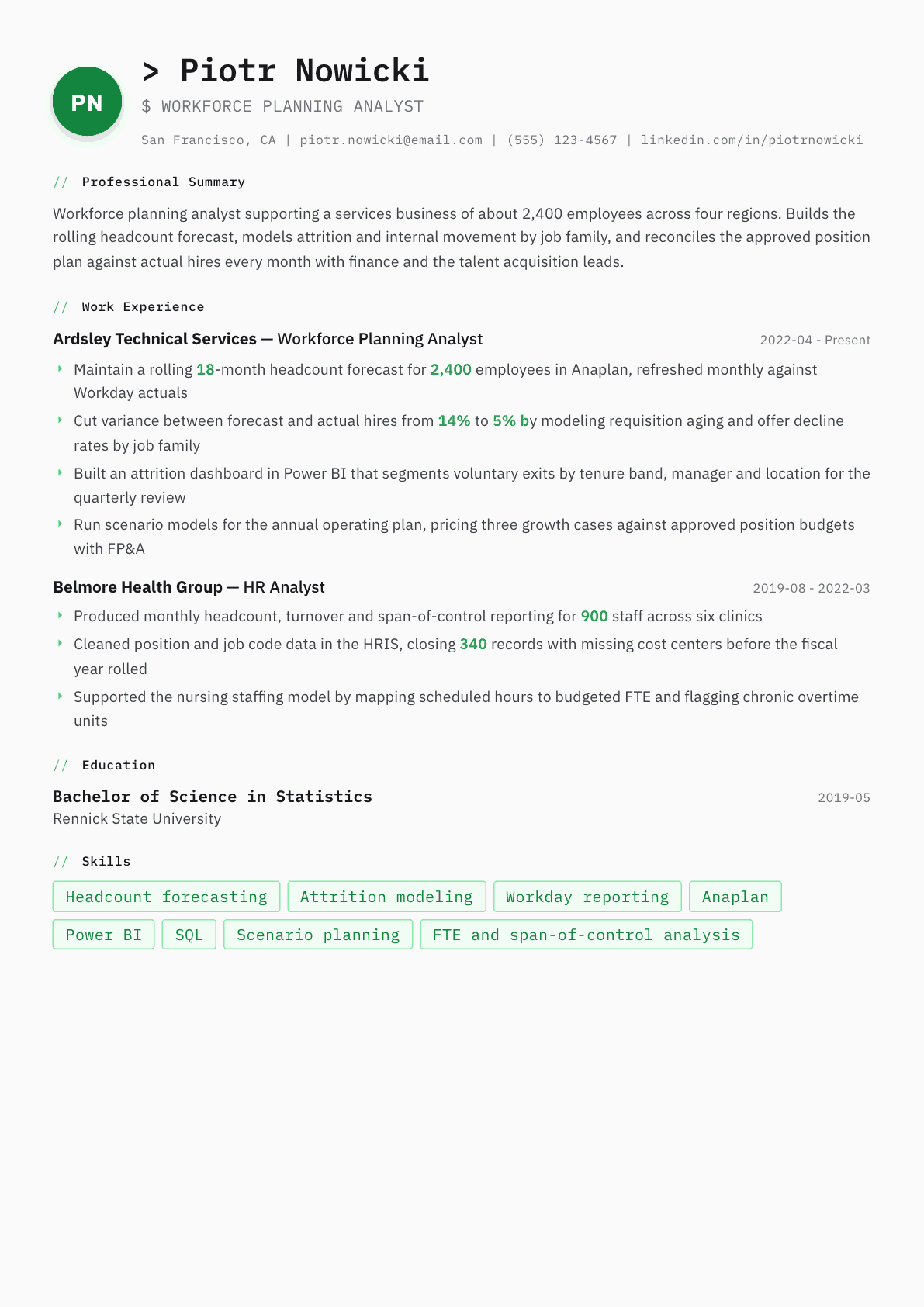
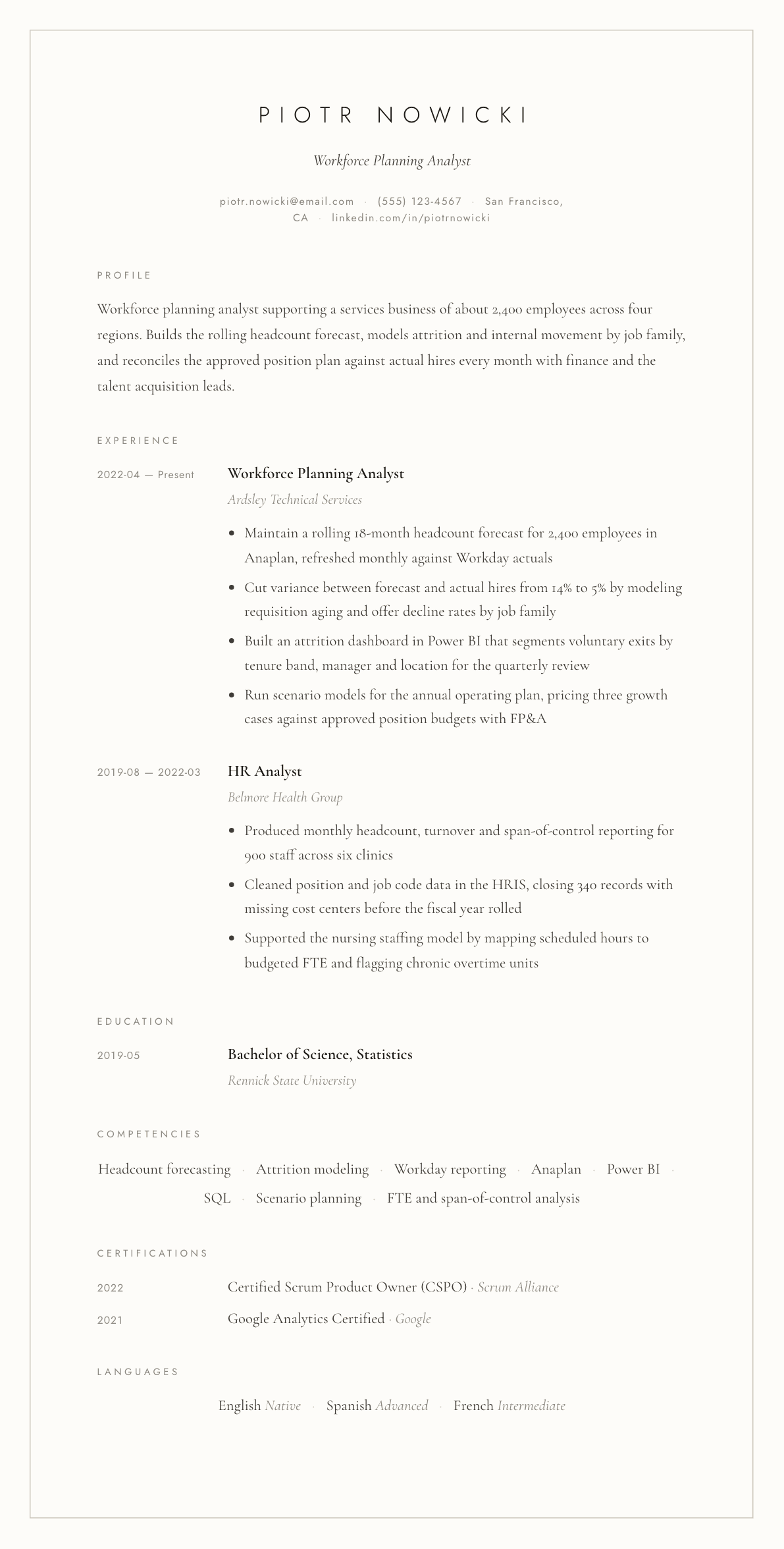
The same workforce planning analyst content laid out in three CVBooster templates, so you can see what the finished document looks like before you write a word.
Example Workforce Planning Analyst summary
Workforce planning analyst with five years building headcount forecasts and attrition models for a workforce of roughly 2,400 across four regions. Owns the monthly reforecast in Anaplan against Workday actuals and cut forecast variance from 14% to 5% in two cycles. Strong in SQL and Power BI, and comfortable defending a staffing scenario to finance and business leaders.
Skills to list on a Workforce Planning Analyst resume
- Headcount forecasting
- Attrition modeling
- Scenario planning
- Workday HCM
- Anaplan
- Adaptive Planning
- SQL
- Power BI
- Tableau
- Advanced Excel
- FTE analysis
- Span of control
- Position management
- Labor cost modeling
- Talent supply and demand analysis
- Data storytelling
What actually gets this resume read
- State the population you plan for: headcount, number of countries or regions, and whether the workforce is salaried, hourly or contingent.
- Name the planning system and the HRIS you pull from, because postings filter on Anaplan, Adaptive, Workday or SAP by name.
- Show forecast accuracy as a number: variance between planned and actual headcount is the metric this job is judged on.
- Separate supply-side work from demand-side work so a reader sees you model attrition as well as business growth.
- Give the cadence you run: monthly reforecast, quarterly business review, annual operating plan, and who receives each one.
- Put SQL and the visualization tool in a skills block, then prove them inside a bullet that names the actual report you built.
How to write a workforce planning analyst resume
A workforce planning analyst resume is judged by two readers who care about opposite things. The HR leader wants to see that you understand talent supply: attrition patterns, internal movement, time to fill, and the difference between a requisition and a funded position. The finance partner wants to see that your numbers tie to the operating plan, that you know what an FTE costs, and that when your forecast moved the reason was written down. A resume that reads like a generic analytics profile satisfies neither.
The strongest signal in this field is forecast accuracy. A hiring manager who has run planning knows that anyone can build a headcount spreadsheet and almost nobody can keep it within a few points of actuals for four quarters in a row. Put the variance number on the page, say what drove it, and describe how you closed the gap.
This guide goes through the resume in the order a planning leader reads it: scope first, then systems, then the forecasting work itself, then the analysis that changed a staffing decision. It includes summaries for three career stages, before and after bullets, and the questions analysts ask when they sit down to write.
Format: one page early, two once you own a full planning cycle
Reverse-chronological, no columns inside experience, and a short skills block that names the planning tool, the HRIS and the query language. Planning teams are small, so the reader is usually the person you would report to and reads every line.
Put a scope line under each employer before the bullets: headcount planned for, number of countries or regions, and the workforce mix. Planning for eight hundred salaried employees in one country is a different job from planning for a hourly and contingent workforce across four regions, and the reader cannot tell unless you say so.
- Header: name, city and state, phone, email, and a link to a portfolio only if the work is anonymized.
- Section order: summary, skills and systems, experience, education, certifications if you hold one.
- Career changers from finance or operations should name the workforce population early so the reader stops guessing.
Summary: population, horizon, systems, one accuracy claim
Four lines at most. Say the size and shape of the workforce you plan for, the horizon you forecast over, the planning and HRIS platforms you work in, and one number that proves your forecasts held up.
Avoid opening with adjectives. A summary that begins "detail-oriented analyst passionate about data" is indistinguishable from every other applicant. One that begins with headcount, horizon and variance tells the reader what you can carry before they reach the first job.
Experience: the forecast, the drivers, the decision it changed
Each job needs bullets in three families. The first is the recurring forecast: what you produce, how often, in which system, and against what actuals you reconcile. The second is the modeling: attrition curves by tenure band, internal mobility, requisition aging, offer acceptance, contingent conversion. The third is the decision family: a scenario you priced, a hiring pause you sized, a location strategy you supported with labor market data.
Name the reconciliation, not just the output. A planning leader wants to know that your headcount ties to the general ledger position of record and that you sit with FP&A when the two disagree. That reconciliation is where most analysts fail and the reason experienced ones are hired.
Skip bullets that describe reporting in the abstract. Producing dashboards, supporting stakeholders and delivering insights could belong to any analyst in any function. Replace each with the specific model, the specific population, and the specific choice it informed.
- Say whether you plan positions, headcount, FTE or hours, because organizations plan in different units.
- Name the calendar: monthly reforecast, quarterly business review, annual operating plan, long-range plan.
- Give the audience for each deliverable: HR leadership, FP&A, a business unit head, or the executive committee.
Systems and technical skills: be exact and be honest
List the planning platform first, then the HRIS, then the analysis stack. Anaplan, Adaptive Planning, Pigment and homegrown models each imply a different build experience, and postings filter on the name. Follow with the HRIS you extract from and the reporting layer you publish in.
For SQL, say what you actually do with it: writing the extracts, building the models, or querying a warehouse someone else maintains. Analysts who overstate this are caught in the first technical screen, and a modest accurate claim reads better than an inflated one.
Keywords the applicant tracking system is matching
Planning postings recycle a small vocabulary: strategic workforce planning, headcount forecasting, attrition modeling, position management, span of control, labor cost, talent supply and demand, scenario planning, capacity modeling. Use the exact phrase from the posting once in your skills block and once inside a bullet where it is doing real work.
Do not build a keyword wall at the bottom of the page. A human reads the resume seconds after the software does, and a block of disconnected terms undoes the credibility the rest of the page earned.
Workforce Planning Analyst resume summary examples
First analyst role
Analyst with two years in HR reporting, now owning the monthly headcount and turnover pack for 900 employees across six sites. Builds extracts in SQL, publishes in Power BI, and supported the last annual plan by modeling attrition against budgeted positions. Looking for a dedicated workforce planning seat.
Five years in
Workforce planning analyst owning an 18-month rolling forecast for 2,400 employees across four regions in Anaplan, reconciled monthly to Workday actuals. Reduced forecast to actual hiring variance from 14% to 5% by modeling requisition aging and offer decline rates. Partners with FP&A on the annual operating plan.
Lead planner
Senior workforce planning lead for a workforce of 11K across three continents, running the long-range plan and the quarterly reforecast for a function of four analysts. Built the location and skills supply model behind two site decisions, and presents talent capacity scenarios to the executive committee each quarter.
Work experience bullets: before and after
Before: Created headcount reports for leadership.
After: Produced the monthly headcount and hiring forecast for 2,400 employees in Anaplan, reconciled to Workday actuals and reviewed with FP&A before the close package went out.
The system, the population, the cadence and the reconciliation turn a task into a job a manager can size.
Before: Analyzed employee turnover and shared findings.
After: Modeled voluntary attrition by tenure band and job family, showing that 40% of exits happened inside the first year in two field roles, which moved the retention budget to onboarding.
The cut of the data and the decision it changed matter far more than the fact that turnover was analyzed.
Before: Improved forecast accuracy.
After: Reduced variance between forecast and actual hires from 14% to 5% over three cycles by adding requisition aging, offer decline rates and internal transfer timing to the model.
Naming the before, the after and the three drivers proves the improvement was engineered rather than lucky.
Before: Helped with the annual planning process.
After: Built three growth scenarios for the annual operating plan, sizing hiring volume, ramp time and labor cost for each, and presented the recommended case to the HR and finance leadership group.
Scenario work with a named audience shows ownership of the plan rather than assistance with someone else's.
Before: Cleaned up HR data in the system.
After: Audited position and job code data across 4,000 records, closing 340 positions with missing cost centers so headcount tied to the general ledger for the first time in four quarters.
Data cleanup only counts when the reader sees the reporting problem it fixed and the scale involved.
Hard skills
- Headcount and hiring forecasting
- Attrition and retention modeling
- Scenario and sensitivity analysis
- Position management
- FTE and span-of-control analysis
- Labor cost modeling
- Anaplan or Adaptive Planning
- Workday HCM reporting
- SQL
- Power BI or Tableau
- Advanced Excel modeling
- Talent supply and demand analysis
- Labor market and location analysis
Soft skills
- Explaining a model to a non-technical executive
- Working across HR and finance
- Written analytical narrative
- Skepticism about your own numbers
- Facilitating planning reviews
Certifications worth listing
- SHRM Certified Professional (SHRM-CP) (Society for Human Resource Management)
- Professional in Human Resources (PHR) (HR Certification Institute)
- Anaplan Certified Model Builder (Anaplan)
- Certified Analytics Professional (CAP) (INFORMS)
Mistakes that cost workforce planning analyst candidates the interview
- Describing dashboards without ever naming the decision a forecast changed.
- Leaving out the population size, so the reader cannot tell whether you planned for hundreds or thousands.
- Claiming deep SQL or Anaplan build experience that collapses in the first technical screen.
- Presenting headcount work with no mention of how it reconciles to the finance position of record.
- Using generic analyst language that would fit a marketing or supply chain analyst equally well.
- Listing every metric you have ever touched instead of the three you actually owned.
- Hiding the planning tool inside a paragraph where the applicant tracking system will not weight it.
Workforce Planning Analyst resume questions
Do I need finance experience to become a workforce planning analyst?
It helps but it is not required. What matters is that you can tie headcount to cost and speak to an FP&A partner in their terms. If your background is HR reporting, show one bullet where your numbers were used in a budget or an operating plan conversation.
Should I put my forecast accuracy on the resume?
Yes, when you can defend it. Give the variance between planned and actual headcount or hires, the period it covers, and what you changed to improve it. Never invent the figure, because the interview will go straight to how you calculated it.
How much SQL do these roles actually require?
Most postings expect you to pull and join your own data rather than wait on a data team. Comfortable joining several HR tables, writing window functions for tenure calculations and validating your own extracts is usually enough. Say plainly what you can do.
Is a planning tool like Anaplan required, or is Excel enough?
Plenty of organizations still plan in Excel, and a strong Excel model is respectable. If you have not used a dedicated planning platform, say what your model did instead: drivers, versions, scenario switches and how you controlled changes across contributors.
How do I show planning work when my title was HR analyst?
Retitle nothing, but lead each job with the planning content. Put the forecast, the attrition model and the scenario work in the first bullets and push the recurring reporting further down. The title stays honest and the reader still sees the planning experience.
Related resume examples
- HRIS Analyst Resume example
- Compensation Analyst Resume example
- HR Data Analyst Resume example
- People Operations Manager Resume example
- HR Analyst Resume example
- HR Business Partner Resume example