HVAC Installer Resume Examples: the lines they read
Write an HVAC Installer Resume That Wins Install Crew Roles
By Mustafa Tarabya, founder of CVBooster · Published · Updated
HVAC installer resume example with ductwork, equipment set and startup bullets, EPA certification keywords and a writing guide.
Sample resumes for a hvac installer
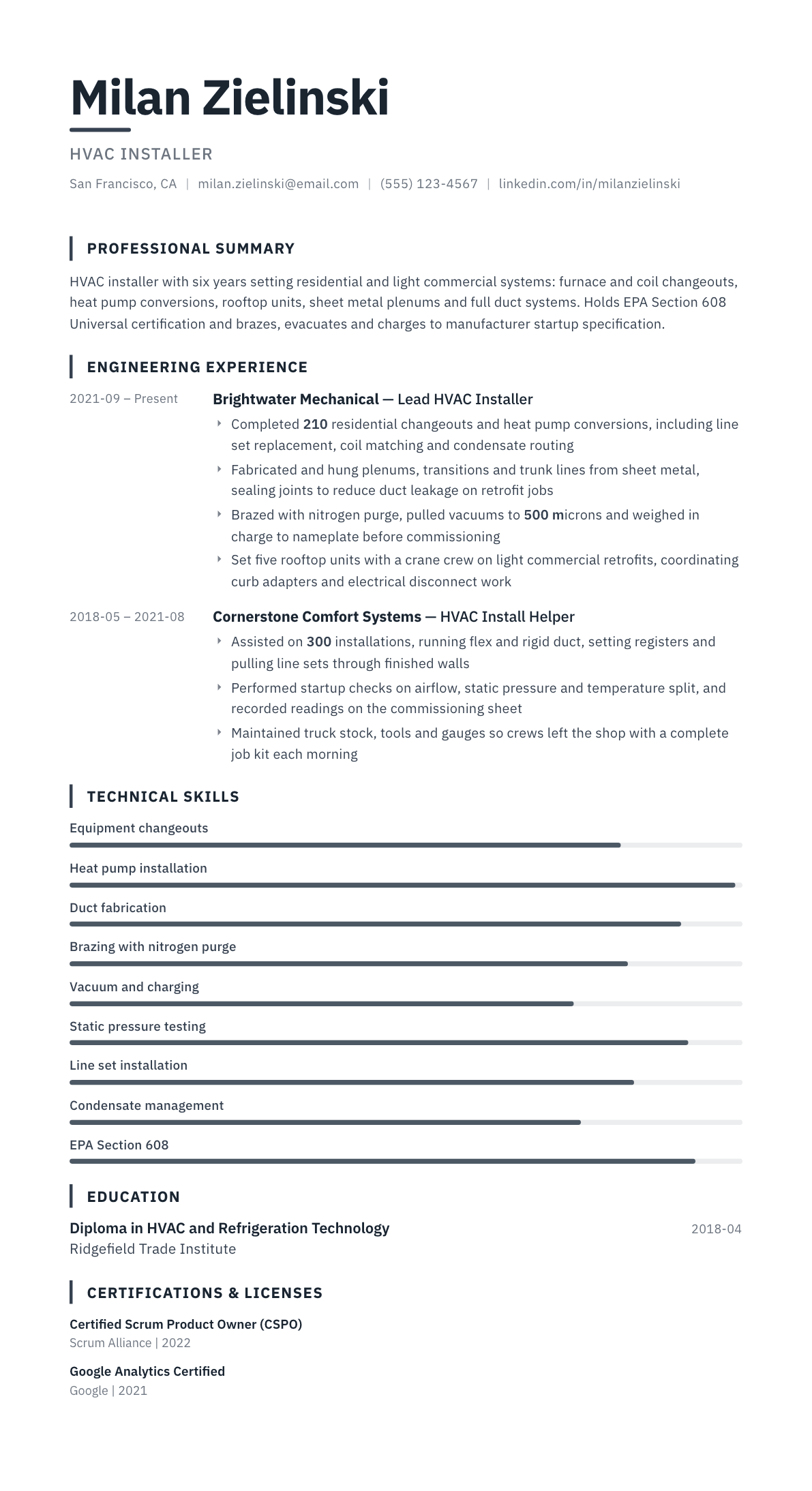
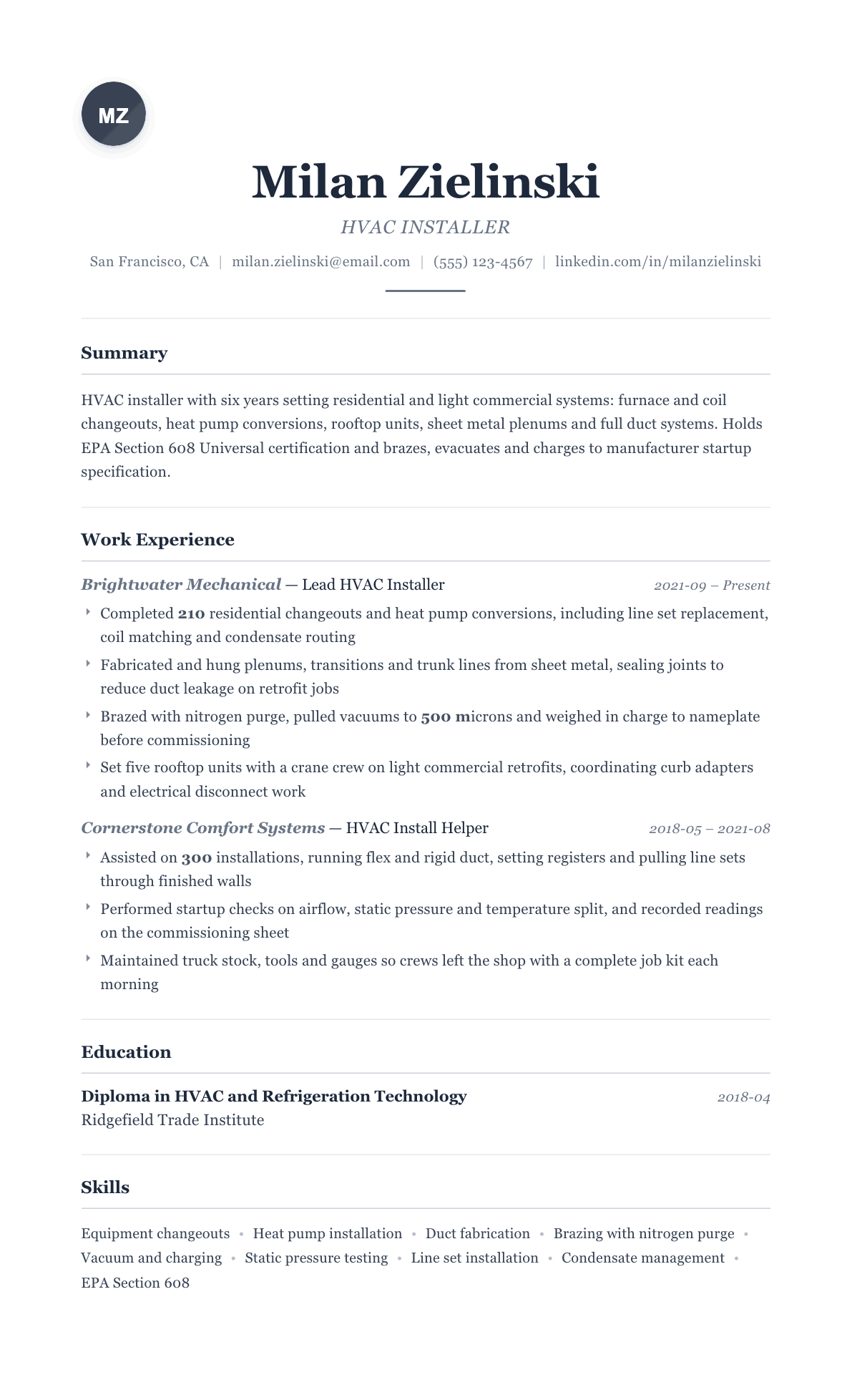
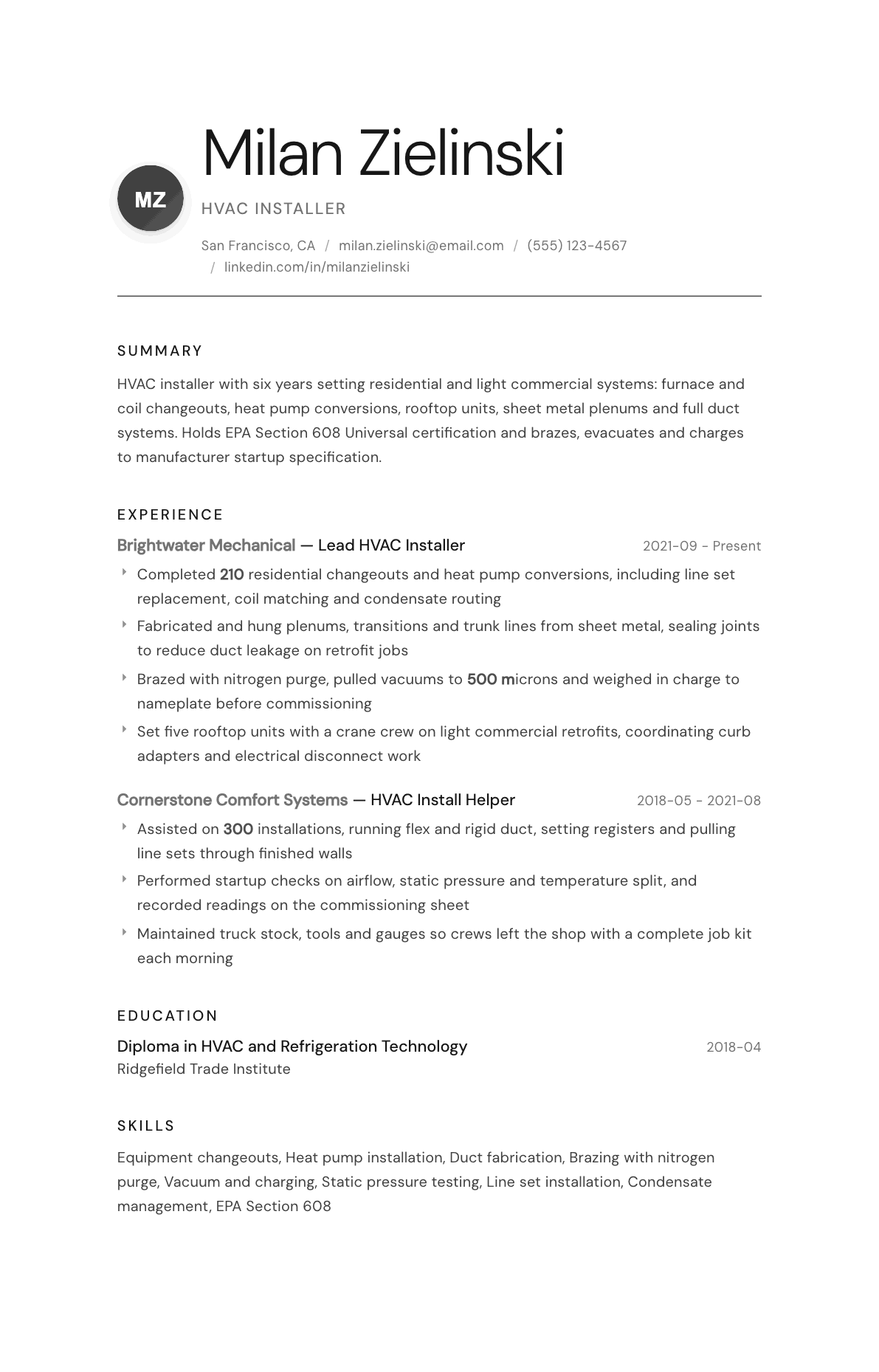
The same hvac installer content laid out in three CVBooster templates, so you can see what the finished document looks like before you write a word.
Example HVAC Installer summary
HVAC installer with six years on residential changeouts, heat pump conversions and light commercial rooftop work. Fabricates and hangs sheet metal, brazes with nitrogen purge, evacuates to specification and charges by weight before startup. Holds EPA Section 608 Universal certification and records airflow, static pressure and subcooling on every commissioning sheet. Seeking a lead installer position with a contractor doing heat pump retrofit work.
Skills to list on a HVAC Installer resume
- Furnace and coil changeouts
- Heat pump installation
- Mini split installation
- Rooftop unit setting
- Sheet metal duct fabrication
- Duct sealing
- Line set brazing
- Evacuation and charging
- Refrigerant recovery
- Airflow and static pressure testing
- Electrical connections
- Condensate and venting
- Blueprint reading
- Customer walkthrough
What actually gets this resume read
- Say how many installs you complete in a year and what mix, since changeout volume is how install managers rank candidates.
- Put your EPA Section 608 certification type on the resume, because a contractor cannot dispatch you to refrigerant work without it.
- Name the equipment families you have set: gas furnaces, heat pumps, mini splits, rooftop units, air handlers and coils.
- Show your sheet metal skill separately, from plenum fabrication to trunk and branch layout and duct sealing methods.
- Include startup numbers you record: vacuum level, subcooling, superheat, static pressure and temperature split.
- List the licenses and cards you carry, including any state mechanical license, and note whether you can pull permits.
How to write a hvac installer resume
Install and service are two different careers inside one trade, and the resumes should not look alike. A service technician is sold on diagnostics. An installer is sold on throughput and craftsmanship: how many systems you can set in a week, how clean the sheet metal is, and whether the job is commissioned properly before the truck leaves.
The install manager reading your resume is usually staffing a two person truck for a busy changeout season. He wants the refrigerant certification, the equipment families you have set, your sheet metal ability, and evidence that you record startup readings instead of guessing at a charge.
This guide covers the format, a summary that reads like an installer rather than a technician, how to describe equipment and duct work in the detail a manager recognizes, the certifications and licenses that unlock dispatch, and the questions installers ask when they change companies or move toward heat pump retrofit work.
Format: one page, certification block near the top
One page, single column, clear headings. Mechanical contractors screen fast during season and slowly in the shoulder months, so the top of the page has to carry the certification, the equipment families and the install volume.
Put refrigerant certification, any state mechanical license and your driver license class into a compact block under the summary. Without refrigerant certification a contractor cannot dispatch you to most of the work, so it should never be buried in an education section.
- Header: name, city and state, phone, email, driver license class.
- Section order: summary, certifications and licenses, install experience, equipment and skills, training.
- A helper moving up leads with install counts assisted, duct work run and startup readings recorded.
Summary: what you set, how many, and how you finish it
Open with the mix. Residential changeouts, new construction rough in, heat pump conversions, ductless mini split work, or light commercial rooftop units all describe different weeks. Give annual volume, because install managers plan crews around it.
Then say how you finish a job: nitrogen purge while brazing, a deep vacuum, charge weighed to nameplate or dialed by subcooling, and airflow verified before you leave. That sentence tells a manager whether he will be sending a service technician back next month.
Experience: equipment, sheet metal, refrigeration, startup
Split the work into the four things an installer is actually paid for. Equipment: furnaces, air handlers, coils, condensers, heat pumps, mini splits, package units and rooftop units, with the details that make a job hard such as attic sets, crawl space work, or a crane pick on a commercial curb.
Sheet metal: plenum and transition fabrication, trunk and branch layout, hanging, sealing methods, flex versus rigid, and any duct redesign you have done on a retrofit where the existing system was undersized.
Refrigeration: line set routing and replacement, brazing with a nitrogen purge, pressure testing, vacuum levels reached, charge method, and how you handle recovery on a removal. These are the specifics that separate a trained installer from a helper who watched.
Startup and documentation: static pressure, temperature split, airflow, superheat and subcooling readings recorded on a commissioning sheet, plus the customer walkthrough on filters, thermostats and warranty registration.
- Install volume per year and the equipment mix behind it.
- Sheet metal scope: fabricated in shop, fabricated on site, or ordered and hung.
- Startup readings you record and where they are documented.
Certifications, licenses and manufacturer training
Name your refrigerant handling certification and its type, since a universal certification covers all equipment classes while a partial one restricts what you can be sent to. Add any state or local mechanical license, an apprenticeship you completed, and whether you can pull permits in your jurisdiction.
Manufacturer training carries weight because warranty and rebate programs often require a trained installer. List the brands you have completed training on, along with any load calculation training and brazing or torch safety certification you hold.
Keywords a mechanical contractor filters on
The vocabulary is consistent: changeout, heat pump, mini split, air handler, evaporator coil, condenser, rooftop unit, sheet metal, plenum, duct sealing, line set, brazing, evacuation, refrigerant charge, static pressure and commissioning. Use the ones that describe your own work.
New construction postings add rough in, gas piping, venting, ventilation and inspection coordination. Retrofit and electrification postings add load calculation, duct redesign, cold climate heat pump and backup heat control. Match the posting rather than sending one file to both.
HVAC Installer resume summary examples
Install helper
HVAC install helper with one year on residential crews, running flex and rigid duct, setting registers and pulling line sets through finished walls. Records startup airflow and temperature split on commissioning sheets, holds refrigerant handling certification, and keeps truck stock and tools organized each morning.
Three years installing
HVAC installer completing about 150 residential changeouts a year, including furnace and coil replacements, heat pump conversions and ductless mini splits. Fabricates plenums and transitions, brazes with nitrogen purge, pulls deep vacuums and weighs in charge to nameplate before commissioning.
Lead installer
Lead HVAC installer running a two person truck on residential and light commercial work, including rooftop unit sets with a crane crew. Redesigns undersized duct on retrofits, coordinates electrical and permit inspections, trains helpers on brazing and evacuation, and documents every startup reading.
Work experience bullets: before and after
Before: Installed furnaces and air conditioners.
After: Completed 210 residential changeouts and heat pump conversions, including line set replacement, coil matching, condensate routing and thermostat control wiring.
Volume plus the full task list shows a complete install rather than a swap of two boxes.
Before: Worked with ductwork.
After: Fabricated and hung plenums, transitions and trunk lines from sheet metal, sealing joints with mastic to cut duct leakage on retrofit systems in unconditioned attics.
Fabrication, sealing method and the location tell a manager you can build duct instead of only connecting it.
Before: Brazed the line set and charged the system.
After: Brazed with a nitrogen purge, pressure tested, pulled vacuums to 500 microns with a micron gauge, and weighed in charge to nameplate before verifying subcooling.
Named procedures and a measured vacuum level are the clearest proof of proper refrigeration practice.
Before: Set rooftop units on commercial buildings.
After: Set five rooftop units with a crane crew on light commercial retrofits, coordinating curb adapters, electrical disconnects and duct transitions with the general contractor.
Coordination detail shows you can run a commercial set rather than simply stand on the roof for it.
Before: Explained the new system to the customer.
After: Walked each homeowner through filter sizes, thermostat programming and warranty registration at closeout, and left the commissioning sheet with recorded readings on site.
A documented handover reduces callbacks and gives the office what it needs for warranty claims.
Hard skills
- Furnace and coil changeouts
- Heat pump and mini split installation
- Rooftop and package unit setting
- Sheet metal fabrication
- Duct layout and sealing
- Line set routing and brazing
- Nitrogen purge and pressure testing
- Evacuation and charging
- Refrigerant recovery
- Static pressure and airflow testing
- Low voltage control wiring
- Venting and combustion air
- Condensate management
Soft skills
- Working clean in occupied homes
- Training helpers on procedure
- Scheduling around inspection windows
- Clear customer explanation
- Consistency in documentation
Certifications worth listing
- EPA Section 608 Universal Certification (Environmental Protection Agency)
- NATE Installation Certification (North American Technician Excellence)
- HVAC Excellence Employment Ready Certification (HVAC Excellence)
- OSHA 10-Hour Construction Outreach Training (Occupational Safety and Health Administration)
Mistakes that cost hvac installer candidates the interview
- Writing a service technician resume for an install job, so the reader never learns how many systems you can set.
- Leaving refrigerant certification off the page, which stops a contractor from dispatching you to most of the work.
- Treating sheet metal as an afterthought when duct quality is what separates installers at the same wage level.
- Describing charging without naming the method, since weighed in charge and dialed subcooling are different skills.
- Skipping startup documentation, which tells a manager you probably do not verify airflow before leaving.
- Listing every brand you have touched instead of the equipment families and the difficult sets you have handled.
HVAC Installer resume questions
What certification do I need to work as an HVAC installer?
Refrigerant handling certification is the practical requirement because it governs who may open a sealed system. Beyond that, some states and cities require a mechanical license for the company or the individual pulling permits.
Should I list the number of installs I complete in a year?
Yes. Install managers plan crews around throughput, so an annual figure with the equipment mix behind it gives them a direct comparison against their own schedule and the truck they need to fill.
How do I show sheet metal ability on a resume?
Say what you fabricate and where. Shop built plenums, field cut transitions, trunk and branch layout, hanging and sealing methods, and any retrofit where you resized duct to fix airflow all demonstrate real metal skill.
Is install experience enough to move into service work later?
It is a strong base but not the whole thing. Add diagnostic exposure to your resume as you get it, including electrical troubleshooting, refrigeration circuit faults and combustion analysis, since service hiring is judged on diagnosis.
How should I present heat pump retrofit experience?
Give it its own bullets. Name the conversions completed, whether you resized duct, how you handled backup heat and controls, and any cold climate equipment you have commissioned, because retrofit work is where demand is growing.
Related resume examples
- HVAC Technician Resume example
- Sheet Metal Worker Resume example
- Plumber Resume example
- Electrician Resume example
- Solar Installer Resume example
- Plumber Apprentice Resume example