Immigration Paralegal Resume Examples: read this first
Write an Immigration Paralegal Resume That Shows Real Caseload
By Mustafa Tarabya, founder of CVBooster · Published · Updated
Immigration paralegal resume example with petition types, case management keywords and a writing guide for employment and family filings.
Sample resumes for a immigration paralegal
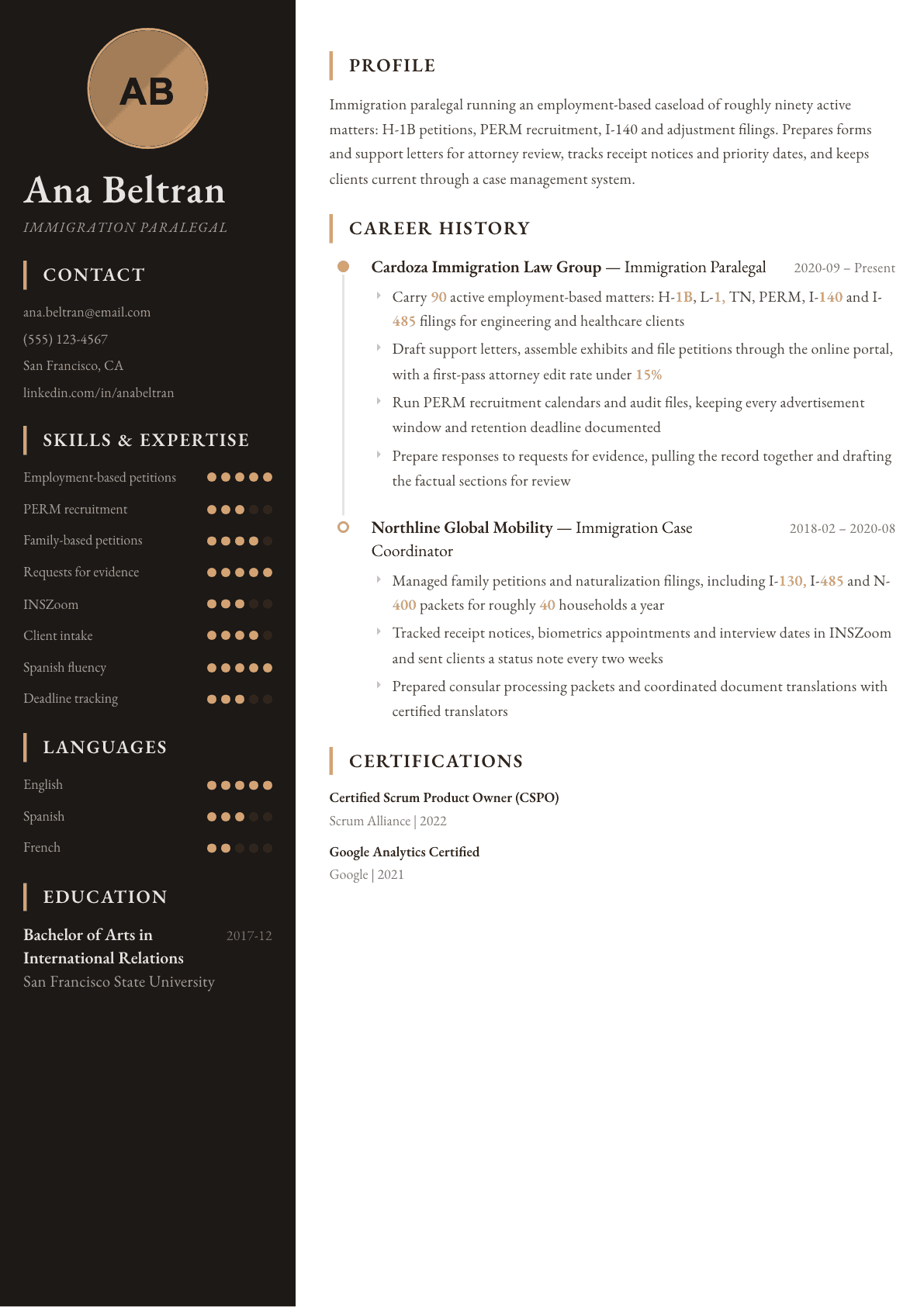
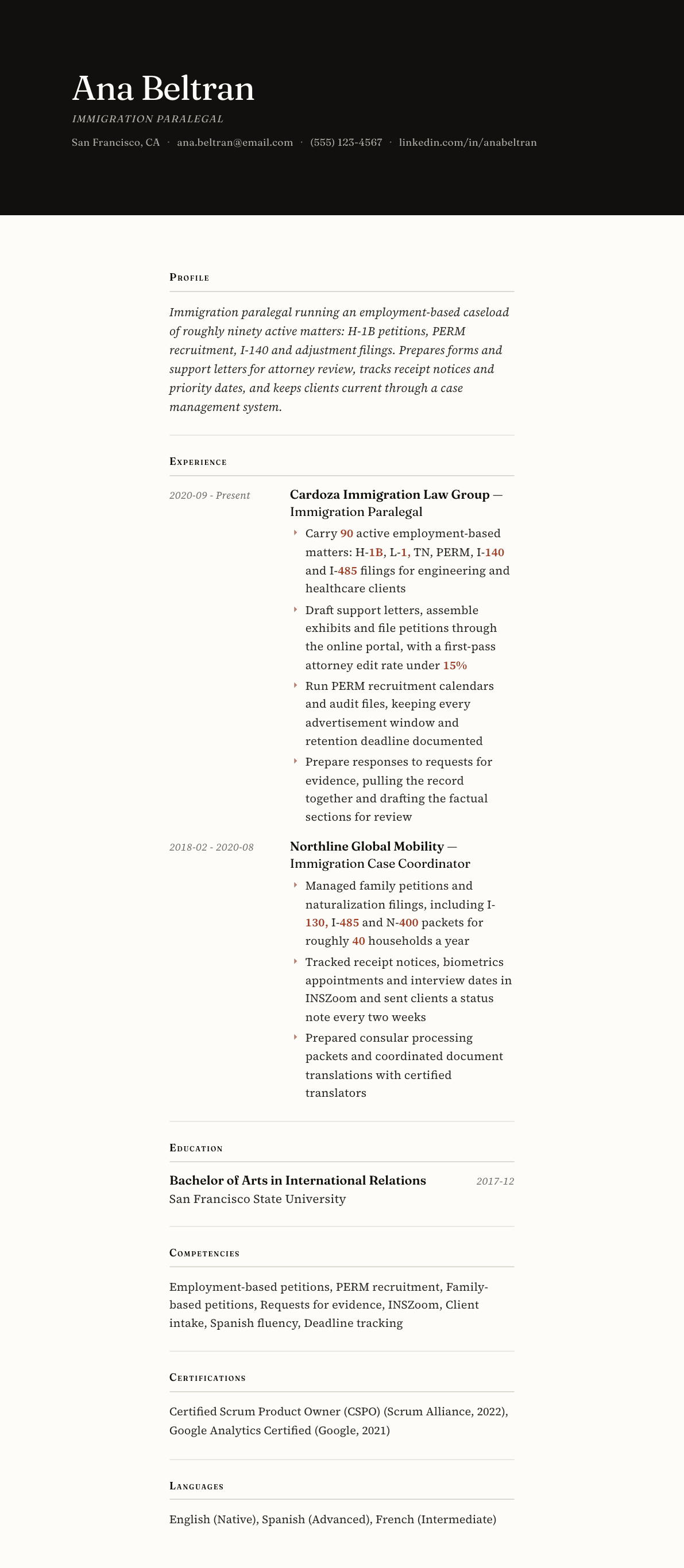
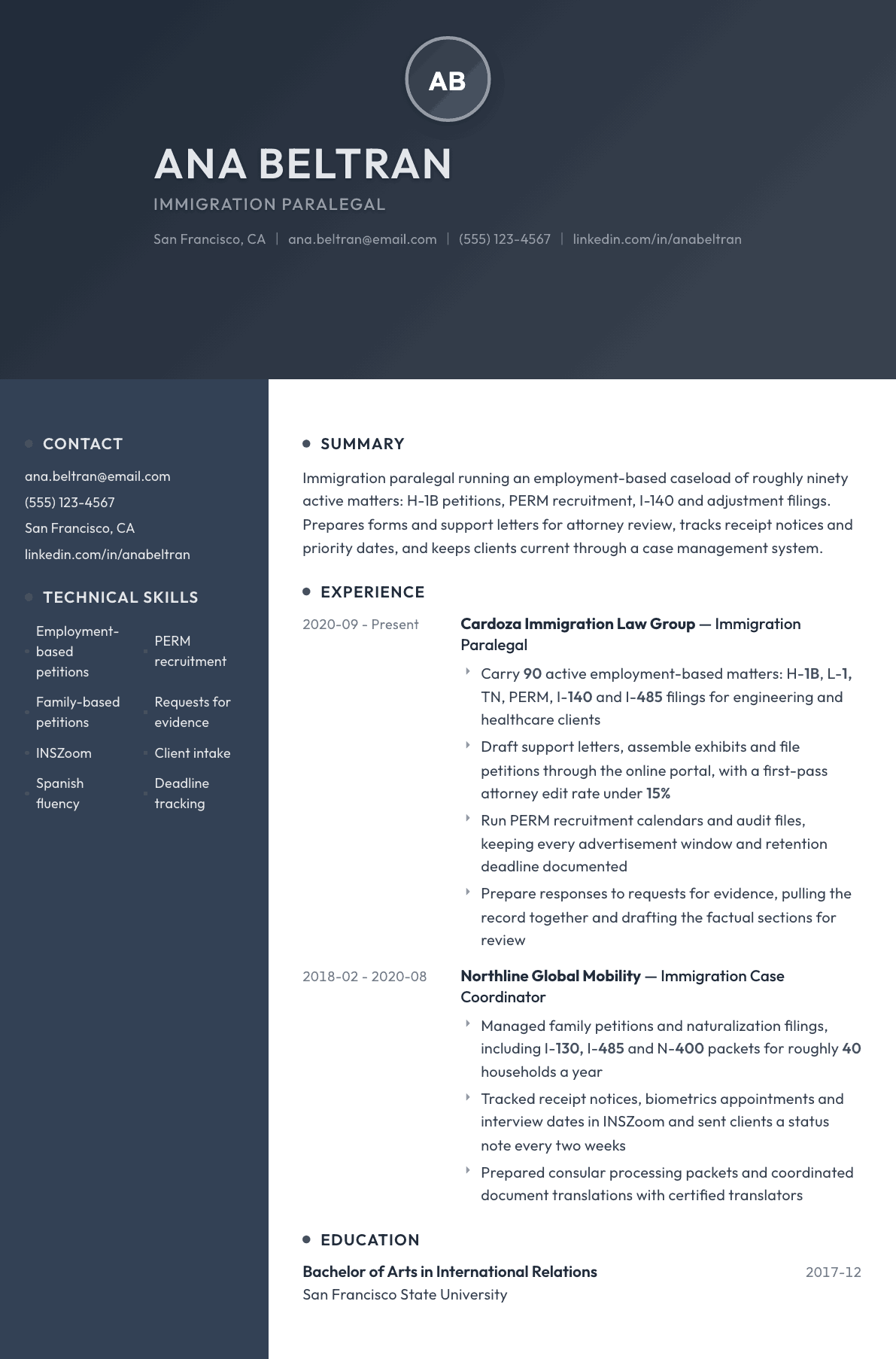
The same immigration paralegal content laid out in three CVBooster templates, so you can see what the finished document looks like before you write a word.
Example Immigration Paralegal summary
Bilingual immigration paralegal with five years across employment and family filings, currently carrying about ninety active matters. Prepares H-1B, PERM and adjustment packets for attorney review, drafts requests for evidence responses, and keeps every client informed on receipt notices and interview dates. Fluent in Spanish and comfortable with high-volume filing calendars.
Skills to list on a Immigration Paralegal resume
- H-1B petitions
- PERM labor certification
- I-140 and I-485 filings
- Family-based petitions
- Naturalization filings
- Requests for evidence
- Consular processing
- Client intake and screening
- Case management systems
- Document translation coordination
- Priority date tracking
- Support letter drafting
- Exhibit preparation
- Bilingual client communication
What actually gets this resume read
- List the petition types you have actually prepared, because an immigration hiring attorney reads that list before anything else.
- Give an active caseload number and say whether it is employment based, family based or removal defense work.
- Name the case management system you know, since firms buy one and want someone who can start on it.
- Mention every language you work in and the level, as a bilingual paralegal handles intake that others cannot.
- Show how you track receipt notices, priority dates and recruitment windows, because a missed deadline is the fear behind the interview.
- Keep a line on requests for evidence, since a paralegal who can pull an RFE record together saves an attorney a full day.
How to write a immigration paralegal resume
Immigration practice runs on deadlines that nobody can extend and forms that reject for a blank field. So the attorney reading an immigration paralegal resume is asking one question in three different ways: can this person carry a live caseload without a filing slipping. Everything on the page either answers that or wastes space.
The answer is built from petition types, caseload size, the case management system you know and the languages you work in. A resume that says prepared immigration forms and communicated with clients tells the reader nothing about whether you have ever assembled an H-1B cap filing in March or drafted a response to a request for evidence with a hard deadline on it.
What follows is the structure immigration hiring attorneys expect, three example summaries pitched at different stages, before-and-after bullets built from real filing work, and answers to the questions paralegals in this field ask when they sit down to update the resume.
Format: petitions and languages high, everything else after
Use reverse chronological order and put a short block directly under the summary listing petition types and languages. This is the fastest read in the whole document and it belongs above the experience section, because an attorney scanning twenty applications is sorting them by filing type before she reads a single job description.
One page carries most immigration paralegals comfortably. Two pages are justified once you have both employment and family experience, or removal defense on top of affirmative filings.
- Header: name, city and state, phone, email, and languages with the level you actually work in.
- Petition block: the forms and categories you have prepared, grouped as employment, family or humanitarian.
- Then experience, systems, education and any paralegal certification.
Summary: caseload, category and who your clients are
Name the practice type first, employment based, family based, humanitarian or removal defense, because firms are usually built around one of them. Then give your active caseload as a number. Then the client population, because preparing petitions for hospital physicians is not the same skill as preparing them for restaurant workers or for a technology company that files in volume every spring.
If you speak a second language at working level, put it in the summary rather than burying it at the bottom. In this practice area the language is often the reason a candidate gets called.
Experience: name the forms, the volume and the tracking
Immigration attorneys read for form numbers. Write them: H-1B, L-1, O-1, TN, PERM, I-140, I-485, I-130, I-751, N-400, I-589, whichever you have prepared. Attach a volume to the category rather than to each form, so the bullet stays readable.
Then show the parts that are genuinely difficult. Drafting support letters that survive attorney edit. Running PERM recruitment calendars and building the audit file. Assembling responses to requests for evidence. Handling consular processing and document translation. Managing the deadline calendar for receipt notices, biometrics, interviews and work authorization renewals.
Say what you prepare for review and what goes out under your own hand, because that boundary is exactly what the attorney needs to know before she hands you a matter.
Systems, client care and the deadline calendar
Name the case management platform you have used. Firms invest heavily in one and a candidate who already knows it saves weeks. Add the filing portals you have worked in and any experience migrating cases between systems, which is unglamorous work that hiring firms value more than candidates expect.
Client communication deserves a bullet of its own. Immigration clients are anxious, often for years, and a paralegal who sends a status update on a schedule reduces the calls the attorney has to take. Describe the cadence rather than calling yourself a good communicator.
Keywords immigration postings repeat
Postings in this field reuse a narrow vocabulary: petition preparation, request for evidence, adjustment of status, consular processing, labor certification, priority date, case management, client intake, bilingual. Use the same wording once in the skills block and once in a bullet that proves it. Do not invent familiarity with a category you have never filed, because the interview will start with a form-by-form walkthrough.
Immigration Paralegal resume summary examples
First paralegal role
Bilingual legal assistant with 18 months in an immigration practice, supporting family petitions and naturalization filings. Prepares I-130, I-485 and N-400 packets for attorney review, runs client intake in Spanish and English, and tracks receipt notices and biometrics appointments for roughly 45 open matters.
Four years, employment based
Immigration paralegal carrying 85 active employment-based matters for technology and healthcare employers. Prepares H-1B, L-1 and TN petitions, runs PERM recruitment calendars and audit files, and drafts the factual sections of responses to requests for evidence. Works daily in a cloud case management system and files through the online portal.
Senior paralegal
Senior immigration paralegal with nine years across employment, family and humanitarian filings, now supervising two paralegals and the intake process. Owns the firm deadline calendar, leads the annual H-1B cap season workflow, and rebuilt the case management templates that cut petition assembly time by a third.
Work experience bullets: before and after
Before: Prepared immigration forms for attorneys.
After: Prepared H-1B, L-1 and TN petitions for a caseload of 85 active matters, assembling forms, exhibits and support letters for attorney review before filing.
Naming the categories and the caseload replaces a line that could describe a first-week trainee.
Before: Worked on PERM cases.
After: Ran PERM recruitment calendars for 30 labor certifications a year, documenting every advertisement window and building the audit file at the time of filing rather than after a request arrived.
The volume and the audit-ready habit show an attorney that this part of the file will not come back as a problem.
Before: Responded to RFEs.
After: Assembled responses to requests for evidence: pulled the full record, drafted the factual narrative, gathered supporting documents and delivered the package to the attorney a week before the response deadline.
The sequence and the buffer prove judgment about deadlines, which is the fear behind the question.
Before: Kept clients updated on their cases.
After: Sent every client a written status note every two weeks and flagged receipt notices, biometrics and interview dates as they arrived, reducing inbound status calls to the attorneys.
A stated cadence and its effect turn a claim about communication into a described process.
Before: Used case management software.
After: Managed 90 matters in INSZoom, rebuilt the questionnaire templates for employment filings, and migrated 400 legacy files into the platform with the deadline calendar intact.
System ownership and a migration show you can improve the tooling rather than only operate it.
Hard skills
- Employment-based petition preparation
- PERM labor certification support
- Family-based petitions
- Adjustment of status filings
- Naturalization applications
- Requests for evidence
- Consular processing
- Client intake and screening
- Case management platforms
- Deadline and priority date tracking
- Support letter drafting
- Exhibit assembly and indexing
- Document translation coordination
- Filing portal submissions
Soft skills
- Bilingual client communication
- Composure with anxious clients
- Deadline discipline
- Attention to form detail
- Cultural sensitivity
- Workload triage
Certifications worth listing
- Certified Paralegal (CP) (National Association of Legal Assistants)
- Registered Paralegal (RP) (National Federation of Paralegal Associations)
Mistakes that cost immigration paralegal candidates the interview
- Writing about immigration work generically instead of naming the petition categories you have actually prepared.
- Leaving the active caseload off, so the attorney cannot tell whether you handle five matters or ninety.
- Hiding language ability at the bottom of the page when it is often the deciding factor for the interview.
- Claiming removal defense or asylum experience on the strength of one observed hearing.
- Skipping the case management system, which is usually the first practical question in the screening call.
- Describing yourself as detail oriented rather than showing a deadline process that has never let a filing lapse.
Immigration Paralegal resume questions
How much detail should I give about petition types?
Enough that an attorney can staff you without asking. Group them by category and name the specific forms you have prepared end to end. Leave out anything you have only watched, because the interview will walk through your list form by form.
Does being bilingual really matter on an immigration paralegal resume?
Yes, and it belongs in the summary. Client intake, document review and interview preparation often happen in the client language, so a firm serving a particular community will filter for it before considering anything else on the page.
I work in-house for a company, not a law firm. How do I frame that?
Say so and lean into scale. Corporate immigration teams run high volumes of the same filings and coordinate with outside counsel and global mobility vendors. Describe the annual filing volume, the internal clients you support and how transfers are tracked across countries.
Should I list the number of approvals I have obtained?
Be careful. Approval rates depend on attorney strategy and the facts of each case, not on paralegal work alone. It reads better to describe your filing volume, your quality control steps and how few of your packets come back needing rework.
What if my experience is only family based and the job is employment based?
Name the transferable spine directly: forms discipline, evidence gathering, deadline tracking, client interviews and portal filing. Then show you have learned the target categories through coursework, a training program or supervised work, so the shift looks planned rather than hopeful.