Court Interpreter Resume Examples: the lines they read
Build a Court Interpreter Resume Courts Take Seriously
By Mustafa Tarabya, founder of CVBooster · Published · Updated
Court interpreter resume examples, sample bullets, certification placement and language pair keywords for courtroom, deposition and remote work.
Sample resumes for a court interpreter
The same court interpreter content laid out in three CVBooster templates, so you can see what the finished document looks like before you write a word.
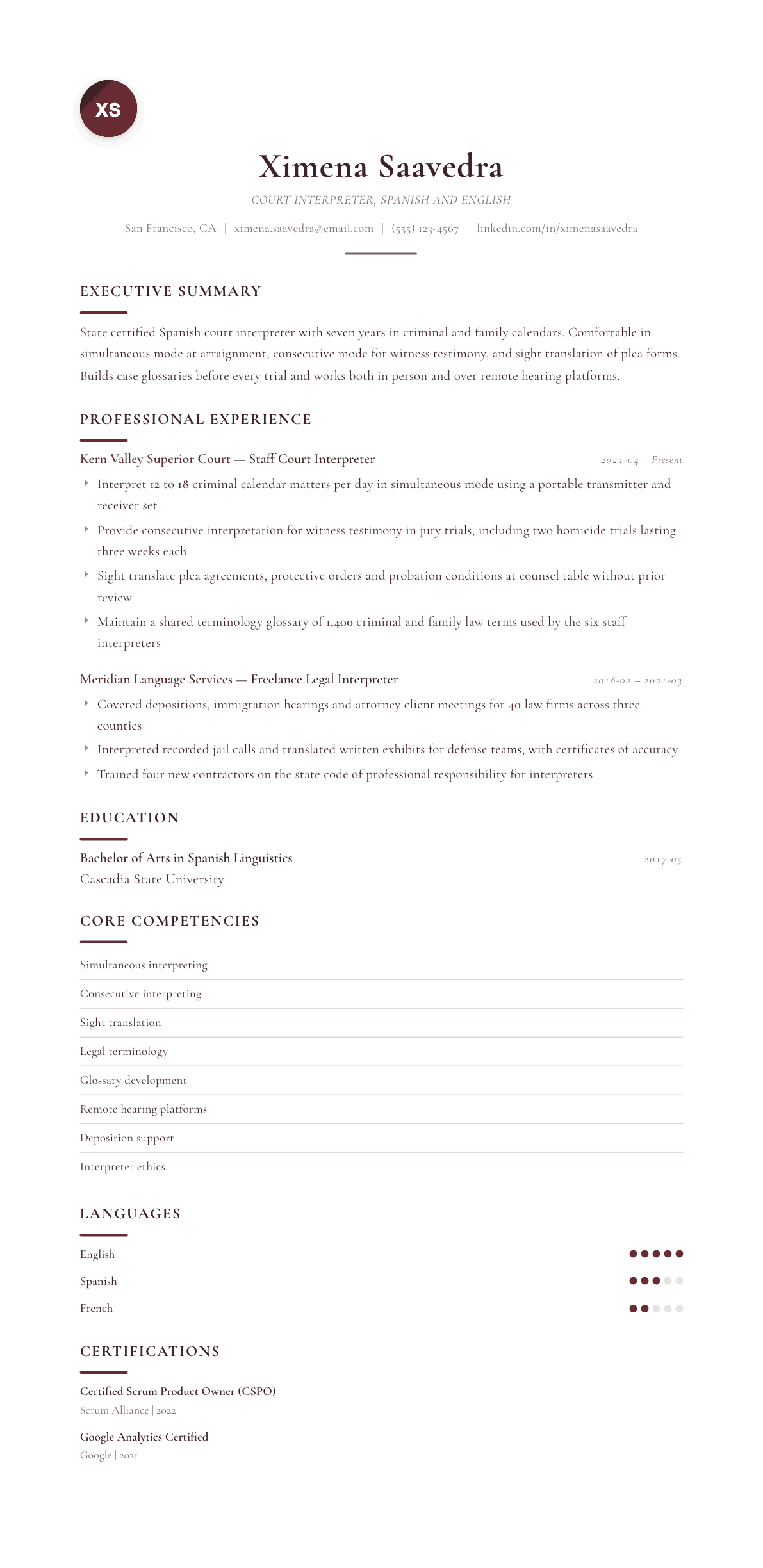
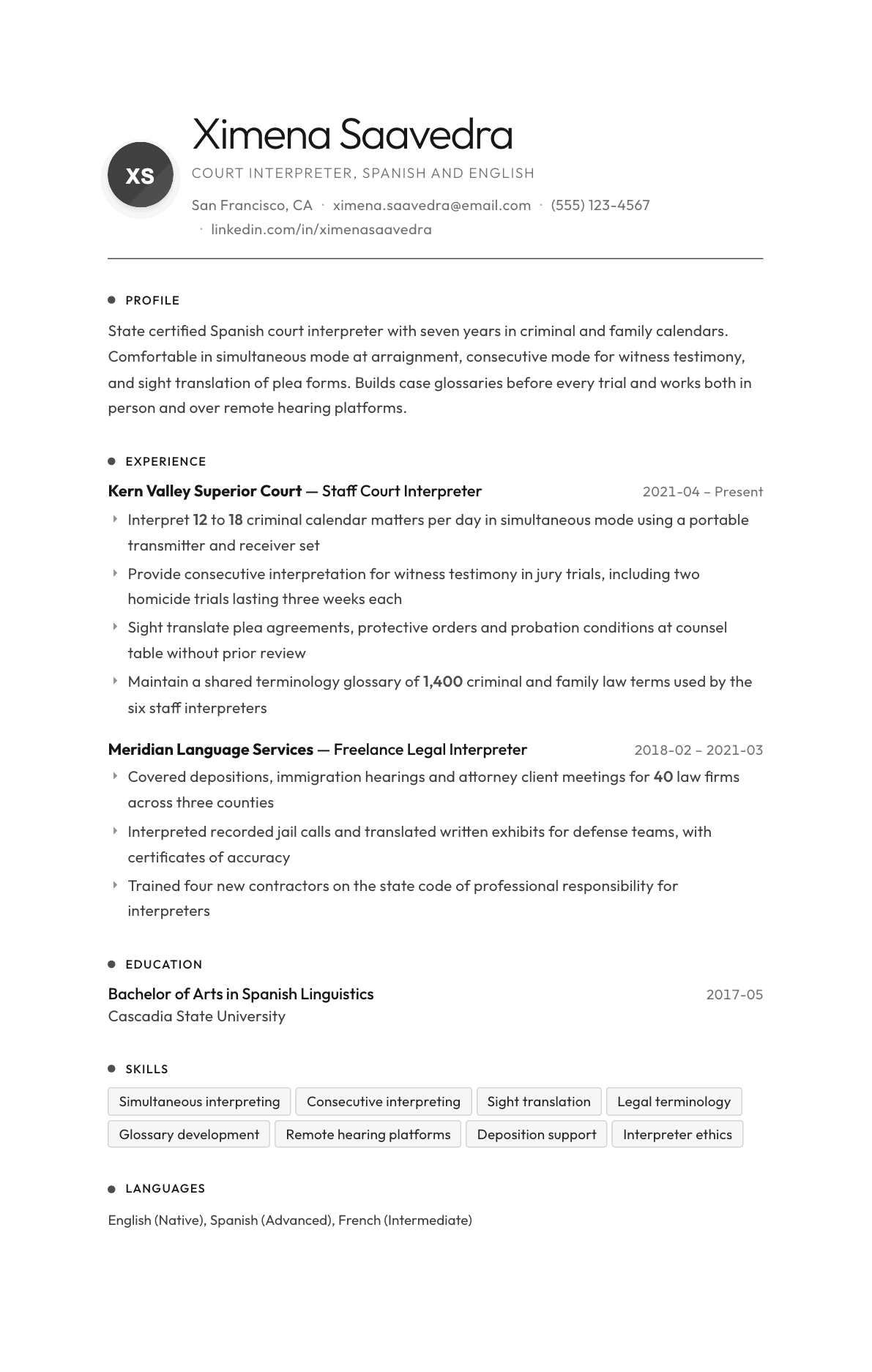
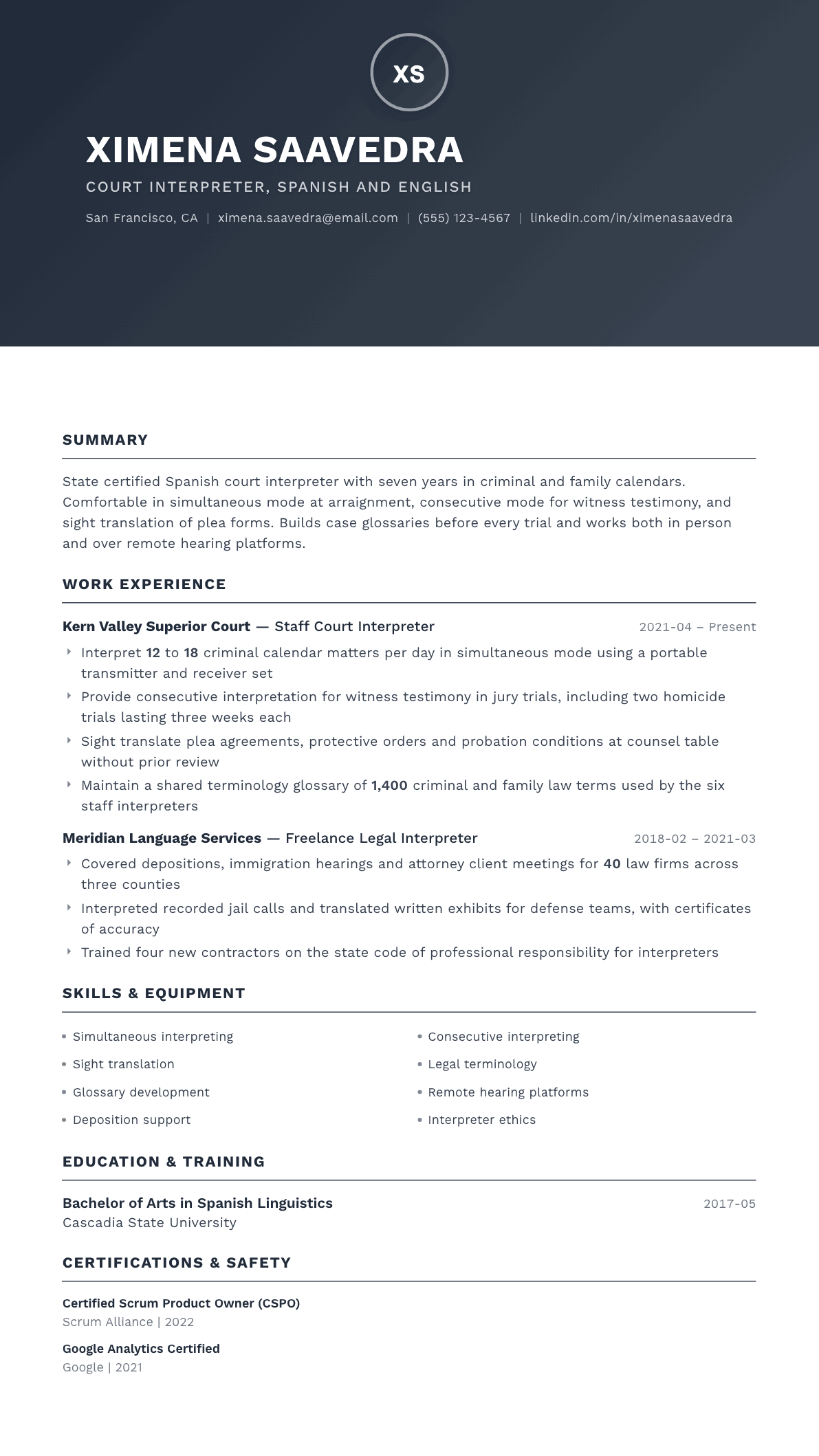
Example Court Interpreter summary
State certified court interpreter with seven years covering criminal, family and probate calendars in a busy trial court. Works simultaneously at arraignment and consecutively for testimony, sight translates plea forms at counsel table, and prepares a case glossary before every trial. Seeking a staff interpreter role in a court with a heavy felony docket.
Skills to list on a Court Interpreter resume
- Simultaneous interpretation
- Consecutive interpretation
- Sight translation
- Criminal procedure terminology
- Family law terminology
- Deposition interpreting
- Written translation
- Certificate of accuracy
- Glossary and term base management
- Remote and video hearings
- Interpreter code of ethics
- Note taking systems
- Witness testimony support
- Jail and custody interviews
What actually gets this resume read
- Put your certification, the certifying body and your language pair in the header so a screener sees them first.
- Name the modes you work in, simultaneous, consecutive and sight translation, because assignment coordinators staff by mode.
- Give each court the level, criminal or civil calendar, and the daily matter volume you carried on the record.
- List the equipment you handle, from transmitter and receiver sets to the remote hearing platform the court uses.
- Separate certified court work from community and medical interpreting so the reader can weigh the legal hours alone.
- Show terminology work such as glossary building or exhibit translation, since accuracy under objection is the real skill.
How to write a court interpreter resume
A court interpreter resume is screened by a language access coordinator before any judge or trial court administrator sees it. That coordinator has a spreadsheet of language pairs, certification tiers and availability, and she is trying to answer one question: can this person stand next to a defendant at arraignment on Monday without the record being challenged.
Everything that answers that question belongs in the top third of the page. The language pair, the certification and who issued it, the modes you work in, and the courts where you have already worked. Everything else is support.
What follows is the section order coordinators expect, three summary examples for different stages of an interpreting career, before and after bullets drawn from real assignment types, and the questions interpreters ask when they try to put a courtroom skill on paper.
Format: credentials in the header, modes in the first line
Reverse chronological, one page until you have six or seven years of courtroom work. Put the language pair next to your name, then the certification and the certifying body, then the states or districts where that certification is recognized. A coordinator who has to hunt for your credential assumes you do not have one.
Avoid two column layouts. Court systems often run resumes through a state hiring portal that flattens columns, and a scrambled certification line is the fastest way to be passed over.
- Header: name, language pair, certification tier, certifying body, city and state, phone, email.
- Order: summary, certifications and languages, court experience, other interpreting and translation, education, skills.
- New interpreters move training and practicum hours above paid experience.
Summary: the pair, the tier, the calendars you cover
Two or three lines. Name the language pair, the certification tier, the number of years in courtrooms, and the calendars you are comfortable on. Criminal arraignment, family law, probate and civil motions each move at a different speed, and a coordinator staffs accordingly.
If you are moving from community or medical interpreting into court work, say that plainly and name the legal training you have completed. Do not leave the reader to guess whether your hours were spent in a clinic or a courtroom.
Experience: the court, the calendar, the mode, the volume
Head each entry with the court and its level: superior court, municipal court, immigration court, or a district court under a federal contract. Then say what you covered. A line such as felony criminal calendar, simultaneous mode, 12 to 18 matters a day, tells a coordinator more than a paragraph of adjectives.
Give three to five bullets per assignment. The strong ones name the proceeding type and the pressure inside it: testimony under cross examination, a suppression hearing with rapid objections, a plea colloquy where the judge reads rights at speed, a sentencing where victim statements arrive unscripted.
Freelancers should group work by agency or court rather than listing every single day. Show the range of venues, the recurring clients, and the assignment volume across a typical month.
Certifications, languages and equipment
Give each credential its full name, the issuing authority and the state or federal program it belongs to. Written and oral exam passage should be stated separately if your program tracks them that way, because a registered interpreter and a certified interpreter are staffed for different hearings.
List the equipment you supply and operate: your own transmitter and receiver set, a headset for remote proceedings, and the video platform the court uses for remote appearances. Interpreters who bring working gear get called back.
Skills and the terms a court portal indexes
The skills block is where the portal finds keywords, so use the language of the job posting: simultaneous interpretation, consecutive interpretation, sight translation, legal terminology, code of professional responsibility, remote video appearance. Add written translation and certificate of accuracy only if you actually produce them.
Keep the block to skills a court would test. Software you used at another job dilutes the list and does nothing for an interpreting posting.
Court Interpreter resume summary examples
Newly certified
Newly certified Spanish court interpreter with 200 hours of legal interpreting practicum and 3 years of medical interpreting. Trained in simultaneous, consecutive and sight translation, passed the state oral exam on first attempt, and available for criminal and traffic calendars across two counties.
Five years in courtrooms
Certified Mandarin and English court interpreter with 5 years covering criminal and family calendars in a metropolitan superior court. Handles simultaneous interpreting at arraignment, consecutive testimony in jury trials, and sight translation of plea forms. Maintains case glossaries and works remote hearings on the court video platform.
Lead staff interpreter
Federally certified Spanish interpreter with 14 years in district and superior courts, the last 4 as lead staff interpreter scheduling a team of 6. Experienced in multi defendant trials, wiretap transcription and expert testimony, and responsible for the court terminology database and new interpreter mentoring.
Work experience bullets: before and after
Before: Interpreted for Spanish speaking defendants in court.
After: Interpreted the felony criminal calendar in simultaneous mode for 12 to 18 matters daily, including arraignments, bail reviews and plea colloquies.
Naming the calendar, the mode and the daily volume shows the pace you can hold rather than the language you speak.
Before: Helped with depositions and hearings.
After: Provided consecutive interpretation across 60 depositions and 3 multi week jury trials, including cross examination of expert witnesses.
Counts and proceeding types let a coordinator match you to an assignment instead of guessing at your range.
Before: Translated documents for attorneys.
After: Produced written translations of police reports, jail calls and medical records with signed certificates of accuracy admitted as exhibits.
The document types and the certificate of accuracy prove courtroom grade written work, not casual translation.
Before: Prepared before assignments.
After: Built case specific glossaries from charging documents and expert reports before each trial, and shared them with the staff interpreter team.
Preparation is invisible unless you name the source documents and what you produced from them.
Before: Worked on remote hearings during court closures.
After: Interpreted remote custody and status hearings over the court video platform, managing audio handoffs between counsel, the bench and detention facilities.
Remote work has its own difficulty, and describing the audio coordination shows you have solved it.
Hard skills
- Simultaneous interpretation
- Consecutive interpretation
- Sight translation
- Legal and criminal procedure terminology
- Written translation and certification
- Case glossary and term base building
- Deposition interpreting
- Remote video hearing platforms
- Transmitter and receiver equipment
- Note taking systems for consecutive mode
- Recorded call transcription
- Interpreter code of professional responsibility
Soft skills
- Neutrality under pressure
- Register matching
- Stamina across long hearings
- Clear intervention protocol
- Discretion with case information
- Team interpreting coordination
Certifications worth listing
- Federal Court Interpreter Certification (Administrative Office of the United States Courts)
- State Court Interpreter Certification (Council of Language Access Coordinators, National Center for State Courts)
- Certified Translator (American Translators Association)
- Certified Medical Interpreter (CMI) (National Board of Certification for Medical Interpreters)
Mistakes that cost court interpreter candidates the interview
- Writing bilingual at the top of the resume instead of naming the certification tier and the body that issued it.
- Mixing community, medical and courtroom hours into one total, which hides how much legal experience you actually have.
- Leaving out the mode, so the reader cannot tell whether you have ever worked simultaneously at speed.
- Listing every one day freelance assignment separately until the courtroom work is buried under agency names.
- Claiming a language pair in both directions without saying which direction your exam and practice cover.
- Skipping the equipment line, then arriving at a hearing expecting the court to supply a headset.
Court Interpreter resume questions
Do I need certification to apply for court interpreter work?
Many courts hire registered or qualified interpreters in languages with no certification exam, so apply and state your tier honestly. For Spanish and other tested languages, certification is usually a screening requirement rather than a preference.
How do I show interpreting volume without breaking confidentiality?
Describe proceeding types and counts, never party names or case facts. Saying you interpreted 3 homicide trials and roughly 400 criminal calendar matters gives scale while keeping everything covered by the record confidential.
Should freelance assignments be listed individually?
No. Group them under the agency or the court that engaged you, give the date range, and describe the venues and assignment types. A list of single days reads as a calendar rather than as a career.
Where do translation projects belong on an interpreting resume?
In a separate written translation section below courtroom experience. Keep it short, name the document types and the certificates of accuracy you signed, and do not let it crowd out live courtroom work.
How do I move from medical interpreting into court interpreting?
Say the goal in the summary, list any legal terminology training and observation hours, and reframe your clinical bullets around the skills that transfer: consecutive accuracy, register control, and intervening cleanly when a speaker is unclear.