Legal Intern Resume Examples: free ATS score and gap list
Write a Legal Intern Resume With Little Legal Experience
By Mustafa Tarabya, founder of CVBooster · Published · Updated
Legal intern resume example with research, filing and intake keywords, plus a guide to building a credible page when you have no legal job yet.
Sample resumes for a legal intern
The same legal intern content laid out in three CVBooster templates, so you can see what the finished document looks like before you write a word.
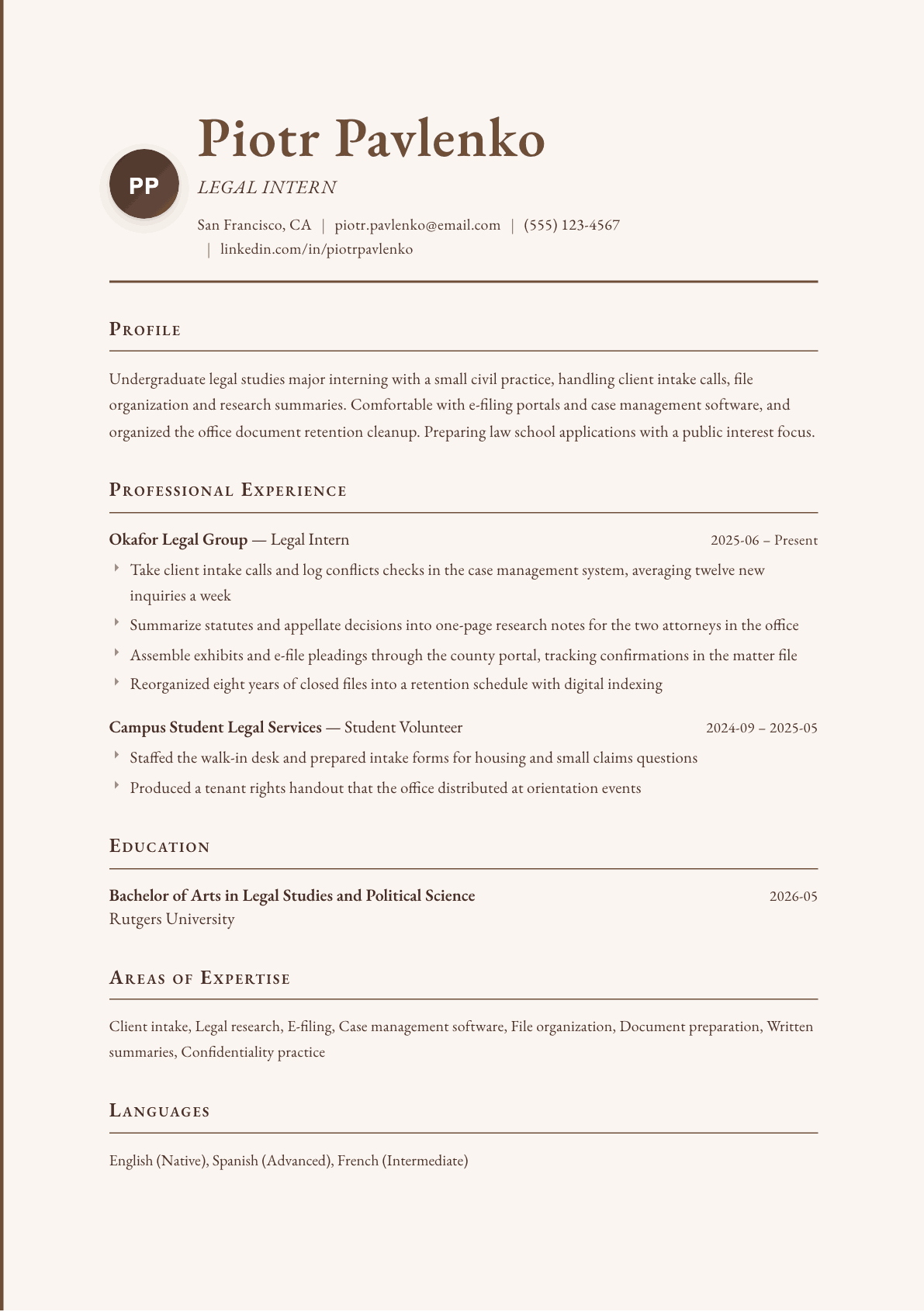
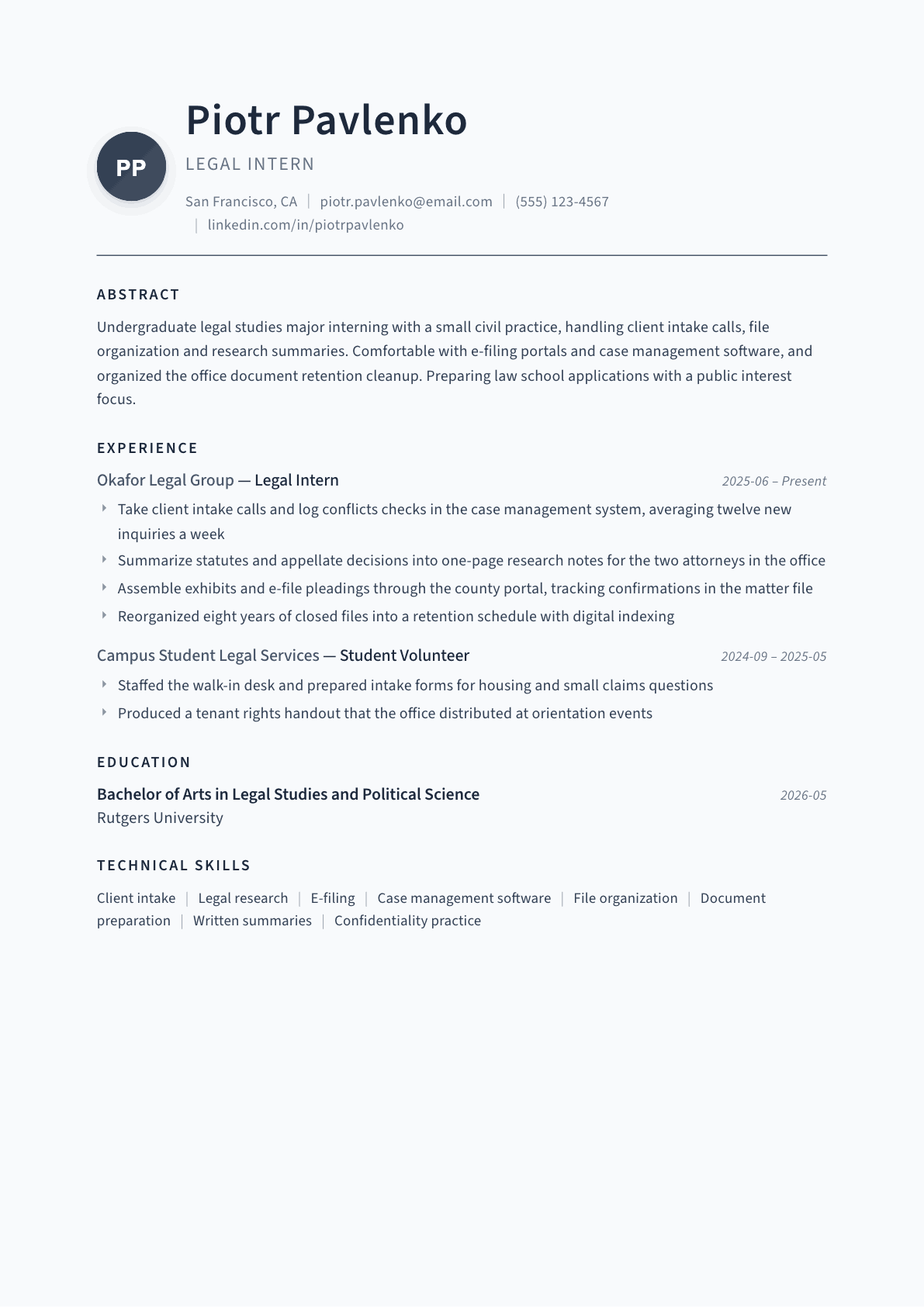
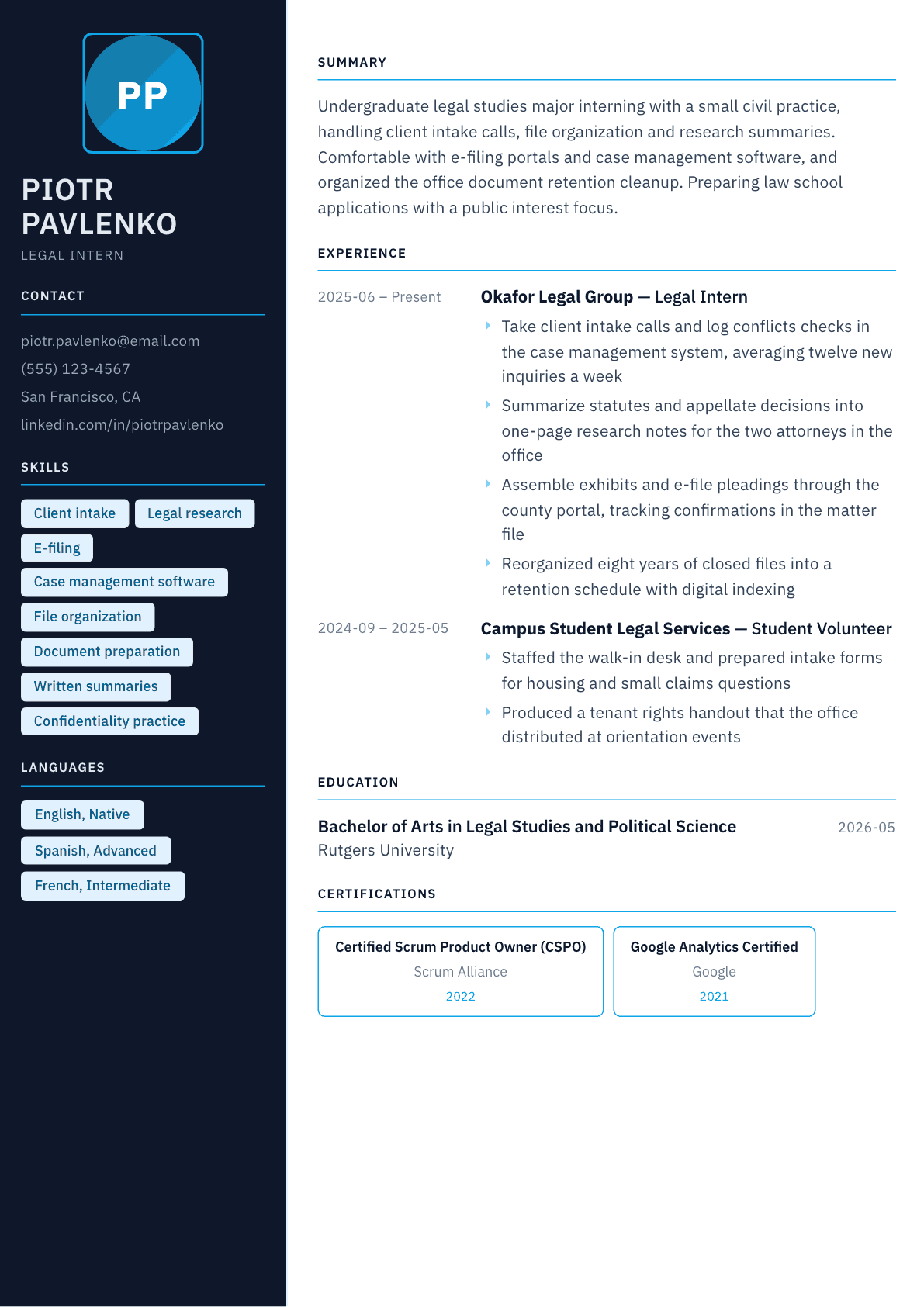
Example Legal Intern summary
Legal studies undergraduate interning with a two-attorney civil practice, handling intake calls and conflicts checks for about twelve new inquiries a week, writing one-page research notes, and e-filing pleadings through the county portal. Reorganized eight years of closed files into a retention schedule. Seeking a paralegal or litigation support internship before law school.
Skills to list on a Legal Intern resume
- Legal research
- Client intake
- Conflicts checking
- Court e-filing portals
- Case management software
- Document preparation
- Exhibit assembly
- File organization and retention
- Legal terminology
- Written research summaries
- Confidentiality and privilege awareness
- Calendar and deadline tracking
What actually gets this resume read
- Lead with education and coursework when you have no paid legal work, and name the classes that map to the practice area.
- Treat volunteer, campus and customer service work as real experience by describing the responsibility and the volume.
- Name the software and portals you have touched, because an office wants to know how much training you will need.
- Show that you understand confidentiality, since a small firm handing you client files cares about that above almost everything.
- Keep the page to one side and use plain section headings, because intern applications are screened quickly and in batches.
- Ask for a specific term in your cover material, naming the semester or months you are available and how many hours a week.
How to write a legal intern resume
A legal intern resume has to solve a chicken and egg problem. Offices want interns with some exposure to legal work, and you cannot get exposure without an internship. The way through is to stop treating the page as a record of legal jobs you have not had and start treating it as evidence that you are reliable, careful with confidential material and quick to learn an office system.
The reader is usually an office manager, a paralegal or the attorney who will be supervising you directly. In a small practice that person is giving you access to client files in your first week, so the traits they screen for are discretion, accuracy and follow-through. In a large office or a government agency the screen is more formal, and the resume needs to survive an application portal before any human sees it.
This guide covers how to build a credible page from coursework, campus work and ordinary jobs, how to describe intake, filing and research tasks so they read as legal work, summaries for a first internship application, a working intern and a returning one, and the questions applicants ask about credit, hours and confidentiality.
Format: one page, education and availability first
One page, education at the top with your institution, expected graduation and major, and any legal coursework listed underneath. Where the internship is for academic credit, note that, because an office needs to know whether a supervisor evaluation form is coming with you.
State availability in a short line: the term or months, the days and the hours per week. Offices schedule interns around court calendars and staff coverage, and an application that answers the scheduling question without an email exchange gets read more favorably.
- Header: name, city and state, phone, a professional email address, and nothing decorative.
- Order: education and relevant coursework, legal or office experience, other work, skills, activities.
- One line naming your available term, weekly hours and whether the position is for course credit.
Building experience out of what you already have
Campus legal services, a student advocacy group, a court observation project, a political campaign, a public defender office tour program, or an administrative job in any regulated setting all produce transferable evidence. Describe them by responsibility: people served, forms prepared, records kept, questions researched, confidentiality maintained.
Ordinary jobs count when written correctly. A bank teller has handled sensitive information under a procedure. A veterinary receptionist has managed a calendar and taken distressed calls. A warehouse supervisor has trained people and kept records. Name the responsibility, not the industry, and the relevance is obvious.
Coursework belongs on an intern resume in a way it does not on a lawyer's. Constitutional law, criminal procedure, legal research and writing, business law and ethics all tell a supervisor what vocabulary you already hold. Keep it to four or five courses that match the office's practice.
Intake, filing and the work an office really needs done
The tasks an intern actually receives are intake calls, conflicts checks, file organization, exhibit assembly, e-filing, calendar entries and short research notes. Describing these accurately is not lowering your sights, it is showing you understand the job.
Give volume and system names where you have them. Twelve intake inquiries a week logged in a case management system is a real workload. Filing through a county portal and tracking confirmations shows you understand that a filing is not complete until the confirmation is in the file.
Research at the intern level means summarizing rather than analyzing. A one page note on a statute, with the text, the relevant subsection and the questions it leaves open, is genuinely useful to a two-attorney office and worth describing as what it is.
Confidentiality: say it, because they are worried about it
Every office handing files to a student worries about the same thing. Address it directly with a skills line on confidentiality and privilege awareness, and support it with an experience bullet showing you have worked under a confidentiality obligation before, whether in a clinic, a medical office, a school or a bank.
Keep your own resume clean of confidential material. An intern applicant who names clients from a prior placement has answered the question in the worst possible way, and readers do notice.
Software, systems and the training cost question
Small offices calculate how many hours it will take to make you useful. Reduce that estimate on paper. Name any case management software, e-filing portal, document assembly tool, spreadsheet work and transcription or dictation experience you have.
Where you have no legal system experience, name the closest analogue and say you learned it quickly. A student who administered a campus booking system or a point of sale platform has proved they can learn a database, and stating that is more persuasive than a claim to be a fast learner.
Legal Intern resume summary examples
First internship application
Legal studies and political science major with coursework in criminal procedure and legal research, a year staffing the campus student legal services walk-in desk, and two summers in a medical office handling confidential records. Available three days a week for a fall internship for course credit.
Working intern
Legal intern with a two-attorney civil practice, handling intake calls and conflicts checks for about twelve new inquiries a week, writing one-page research notes on statutes and appellate decisions, and e-filing pleadings through the county portal. Reorganized eight years of closed files into a retention schedule.
Returning intern before law school
Returning legal intern moving into a paralegal-track role, now preparing discovery responses from client documents, maintaining the litigation calendar for fourteen active matters and training two incoming interns on the case management system. Applying to law school with a public interest focus.
Work experience bullets: before and after
Before: Answered phones and helped clients at the front desk.
After: Took client intake calls and logged conflicts checks in the case management system, handling about twelve new inquiries a week and routing urgent matters to the supervising attorney the same day.
The system, the volume and the escalation rule turn reception duties into a described legal office process.
Before: Did legal research for the attorneys.
After: Summarized statutes and appellate decisions into one-page research notes for two attorneys, giving the controlling text, the relevant subsections and the open questions.
Describing the format and what the note contains shows you know what a useful research summary looks like.
Before: Filed documents with the court.
After: Assembled exhibits and e-filed pleadings through the county portal, checking caption and formatting requirements and recording each acceptance confirmation in the matter file.
Format checks and confirmation tracking prove you treat filing as a process with real failure points.
Before: Organized old case files for the office.
After: Reorganized eight years of closed files into a retention schedule with digital indexing, making archived matters searchable by client, matter type and closing date.
A cleanup task becomes a project once the reader sees the structure you created and how the office uses it.
Before: Volunteered at the student legal services office.
After: Staffed the campus walk-in desk, prepared intake forms for housing and small claims questions, and wrote a tenant rights handout distributed at orientation.
A produced document and a named subject area make volunteer work read as real legal support experience.
Hard skills
- Client intake and screening
- Conflicts checking
- Case management software
- Court e-filing portals
- Document preparation and formatting
- Exhibit assembly
- File organization and retention schedules
- Written research summaries
- Legal terminology
- Calendar and deadline entry
- Records handling under confidentiality rules
- Spreadsheet tracking
Soft skills
- Discretion
- Attention to detail
- Taking direction accurately
- Phone manner with distressed callers
- Punctuality and reliability
- Asking before assuming
Mistakes that cost legal intern candidates the interview
- Leaving the page nearly empty because no job on it had the word legal in the title.
- Omitting availability, which forces an office to email before it can even consider the schedule.
- Describing intake and filing as menial when they are the tasks an office is actually hiring for.
- Skipping any mention of confidentiality, the concern that sits behind every intern hiring decision.
- Naming clients or matters from a previous placement, which answers the discretion question in the worst way.
- Using an informal email address on an application that a supervising attorney will read.
Legal Intern resume questions
How do I get a legal internship with no legal experience?
Apply with a page built on reliability. Show coursework that matches the office, any work where you handled confidential records or a scheduling system, and volunteer work with real responsibility. Then apply to small practices and public offices directly, since they hire outside formal recruiting cycles.
What should a legal intern put on a resume?
Education with expected graduation and relevant courses, any experience involving records, intake or research, the software and portals you have used, a confidentiality line, and your availability. Keep it to one page and make every entry describe a responsibility rather than a title.
Should I mention that the internship is for course credit?
Yes, in a short line near your availability. Credit-bearing placements involve a supervisor evaluation, an hours requirement and sometimes a faculty contact, and an office would rather know that upfront than discover the paperwork after making an offer.
Do undergraduate grades belong on a legal intern resume?
Include your grade point average if it is strong, along with any honors or scholarships. If it is average, use that space for coursework and experience instead. Offices hiring interns care more about dependability and available hours than about a transcript number.
How do I describe office tasks so they sound like legal work?
Attach each task to the legal process it belongs to. Filing becomes preparing and submitting pleadings through a court portal with confirmation tracking. Answering phones becomes client intake with conflicts screening. The work is the same, and the description shows you understand why it matters.