Legal Administrative Assistant Resume Examples: free
A Legal Administrative Assistant Resume Law Firms Read Twice
By Mustafa Tarabya, founder of CVBooster · Published · Updated
Legal administrative assistant resume example with court filing bullets, practice area keywords, software names and a writing guide.
Sample resumes for a legal administrative assistant
The same legal administrative assistant content laid out in three CVBooster templates, so you can see what the finished document looks like before you write a word.
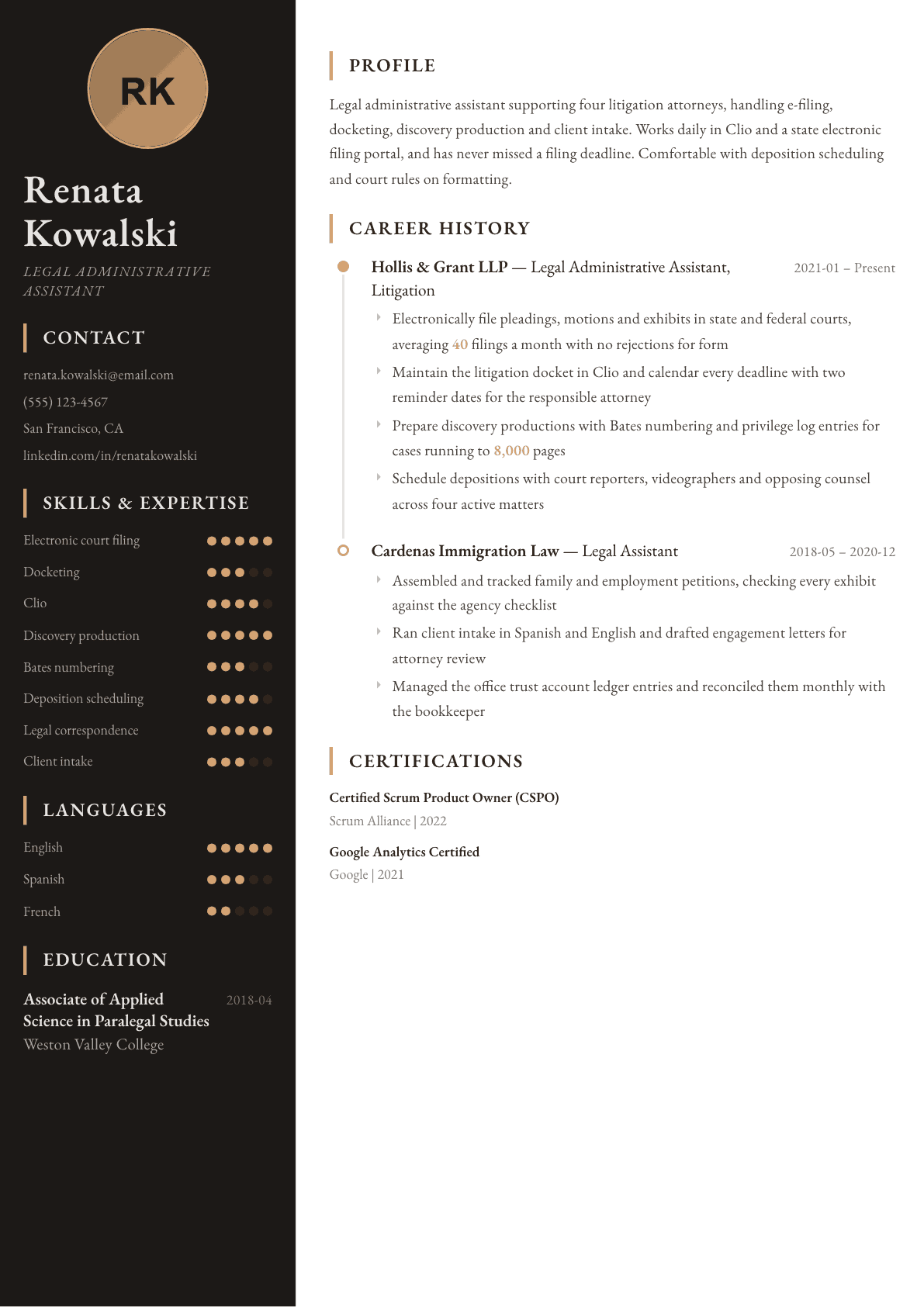
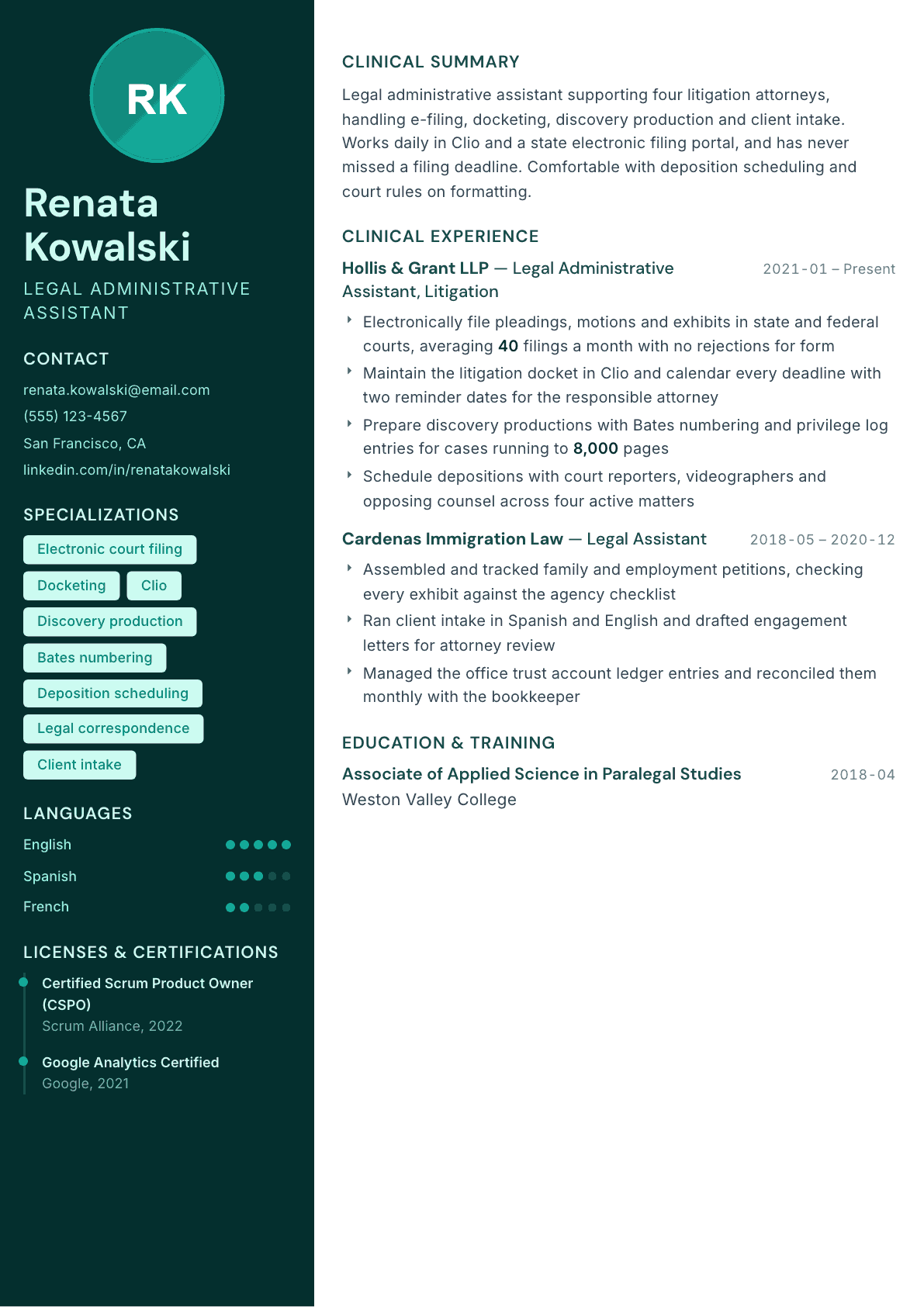
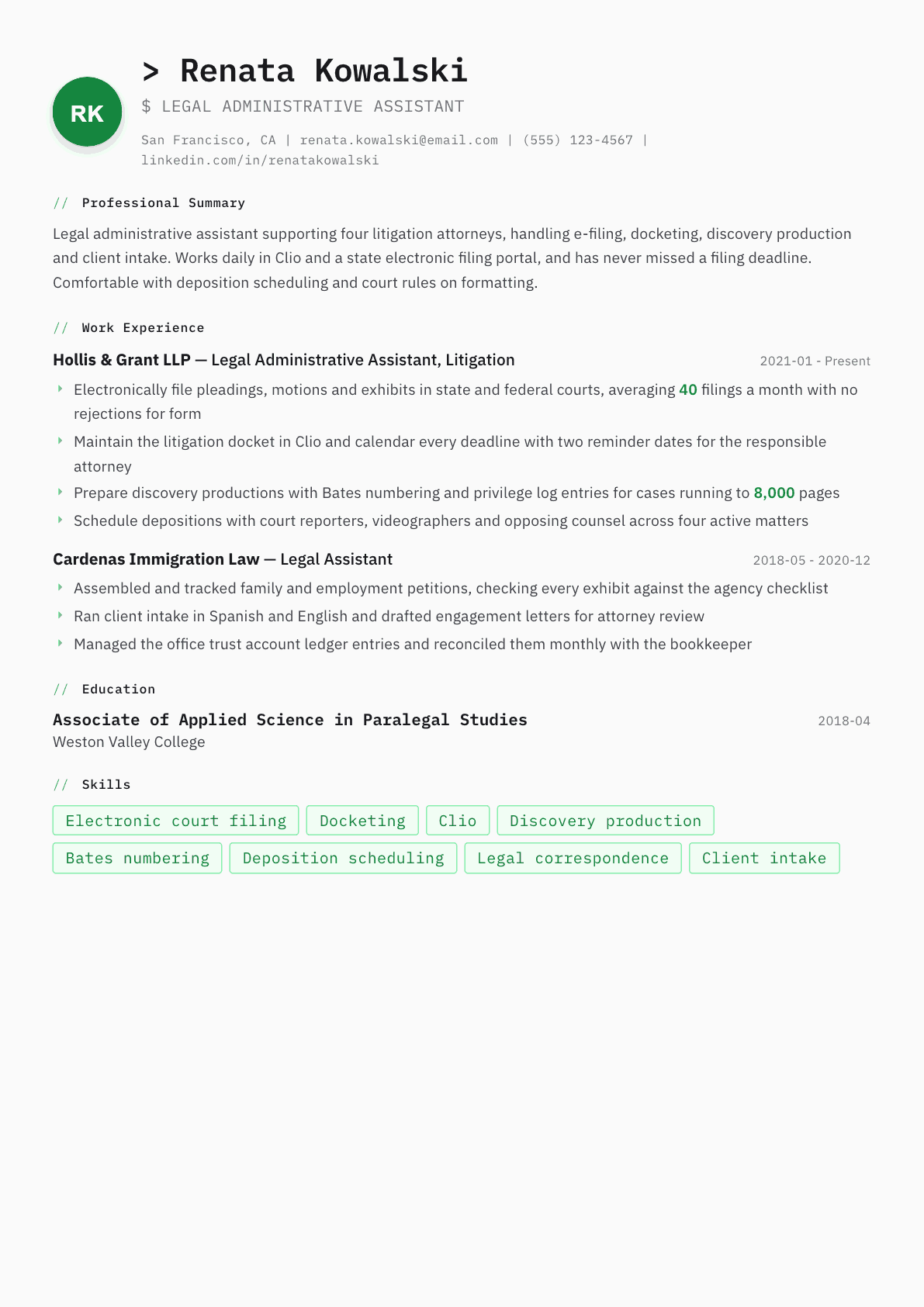
Example Legal Administrative Assistant summary
Legal administrative assistant with six years in litigation and immigration practice. Files in state and federal courts through electronic portals, maintains the docket in Clio with layered deadline reminders, and prepares discovery productions with Bates numbering and privilege logs. Runs client intake in English and Spanish. Seeking a litigation support role in a firm where filing accuracy carries real weight.
Skills to list on a Legal Administrative Assistant resume
- Electronic court filing
- Docketing and calendaring
- Clio
- Discovery production
- Bates numbering
- Privilege logs
- Deposition scheduling
- Legal correspondence
- Client intake
- Court rules compliance
- Trust account records
- Document redaction
- Transcription of attorney dictation
- Case file organization
What actually gets this resume read
- Name the practice area first: litigation, immigration, real estate, corporate. Firms hire for the area, not for general admin.
- State the courts you file in and the portals you use, because e-filing competence is the first thing a firm checks.
- Show docketing as deadline control with reminder rules, since a blown deadline is the risk the hiring attorney fears.
- List legal software by name: Clio, MyCase, Relativity, iManage, ProLaw. Generic phrasing loses these keyword matches.
- Mention Bates numbering, privilege logs and redaction if you have done discovery work at any volume.
- Include second languages used with clients, as intake in another language is a direct billing advantage for many firms.
How to write a legal administrative assistant resume
Law firms hire by practice area first. A litigation secretary and a real estate assistant do almost nothing in common day to day, so a resume that opens with general administrative support gets read as neither. Put the practice area in the title line and the summary, and let the rest of the document argue for it.
The second thing the hiring attorney checks is whether you can file without supervision. Electronic filing in state and federal courts, docketing with layered deadline reminders, and knowledge of local rules on formatting and exhibits are the competencies that stop a matter going wrong. A blown deadline is the risk that keeps a supervising attorney awake, so the resume that shows deadline control gets the call.
This guide covers how to name courts and portals, how to describe discovery production at volume, which legal software to list, and how to handle a move between practice areas without looking like a beginner again.
Format: one page early, two once you have real docket history
Use a single column, reverse-chronological layout with month and year dates. Firms are conservative readers and many still run resumes through parsing software that mangles columns, so keep the design plain and put the practice area, the courts and the software where a scanning eye finds them in the first ten seconds.
Group your experience by firm and put the practice group in the title line: Legal Administrative Assistant, Litigation reads far better than the same job listed without the group. If you have supported several practice areas at one firm, list them in a single line under the employer before the bullets start.
- Header: name, city and state, phone, email, and a line for notary commission if you hold one.
- Section order: summary, practice areas and courts, experience, legal software, education and certifications.
- Give attorney count supported per role, because four litigators is a different load from one.
Summary: practice area, attorneys supported, filing record
Name the practice area, how many attorneys you support and at what seniority, and the systems you work in daily. Then state your filing record plainly. A line saying no filings rejected for form is the single most persuasive sentence a legal administrative assistant can write, provided it is true.
If you speak a second language used with clients, put it in the summary rather than at the bottom. Intake in another language is a direct advantage for firms in immigration, family and personal injury work, and it is often the reason one resume gets pulled from the stack.
Filing, docketing and deadline control
Say which courts you file in, state and federal, and name the electronic filing portals you use. Give a monthly filing volume and note whether your filings have been rejected for form. Attorneys read a rejection as lost time and a possible missed deadline, so a clean record is worth stating.
Then describe docketing as a system rather than a task. Explain how a deadline enters the calendar, how many reminder dates you set, who receives them, and how you handle a date that moves because an order changed the schedule. Layered reminders with a named responsible attorney is what a firm wants to hear, because it survives a single person being out of the office.
Mention local rules where you know them: page limits, exhibit labeling, courtesy copies, chambers requirements and signature blocks. Those details are why an experienced legal assistant is worth more than a fast typist.
Discovery, documents and client intake
Discovery production is where volume matters. Give the page counts you have worked with, name Bates numbering, privilege log preparation and redaction, and say whether you handled productions in a review platform or from a document management system. A production running to several thousand pages with a privilege log attached is a credential in litigation support.
Client intake belongs on the resume too: how you take the first call, what you check for conflicts, whether you draft the engagement letter for attorney review, and how the new matter gets opened in the case management system. Firms hire for the whole path from call to open file, not just the middle of it.
Include trust account work carefully. Recording ledger entries and reconciling with the bookkeeper is a legitimate duty to list, and it signals that you understand why client funds are handled differently from everything else in the office.
Legal software and the keyword pass
Name every legal tool you have used, spelled as the vendor spells it: Clio, MyCase, ProLaw, iManage, NetDocuments, Relativity, and the electronic filing portal for your state. Then the general tools: Microsoft Word with styles and tables of authorities, Adobe Acrobat for Bates numbering and redaction, and Outlook.
Add the vocabulary a legal posting is written in, used once in a bullet and once in the skills list: pleadings, motions, discovery, depositions, calendaring, conflicts check, engagement letter, court rules compliance. That vocabulary is what a screener matches on before an attorney ever sees the file.
Legal Administrative Assistant resume summary examples
Paralegal studies graduate
Paralegal studies graduate with an office placement in a two-attorney family law practice, preparing pleadings for review, organizing exhibits and running the conflicts check on new matters. Trained on a case management system and a state electronic filing portal. Seeking a litigation support role in a firm with structured mentoring.
Four years in litigation
Legal administrative assistant supporting four litigation attorneys, filing pleadings and motions in state and federal courts at around 40 filings a month with no rejections for form. Maintains the docket in Clio with two reminder dates per deadline and prepares discovery productions with Bates numbering and privilege logs.
Senior legal assistant
Senior legal administrative assistant with nine years across litigation and immigration practice, running docket control for two attorney teams and coordinating depositions with court reporters and opposing counsel. Handles productions running to thousands of pages, and takes client intake in English and Spanish.
Work experience bullets: before and after
Before: Filed documents with the court.
After: Electronically filed pleadings, motions and exhibits in state and federal courts, averaging 40 filings a month with no rejections for form.
Court level, document types, volume and the clean record are exactly what a supervising attorney screens for.
Before: Kept track of deadlines.
After: Maintained the litigation docket in Clio and calendared every deadline with two reminder dates routed to the responsible attorney and the practice group lead.
A named system and a layered reminder rule prove deadline control that survives someone being out of the office.
Before: Assisted with discovery.
After: Prepared discovery productions with Bates numbering, redactions and privilege log entries for matters running to 8,000 pages.
Page volume and the specific production steps distinguish real litigation support from general document handling.
Before: Scheduled depositions.
After: Scheduled depositions across four active matters, coordinating court reporters, videographers, opposing counsel and interpreter bookings, and issued the notices for attorney signature.
Naming every party to coordinate shows the actual difficulty of the task rather than a calendar entry.
Before: Talked to clients and opened files.
After: Ran client intake in Spanish and English, completed the conflicts check, opened the matter in the case management system and drafted engagement letters for attorney review.
The full path from first call to open matter is a firm process, and covering it end to end is what gets hired.
Hard skills
- Electronic court filing
- Docketing and calendaring
- Court rules compliance
- Clio
- Discovery production
- Bates numbering
- Privilege logs
- Document redaction
- Deposition scheduling
- Client intake and conflicts checks
- Legal correspondence drafting
- Trust account ledger entries
- Microsoft Word styles and tables of authorities
- Adobe Acrobat
Soft skills
- Deadline discipline
- Accuracy under filing pressure
- Client-facing composure
- Discretion with case material
- Following instructions precisely
- Working with several attorneys at once
Certifications worth listing
- Accredited Legal Professional (ALP) (NALS, the association for legal professionals)
- Certified Legal Professional (CLP/PLS) (NALS, the association for legal professionals)
- Professional Paralegal (PP) (NALS, the association for legal professionals)
- Certified Paralegal (CP) (National Association of Legal Assistants)
- Notary Public commission (State commissioning authority)
Mistakes that cost legal administrative assistant candidates the interview
- Opening with general administrative support instead of the practice area the firm is actually hiring for.
- Leaving out the courts and the electronic filing portal, which is the first competence a litigation firm verifies.
- Describing docketing as calendaring deadlines with no reminder rule, no owner and no system named.
- Listing legal software generically as case management software rather than by the vendor name in the posting.
- Omitting page volumes on discovery work, so a reader cannot tell a two-box case from a production of thousands of pages.
- Claiming legal advice or drafting authority you did not have, which reads as a compliance risk to any hiring attorney.
Legal Administrative Assistant resume questions
Do I need a paralegal certificate to be a legal administrative assistant?
No. Many firms hire on office experience and train the legal specifics, though a paralegal studies associate degree or an accredited legal professional credential makes an application competitive. If you hold one, put it near the top with the issuing body written out in full.
How do I move from one practice area to another?
Lead with the parts that transfer: filing, docketing, client intake, document production and court rules. Then state the target area in your summary and name any exposure you already have to it, even a few matters, so the reader sees a short learning curve rather than a fresh start.
Should I list the number of attorneys I support?
Yes, and give their seniority where it helps. Supporting four litigation attorneys signals a heavier docket than supporting one, and it tells the firm whether you can absorb their team. Add the practice group so the number has context.
Is it worth mentioning that no filing was ever rejected?
It is one of the strongest lines you can write, because rejected filings cost billable time and can threaten a deadline. Only state it if it is accurate, and pair it with the monthly filing volume so the claim carries weight.
How do I describe confidential case work on a resume?
Describe the type of matter and the task, never the client or the facts. Employment litigation, immigration petitions or commercial disputes tell a reader what you have handled, and the ethical restraint of leaving names out is itself a point in your favor.
Related resume examples
- Legal Secretary Resume example
- Paralegal Resume example
- Law Clerk Resume example
- Legal Receptionist Resume example
- Court Clerk Resume example
- File Clerk Resume example