Logistics Specialist Resume Examples: what gets the call
Write a Logistics Specialist Resume That Covers the Whole Order
By Mustafa Tarabya, founder of CVBooster · Published · Updated
Logistics specialist resume example with carrier, documentation and order flow keywords, plus a writing guide for logistics and distribution job applications.
Sample resumes for a logistics specialist
The same logistics specialist content laid out in three CVBooster templates, so you can see what the finished document looks like before you write a word.
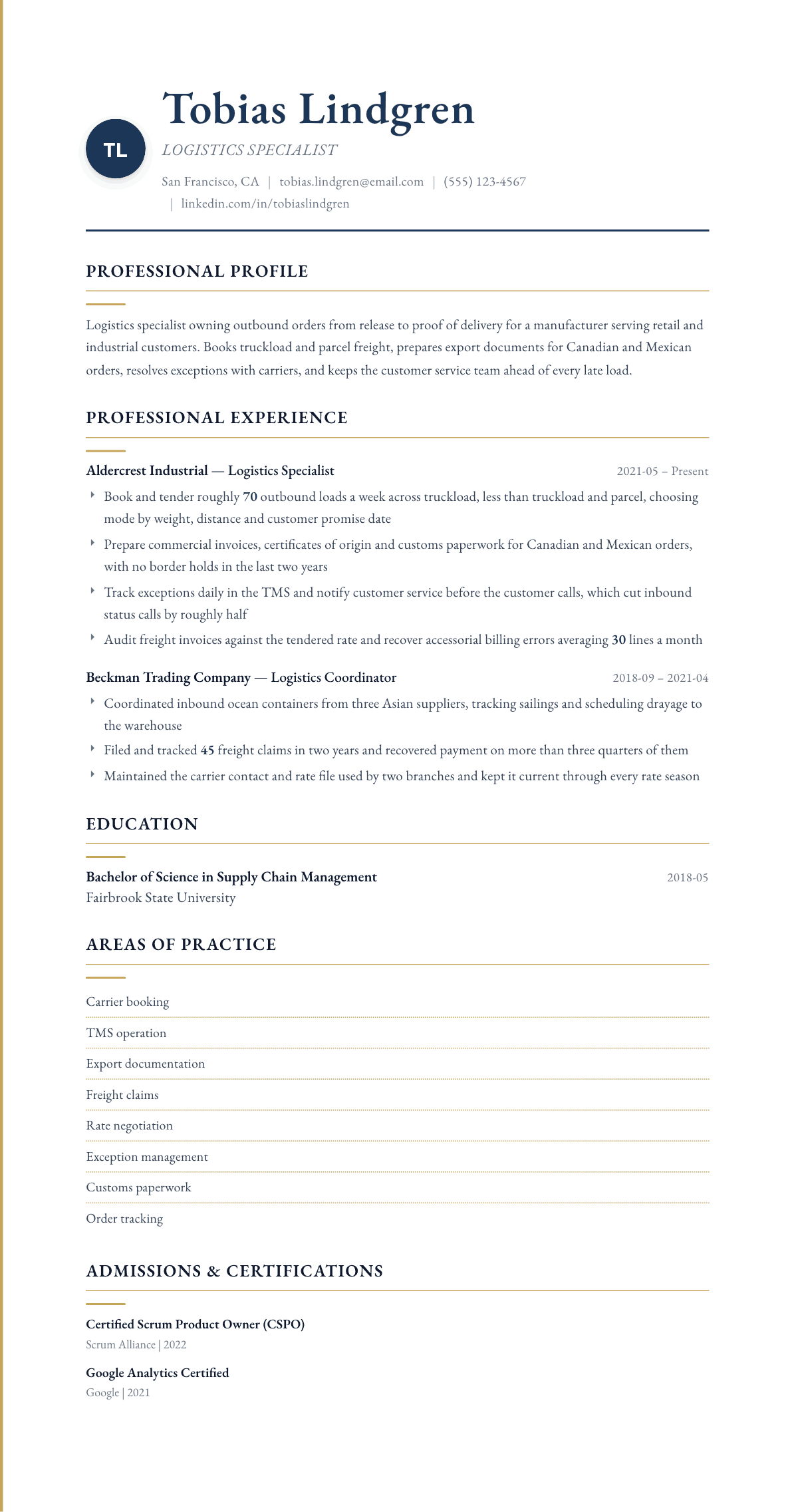
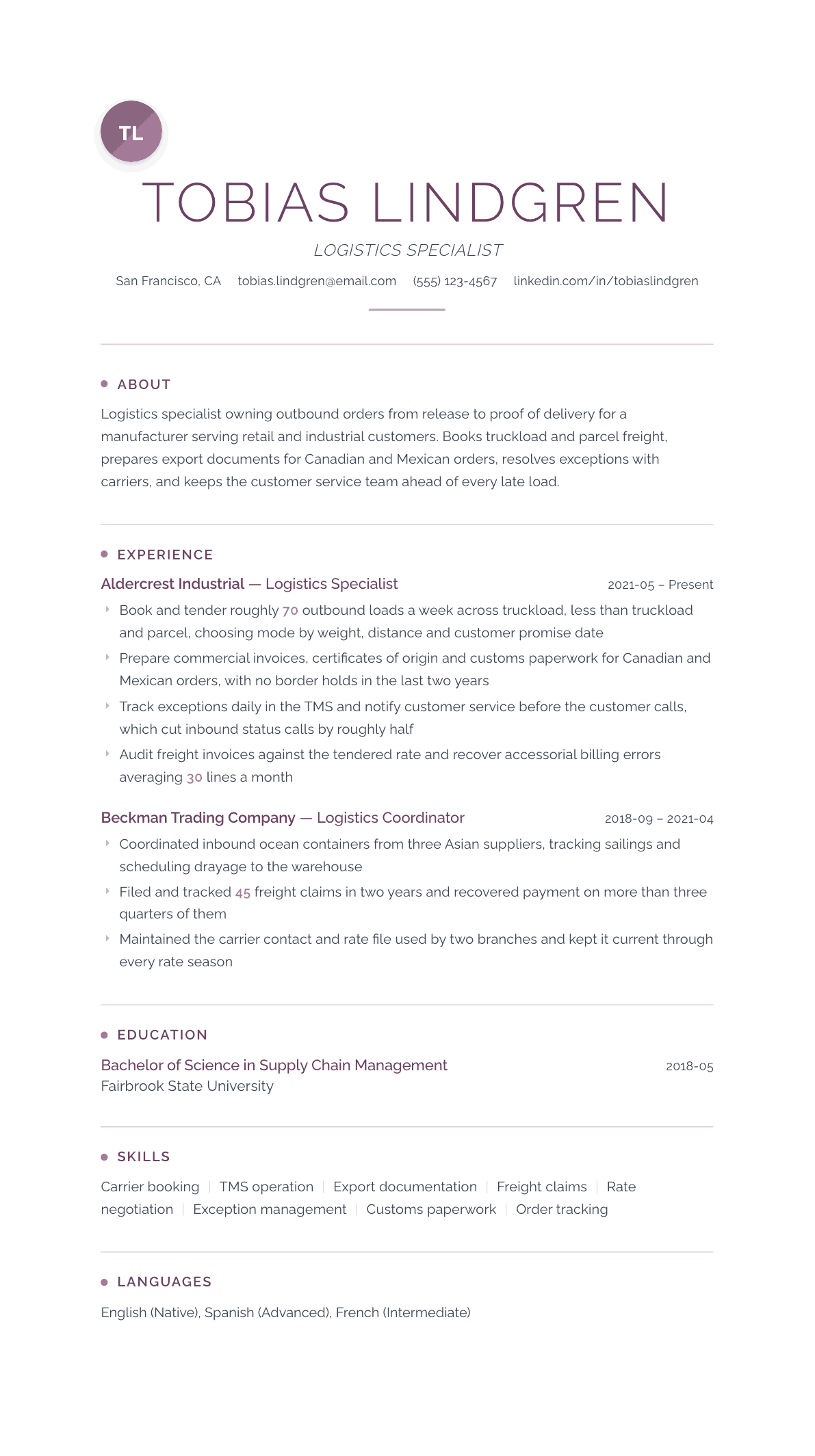
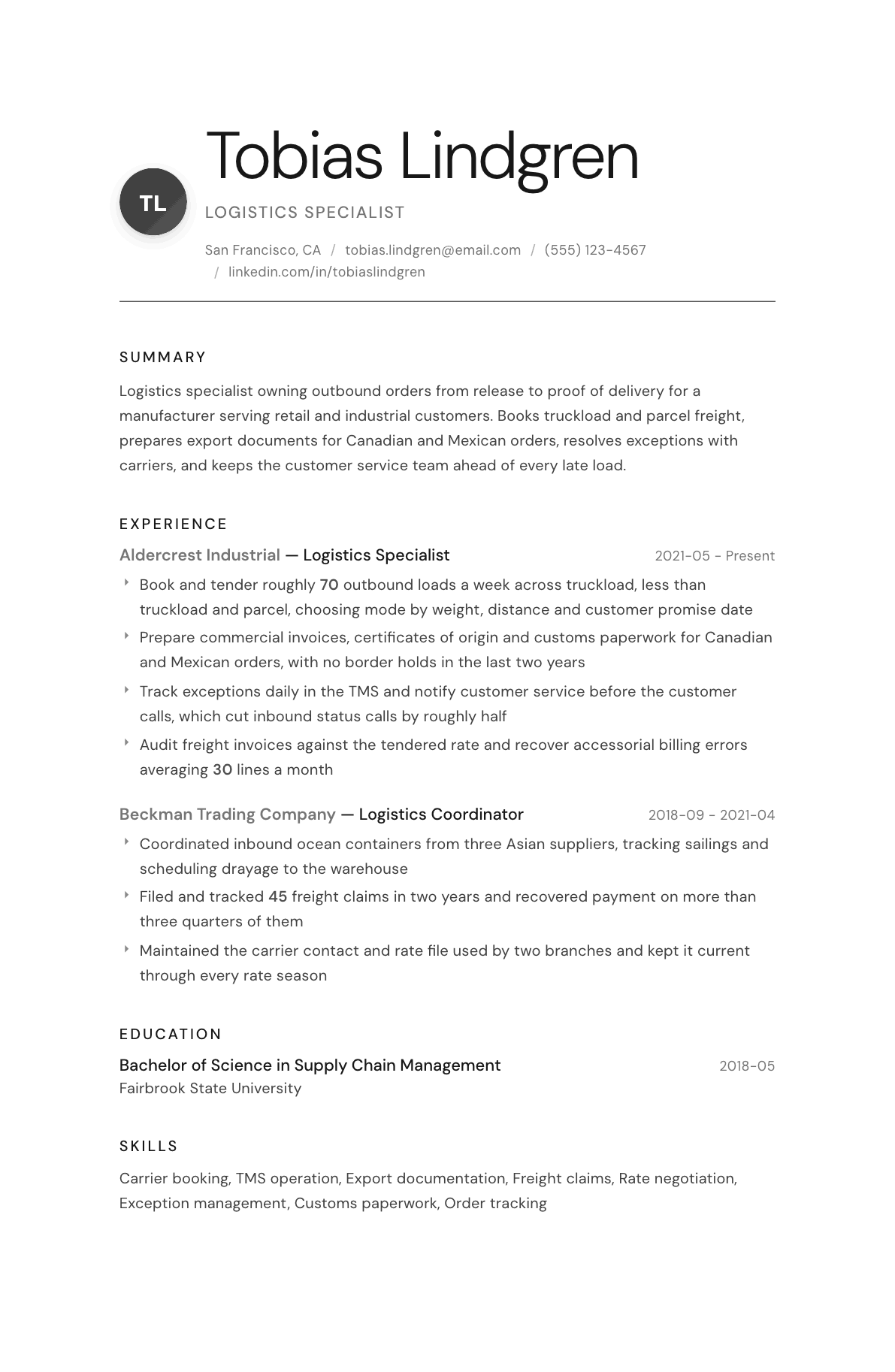
Example Logistics Specialist summary
Logistics specialist with six years moving outbound freight for industrial manufacturers, tendering about seventy loads a week across truckload, less than truckload and parcel. Prepares commercial invoices and certificates of origin for Canadian and Mexican orders, works exceptions in the TMS before customers call, and recovers accessorial billing errors every month. Looking for a logistics supervisor role with carrier ownership.
Skills to list on a Logistics Specialist resume
- Carrier booking
- Transportation management systems
- Freight quoting
- Bill of lading preparation
- Export documentation
- Customs compliance
- Freight claims
- Exception management
- Rate negotiation
- Order tracking
- ERP order entry
- Vendor communication
- Freight invoice audit
- Inventory coordination
What actually gets this resume read
- Define the slice of the order you own, because a logistics specialist can mean booking, documentation, tracking or all three.
- Name the modes you have actually tendered: truckload, less than truckload, parcel, intermodal, ocean or air.
- If you handle cross border work, list the documents by name so a customs manager can see you have touched real paperwork.
- Show exception handling with a result, since the job is judged on how fast a problem load is fixed and communicated.
- Give the volume you carry each week in loads or orders, so a hiring manager can size you against their own operation.
- Keep certifications and system names in a block near the top and mirror the exact wording used in the posting.
How to write a logistics specialist resume
Logistics specialist is a title employers use for very different jobs. At a manufacturer it usually means owning outbound orders from release to proof of delivery. At a freight forwarder it means documentation and customs. In a government or defense setting it means property accountability and requisitions. Because the title is elastic, the first job of the resume is to say which version of it you have done, in the first two lines.
The second job is proof of paperwork discipline. This role lives on documents that create legal and financial exposure: bills of lading, commercial invoices, certificates of origin, packing lists, claims and rate confirmations. A hiring manager is scanning for someone who has handled those without creating a border hold or an unpaid claim.
This guide covers how to define your slice of the order flow, how to write cross border and exception work so it is believed, three summaries from a first coordinator seat to a senior specialist, before and after bullets, and the questions specialists ask when a posting mixes domestic freight with international documentation.
Format: one page, mode and document blocks visible early
One page for most specialists, two only when you carry international and domestic scope across several sites. Reverse chronological, single column, no columns or graphics. The reader is often a logistics supervisor working through a stack between carrier calls.
Include two short blocks under the summary: modes you have tendered, and documents you have prepared. Those two lines answer more screening questions than anything else on the page, because they tell a manager whether you can cover his desk without supervision.
- Header: name, city and state, phone, email.
- Modes block: truckload, less than truckload, parcel, intermodal, ocean, air.
- Documents block: bill of lading, commercial invoice, certificate of origin, packing list, claims.
Summary: what you own, at what volume, across which borders
Name the span of the order you control. Booking only, documentation only, tracking only, or all of it from release through proof of delivery. Then the volume in loads or orders a week, the modes, and whether the freight crosses a border. A specialist who writes experienced logistics professional with strong attention to detail has said nothing a manager can screen on. One who writes tenders roughly seventy outbound loads a week and prepares customs paperwork for Canadian and Mexican orders has answered the screen.
If your experience is inbound rather than outbound, say so plainly. Managing supplier containers and drayage is a real skill set and pretending it is outbound customer freight only sets up a bad first week.
Experience: booking, documents, exceptions, and money recovered
Build each job around four threads. Booking is how you choose mode and carrier against a promise date and a cost target. Documentation is what you prepare, for which destinations, and under whose review. Exceptions are what you do when a pickup fails, a load is refused, or freight is damaged. Recovery is claims filed, accessorial charges disputed and invoice errors corrected.
The exception thread is where most specialists undersell themselves. Every operation has bad days, and a manager is buying the person who works the problem and tells customer service before the customer calls. Write one bullet that shows the whole loop from detection to notification to root cause logged.
For international work, name the documents rather than saying handled international paperwork. Commercial invoice, packing list, certificate of origin, and the coordination with a customs broker are concrete and checkable. If you have worked under a trade agreement or a duty program, describe your part carefully and do not overstate authority you did not hold.
- Volume: loads or orders a week, and the number of sites you cover.
- Modes and lanes: domestic, cross border, ocean import, and typical destinations.
- Documents: what you prepare, what you review, and who signs.
- Recovery: claims filed and settled, accessorial disputes, invoice audit results.
Systems: the transportation stack and the order stack
This role touches two system families. One is the transportation side, where you tender loads, track events and pull rates. The other is the order side in an enterprise system, where the order lives, the delivery is created and the invoice is triggered. Name both and say what you do in each, because a specialist who only knows one will need cover on half the job.
Add the customer portals if you use them. Retail vendor portals, carrier booking sites and broker platforms are day to day tools, and the manager reading your resume has a specific list of them in mind.
Keywords logistics postings repeat
The steady vocabulary is carrier tendering, bill of lading, freight quoting, less than truckload, truckload, drayage, customs clearance, certificate of origin, freight claim, accessorial, proof of delivery, exception management, and the system names. Put each phrase where it is doing work in a bullet. A document named next to a volume and a destination reads as experience, and the same word in a list does not.
Logistics Specialist resume summary examples
First logistics seat
Logistics coordinator with a year supporting outbound orders, preparing bills of lading, booking less than truckload pickups and tracking deliveries to proof of delivery. Comfortable in an enterprise order system and a carrier portal, and moving into a full logistics specialist role with carrier ownership.
Five years in
Logistics specialist owning outbound freight for two manufacturing sites, tendering about seventy loads a week across truckload, less than truckload and parcel. Prepares commercial invoices and certificates of origin for Canadian and Mexican orders, and works exceptions before customer service hears about them.
Senior specialist
Senior logistics specialist covering domestic outbound and ocean import for a distributor with three warehouses. Manages the carrier base and rate file, owns the freight claim process end to end, and trains two coordinators on documentation standards and exception handling.
Work experience bullets: before and after
Before: Booked freight with carriers.
After: Booked and tendered roughly 70 outbound loads a week across truckload, less than truckload and parcel, choosing mode by weight, distance and customer promise date.
Volume plus the mode decision rule shows judgment rather than order taking.
Before: Handled international paperwork.
After: Prepared commercial invoices, packing lists and certificates of origin for Canadian and Mexican orders, with no border holds across two years of volume.
Named documents and a clean outcome make the customs claim verifiable instead of vague.
Before: Solved problems with late shipments.
After: Worked daily exceptions in the transportation system and notified customer service before the customer called, which cut inbound status calls by roughly half.
The loop from detection to notification, plus the result, is the part a manager is actually buying.
Before: Filed claims when freight was damaged.
After: Filed and tracked 45 freight claims over two years with photo evidence and delivery receipt notations, recovering payment on more than three quarters of them.
Volume, evidence practice and recovery rate turn a task into a demonstrated result.
Before: Checked freight bills.
After: Audited freight invoices against the tendered rate and recovered accessorial billing errors averaging 30 lines a month, then raised the two most frequent causes with the carriers.
Recovery volume and the follow up show prevention rather than a monthly chore.
Hard skills
- Carrier booking and tendering
- Transportation management systems
- Bill of lading preparation
- Freight quoting and rate comparison
- Export documentation
- Customs coordination
- Freight claims
- Freight invoice audit
- ERP order and delivery processing
- Exception management
- Retail vendor portals
- Proof of delivery tracking
Soft skills
- Carrier negotiation
- Clear status communication
- Working several open problems at once
- Documentation accuracy
- Coordination with customer service
- Follow through on open claims
Certifications worth listing
- Certified in Logistics, Transportation and Distribution (CLTD) (Association for Supply Chain Management)
- Certified Supply Chain Professional (CSCP) (Association for Supply Chain Management)
- Certified Customs Specialist (CCS) (National Customs Brokers and Forwarders Association of America)
- Hazardous Materials Employee Training (Employer program under Department of Transportation rules)
Mistakes that cost logistics specialist candidates the interview
- Leaving the reader guessing which version of the title you held, when the role differs completely between a plant and a forwarder.
- Writing handled logistics operations instead of naming the modes you tendered and the documents you prepared.
- Omitting weekly volume, which makes it impossible to tell a two load a day desk from a national outbound seat.
- Skipping the claims and invoice audit work, which is the clearest money result the role produces.
- Overstating customs authority when a broker did the filing, since that unravels in the first technical question.
- Listing systems in a block while no bullet shows a single transaction you performed in one of them.
Logistics Specialist resume questions
What is the difference between a logistics specialist and a logistics coordinator?
Coordinator usually means executing a defined process such as booking and tracking. Specialist implies ownership of a piece of the operation including carrier relationships, documentation standards or claims. Titles vary by employer, so compare the duty lists rather than assuming a hierarchy.
Do I need customs knowledge for a domestic logistics specialist role?
Not for purely domestic freight, but Canadian and Mexican volume shows up in more postings than people expect. If you have prepared commercial invoices or certificates of origin, list them, because that experience separates you from otherwise similar domestic candidates.
How do I show that I can negotiate with carriers?
Describe a spot market situation you handled: the lane, how many quotes you gathered, what you paid against the benchmark, and whether the load moved on time. A specific event proves negotiation far better than the word negotiation in a skills list.
Is a supply chain degree required for this job?
Many postings ask for one and many accept experience instead, particularly at manufacturers hiring from within. If you have no degree, put certifications and system experience high on the page and let volume, documents and claim results carry the rest.
How should I handle a resume when my employer had no formal transportation system?
Say what you used instead, whether that was carrier portals, spreadsheets and email confirmations. Then describe the process you built or maintained. Managers understand small operations and care more about whether your habits will survive inside a real system.
Related resume examples
- Logistics Coordinator Resume example
- Freight Broker Resume example
- Freight Forwarder Resume example
- Import Coordinator Resume example
- Supply Chain Coordinator Resume example
- Shipping and Receiving Clerk Resume example