Soft Skills for a Resume: Communication Examples and More
By Mustafa Tarabya, founder of CVBooster · Published · Updated
14 min read
Soft skills belong on your resume as evidence, not as a list. Write "communication" in a skills box and you have made a claim nobody can check. Describe the handover you ran every Monday and you have made the same claim in a form that survives an interview. The communication skill examples further down give six complete bullet sets you can adapt.
That is the whole argument, and it changes what you actually do with the page. This article is about the mechanics: which soft skills are worth naming, where each one goes, and what the rewritten line looks like.
What counts as a soft skill?
A soft skill is anything about how you work rather than what you operate. Communication, teamwork, leadership, adaptability, empathy, time management, problem solving. They are real capabilities. The problem is not that they do not exist, it is that the word for them is free.
Compare that with a hard skill, which is checkable by design. If you write Kubernetes on your resume, somebody can ask you a Kubernetes question and find out in ninety seconds. If you write "adaptable", there is no question to ask. That asymmetry is covered from the other side in our piece on hard skills for a resume at hard skills, and the two sections of your resume should be built to different rules because of it.
Why does listing soft skills do so little?
Because nobody lists the opposite. No resume has ever said "poor communicator, avoids teams, resistant to change". When every applicant makes the same claim, the claim stops carrying information, and a reader learns to skip the row entirely.
There is a second cost. A skills section has a budget — a few lines before it stops being scannable. Every adjective you spend that budget on is a named tool, system or certification you did not have room for, and those are the entries a reader is actually hunting. If you want traits such as dependability and composure in the section anyway, our personal skills for resume guide gives the proof line for each one.
How do you turn a soft skill into evidence?
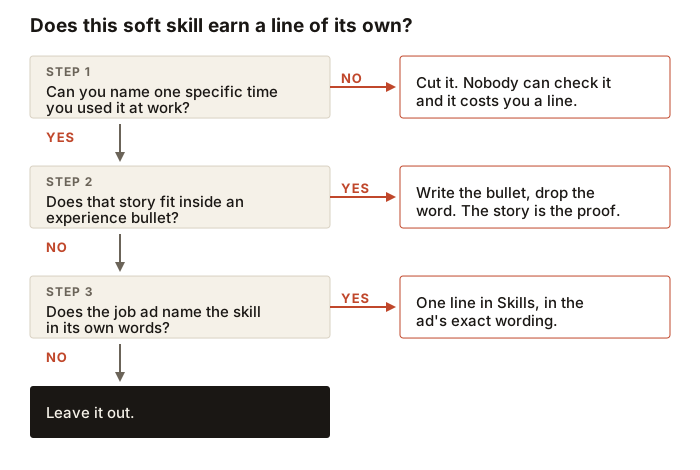
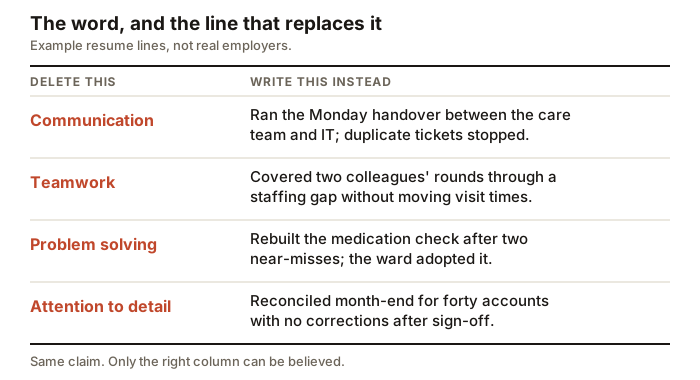
Take the word and ask yourself the follow-up question an interviewer would ask: when? Then write the answer down and throw the word away. The answer is the resume line.
The mechanical version is three parts. What was the situation, what did you specifically do, and what changed as a result. You do not need a dramatic outcome. "The ward adopted it" is a result. "Duplicate tickets stopped" is a result. What you need is something that happened outside your own head.
Tip: Write the bullet first, then check which soft skill it demonstrates. Doing it in that order stops you reaching for the adjective at all, and the bullets come out concrete instead of abstract.
When does a soft skill deserve its own line?
Two cases. The first is when the job ad names it as a requirement in its own words, and the software or the person on the other end is matching against that phrasing. Give them the match, in the ad's wording, and then prove it in a bullet a few centimetres further down. One line, not five.
The second is when the skill has a professional name that means something specific. "De-escalation" is not a synonym for patience — it is a taught technique with a procedure attached. "Facilitation" is a thing you do to a room, on purpose, with an agenda. Those words survive being questioned, which is what separates them from adjectives.
How does an employer actually assess a soft skill?
Knowing the mechanism on the other end tells you what to write. Soft skills are rarely assessed from the resume at all. They are assessed in the interview, through questions that ask for an example, and afterwards through whoever they call about you.
Competency and behavioural interviews are built on the same shape: describe a situation, what you did, what happened. Public sector and large private employers often publish the competency framework they score against, which means the words they will use are printed in the ad itself.
So the resume's job is not to assert the soft skill. It is to put the example on the page early enough that the interviewer asks you about the story you already have prepared, rather than one you have to invent under pressure. A well-chosen bullet is a question you are steering them towards.
The follow-up worth answering here: does that mean soft skills matter less than hard ones? No. It means they are decided later in the process by a different method, and the resume's contribution is to survive to that point and to hand the interviewer good material when you get there.
Which soft skills are actually worth naming?
The ones with a job attached. Use these as prompts for your own memory rather than a menu, and only keep the ones you could describe doing.
- De-escalation and complaint handling — a named technique, common in care, retail and support roles.
- Facilitation and chairing — running a meeting to an agenda and an outcome, not attending one.
- Stakeholder management — translating between people who want different things and do not share vocabulary.
- Onboarding and mentoring — you trained named people into a named role, and they stayed.
- Written documentation — you left something behind that colleagues still use.
- Prioritisation under load — triage rules you applied when there was more work than time.
- Negotiation — with suppliers, patients, tenants or clients, where there was a real position to move.
- Cross-functional coordination — you got two teams that report to different managers to ship one thing.
Notice what these have in common. Each one implies a specific story, so each one invites a question you would enjoy answering. "Hard working" invites nothing.
Six soft skills, rewritten
The general instruction is easy to agree with and hard to apply, so here are six worked pairs. In each one the weak version comes first. All are example resume lines rather than real employers.
Communication. Weak: "Excellent written and verbal communication skills." Rewritten: "Wrote the weekly status note that went to the three department heads, replacing the standing meeting they had all stopped attending."
Leadership. Weak: "Natural leader with strong management potential." Rewritten: "Ran the evening shift of six without a supervisor present, including the rota changes and the close-down checks."
Adaptability. Weak: "Highly adaptable and comfortable with change." Rewritten: "Moved from the returns desk to the stockroom mid-quarter when the team was restructured, and trained the two people who took over returns."
Time management. Weak: "Excellent time management and organisational skills." Rewritten: "Held eleven client accounts to their reporting deadlines through a two-month vacancy on the team, by moving the whole set onto one shared calendar."
Initiative. Weak: "Proactive self-starter who uses initiative." Rewritten: "Noticed the same three questions filling the inbox each Monday, wrote them into the customer-facing FAQ, and the Monday volume dropped."
Conflict resolution. Weak: "Able to handle conflict and difficult personalities." Rewritten: "Mediated the handover dispute between the two care teams, took both versions in writing, and proposed the split that both signed off."
Look at what actually changed. No rewrite claims more than the original did. Each one simply names the situation the claim came from, and by doing that it becomes something the reader can picture and an interviewer can probe. The information was always there — the weak version had just deleted it.
Tip: If a rewrite feels impossible for one of your soft skills, that is useful information rather than a writing problem. It usually means the skill is aspirational rather than demonstrated, and the right move is to cut it and spend the line on something else.
Where do soft skills go if not the skills list?
- Experience bullets. The main home. One bullet per job that is about how you worked, not just what you produced.
- The professional summary. Two or three lines at the top can carry one characterisation of how you operate, if it is specific to this role.
- The cover letter. This is where a short story fits comfortably and where the reader expects tone rather than data.
- The interview. Most soft skill questions are answered from the same material, so preparing the bullets prepares the answers.
- Referees. The strongest evidence of how somebody works comes from somebody who is not them.
Communication skill examples for a resume
Communication skills on a resume are proved by naming what you wrote, said or listened to, who received it, and what happened next. O*NET, the US Department of Labor's occupation database, splits communication into separate skills, including Speaking, "talking to others to convey information effectively", and Writing, "communicating effectively in writing as appropriate for the needs of the audience". Use the kind the job advert asks for. Each example below is a complete set of bullets for one kind of communication, tagged by level.
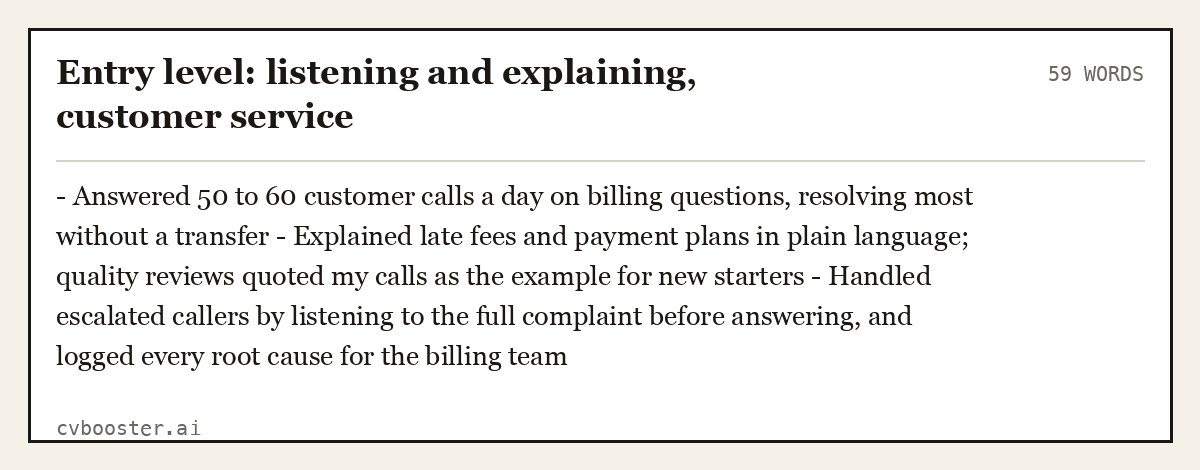
Entry level: listening and explaining, customer service (59 words)
- Answered 50 to 60 customer calls a day on billing questions, resolving most without a transfer - Explained late fees and payment plans in plain language; quality reviews quoted my calls as the example for new starters - Handled escalated callers by listening to the full complaint before answering, and logged every root cause for the billing team
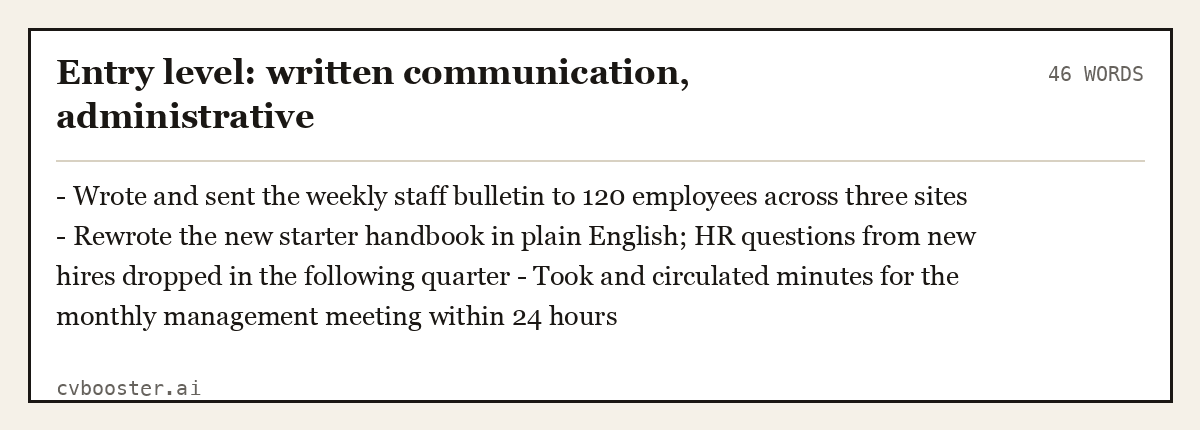
Entry level: written communication, administrative (46 words)
- Wrote and sent the weekly staff bulletin to 120 employees across three sites - Rewrote the new starter handbook in plain English; HR questions from new hires dropped in the following quarter - Took and circulated minutes for the monthly management meeting within 24 hours
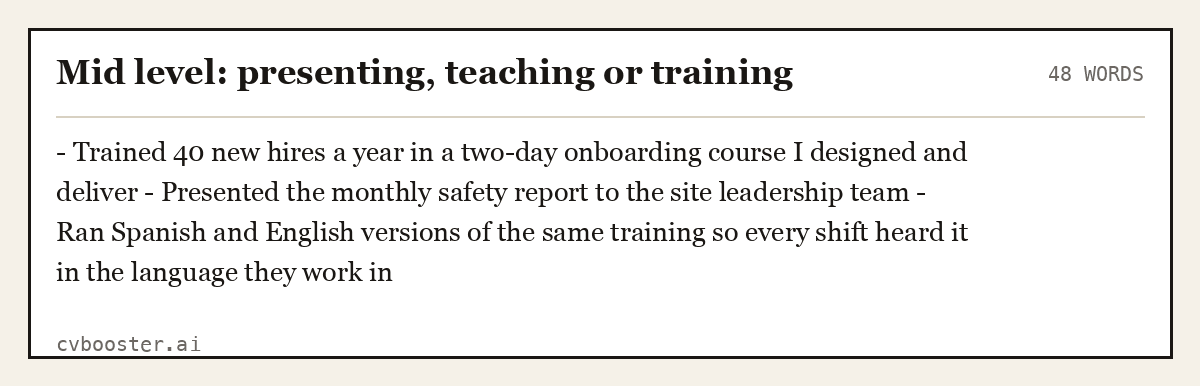
Mid level: presenting, teaching or training (48 words)
- Trained 40 new hires a year in a two-day onboarding course I designed and deliver - Presented the monthly safety report to the site leadership team - Ran Spanish and English versions of the same training so every shift heard it in the language they work in
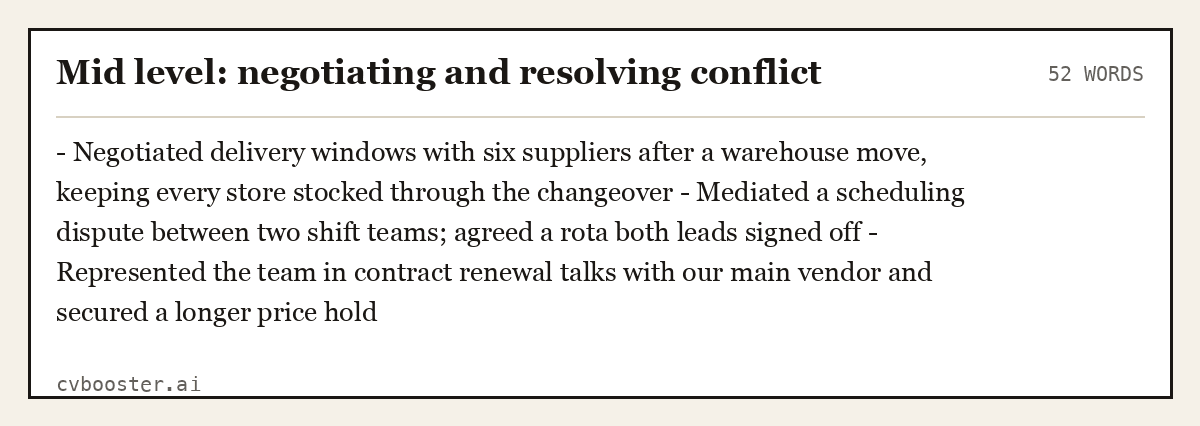
Mid level: negotiating and resolving conflict (52 words)
- Negotiated delivery windows with six suppliers after a warehouse move, keeping every store stocked through the changeover - Mediated a scheduling dispute between two shift teams; agreed a rota both leads signed off - Represented the team in contract renewal talks with our main vendor and secured a longer price hold
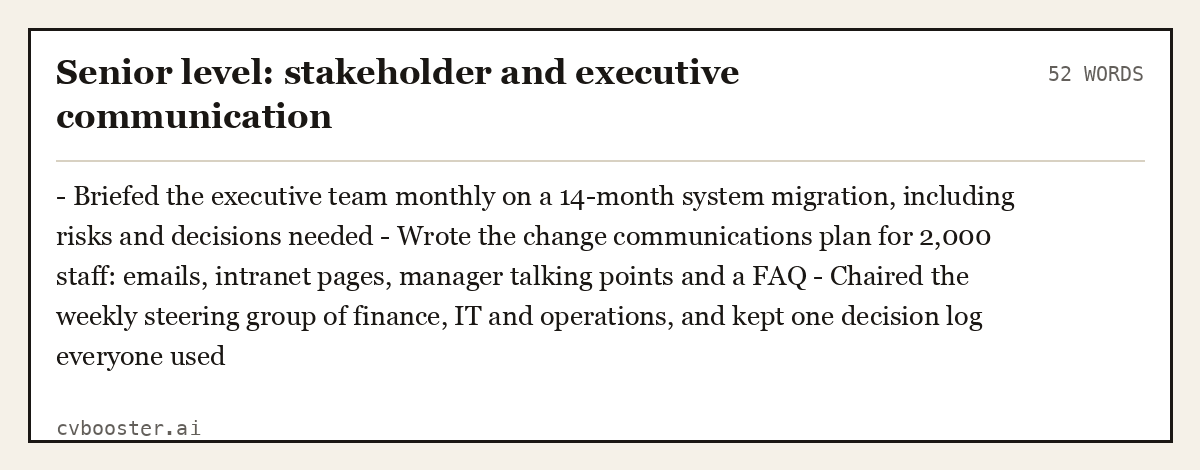
Senior level: stakeholder and executive communication (52 words)
- Briefed the executive team monthly on a 14-month system migration, including risks and decisions needed - Wrote the change communications plan for 2,000 staff: emails, intranet pages, manager talking points and a FAQ - Chaired the weekly steering group of finance, IT and operations, and kept one decision log everyone used
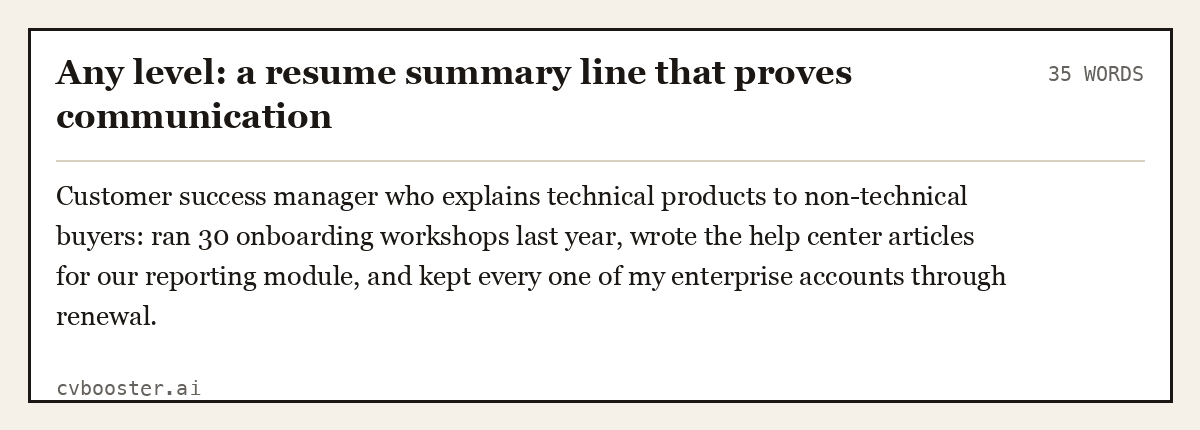
Any level: a resume summary line that proves communication (35 words)
Customer success manager who explains technical products to non-technical buyers: ran 30 onboarding workshops last year, wrote the help center articles for our reporting module, and kept every one of my enterprise accounts through renewal.
O*NET also lists Active Listening as "giving full attention to what other people are saying, taking time to understand the points being made, asking questions as appropriate, and not interrupting at inappropriate times." It is the most underused communication skill on resumes, and the easiest to evidence in customer service, care and sales roles; six complete CV listening skills examples show it from a first job to a manager. Start each bullet with a verb from the resume buzzwords and action verbs list, such as briefed, wrote, explained, negotiated or presented.
What if the ad only asks for "excellent communication skills"?
Then it is telling you something about the job, not about the resume. Read further into the ad and find out what communication means there. Writing patient notes is not the same as presenting to a board, and chasing suppliers is not the same as either.
Once you know which one it is, name that instead. "Wrote the shift handover notes the incoming team worked from" answers an ad about clinical communication. "Presented monthly numbers to the regional managers" answers an ad about upward communication. Both beat the word itself, and both are still a match for it.
What if you have nothing to draw the examples from?
Four situations come up repeatedly, and each has a different source of evidence.
A first resume. You have more material than you think, it just does not sit under a job title. Group projects, a society committee, coaching a junior team, a summer in a family business, moderating a server, organising anything that other people turned up to. Example: "Coordinated the six-person group project, split the work by deadline and merged the final report the night before submission." That is a coordination claim with a situation attached, which is all the stronger version of "team player" ever was.
A career change. Your soft skills are the most transferable thing you own, and they are the reason the change is plausible. Write them in the vocabulary of the field you are moving into rather than the one you are leaving. A nurse's handover discipline is stakeholder communication. A teacher's differentiation is explaining a technical thing to an audience that does not share your background.
A gap in your history. Anything you organised during it is usable if it was real: a care responsibility with logistics attached, a committee, a course you finished, a small business you ran badly and closed. What is not usable is a claim that the gap itself taught you resilience, which is the kind of sentence that reads as filling space.
A self-taught background. The evidence is what you built and who used it, not the hours you put in. "Built and maintained the booking page the club still takes reservations through" carries a great deal about persistence, ownership and dealing with users, and none of those words appear.
Does any of this change for a cover letter?
The material is the same, the length is not. If the soft skill you want to claim is learning quickly, our guide to showing you are a fast learner on a resume has six example lines. A cover letter is where a soft skill story can breathe: three or four sentences with a middle, rather than one compressed line. Pick your single strongest example and tell it properly there rather than distributing four thin ones. Our esthetician cover letter examples show it in a service job: one consultation habit told properly instead of a list of adjectives.
One thing to avoid: repeating a resume bullet word for word. If the reader has both documents open, an identical sentence in each wastes the only extra space you were given.
The words to stop using
- "Hard working", "motivated", "passionate", "driven" — attitude, not skill, and self-assessed.
- "Team player" — the phrase has been used so widely it now reads as filler.
- "Excellent communication skills" as a standalone bullet, unattached to anything you communicated.
- "Detail-oriented" on a resume that contains a typo, which is a self-cancelling claim.
- "Fast learner" — usually a substitute for the experience the ad asked for, and read that way.
A last pass before you send it
- Count the adjectives in your skills section. The target is zero.
- For every soft skill still on the page, point to the bullet that proves it.
- Check the soft skills you kept are the ones this specific ad asked for, not the ones you always list.
- Read each bullet and ask "how would they know?" If there is no answer, rewrite it.
- Make sure the space you freed went to something named and checkable.
Do that and the soft skills do not disappear from your resume — they stop being a row of words and start being the reason your experience section reads like a person rather than a job description. For the wider question of choosing what goes in the section in the first place, and how it should be formatted, start from the main guide at which skills to put on a resume, and pair this with the hard skills article at hard skills so the two halves of your list are built on purpose.
Related articles
- Hard Skills for a Resume: How to List Them
- Skills to Put on a Resume (and What to Cut)
- How to List Skills on a Resume (With 50+ Examples)
- Computer Skills on a Resume: 30 With the Line for Each Level
More articles
- Spanish Resume Template: 6 Examples Written in Spanish
- Special Education Teacher Interview Questions: 12 Answers
- Resume for Sports: 6 Athletic and Sports Job Resumes
Looking for a worked example for your job title? Browse the resume examples by job title.