Inventory Control Specialist Resume Examples: free score
Build an Inventory Control Specialist Resume That Proves Accuracy
By Mustafa Tarabya, founder of CVBooster · Published · Updated
Inventory control specialist resume example with cycle count, WMS and variance research keywords, plus a writing guide for warehouse inventory jobs.
Sample resumes for a inventory control specialist
The same inventory control specialist content laid out in three CVBooster templates, so you can see what the finished document looks like before you write a word.
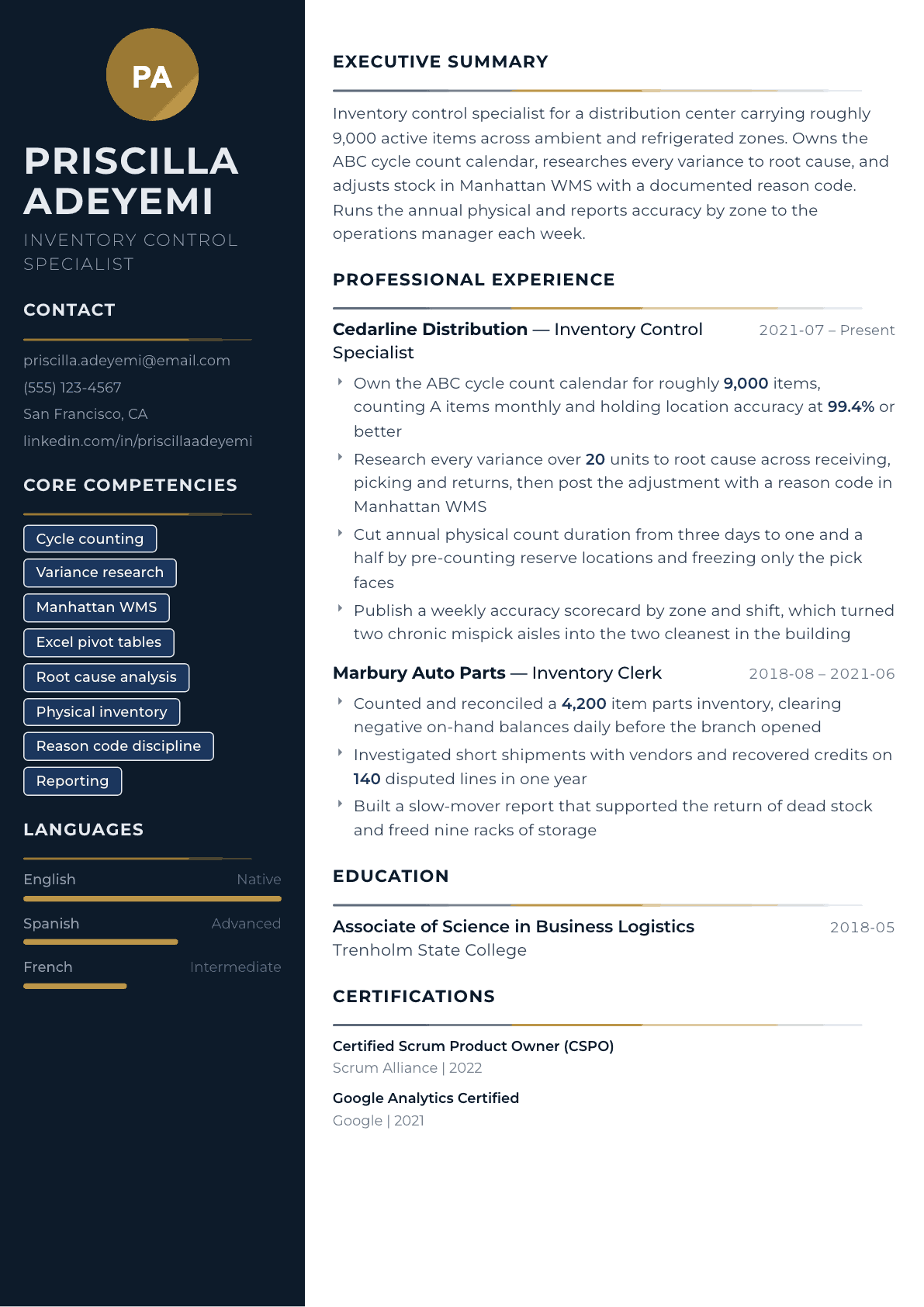
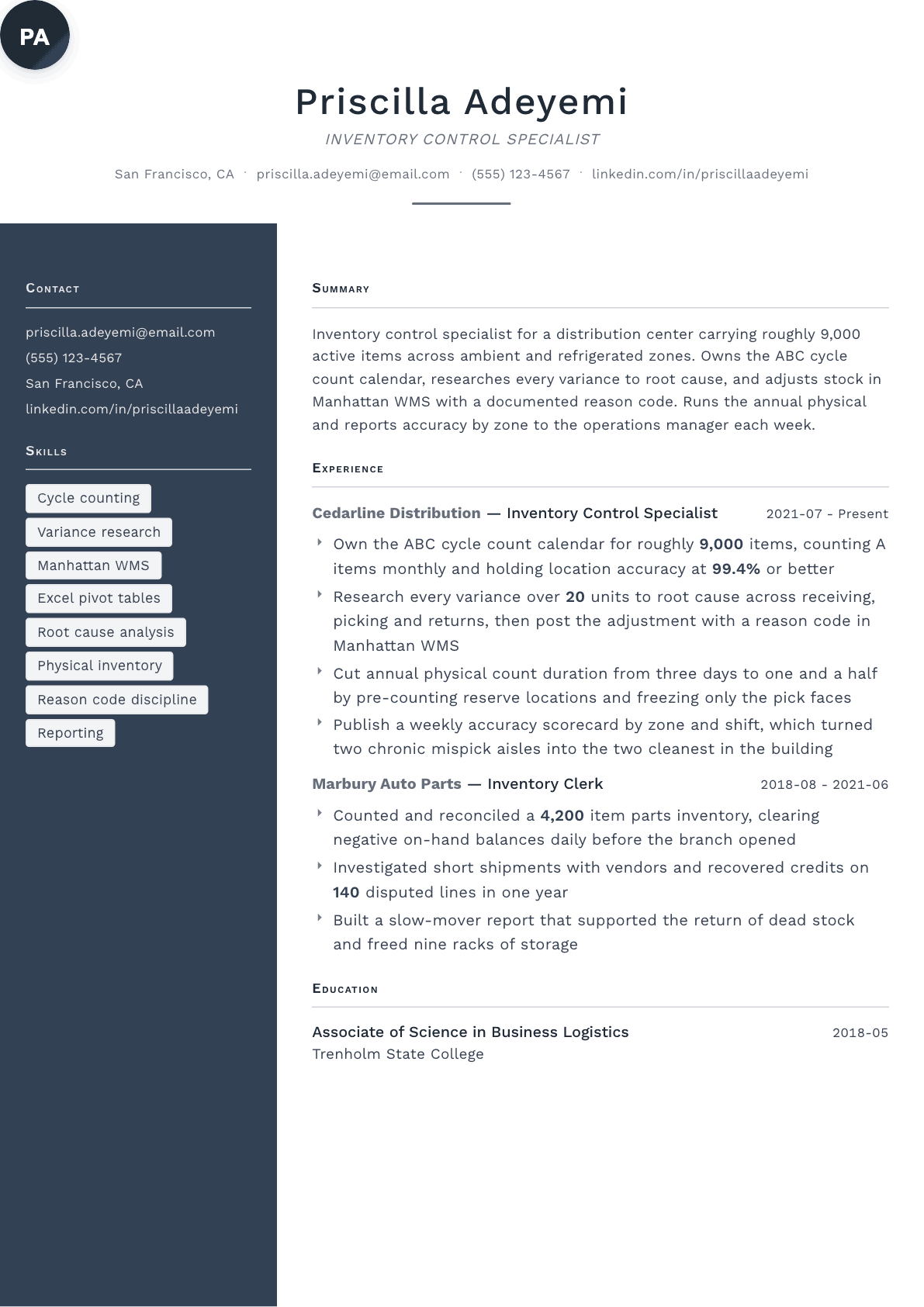
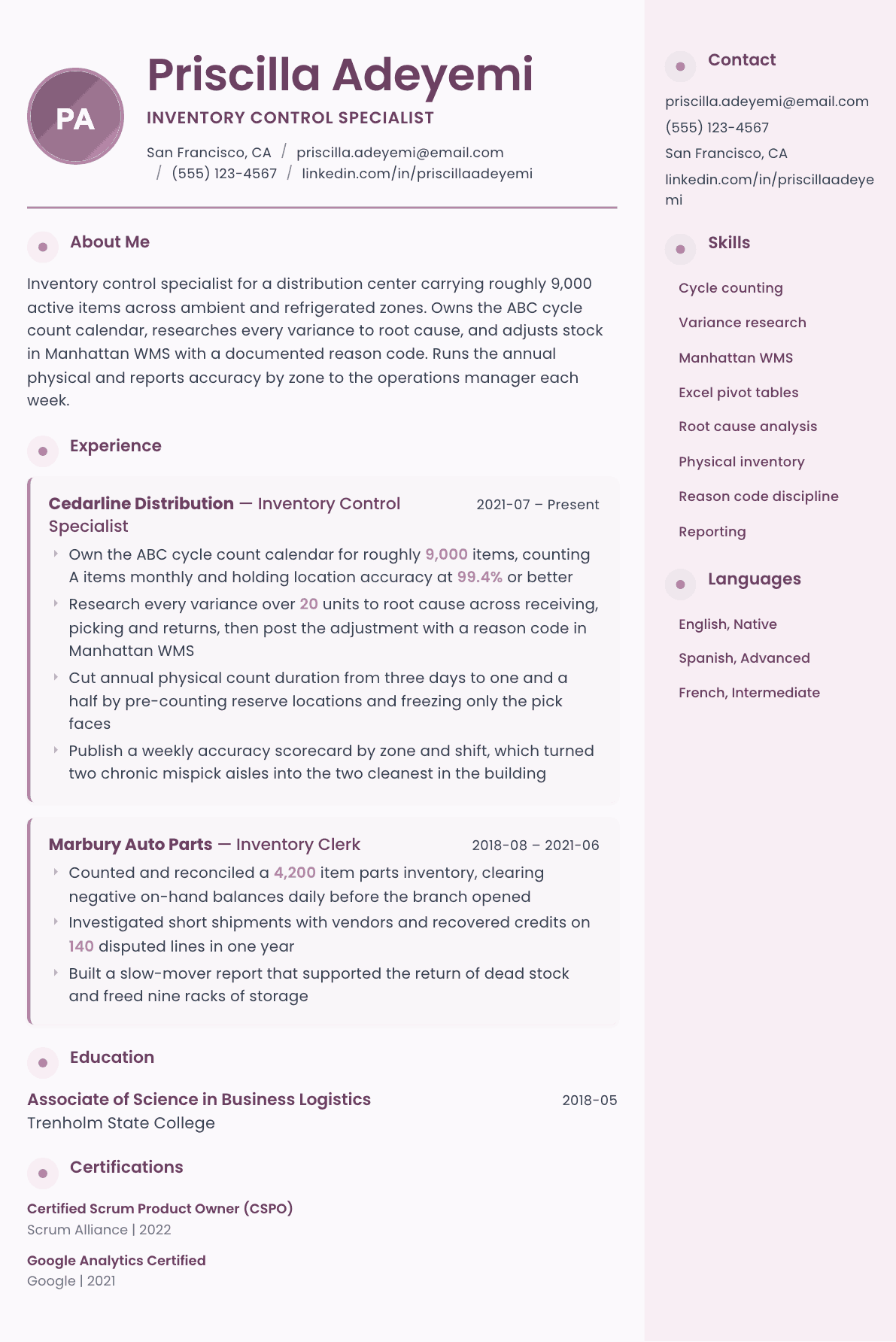
Example Inventory Control Specialist summary
Inventory control specialist with six years in distribution, holding location accuracy above 99% on a catalog of roughly nine thousand items. Owns the cycle count calendar, researches variances to root cause across receiving and picking, and posts adjustments with documented reason codes in Manhattan WMS. Cut the annual physical count from three days to one and a half. Seeking an inventory supervisor role in a multi-zone building.
Skills to list on a Inventory Control Specialist resume
- Cycle counting
- ABC analysis
- Inventory accuracy
- Variance research
- Root cause analysis
- Physical inventory
- Warehouse management systems
- Manhattan WMS
- SAP MM
- Excel pivot tables
- Bin location management
- Stock adjustments
- Returns reconciliation
- Slow-mover reporting
- Standard operating procedures
What actually gets this resume read
- Lead with an accuracy number and say how it is measured, because location accuracy and unit accuracy are not the same claim.
- Name the warehouse management system and the version of counting you run, whether ABC cycle counts, blind counts or control groups.
- Show root cause work, since anyone can post an adjustment and only a specialist can explain why the variance happened.
- Give the size of the catalog you controlled in active items, plus the zones such as ambient, refrigerated or hazardous.
- Include the annual physical: your role in planning it, how long it took, and what the book to physical result was.
- Add the Excel or reporting tools you use, because inventory control is half floor work and half spreadsheet work.
How to write a inventory control specialist resume
An inventory control specialist is hired because a building has stopped trusting its own numbers. The operations manager reading your resume has a book to physical gap he cannot explain, pickers finding empty locations the system says are full, and a finance team asking why the write-off was what it was. He is scanning for someone who counts on a schedule, finds root cause, and posts adjustments that can be defended later.
That makes this resume different from other warehouse resumes. Throughput is not the headline. Accuracy is, and accuracy has to be stated in a way a manager can interpret: what was measured, over how many items, in which zones, and by which counting method. An accuracy number with no definition behind it is noise.
This guide covers how to state accuracy so it is believed, how to write the variance research that makes the role senior, three summaries from a first inventory job to a control lead, before and after bullets, and the questions specialists ask when a posting mixes counting duties with analyst duties.
Format: one page, systems block high, accuracy in the first three lines
Reverse chronological on one page, single column, plain headings. This role sits between the floor and the office, so the resume has to satisfy a warehouse parser and a manager who lives in spreadsheets. Keep the layout simple and put the systems block directly under the summary rather than at the bottom.
The systems block names the warehouse management system, the enterprise system inventory lives in, the counting tool or handheld, and your spreadsheet depth. Those four items decide whether you can start counting in week one or need a month of shadowing.
- Header: name, city and state, phone, email.
- Systems block: WMS, ERP, RF or handheld device, Excel and reporting depth.
- Sections: summary, systems, experience, certifications and training, education.
Summary: catalog size, zones, method, and the accuracy you held
Four facts belong in the summary: how many active items you controlled, what kind of zones the building had, which counting method you ran, and the accuracy you sustained. A specialist who writes detail oriented professional with strong inventory skills has given a hiring manager nothing to compare. A specialist who writes owns an ABC cycle count calendar across roughly nine thousand items in ambient and refrigerated zones has given him a match or a mismatch, and either answer is useful.
Add one line about what you do with a variance. The counting is the entry ticket. The research is the reason the position exists at a specialist level rather than a clerk level.
Experience: count, research, adjust, prevent
Structure each job around the four stages of the work. Counting is the schedule you ran and the coverage it achieved. Research is how you traced a variance back to the transaction that caused it, whether that was a receiving error, a picking substitution, an unposted return or a location mislabel. Adjustment is the posting itself with a reason code and an approval path. Prevention is the process change that stopped the same variance recurring.
The fourth stage is where most resumes stop short, and it is the one that separates candidates. Anyone can count. A specialist who noticed that two aisles produced most of the variance, traced it to a putaway habit, and got the habit changed is describing the job the manager actually needs done.
Name the count method precisely. Cycle counts, blind counts, control group counts, wall to wall physicals and location audits are different disciplines with different credibility. If you ran an annual physical, say how long it took, how you froze or pre-counted, and what the result was against book value.
- Coverage: active item count, number of zones, and how often A items were counted.
- Accuracy: state whether it is location accuracy, unit accuracy or dollar variance.
- Research: the transaction sources you trace and the tools you use to trace them.
- Governance: reason codes, adjustment thresholds, and who approves above them.
Analysis skills: the half of the job that happens at a desk
Inventory control is a reporting job as much as a floor job. Show the spreadsheet work honestly: pivot tables, lookups, conditional formatting on variance thresholds, and any query language if you pull your own data. If you built a scorecard by zone or shift, say who received it and what changed because of it, since a report nobody acts on is not an accomplishment.
Where you have used the analysis to shape stock rather than just describe it, say so. Slow mover reports that led to returns, obsolete stock reviews that freed racking, and location profiling that shortened pick paths all show a specialist thinking beyond the count sheet.
Keywords that inventory postings repeat
The vocabulary is consistent across employers: cycle count, ABC analysis, inventory accuracy, variance, root cause, reason code, bin location, stock adjustment, physical inventory, reconciliation, shrink, and the system names. Place each term where it is doing real work. A term inside a bullet that also carries a number reads as experience, and a term sitting alone in a list reads as a wish.
Inventory Control Specialist resume summary examples
First inventory role
Warehouse associate moving into inventory control after two years of picking and cycle count support, counting reserve locations weekly and clearing negative on hand balances each morning. Strong with RF transactions and Excel lookups, and looking for a full inventory control specialist role in distribution.
Four years in
Inventory control specialist owning the ABC cycle count calendar for roughly nine thousand items across ambient and refrigerated zones. Holds location accuracy at 99.4% or better, researches every variance above twenty units to root cause, and posts adjustments with documented reason codes in the warehouse system.
Inventory control lead
Inventory control lead across two distribution centers with three counters reporting in, responsible for count policy, adjustment governance and the annual physical. Reduced the year end write-off for a third straight year and rebuilt the location numbering scheme that caused most of the historical variance.
Work experience bullets: before and after
Before: Performed cycle counts in the warehouse.
After: Ran an ABC cycle count calendar covering roughly nine thousand active items, counting A items monthly and every location at least twice a year.
The method, the catalog size and the count frequency turn a task into a documented program.
Before: Fixed inventory errors in the system.
After: Traced every variance above twenty units back to a receiving, picking or returns transaction, then posted the adjustment with a reason code and a supporting note.
Research and governance are what a manager is buying, and neither is visible in the weak line.
Before: Improved inventory accuracy.
After: Lifted location accuracy from 96.8% to 99.4% over three quarters by tightening putaway confirmation and adding a second count on high variance aisles.
A before, an after and the specific changes make the improvement checkable rather than asserted.
Before: Helped with the annual physical inventory.
After: Cut the annual physical from three days to one and a half by pre-counting reserve locations and freezing only the pick faces during the count window.
Time saved and the method behind it show ownership of the event rather than attendance at it.
Before: Made reports for management.
After: Published a weekly accuracy scorecard by zone and shift, which turned the two worst aisles in the building into the two cleanest within a quarter.
The report is only worth space if the reader can see what changed because it existed.
Hard skills
- Cycle counting programs
- ABC analysis
- Variance root cause research
- Physical inventory planning
- Stock adjustments and reason codes
- Bin and location management
- Warehouse management systems
- ERP inventory modules
- RF transaction auditing
- Excel pivot tables and lookups
- Accuracy reporting
- Returns and damage reconciliation
Soft skills
- Patience with detail
- Cross-team questioning
- Written documentation
- Skepticism about clean numbers
- Coaching counters
- Calm during peak freezes
Certifications worth listing
- Certified in Planning and Inventory Management (CPIM) (Association for Supply Chain Management)
- Certified Supply Chain Professional (CSCP) (Association for Supply Chain Management)
- Certified Logistics Technician (CLT) (Manufacturing Skill Standards Council)
- Certified Six Sigma Yellow Belt (CSSYB) (American Society for Quality)
Mistakes that cost inventory control specialist candidates the interview
- Giving an accuracy figure without saying whether it measures locations, units or value, which makes the number impossible to compare.
- Listing counting duties only, so the resume reads like a counter rather than someone who finds and fixes causes.
- Omitting the catalog size, which leaves a manager unable to tell a small stockroom from a multi zone distribution center.
- Treating the annual physical as a footnote when it is the single event finance associates with this role.
- Naming Excel as a skill without any evidence of what you built in it, on a resume where analysis is half the job.
- Burying the system names at the bottom of the page, when they are the fastest signal that you can start counting immediately.
Inventory Control Specialist resume questions
What accuracy number should I put on an inventory control resume?
Use the one your building actually reported and label it. Location accuracy, unit accuracy and value variance all sound similar and mean different things. A labeled figure with its measurement basis is credible, while a bare figure invites a hiring manager to discount it.
Is an inventory control specialist the same job as an inventory analyst?
No, though the titles get mixed. A control specialist owns physical accuracy, counting and adjustments inside a building. An analyst owns stocking policy such as reorder points and safety stock across a network. Some employers combine them, so read the duties before choosing your emphasis.
Do I need a CPIM certification to get an inventory control job?
It is not required for most warehouse level roles, but it helps when you want to move toward planning or analysis. If you are studying for it, list it as in progress with the issuing body named, since that shows direction without overstating what you hold.
How do I write this resume if my warehouse never ran formal cycle counts?
Describe what you did run, whether that was spot checks, negative balance clearing or an annual wall to wall count. Then say what you know about cycle counting from study or from a rollout you supported. Honesty about the gap reads better than borrowed vocabulary.
Should I include shrink numbers on my resume?
Only if you are confident the figure was published internally and you can describe how it was calculated. Shrink is sensitive and often disputed, so a vague claim can hurt you in an interview. A defensible variance trend is usually the safer way to show the same impact.
Related resume examples
- Warehouse Worker Resume example
- Supply Chain Analyst Resume example
- Inventory Analyst Resume example
- Warehouse Supervisor Resume example
- Supply Chain Coordinator Resume example
- Receiving Clerk Resume example