Receiving Clerk Resume Examples: the lines they read
Build a Receiving Clerk Resume the Dock Supervisor Trusts
By Mustafa Tarabya, founder of CVBooster · Published · Updated
Receiving clerk resume example with inbound dock, WMS and inspection keywords, plus a writing guide for warehouse and distribution center applications.
Sample resumes for a receiving clerk
The same receiving clerk content laid out in three CVBooster templates, so you can see what the finished document looks like before you write a word.
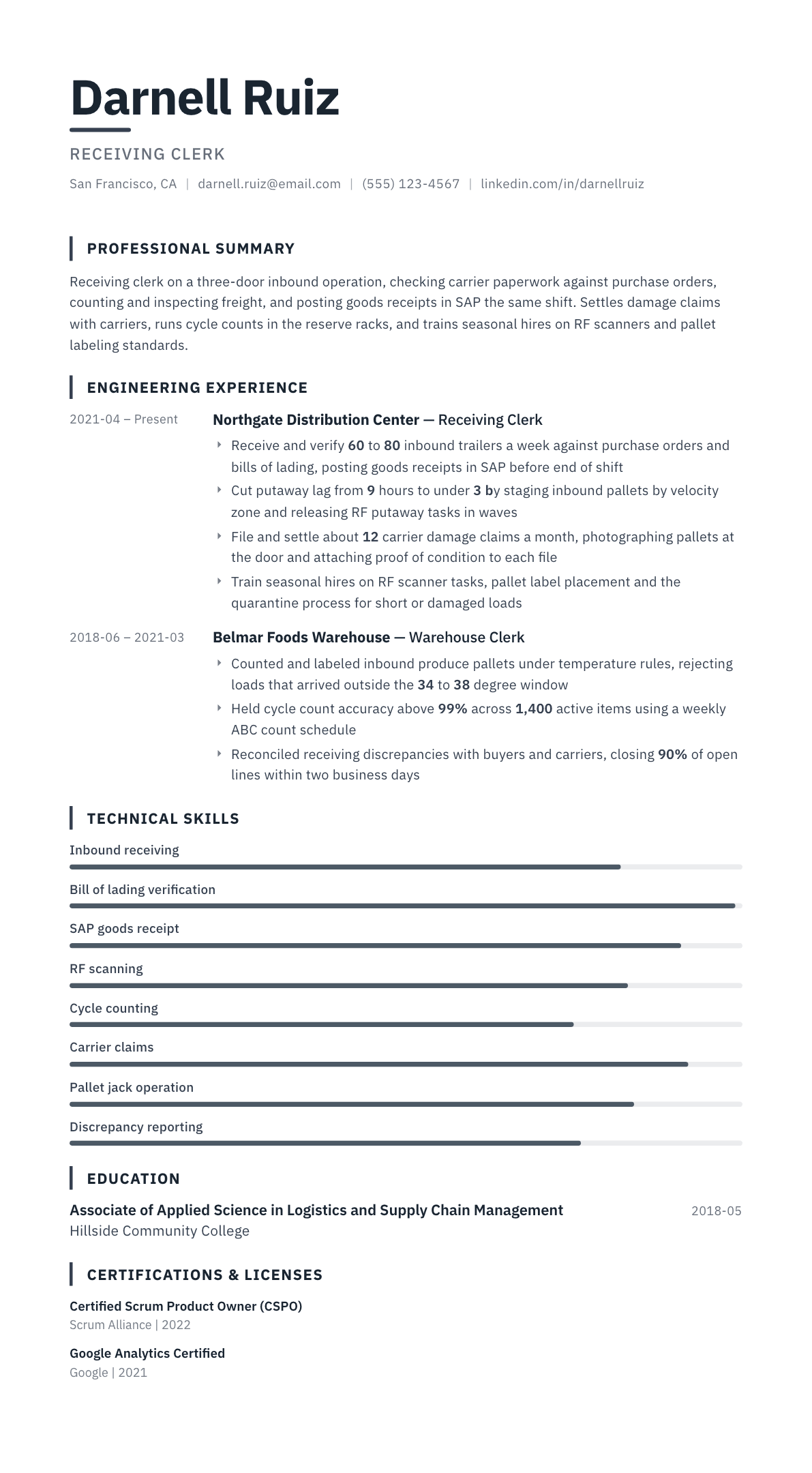
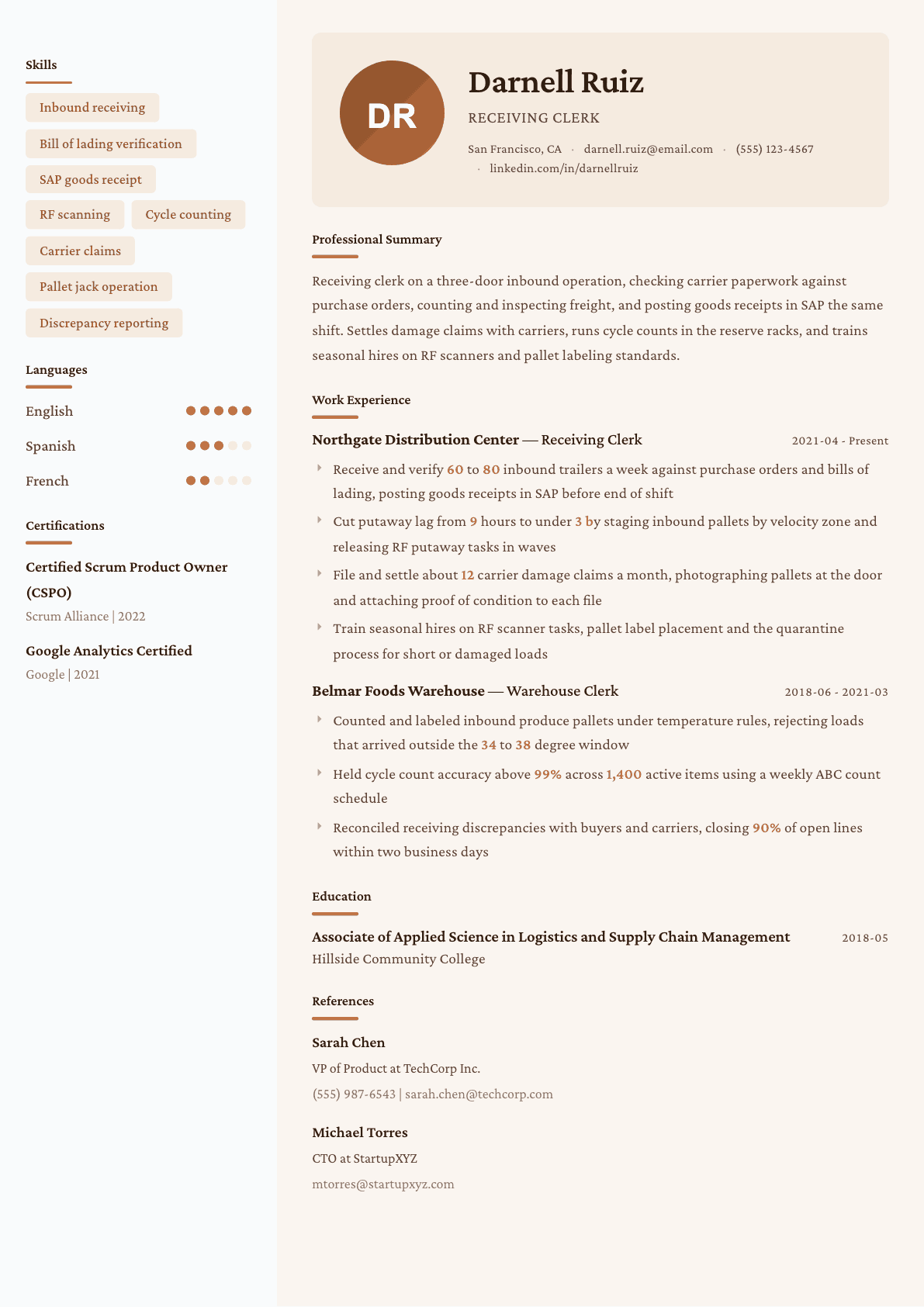
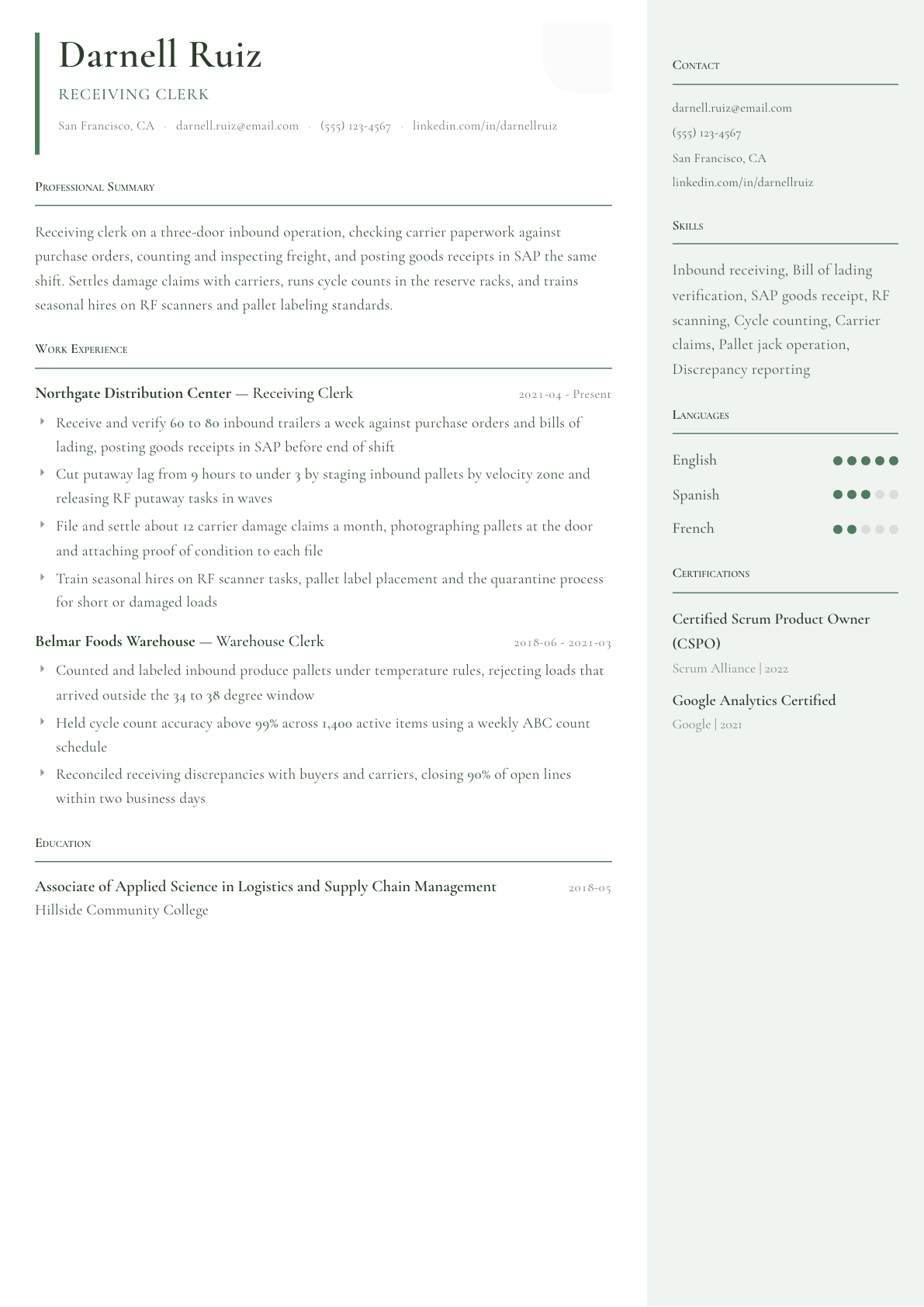
Example Receiving Clerk summary
Receiving clerk with five years on inbound docks in food and general merchandise distribution. Verifies carrier paperwork against purchase orders, inspects and counts freight before it leaves the door, and posts receipts in SAP the same shift. Certified on sit-down and stand-up forklifts, and the person the buyers call when a load arrives short. Looking for a lead receiving role on a multi-door operation.
Skills to list on a Receiving Clerk resume
- Inbound receiving
- Purchase order matching
- Bill of lading verification
- Packing slip reconciliation
- WMS data entry
- SAP MM
- RF scanning
- Cycle counting
- Pallet jack operation
- Forklift operation
- Damage inspection
- Carrier claims
- Putaway staging
- Returns processing
- Inventory accuracy
What actually gets this resume read
- Name the warehouse management system you post receipts in, because that single word decides whether the file gets read.
- Give the dock size in every job: number of doors, trailers a day, and whether the freight is palletized or floor loaded.
- Show discrepancy work, not just counting, since a supervisor hires for the person who catches a short load before it hits inventory.
- List equipment certifications with the class of truck you are cleared on, such as sit-down counterbalance or electric pallet jack.
- Put temperature, hazardous material or food safety rules on the page if you have worked under them, because those jobs screen for it.
- Keep the resume to one page and put the systems and equipment near the top where a screener scans first.
How to write a receiving clerk resume
A receiving clerk resume is screened by an operations supervisor who has a dock to cover on Monday. He is not looking for polish. He wants to know how many doors you have worked, which warehouse management system you post into, whether you are cleared on a forklift, and whether you catch a short load before it becomes an inventory problem for somebody else.
The trap most applicants fall into is writing the job description instead of the job. Lines like unloaded trucks and checked paperwork appear on every application in the pile, so they carry no information. The clerk who gets called back names the volume, the system, the documents and the discrepancy work.
This guide covers the section order a dock supervisor reads in, what to put in each one, three summaries for different stages of a receiving career, before and after bullets taken from the way people really write them, and the questions clerks ask when they sit down to update the page.
Format: one page, single column, systems and equipment near the top
Reverse chronological, one page, no columns and no icons. Distribution centers run applicant tracking systems that are older and simpler than the ones a corporate office uses, and a two column layout is where dates go missing. Plain headings and a normal font parse cleanly every time.
Under your name put city and state, phone, email, and a one line credential strip: forklift classes you are cleared on, any food safety or hazardous material training, and the warehouse systems you have used. A supervisor reads that strip before anything else because it answers whether you can be put to work without a two week ramp.
- Header: name, city and state, phone, email, forklift classes, systems used.
- Order: summary, work experience, equipment and systems, education and training.
- Add availability if you can work nights, weekends or peak season, because dock schedules are built around it.
Summary: doors, volume, system, and the discrepancy work
Three sentences. Name the type of building you have received in, the inbound volume, the system you post receipts in, and one thing you own beyond counting boxes. A receiving clerk who writes hardworking and reliable has described nobody. A clerk who writes verifies 60 to 80 inbound trailers a week against purchase orders and posts goods receipts in SAP the same shift has answered the first three questions in the interview.
If you are moving between industries, say what carries over. Produce receiving, auto parts receiving and apparel receiving all share paperwork, counting and putaway, but the temperature rules and the count granularity differ. Naming the transfer stops the reader from guessing.
Experience: paperwork in, freight checked, inventory posted
Set the scene in one line under each employer: number of dock doors, inbound trailers a day or week, whether freight arrives palletized or floor loaded, and whether the building is ambient, refrigerated or mixed. That line does more than a paragraph of adjectives, because it lets the reader picture your day.
Then three to five bullets. Cover the whole receipt: checking the bill of lading and packing slip against the purchase order, counting and inspecting, noting exceptions on the delivery receipt before the driver leaves, posting the receipt, and directing putaway. At least one bullet should be about what happens when the count is wrong, because that is the part of the job that costs money.
Leave out the bullets that describe receiving in general. Received incoming shipments is a definition, not an accomplishment. If a line would be equally true of every clerk who has ever stood at a dock door, cut it and use the space for a number.
- Volume: trailers, pallets, cartons or lines received per shift or per week.
- Systems: the WMS or ERP name, the transaction you run, and the RF device.
- Exceptions: short and damaged loads, carrier claims, vendor chargebacks, quarantine.
- Downstream: putaway direction, staging by zone, cycle count support.
Equipment, systems and training: a block, not a sentence
Give powered equipment its own block and be specific about class. Sit-down counterbalance, stand-up reach truck, order picker, walkie rider and manual pallet jack are separate qualifications, and a supervisor who needs a reach truck operator will not assume you have one because you wrote forklift. Include who trained and evaluated you if it was an employer program, since the operator evaluation is what matters for compliance.
For systems, name the product and the piece you touched. SAP goods receipt, Manhattan receiving, Oracle WMS, HighJump, a proprietary RF application: any of these tells the reader more than data entry. If your building used paper and you are applying to a scanned operation, say that you learned the RF flow during a rollout, because willingness matters when the tool is teachable.
Keywords: mirror the posting, once in the skills and once in a bullet
Warehouse postings recycle a small vocabulary: inbound receiving, bill of lading, packing slip, purchase order, putaway, cycle count, RF scanner, pallet jack, dock, discrepancy, vendor compliance. Use the exact phrase the posting uses, in the skills block and once inside a real bullet where it is attached to something you did. A keyword with evidence behind it survives the human read that follows the software read.
Receiving Clerk resume summary examples
First warehouse job
Warehouse worker with one year on a four door inbound dock, unloading floor loaded trailers, checking cartons against packing slips and staging pallets for putaway. Certified on manual pallet jack and walkie rider, trained on RF scanning, and looking for a full time receiving clerk role in distribution.
Three to five years in
Receiving clerk with four years on a 12 door inbound operation handling 70 trailers a week. Verifies bills of lading and packing slips against purchase orders, posts goods receipts in SAP the same shift, and files carrier claims with photo evidence. Certified on sit-down and stand-up trucks.
Lead receiver
Lead receiving clerk running the inbound side of a 30 door distribution center across two shifts, with four clerks reporting in on the day side. Owns vendor compliance chargebacks, the quarantine process and receipt posting accuracy, which has held above 99.5% for three years running.
Work experience bullets: before and after
Before: Unloaded trucks and checked in deliveries.
After: Unloaded and checked in 60 to 80 inbound trailers a week, matching each bill of lading and packing slip to the purchase order before signing the delivery receipt.
Volume plus the three documents you reconcile turns a chore into a measurable responsibility.
Before: Entered receipts into the computer.
After: Posted goods receipts in SAP the same shift the freight arrived, keeping the open receipt queue under ten lines at any point in the week.
Naming the system and the timing shows the reader you understand that a late receipt hides inventory.
Before: Reported damaged product to my supervisor.
After: Photographed damaged pallets at the door, noted the exception on the delivery receipt before the driver left, and filed about 12 carrier claims a month with proof of condition attached.
The strong version shows the full claim process, which is where a receiving mistake actually costs the company.
Before: Used a forklift in the warehouse.
After: Operated a sit-down counterbalance and a stand-up reach truck for trailer unloading and reserve putaway, with a clean operator evaluation at every annual recertification.
Equipment class and the evaluation record answer the compliance question a supervisor has to ask anyway.
Before: Helped with inventory counts.
After: Counted A items on a weekly ABC schedule across 1,400 active parts and researched every variance over ten units back to a receiving or picking transaction.
The count method, the catalog size and the research step separate a helper from someone who owns accuracy.
Hard skills
- Inbound receiving
- Bill of lading verification
- Packing slip reconciliation
- Purchase order matching
- Goods receipt posting
- RF scanning
- Warehouse management systems
- Cycle counting
- Carrier claim filing
- Forklift and pallet jack operation
- Putaway direction
- Returns processing
Soft skills
- Attention to count detail
- Carrier and driver communication
- Steady work under trailer pressure
- Written exception notes
- Coordination with buyers
- Training new hires
Certifications worth listing
- Powered Industrial Truck Operator Training (Employer program under OSHA powered industrial truck rules)
- ServSafe Food Handler (National Restaurant Association)
- Certified in Logistics, Transportation and Distribution (CLTD) (Association for Supply Chain Management)
- Certified Logistics Associate (CLA) (Manufacturing Skill Standards Council)
Mistakes that cost receiving clerk candidates the interview
- Writing duties instead of volume, so a supervisor cannot tell a two door back room from a 30 door distribution center.
- Saying forklift certified without naming the equipment class, which forces the reader to assume the least useful one.
- Leaving the warehouse system off the page entirely, when the system name is the single strongest keyword on a receiving resume.
- Skipping the discrepancy and claim work, which is exactly the part of receiving that protects inventory and vendor money.
- Using a designed template with columns and icons, which older warehouse parsers read out of order and sometimes drop dates from.
- Listing every temporary assignment separately instead of grouping them under the staffing agency with the sites named underneath.
Receiving Clerk resume questions
Do I need a forklift certification before I apply for a receiving clerk job?
Not always. Many buildings train and evaluate operators in house because the qualification has to be employer specific anyway. If you already hold one, name the equipment classes. If you do not, say you are trained on manual pallet jack and willing to certify.
How do I write a receiving resume when my building used paper instead of a scanner?
Describe the paper process honestly, including how receipts reached the system, then say you learned the scanned flow if you ever supported a rollout. Supervisors hire for count discipline and paperwork accuracy, and the device itself takes a few days to teach.
Should I list temporary agency assignments on a receiving clerk resume?
Yes, and group them. Put the staffing agency as the employer with one date range, then list each site underneath with the length of the assignment and what you did. That keeps the page from looking like job hopping when the placements were never yours to control.
What is the difference between a receiving clerk and a combined dock clerk role?
A receiving clerk owns the inbound side only: checking freight in, posting receipts and directing putaway. A combined dock role adds outbound work such as building loads, preparing bills of lading and staging pallets by route. Apply to the combined role only if you have done both.
How long should a receiving clerk resume be?
One page for almost everyone in this role. Two pages is defensible only if you have supervised a crew across multiple buildings. A hiring supervisor reads dock resumes quickly, so the density of specifics matters far more than the number of pages.
Related resume examples
- Warehouse Worker Resume example
- Logistics Coordinator Resume example
- Shipping and Receiving Clerk Resume example
- Material Handler Resume example
- Forklift Operator Resume example
- Mover Resume example