Inventory Analyst Resume Examples: the lines they read
Write an Inventory Analyst Resume That Speaks in Turns and Fill Rate
By Mustafa Tarabya, founder of CVBooster · Published · Updated
Inventory analyst resume example with safety stock, turns and forecasting keywords, plus a writing guide for supply chain analyst applications.
Sample resumes for a inventory analyst
The same inventory analyst content laid out in three CVBooster templates, so you can see what the finished document looks like before you write a word.
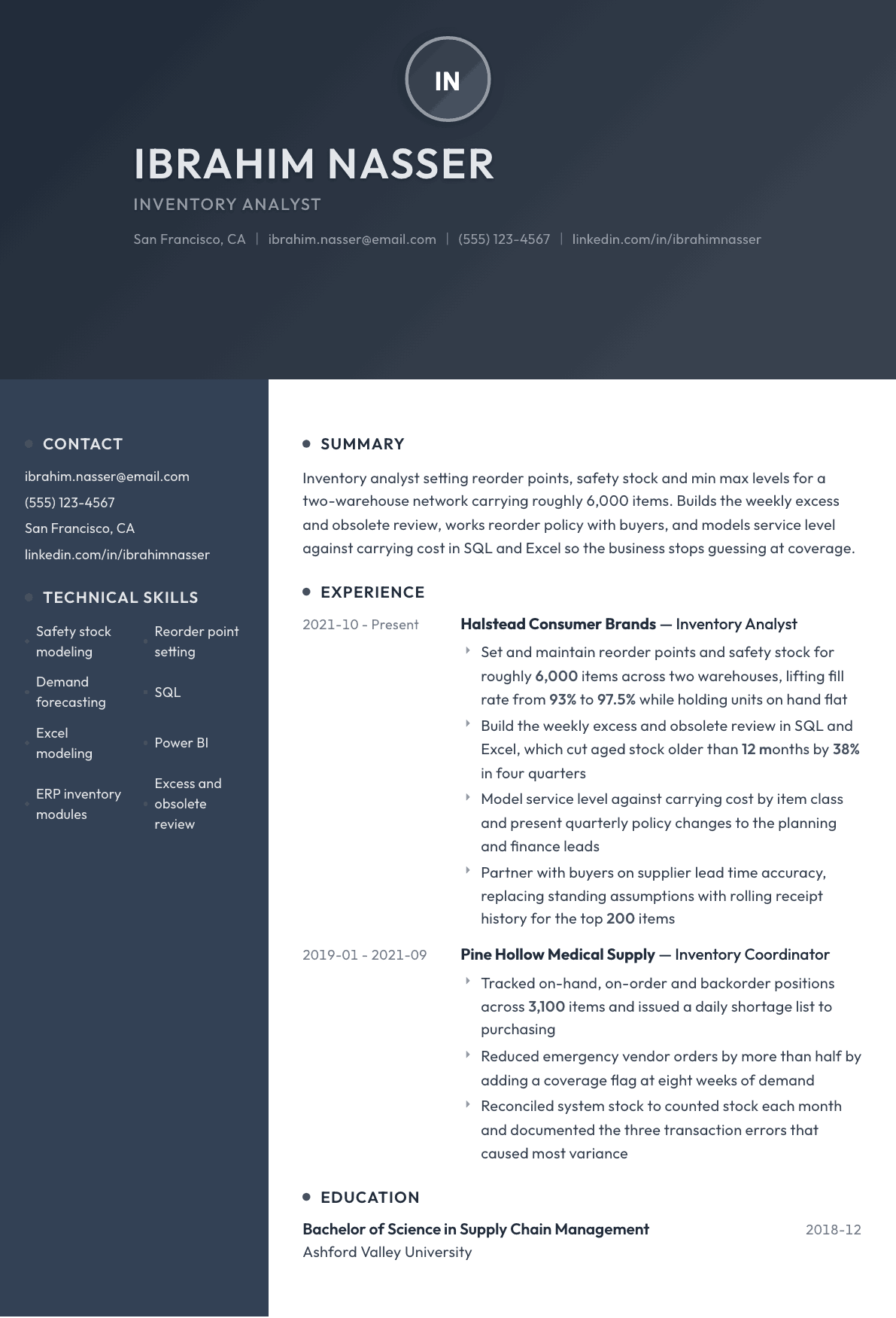
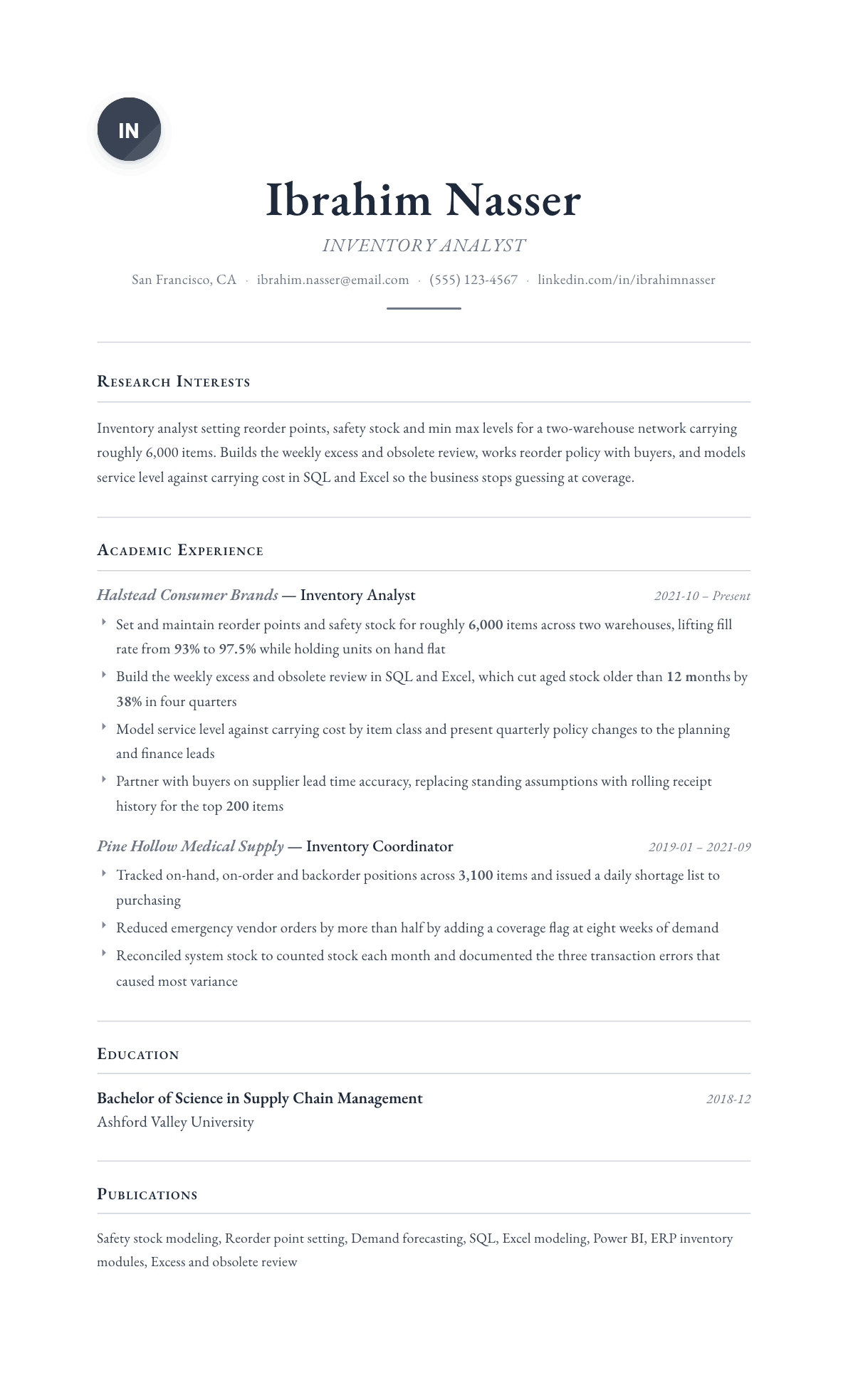
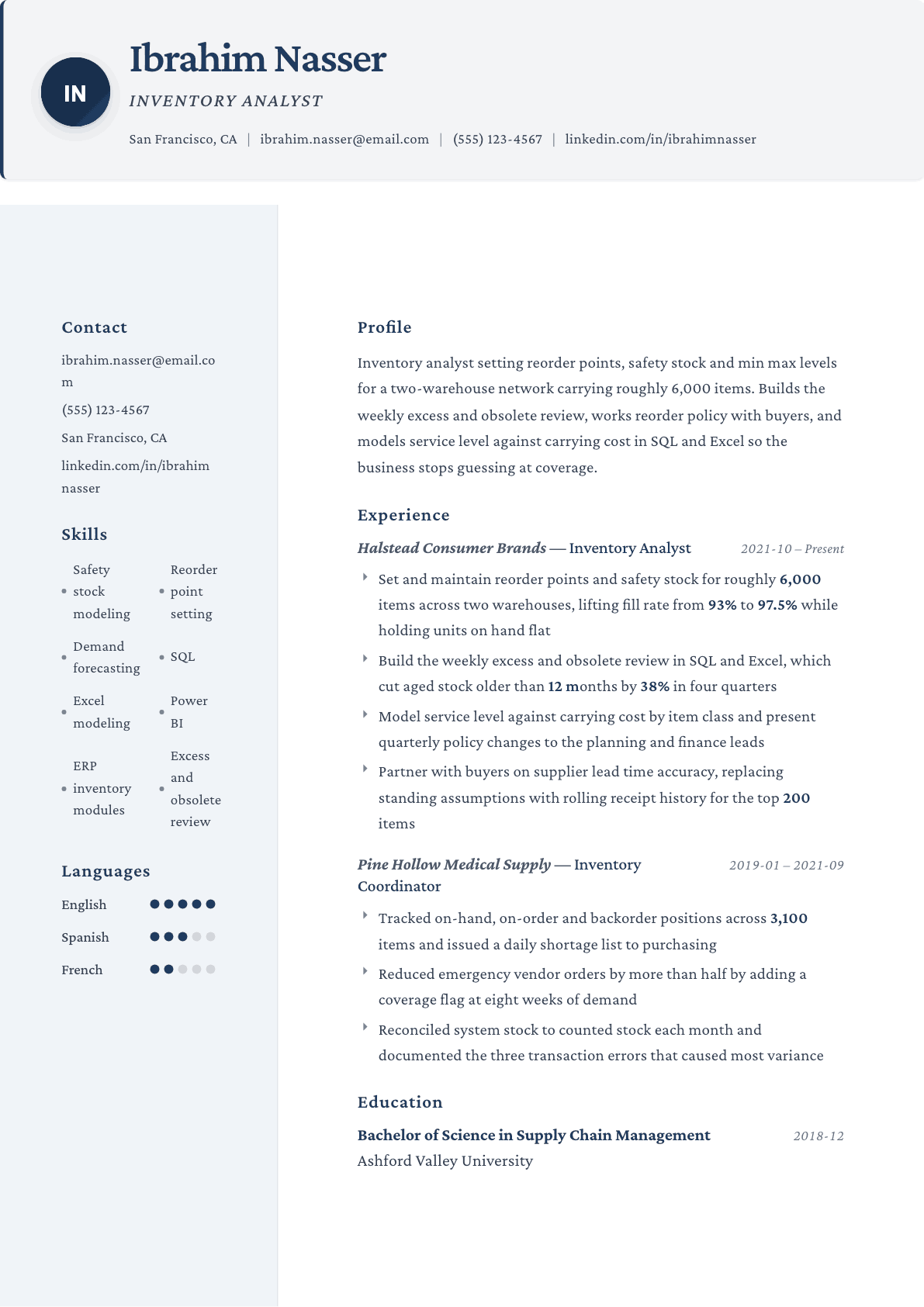
Example Inventory Analyst summary
Inventory analyst with five years setting stocking policy for consumer goods and medical supply networks. Owns reorder points and safety stock for roughly six thousand items across two warehouses, and lifted fill rate from 93% to 97.5% without adding units on hand. Writes the SQL behind the excess and obsolete review and presents policy changes to planning and finance. Looking for a senior planning role.
Skills to list on a Inventory Analyst resume
- Inventory analysis
- Safety stock modeling
- Reorder point setting
- Min max planning
- Demand forecasting
- Fill rate analysis
- Inventory turns
- Excess and obsolete review
- SQL
- Excel modeling
- Power BI
- ERP inventory modules
- Lead time analysis
- ABC segmentation
- Supplier performance reporting
What actually gets this resume read
- Open with the two numbers your job is judged on: fill rate or service level, and inventory turns or days of supply.
- Say how many items and how many stocking locations you covered, because coverage scope is what sizes the role.
- Name the tools honestly and separately: the ERP you pull from, the query language you write, and the tool you visualize in.
- Show a policy change you owned, such as a new safety stock method, rather than only listing reports you produced.
- Tie a saving to a tradeoff, since anyone can cut stock and an analyst has to cut it without hurting service.
- Keep formatting simple and put a skills block near the top with the systems named exactly as postings write them.
How to write a inventory analyst resume
An inventory analyst is judged on a tension, not a task. Service level pulls stock up, carrying cost pulls it down, and the analyst is the person expected to hold both at once and explain the tradeoff to buyers, planners and finance. A resume that lists reports produced misses this entirely. A resume that shows a policy change made and the two numbers it moved gets an interview.
The hiring manager is usually a planning or supply chain lead who wants three things visible fast: the scope you covered in items and stocking locations, the stack you work in from the source system through to the tool you model in, and at least one decision that changed because of your analysis.
This guide covers the numbers that carry weight in inventory planning, how to describe a policy change without inflating it, three summaries from a first analytics role to a senior planner, before and after bullets, and the questions analysts ask when they move between industries.
Format: one page early, two later, with the metric pair up top
One page until you have roughly eight years, then two. Reverse chronological, single column, and a summary that opens with the pair of metrics your work balances. Service level or fill rate on one side, turns or days of supply on the other. Leading with only one of them is the most common tell that a candidate has not owned the tradeoff.
Keep a compact technical block near the top listing the source system, the query and modeling tools, and the visualization layer. Planning teams filter on those words hard, because a candidate who cannot pull his own data becomes somebody else workload.
- Header: name, city and state, phone, email, and a portfolio or dashboard note if you have one.
- Technical block: ERP or planning system, SQL, Excel depth, reporting tool.
- Sections: summary, technical block, experience, education, certifications.
Summary: scope, stack, and the tradeoff you managed
Three sentences carrying scope, stack and outcome. Scope is how many items and how many stocking locations. Stack is where the numbers come from and where you model them. Outcome is a service and stock result stated together, because a fill rate gain that quietly doubled inventory is not an accomplishment and a planning lead knows it.
If your title was coordinator or planner rather than analyst, do not change the title. Describe the analytical content of the work in the summary instead. The title on the page has to match what a reference will confirm, and the substance is what earns the interview anyway.
Experience: policy, method, and the decision it changed
Write each job as a set of decisions rather than a set of reports. The core decisions in this role are reorder point and safety stock setting, min max levels, item segmentation, lead time assumptions, and what to do with excess and obsolete stock. For each one you owned, say the method you used, the scope it covered, and what moved.
Method matters because it separates an analyst from a spreadsheet operator. Setting safety stock as a flat number of weeks is a different discipline from setting it from demand variability and lead time variability at a target service level. Say which you did. If you replaced the first with the second, that is one of the strongest bullets you can write.
Include the unglamorous work. Lead time accuracy, cleaning up master data, and killing standing assumptions that nobody had checked in years are the projects that actually move fill rate, and they show a reader you go to the source rather than trusting the report.
- Scope: active items, stocking locations, and whether the network is single or multi echelon.
- Policy: what you set, how you set it, and how often it is refreshed.
- Results: service and stock stated together, over a stated period.
- Data: the queries you write, the joins you know, and where the master data problems live.
Tools: name the layer, not just the logo
Say what you do in each tool. Pulling receipts and demand history from an enterprise system, building a variability model in Excel, running a query that joins order lines to receipt dates, and publishing a coverage dashboard are four different capabilities and a planning lead reads them differently. A list of product names with no verbs attached tells him nothing about depth.
If you have worked in a dedicated planning system, name it and say what you configured rather than only what you viewed. Analysts who have touched planning parameters inside a real system are a smaller group than analysts who have looked at its output.
Keywords planning postings use
Expect these terms in almost every inventory analyst posting: safety stock, reorder point, min max, fill rate, service level, inventory turns, days of supply, excess and obsolete, ABC segmentation, lead time variability, demand variability, and forecast accuracy. Use them where they describe something you actually set or measured. A term you can defend in the second interview is worth more than three you cannot.
Inventory Analyst resume summary examples
First analyst role
Supply chain graduate with an internship in distribution and a year as an inventory coordinator, tracking on hand and on order positions across three thousand items and issuing the daily shortage list. Comfortable with Excel lookups, pivot tables and basic SQL, and moving into a full inventory analyst seat.
Four years in
Inventory analyst setting reorder points and safety stock for roughly six thousand items across two warehouses. Lifted fill rate from 93% to 97.5% while holding units on hand flat, and rebuilt the excess and obsolete review in SQL. Presents stocking policy changes to planning and finance each quarter.
Senior inventory analyst
Senior inventory analyst covering a four site network and a contract manufacturing base, owning segmentation, service level targets and the inventory plan behind the annual budget. Replaced fixed weeks of coverage with a variability based safety stock model and mentors two analysts on the same method.
Work experience bullets: before and after
Before: Managed inventory levels for the company.
After: Set and maintained reorder points and safety stock for roughly six thousand items across two warehouses, refreshing parameters monthly against rolling demand history.
Scope and refresh cadence show a running policy rather than a one time spreadsheet exercise.
Before: Improved product availability.
After: Lifted fill rate from 93% to 97.5% over three quarters while holding total units on hand flat, by reallocating coverage from slow movers to A items.
Stating service and stock together proves the gain was earned rather than bought with more inventory.
Before: Reduced obsolete inventory.
After: Rebuilt the weekly excess and obsolete review in SQL and worked the disposition list with buyers, cutting stock aged over 12 months by 38% in four quarters.
The tool, the partner and the timeframe make the reduction traceable to your work.
Before: Worked with buyers on supplier lead times.
After: Replaced standing lead time assumptions with rolling receipt history for the top 200 items, which removed most of the phantom coverage in the planning system.
Naming the assumption you killed shows the reader you audit inputs instead of trusting them.
Before: Created reports for management.
After: Published a quarterly service versus carrying cost view by item class and used it to move three categories onto a lower coverage target with planning approval.
The report earns its space only when the decision it produced is on the page beside it.
Hard skills
- Safety stock modeling
- Reorder point and min max setting
- ABC and item segmentation
- Fill rate and service level analysis
- Inventory turns and days of supply
- Excess and obsolete review
- Lead time and demand variability analysis
- SQL
- Excel modeling
- Power BI or equivalent reporting
- ERP inventory and planning modules
- Forecast accuracy measurement
Soft skills
- Explaining tradeoffs to non-analysts
- Questioning inherited assumptions
- Working with buyers and planners
- Written recommendations
- Prioritizing the item classes that matter
- Presenting to finance
Certifications worth listing
- Certified in Planning and Inventory Management (CPIM) (Association for Supply Chain Management)
- Certified Supply Chain Professional (CSCP) (Association for Supply Chain Management)
- Certified Professional Forecaster (CPF) (Institute of Business Forecasting and Planning)
- Certified Six Sigma Green Belt (CSSGB) (American Society for Quality)
Mistakes that cost inventory analyst candidates the interview
- Reporting a service improvement with no inventory figure beside it, which a planning lead reads as coverage bought with cash.
- Listing dashboards built instead of decisions changed, which makes the role look like report maintenance.
- Leaving out the number of items and stocking locations, so the reader cannot size the job against his own network.
- Naming a planning system without saying whether you configured parameters in it or only viewed its output.
- Claiming forecasting ownership when the forecast came from demand planning, which unravels in a technical interview.
- Filling the page with supply chain vocabulary while never showing one model you actually built.
Inventory Analyst resume questions
How much SQL does an inventory analyst really need?
Enough to pull and join your own data: selects, joins across order, receipt and item tables, aggregation and date logic. You rarely need to write production code. Being able to answer a question without waiting on a data team is the practical bar most planning leads apply.
Should I use fill rate or service level on my resume?
Use whichever your employer measured, then define it in the same line. Fill rate usually means lines or units satisfied from stock, while service level often means the probability of not stocking out in a cycle. Naming the definition prevents an interviewer from assuming the easier one.
Can I move into an inventory analyst role from a warehouse job?
Yes, and the floor experience is an advantage because you know why system numbers drift. Lead with any counting, reconciliation and reporting work, add evidence of Excel and query skill, and target roles in the industry you already know so the product knowledge carries.
How do I describe planning work when the tool was homegrown?
Name the logic rather than the software. Say you maintained reorder points from rolling demand and lead time, or ran segmentation on a defined rule, then note the tool was internal. Methods transfer between systems, and hiring managers care more about the method you can defend.
What projects make the strongest inventory analyst portfolio?
A safety stock method change with a before and after, an excess and obsolete reduction with the disposition path described, and a lead time cleanup. Those three cover policy, cash release and data quality, which is most of what a planning lead needs from the seat.
Related resume examples
- Supply Chain Analyst Resume example
- Supply Chain Manager Resume example
- Demand Planner Resume example
- Inventory Control Specialist Resume example
- Supply Planner Resume example
- Supply Chain Specialist Resume example