Stock Associate Resume Examples: the lines they read
Write a Stock Associate Resume Built Around Freight and Accuracy
By Mustafa Tarabya, founder of CVBooster · Published · Updated
Stock associate resume examples with truck, backroom, and RF scanner bullets, plus a writing guide for retail and warehouse-facing roles.
Sample resumes for a stock associate
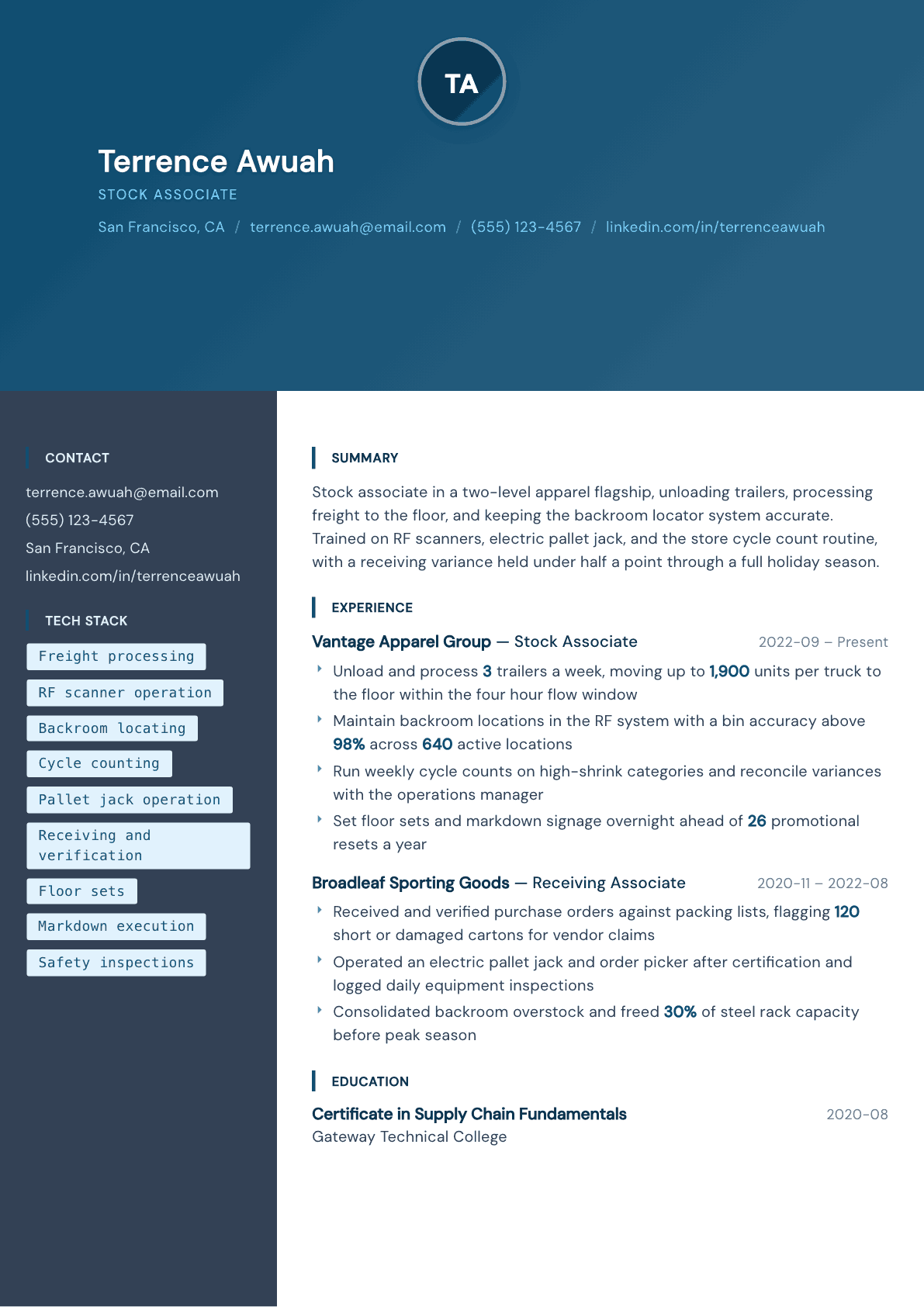
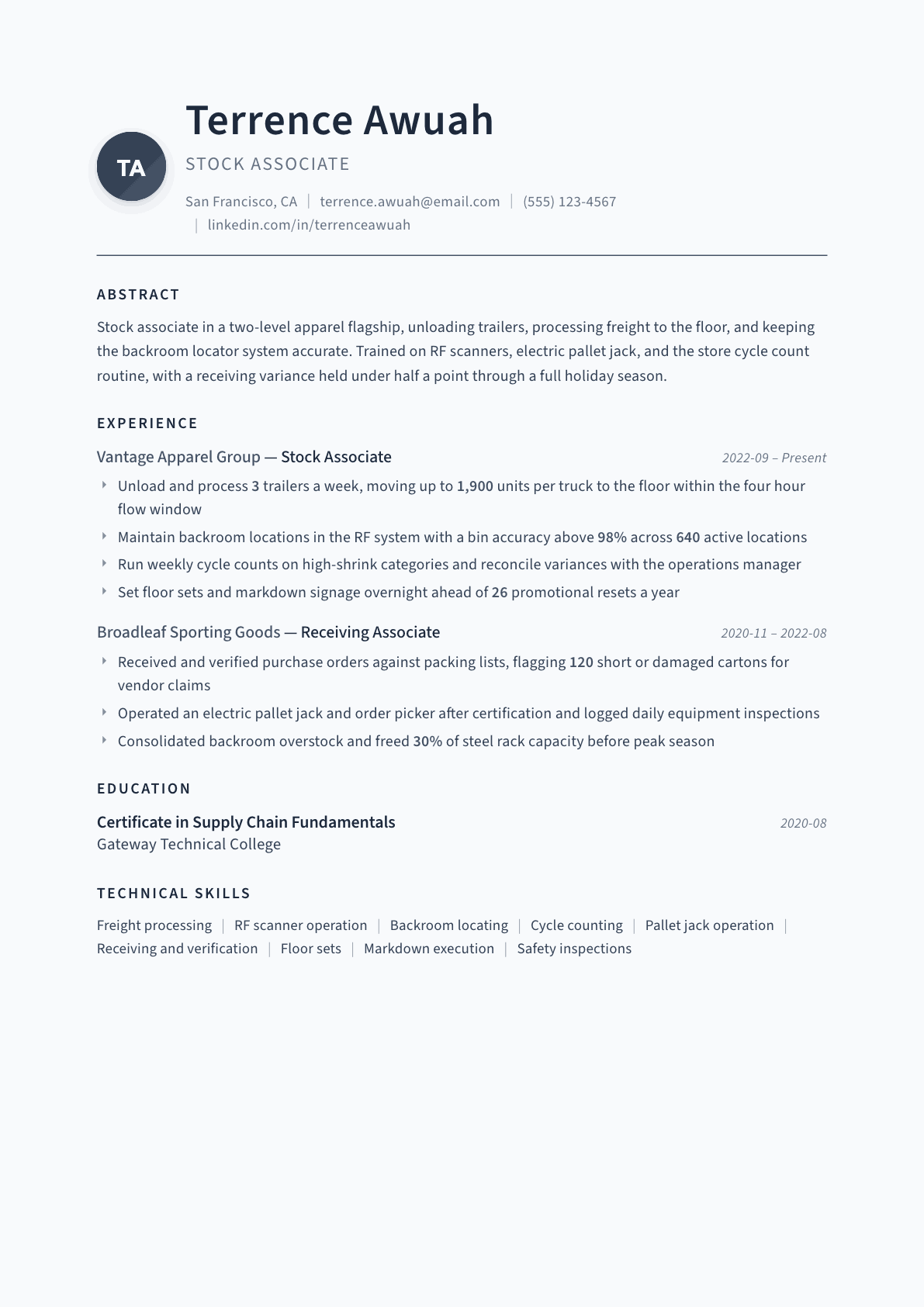
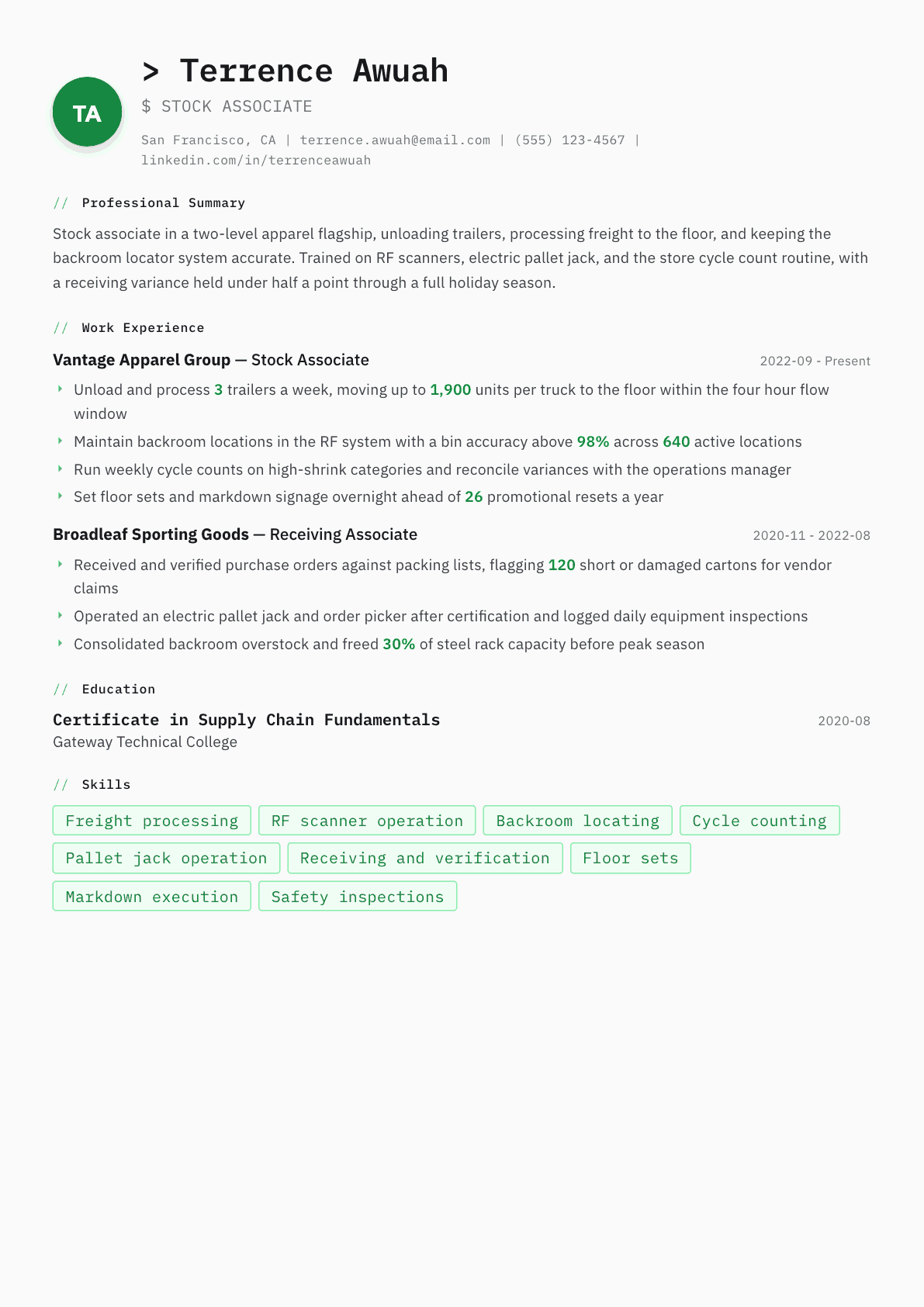
The same stock associate content laid out in three CVBooster templates, so you can see what the finished document looks like before you write a word.
Example Stock Associate summary
Stock associate with four years processing freight in apparel and sporting goods, unloading three trailers a week and moving up to 1,900 units per truck inside the flow window. Holds backroom bin accuracy above 98% on 640 locations, runs weekly cycle counts, and is certified on electric pallet jack and order picker.
Skills to list on a Stock Associate resume
- Freight processing
- Truck unloading
- RF scanner operation
- Backroom organization
- Bin locating
- Cycle counting
- Receiving verification
- Purchase order matching
- Electric pallet jack
- Order picker operation
- Floor set execution
- Markdown and signage
- Inventory accuracy
- Warehouse safety
What actually gets this resume read
- Lead with truck volume and unit counts, because a stock lead reads pace before anything else on the page.
- Name the handheld and inventory system you used, whether that is an RF scanner, a Zebra unit, or a store app.
- Say which powered equipment you are certified on and who trained you, since that decides your first week.
- Show backroom accuracy or bin location numbers, not just that you organized the stockroom.
- Include floor sets, resets, and markdown execution if you did them, as those hours are hard for managers to cover.
- List your availability for early morning and overnight flow, which is when most freight actually gets worked.
How to write a stock associate resume
A stock associate resume is scanned by an operations or flow manager who has a truck arriving on a fixed day and a window to clear it. What that manager wants from the page is throughput: how many trailers you have unloaded, how many units you have moved to the floor, and whether the backroom stays accurate after you have worked it. Personality comes later.
Most applicants write the role as unskilled labor and lose the interview to someone who wrote it as inventory control. Processing freight, holding bin accuracy in a handheld system, matching purchase orders against packing lists, and running cycle counts are learned skills with measurable results, and every one of them belongs on the page as a number.
This guide covers the layout, the numbers to collect before you write, three summary examples from a first flow crew job to a stock lead, before and after bullets that add the missing specifics, and the questions stock associates ask when they are aiming at a lead or receiving role.
Format: one page, throughput in the first block
One page, reverse chronological, single column, no graphics. Retail flow teams hire through the same portals the sales floor uses, so a decorative template is a liability. Give each job a short scope line: store format, square footage band or department count, truck frequency, and crew size.
Put equipment certifications in their own short section. A manager deciding between two applicants will take the one already cleared on an electric pallet jack or order picker, because that saves a training block in the first week.
- Header: name, city and state, phone, email, and the shifts you can work.
- Section order: summary, experience, equipment and certifications, skills, education.
- Name the handheld and inventory system, since chains vary and matching one is a real advantage.
Summary: trucks, units, and accuracy in three lines
Open with the category and format you have worked, then the truck cadence and unit volume, then the accuracy number you were measured on. A stock associate who moves nineteen hundred units inside a four hour flow window and keeps bin accuracy high is describing two different strengths, and a flow manager needs both.
If you are moving in from a warehouse or delivery job, say so and translate. Cases picked per hour, trailer unloads, and scanner work all read the same way to a retail flow manager, and the transition is short.
Experience: freight, backroom, counts, resets
Start with freight. Trucks per week, units or cartons per truck, and the window you finished in. Add whether you unload, sort by department, push to the floor, or all three, because stores split those tasks differently and the manager is filling a specific slot.
Then backroom control. Bin or location accuracy, the number of active locations, how you handle overstock, and what you did to free capacity before peak. This is the part most applicants skip, and it is the part that separates a stock associate from a temporary helper.
Then counts and audits: cycle counts on high shrink categories, reconciling variances, receiving verification against packing lists, and vendor claims for short or damaged cartons. Close with floor sets, resets, markdowns, and signage if you have done overnight work, since those hours are chronically hard to cover.
Equipment, safety, and the physical requirements
List what you are trained to operate and who trained you: manual and electric pallet jacks, order pickers, walkie riders, balers, and compactors. Powered industrial truck operation requires employer training and evaluation under federal workplace safety rules, so name the employer program rather than implying a portable license.
Address the physical requirements plainly in a bullet rather than a claim. Lifting to a stated weight, working at height on a picker, and completing daily equipment inspections tell the manager you understand the safety expectations that come with the job.
Skills and keywords the flow manager searches
Use the nouns from the posting: freight processing, truck unload, replenishment, back stock, bin locating, cycle count, receiving, purchase order, RF scanner, planogram, floor set, markdown. Split the list into process skills and equipment so a reader can find both without reading a paragraph.
Skip filler such as hard working and team player. A bullet showing that you consolidated overstock and freed a third of the steel rack capacity before peak season proves both without spending a line on adjectives.
Stock Associate resume summary examples
First flow crew job
Warehouse helper moving into retail stock work, with a year of trailer unloading and case picking at a distribution site. Comfortable on a manual pallet jack, trained on handheld scanning, and available for early morning and overnight flow shifts. Lifts to 50 pounds repeatedly through a full shift.
Three years on freight
Stock associate in a two level apparel flagship, processing three trailers a week and moving up to 1,900 units per truck inside a four hour window. Holds bin accuracy above 98% across 640 backroom locations, runs weekly cycle counts, and is certified on electric pallet jack and order picker.
Stock lead
Stock lead directing a six person overnight flow crew across a 60K square foot store. Assigns trucks by department, owns the backroom layout and capacity plan, and reconciles cycle count variances with operations. Trained 14 associates on scanning, receiving verification, and equipment safety.
Work experience bullets: before and after
Before: Unloaded trucks and put stock on the shelves.
After: Unloaded and processed three trailers a week, moving up to 1,900 units per truck to the sales floor inside the four hour flow window.
Truck cadence, unit count, and the window turn a physical task into a throughput number the manager plans around.
Before: Kept the stockroom organized.
After: Maintained backroom locations in the handheld system at above 98% bin accuracy across 640 active locations, including a weekly sweep of aged overstock.
Accuracy against a location count is a measurable control; organized is an impression.
Before: Counted inventory when asked.
After: Ran weekly cycle counts on high shrink categories and reconciled every variance with the operations manager before the file closed.
Naming the cadence, the categories, and the reconciliation shows you understand why counts exist.
Before: Checked deliveries against paperwork.
After: Verified purchase orders against packing lists on arrival and flagged 120 short or damaged cartons for vendor claims over one year.
The claim volume proves you caught real money instead of signing whatever the driver handed over.
Before: Helped set up displays for sales events.
After: Staged and executed 26 promotional resets a year overnight, hanging signage and markdown tickets so the department opened complete at first customer.
Reset count and the opening standard make the work verifiable and show you know what completion means.
Hard skills
- Freight processing and truck unload
- Replenishment and floor push
- RF and handheld scanner operation
- Backroom bin locating
- Cycle counting and variance reconciliation
- Receiving and purchase order verification
- Vendor claim documentation
- Electric pallet jack operation
- Order picker operation
- Floor set and planogram execution
- Markdown and signage execution
- Baler and compactor operation
Soft skills
- Working to a shift window
- Consistent pace over long shifts
- Following safety procedure
- Communication with the flow lead
- Care with fragile stock
- Willingness to cover overnight
Certifications worth listing
- OSHA 10-Hour General Industry (OSHA Outreach Training Program, U.S. Department of Labor)
- Powered Industrial Truck Operator Training (Employer-conducted program under the OSHA powered industrial truck standard)
- Certified Logistics Associate (Manufacturing Skill Standards Council)
Mistakes that cost stock associate candidates the interview
- Writing the job as lifting and carrying, when the interview is decided by throughput and inventory accuracy.
- Leaving out truck frequency and unit volume, so the manager cannot compare you to the crew already on the schedule.
- Claiming a forklift or pallet jack license, when powered equipment operation is authorized by an employer through training and evaluation.
- Ignoring the backroom entirely, which is where a stock associate actually earns a lead position.
- Skipping the resets, markdowns, and floor sets that overnight teams struggle to staff and gladly hire for.
- Filling the skills list with adjectives instead of the system names and equipment a flow manager filters on.
Stock Associate resume questions
What numbers should a stock associate put on a resume?
Trucks per week, units or cartons per truck, the flow window you finished in, backroom location count, bin accuracy, and cycle count cadence. If your store does not publish figures, estimate conservatively from the pallet or carton counts you handled and describe the method behind the number.
Do I need a forklift certification to be hired as a stock associate?
Usually not to be hired, but it helps. Powered industrial truck operation is authorized by the employer after training and evaluation, so state which equipment you were trained and evaluated on and by whom. Many retail stock roles use manual and electric pallet jacks rather than sit down forklifts.
How is a stock associate resume different from a warehouse resume?
A warehouse resume is picking, packing, and outbound accuracy. A retail stock resume adds the sales floor: replenishment, planogram compliance, floor sets, markdowns, and the customer facing standard the department opens to. Include both halves if you have moved between the two settings.
Should I mention that I can work overnight shifts?
Yes, near the top. Most freight is worked before the store opens, and overnight availability is the hardest slot for a flow manager to fill. Naming specific windows such as ten at night to seven in the morning is more useful than writing that you are flexible.
How do I move from stock associate to a lead or receiving role?
Build evidence of ownership on the page: the backroom capacity plan, cycle count reconciliation, vendor claims, and any associates you trained on scanning or equipment safety. Those bullets tell an operations manager you already do part of the lead job without the title.