Inventory Manager Resume Examples: the lines they read
Inventory Manager and Inventory Executive Resume That Shows Control
By Mustafa Tarabya, founder of CVBooster · Published · Updated
Inventory manager and inventory executive resume examples, with forecasting, shrink and turn keywords and bullets that buyers and directors respect.
Sample resumes for a inventory manager
The same inventory manager content laid out in three CVBooster templates, so you can see what the finished document looks like before you write a word.
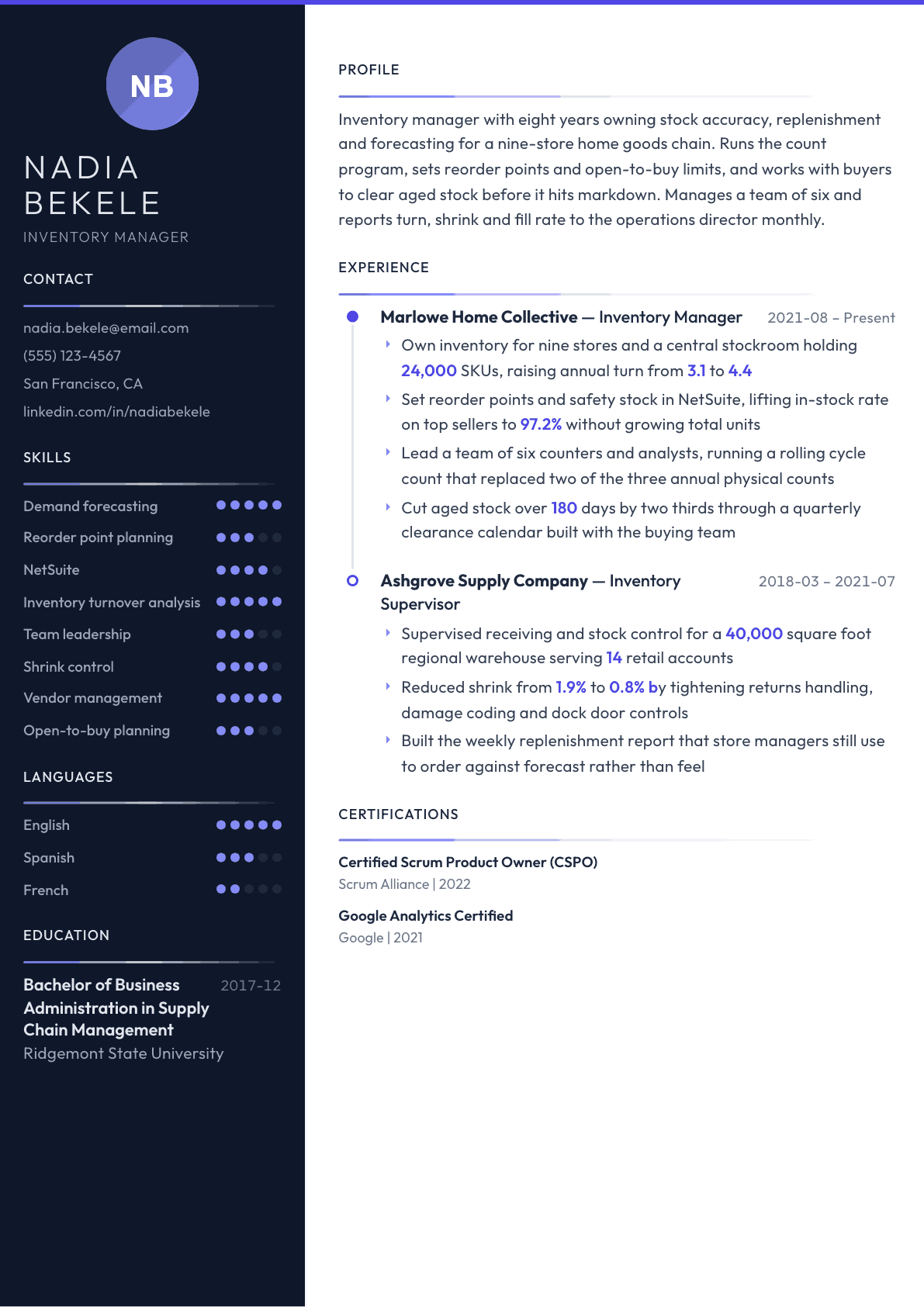
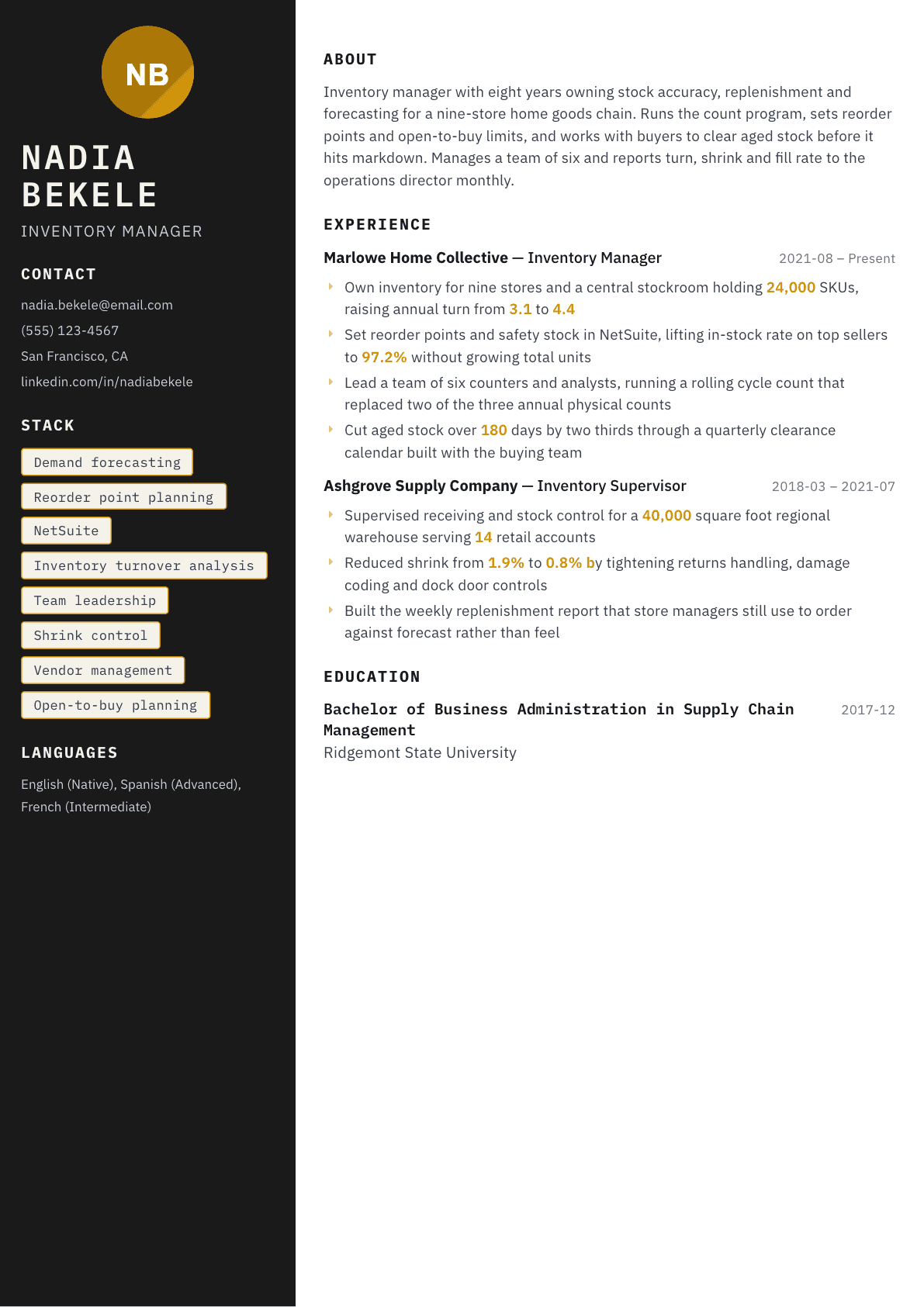
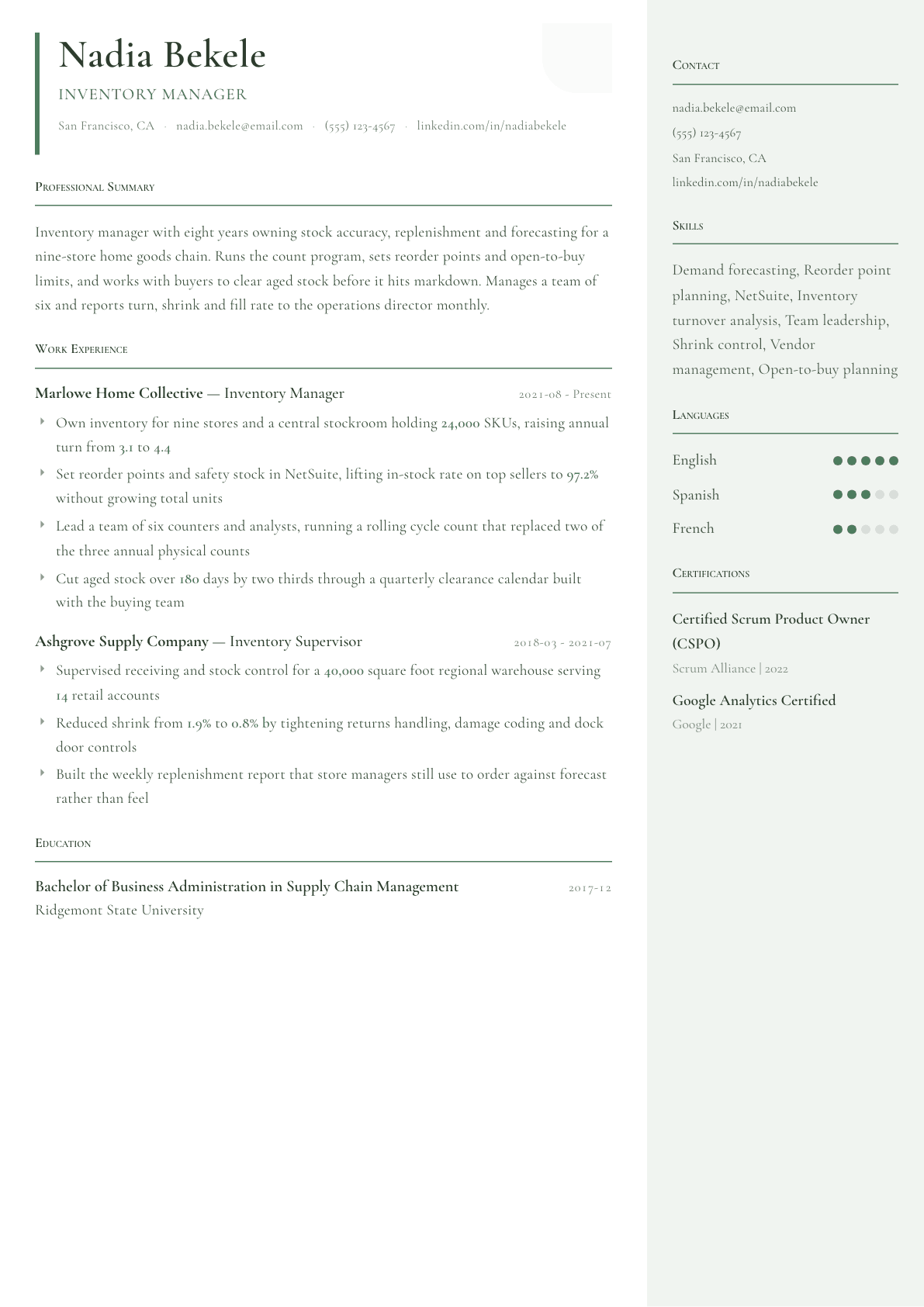
Example Inventory Manager summary
Inventory manager with eight years owning stock for a multi-store home goods chain, from reorder points to the annual count calendar. Raised turn while holding in-stock above 97% on top sellers, cut shrink by more than half at a regional warehouse, and cleared aged stock through a quarterly calendar built with buyers. Leads a team of six and reports fill rate and turn to the operations director.
Skills to list on a Inventory Manager resume
- Inventory planning
- Demand forecasting
- Reorder point and safety stock
- Inventory turnover
- Shrink reduction
- Cycle count program design
- ERP systems
- Open-to-buy
- Vendor and purchase order management
- Aged stock and markdown planning
- Team leadership
- KPI reporting
- Allocation and replenishment
- Warehouse layout and slotting
What actually gets this resume read
- Lead with the inventory value or SKU count you controlled and the number of locations you supplied.
- Report turn, fill rate and shrink together, because a director reads those three numbers as one story.
- Name your ERP or planning system, since most postings screen on the exact platform in use.
- Show the people side: how many counters or analysts you led and what you changed about their routine.
- Include one bullet on aged and obsolete stock, because clearing it is the fastest cash win in the role.
- Quantify the forecast improvement rather than saying you improved forecasting, which every applicant claims.
How to write a inventory manager resume
An inventory manager is hired to fix a specific pain, and the posting usually admits which one. Too much cash sitting in stock, too many out of stocks on the items that sell, a count nobody trusts, or a team that reacts instead of plans. The resume that wins is the one where a director can point at a bullet and say that is our problem.
The reader is typically an operations or supply chain director. They think in turn, fill rate, shrink and working capital, and they will assume anything you leave unquantified did not move. A resume full of responsibilities gets filed. A resume that shows a number before and after, plus the mechanism between them, gets a call.
This guide sets out how to structure the document, how to write summaries at three levels of scope, how to convert planning work into bullets, and which credentials and systems carry real weight when an inventory manager job is screened.
Format: two pages once you have owned a team and a budget
One page is right until you have managed people and multiple sites. After that, two pages is normal and expected, because a director wants the scope history: how many locations, what inventory value, how many direct reports, and which systems at each stop. Keep it reverse chronological and single column.
Put a short scope block under your summary listing sites supported, catalog size, approximate inventory value in units rather than currency, and team size. It saves the reader from reconstructing your career arc out of bullets, and it front loads the numbers that decide whether you clear the first screen.
- Header: name, city and state, phone, email, and a professional profile link only when it names the facilities and systems you have run.
- Section order: summary, scope snapshot, experience, systems, education and certifications.
- Every job opens with locations supported, catalog size and reports, then three to five outcome bullets.
Summary: the three numbers a director reads first
Turn, fill rate and shrink. Name the scope, then name what happened to those three under your ownership. A summary that says you raised turn while holding availability on top sellers is doing more work than four lines about being a results driven leader with a passion for supply chain.
If your background is heavier on one side, say which. Some inventory managers are counting and control people who own accuracy and the physical program. Others are planning people who own reorder points, allocation and forecast. Both titles exist, they are hired for different reasons, and a summary that stays neutral matches neither posting.
Experience: mechanism, not just movement
Directors discount improvement claims without a mechanism, because inventory numbers move for many reasons and not all of them are the manager. Write the lever. Reorder points and safety stock rebuilt in the planning system. A count program redesigned around velocity. A returns and damage process that stopped leaking units. A clearance calendar agreed with buyers so aging stock left before it needed a deep markdown.
Include the people work, because this is a management role and the first interview question is usually about the team. Say how many counters, analysts or receivers you led, what you changed about how they worked, and whether anyone was promoted under you.
Cross functional friction is worth a bullet too. The inventory manager sits between buying, store operations and finance, and the honest description of that seat is where the good candidates separate. Describe a standing review you ran, or a report you built that made the argument for you.
Systems: the planning stack, named precisely
Write the exact platforms. SAP, Oracle, NetSuite, Microsoft Dynamics, Blue Yonder, Manhattan Associates and the retail specific merchandising suites all appear by name in postings, and a director who is mid implementation will filter for the one on their roadmap.
Add the analysis layer separately. Excel at a serious level, SQL if you have it, and any reporting tool you built dashboards in. An inventory manager who can pull their own data is faster than one who queues a request with an analyst, and that speed is a real hiring argument.
Inventory executive resume: the same file under another title
Inventory executive is a common title in many companies outside the US, and it usually means the person who runs stock control day to day: counts, reconciliations, stock reports and the link between the warehouse and purchasing. In some firms it sits below an inventory manager, in others it is the senior inventory role on site, so read the posting for team size and budget before deciding how to pitch the level.
The resume itself follows the structure on this page. Put the employer's exact title in each role, then let the scope line explain the job: number of SKUs, sites, stock value and whether you led anyone. A reader comparing an inventory executive with an inventory manager candidate decides on those numbers, not on the word in the title.
- Headline: use the title in the posting, such as Inventory Executive or Inventory Control Executive.
- Scope line under each role: SKUs, sites, stock value, team size and reporting line.
- Lead bullets with count accuracy, stock variance resolved and aged stock cleared, the results an executive level role owns.
Credentials and education
A supply chain degree helps but rarely gates the role. Certification does more: the planning and inventory management credential from the supply chain body is recognized by most retail and distribution employers, and a process improvement belt reads well when the posting mentions continuous improvement or cost reduction.
If you came up through the stockroom rather than a classroom, say so plainly in the summary. Operators respect a manager who has counted, and the career path from receiving clerk to inventory manager is common enough that a director will read it as credibility rather than a gap.
Inventory Manager resume summary examples
Stepping up from supervisor
Inventory supervisor ready for a manager seat, with five years running receiving and stock control for a regional warehouse serving 14 retail accounts. Cut shrink from 1.9% to 0.8% by tightening returns handling, damage coding and dock door controls, and built the weekly replenishment report store managers order against.
Single chain, multi-store
Inventory manager owning stock across nine stores and a central stockroom, with a catalog of twenty four thousand items and a team of six. Raised annual turn from 3.1 to 4.4 while lifting in stock rate on top sellers to 97.2%, and replaced two of three annual physical counts with a rolling cycle count.
Director track
Senior inventory manager across three regions and a distribution center, accountable for availability, aged stock and the annual count program. Rebuilt safety stock policy by velocity class, cut stock older than 180 days by two thirds through a quarterly clearance calendar, and manages a team of eleven planners and counters.
Work experience bullets: before and after
Before: Managed inventory for multiple store locations.
After: Owned inventory across nine stores and a central stockroom carrying twenty four thousand items, raising annual turn from 3.1 to 4.4 in two years.
Scope and a turn movement give the director both the size of the job and the result in one line.
Before: Improved product availability.
After: Reset reorder points and safety stock by velocity class in the planning system, lifting in stock rate on top sellers to 97.2% without increasing total units held.
The without clause is the whole argument: availability rose while working capital did not.
Before: Reduced excess and obsolete stock.
After: Cut stock aged past 180 days by two thirds through a quarterly clearance calendar agreed with buyers and executed by store teams on a set schedule.
Naming the horizon, the mechanism and who executed it turns a claim into a repeatable process.
Before: Supervised the inventory team.
After: Led six counters and analysts through a move to rolling cycle counts, retiring two of three annual physical counts and promoting two team members into planning roles.
Team size plus a structural change plus promotions is the evidence a management hire is judged on.
Before: Worked with buyers and store operations.
After: Ran a weekly assortment and availability review with buyers and store leads, using a shared exception report to settle what gets reordered and what gets cleared.
Describing the forum and the artifact shows how you actually resolve conflicts between functions.
Hard skills
- Inventory planning and control
- Demand forecasting
- Reorder point and safety stock policy
- Inventory turnover analysis
- Cycle count program design
- Shrink reduction
- ERP and planning systems
- Open to buy management
- Allocation and replenishment
- Aged and obsolete stock strategy
- Vendor and purchase order management
- KPI reporting and dashboards
Soft skills
- Team leadership and development
- Negotiating priorities with buyers
- Explaining variance to finance
- Process design
- Decision making with incomplete data
- Coaching store managers
Certifications worth listing
- Certified in Planning and Inventory Management (CPIM) (Association for Supply Chain Management)
- Certified Supply Chain Professional (CSCP) (Association for Supply Chain Management)
- Certified Professional in Supply Management (CPSM) (Institute for Supply Management)
- Certified Six Sigma Green Belt (CSSGB) (American Society for Quality)
- Project Management Professional (PMP) (Project Management Institute)
Mistakes that cost inventory manager candidates the interview
- Reporting turn or fill rate with no starting point, which leaves the reader unable to judge whether you moved anything.
- Describing the planning system as ERP experience rather than naming the platform a director is hiring around.
- Omitting team size and reporting line, so a management role reads as an individual contributor file.
- Claiming a shrink result that belonged to a loss prevention program you did not run.
- Filling the page with duties from a job description instead of the two or three problems you actually solved.
- Ignoring aged stock entirely, when clearing it is usually the fastest cash improvement a new manager can deliver.
- Writing a single page for a fifteen year career, which forces you to cut exactly the scope numbers that qualify you.
Inventory Manager resume questions
How long should an inventory manager resume be?
Two pages is normal once you have managed a team across more than one site. Use the extra room for scope numbers and outcomes, not for older jobs, which can shrink to a title, employer, dates and a single line each.
Which metrics belong on an inventory manager resume?
Turn, in stock or fill rate, shrink, count accuracy and aged stock cover almost every posting. Choose the ones your employer actually tracked, give a starting and ending value, and name the change you made between them.
Do I need a supply chain degree for this job?
It helps at larger employers but is rarely mandatory. Many strong inventory managers came up through receiving and stock control, and that path signals credibility with the team. Certification is often the faster way to satisfy an education filter.
Can I use this guide for an inventory executive resume?
Yes. An inventory executive role covers the same work, stock control, counts, variance and reporting, often with a smaller team or none. Keep your employer's exact title, add a scope line with SKUs, sites and stock value, and lead with count accuracy and variance results rather than strategy.
What is the difference between an inventory manager and a materials manager resume?
Materials roles lean toward production supply, bills of material and supplier scheduling, while inventory manager roles in retail lean toward availability, assortment and count integrity. Same vocabulary, different emphasis, so lead with the half that matches the posting you are answering.