TEFL Teacher Resume Examples: free ATS score and gap list
Build a TEFL Teacher Resume Schools Abroad Respond To
By Mustafa Tarabya, founder of CVBooster · Published · Updated
TEFL teacher resume examples with certification, class level and curriculum keywords, plus a guide to writing each section for jobs abroad.
Sample resumes for a tefl teacher
The same tefl teacher content laid out in three CVBooster templates, so you can see what the finished document looks like before you write a word.
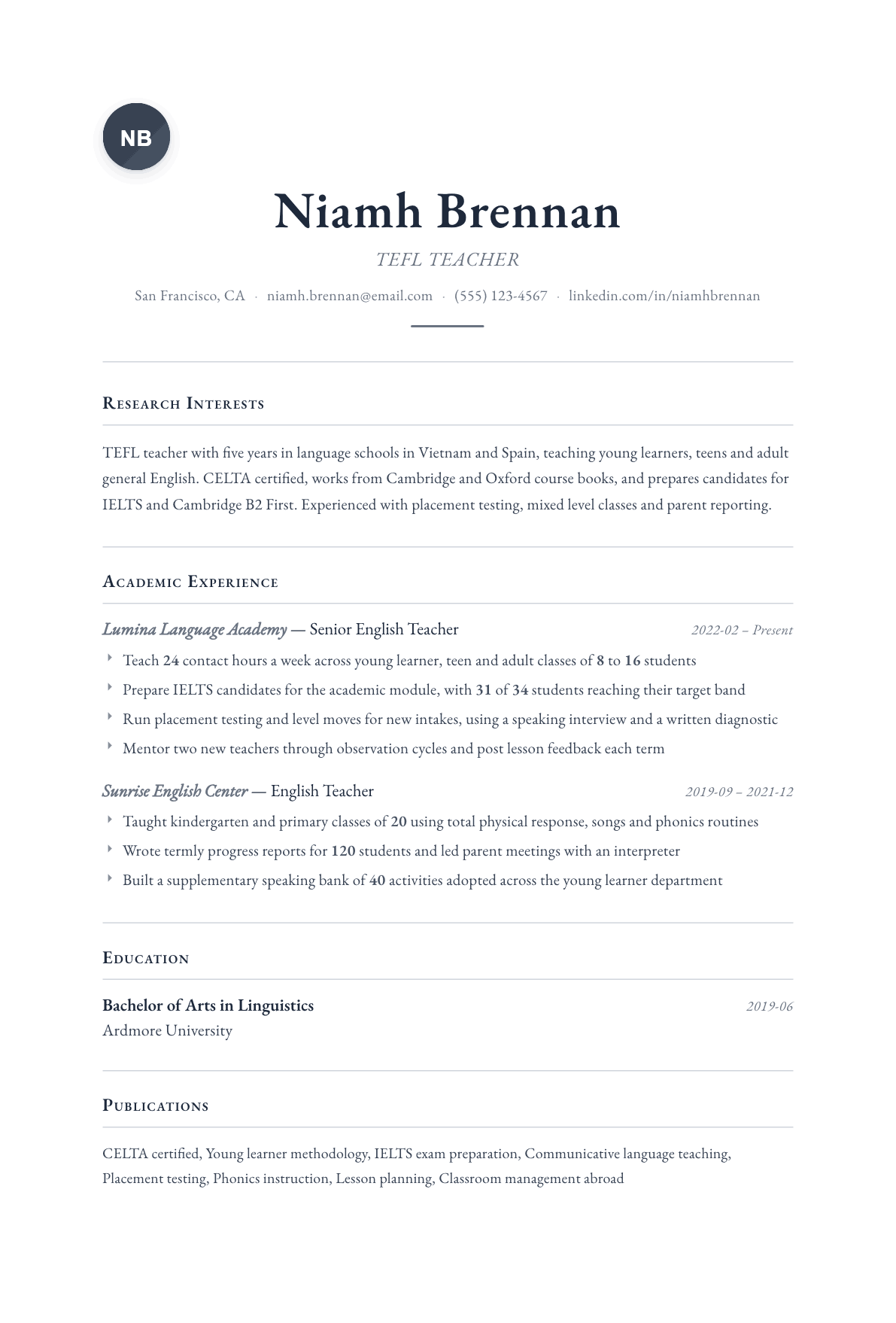
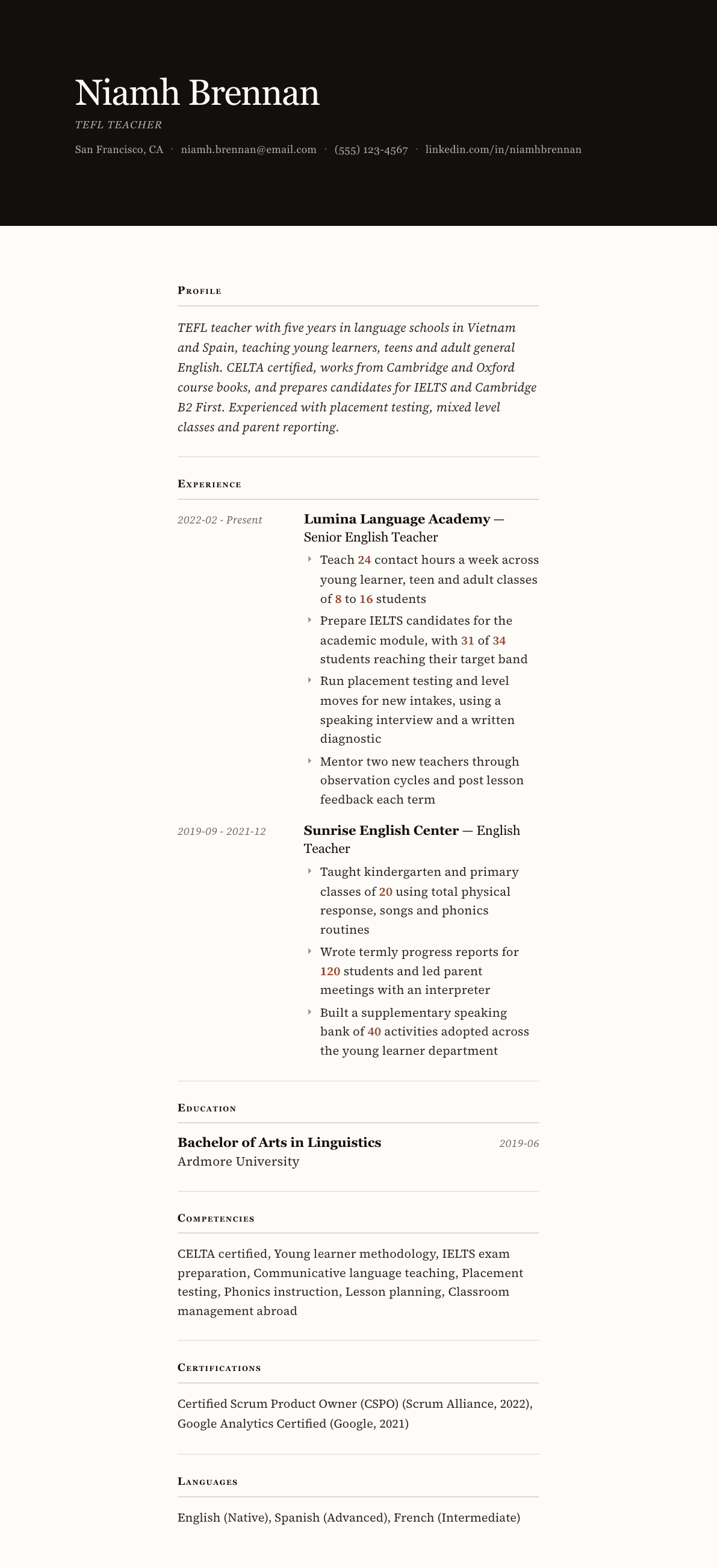
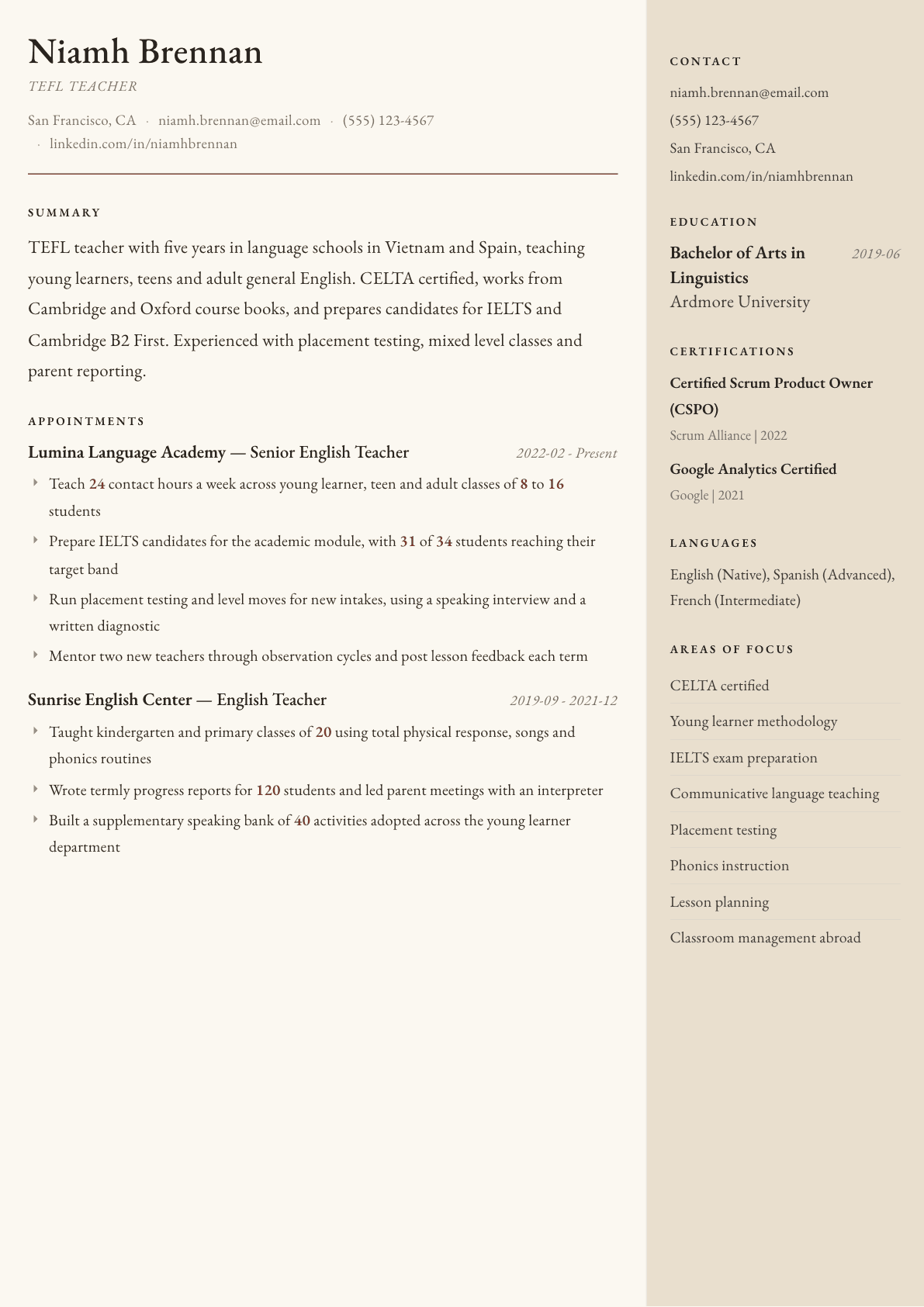
Example TEFL Teacher summary
TEFL teacher with five years in language schools in Vietnam and Spain, teaching young learners through adult exam classes. CELTA certified, carrying twenty four contact hours a week, preparing IELTS and Cambridge candidates, and running placement testing for new intakes. Comfortable with mixed level rooms, phonics routines for very young learners, and parent reporting through an interpreter.
Skills to list on a TEFL Teacher resume
- CELTA and TEFL methodology
- Communicative language teaching
- Young learner instruction
- Teen and adult general English
- IELTS preparation
- Cambridge exam preparation
- Business English
- Phonics and pronunciation
- Placement and diagnostic testing
- Lesson planning and staging
- Course book adaptation
- Mixed level classroom management
- Online and hybrid teaching
- Progress reporting to parents
What actually gets this resume read
- Put your CELTA, CertTESOL or hour count TEFL certificate in the header, since recruiters filter on it first.
- Name the countries and school types you have taught in, because visa eligibility often depends on that history.
- State the learner ages, class sizes and levels you can teach, from young learners through adult exam classes.
- List the course books and exams you know, such as Cambridge exams and IELTS, because schools teach to them.
- Give results plainly: exam pass bands, retention across terms, or classes you were asked to take over.
- Mention your degree, nationality where visas require it, and any second language, since these gate applications.
How to write a tefl teacher resume
A TEFL teacher resume is a hiring document and an immigration document at the same time. The academic manager at a language school reads it to see which classes you can take. The school's administrator reads it to see whether you can be granted a work visa in that country, which usually depends on nationality, a bachelor's degree, a recognized certificate and a clean background check. If the second reader cannot answer her questions, the first never gets the file.
That is why a TEFL resume looks different from a domestic teaching resume. The certificate goes at the top with its hour count and awarding body. The degree is stated plainly even when it is unrelated to English. Nationality and visa eligibility appear where a recruiter can see them, because in many countries they are a legal condition rather than a preference.
This guide covers that structure, three summaries at different points in a TEFL career, before and after bullets that replace classroom generalities with method, and the questions people ask when applying abroad for the first time or moving from young learners into adult exam classes.
Format: one page, certificate and degree at the top, photo only where expected
One page for almost every language school application. Recruiters handle large volumes across time zones and read on a phone as often as a screen, so a single clean column with clear headings travels better than any design. Save the file with your name and the position in the filename, since recruiters sort by it.
Some markets still expect a photograph and a date of birth on a teaching resume, and some explicitly forbid them. Follow the convention of the country you are applying to, and when the school's own application form asks for those fields, let the form carry them rather than the resume.
- Header: name, nationality, current location, phone with country code, email.
- A qualifications line directly under it: certificate with hours and awarding body, degree with subject.
- Sections: summary, qualifications, teaching experience, education, skills, availability and visa status.
Summary: certificate, countries, learner ages, levels
Open with the certificate and the years taught, then the countries and school types. A recruiter needs to know quickly whether your experience is private language academy, public school placement, university, in-company business English or online, because the classroom realities differ enormously.
Then learner ages and levels. Very young learners, young learners, teenagers, adult general English and exam classes each need different training, and a school hires to fill one of them. Add contact hours per week if your record is strong, since the number tells an academic manager what load you can carry.
Experience: hours, levels, course books, exams, results
Open each role with the load: contact hours a week, class sizes, age bands and levels taught. Twenty four contact hours across young learner, teen and adult classes of eight to sixteen tells an academic manager more than a paragraph about student centered teaching.
Then name the material. Course book series, the level framework the school worked to, and any examination you prepared students for. Schools teach to a syllabus and a shelf, and a teacher who already knows the book or the exam needs far less induction. IELTS, Cambridge exams, business English frameworks and young learner exam suites are all worth naming explicitly.
Show method rather than adjectives. Staging a lesson, eliciting instead of explaining, drilling and pronunciation work, total physical response with very young learners, phonics routines, error correction technique, and using the first language sparingly are all concrete and all things an observer would look for.
Then results. Exam bands achieved, students moved up a level after placement review, classes retained across terms, or a teacher observation grade if your school used one. Language schools live on retention and referrals, so a teacher whose classes come back is directly valuable.
Qualifications, visa eligibility and the administrative block
State the certificate precisely: the name, the awarding body and the hour count, plus whether it included assessed teaching practice with real learners. Assessed practice is what separates a serious certificate from a weekend online course, and academic managers know the difference.
Then a short administrative block answering the visa questions before they are asked: nationality, degree subject and awarding institution, whether your documents are apostilled or authenticated, background check status, and your earliest start date. Recruiters filter on these constantly, and a candidate who supplies them moves to the front of the queue.
- Certificate name, awarding body, hours, and assessed teaching practice hours.
- Bachelor's degree with subject and institution, and any higher qualification.
- Nationality, visa eligibility and document authentication status.
- Background check, medical clearance and earliest available start date.
Skills, keywords and the parts of the job outside the classroom
Language school postings recycle a small vocabulary: communicative approach, lesson planning and staging, classroom management, differentiation, placement testing, progress reporting, course book adaptation and exam preparation. Use the ones you can defend, once in the skills list and once inside an experience bullet.
Add the work around the teaching, because it is what makes a teacher easy to keep. Placement and diagnostic testing, writing progress reports, parent meetings sometimes through an interpreter, demo lessons for prospective families, covering colleagues at short notice, and mentoring new arrivals. Schools abroad depend heavily on teachers who can do these things without supervision.
TEFL Teacher resume summary examples
Newly certified
Newly certified English teacher with a 120 hour TEFL certificate including 8 hours of assessed teaching practice and a bachelor's degree in history. Taught 2 terms of volunteer conversation classes to adult learners at A2 to B1 level, and available for placement with a September start.
Experienced classroom teacher
TEFL teacher with 5 years in language schools in Vietnam and Spain, CELTA certified, carrying 24 contact hours a week across young learner, teen and adult classes. Prepares IELTS candidates for the academic module, with 31 of 34 students reaching their target band last year.
Senior teacher and trainer
Senior English teacher with 12 years abroad and a diploma level qualification, responsible for placement testing, timetabling and teacher development at a school of 18 staff. Observes and mentors new teachers, writes the young learner syllabus, and prepares Cambridge exam classes.
Work experience bullets: before and after
Before: Taught English to students of different levels.
After: Taught 24 contact hours a week across young learner, teen and adult classes of 8 to 16 students, covering A1 to C1 general English and exam preparation groups.
Contact hours, class sizes and the level range tell an academic manager exactly which slots on the timetable you can fill.
Before: Prepared students for the IELTS exam.
After: Prepared IELTS academic candidates through weekly writing task feedback, timed speaking practice and reading strategy work, with 31 of 34 students reaching their target band.
The named exam components and the outcome show a working method rather than a class label.
Before: Taught young children using games and songs.
After: Taught kindergarten and primary classes of 20 using total physical response, action songs and a phonics routine, with flashcard drilling and a fixed lesson stage sequence each session.
Naming the young learner methodology proves training, since games alone describe every classroom abroad.
Before: Tested new students to put them in the right class.
After: Ran placement testing for new intakes using a written diagnostic and a short speaking interview, then recommended level moves at the mid term review with written justification.
The two part assessment and the review cycle show you can be trusted with the timetable, not just a classroom.
Before: Wrote reports for parents about student progress.
After: Wrote termly progress reports for 120 students against the school's level descriptors and led parent meetings through an interpreter to explain next steps at home.
Volume, the descriptor framework and the interpreted meetings show the administrative half of the job being done well.
Hard skills
- Communicative language teaching
- Lesson planning and staging
- Very young learner methodology
- Teen and adult general English
- IELTS preparation
- Cambridge exam preparation
- Business English delivery
- Phonics and pronunciation work
- Placement and diagnostic testing
- Course book adaptation
- Error correction technique
- Mixed ability classroom management
- Online and hybrid lesson delivery
- Progress reporting and parent meetings
Soft skills
- Adapting to a new country quickly
- Cultural sensitivity in the classroom
- Clear instruction with limited shared language
- Reliability with a heavy timetable
- Collaboration with local staff
- Openness to observation and feedback
Certifications worth listing
- CELTA, Certificate in Teaching English to Speakers of Other Languages (Cambridge Assessment English)
- DELTA, Diploma in Teaching English to Speakers of Other Languages (Cambridge Assessment English)
- CertTESOL, Certificate in Teaching English to Speakers of Other Languages (Trinity College London)
Mistakes that cost tefl teacher candidates the interview
- Burying the certificate and its awarding body, when it is the first field a language school recruiter checks.
- Leaving out nationality and degree status, which are visa conditions in many countries rather than preferences.
- Writing that you taught all levels without naming the level framework or the course books you worked from.
- Giving no contact hours or class sizes, so an academic manager cannot judge the load you have carried.
- Describing lessons as fun and engaging instead of naming the methodology behind them.
- Ignoring the exam classes you prepared, which are the hardest classes for a school to staff.
- Sending the same document to every country when photograph and personal detail conventions differ.
TEFL Teacher resume questions
What TEFL certificate do employers actually accept?
Schools generally look for at least a 120 hour course with assessed teaching practice on real learners. A CELTA or Trinity CertTESOL carries the most weight internationally, though many reputable schools accept other accredited courses that include observed practice.
Do I need a degree to teach English abroad?
Often yes, because the work visa requires one rather than the school. Countries with degree requirements will not sponsor you without it, whatever the subject. Where a degree is not required, the certificate and experience carry the application.
Should I put a photo on my TEFL resume?
It depends on the market. Some regions expect a photograph and basic personal details on a teaching resume, while others treat them as inappropriate. Follow the convention where you are applying, and let the school's own form carry those fields when it asks.
How do I write a TEFL resume with no classroom experience?
Lead with the certificate and its assessed teaching practice, describing what you taught and to whom. Then add tutoring, volunteer conversation classes, camp work, coaching or any role where you instructed a group, and state your earliest available start date.
How do I move from young learners into adult exam teaching?
Say so in the summary and name the transferable parts: lesson staging, error correction and assessment. Then add exam familiarity through a preparation course, observing colleagues, or taking the exam yourself, and lead each entry with your oldest and highest level classes.