Landscape Architect Resume Examples: what gets the call
Write a Landscape Architect Resume That Wins Site Design Work
By Mustafa Tarabya, founder of CVBooster · Published · Updated
Landscape architect resume example with licensure placement, grading and planting plan bullets, CAD keywords, and a full writing guide.
Sample resumes for a landscape architect
The same landscape architect content laid out in three CVBooster templates, so you can see what the finished document looks like before you write a word.
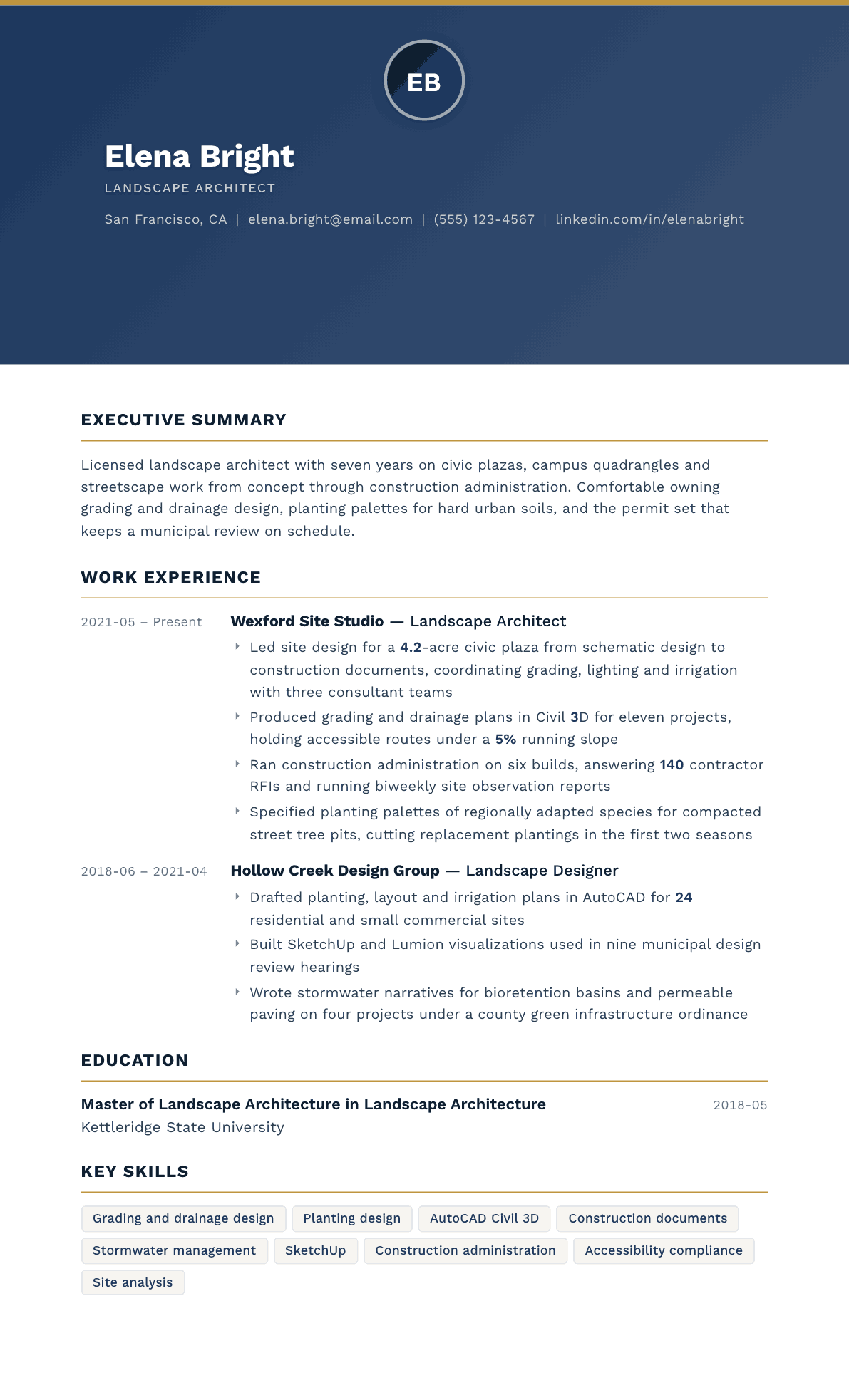
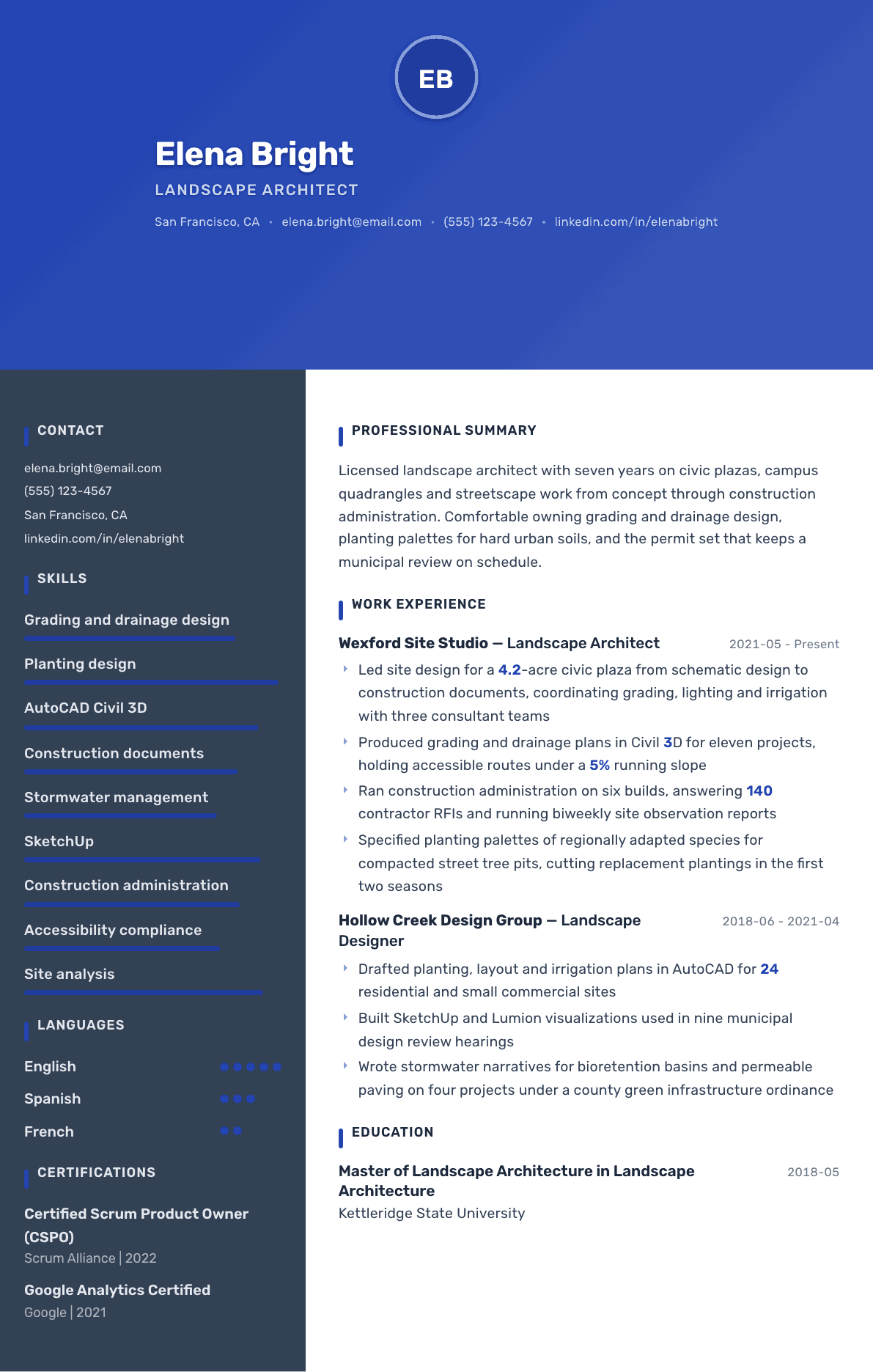
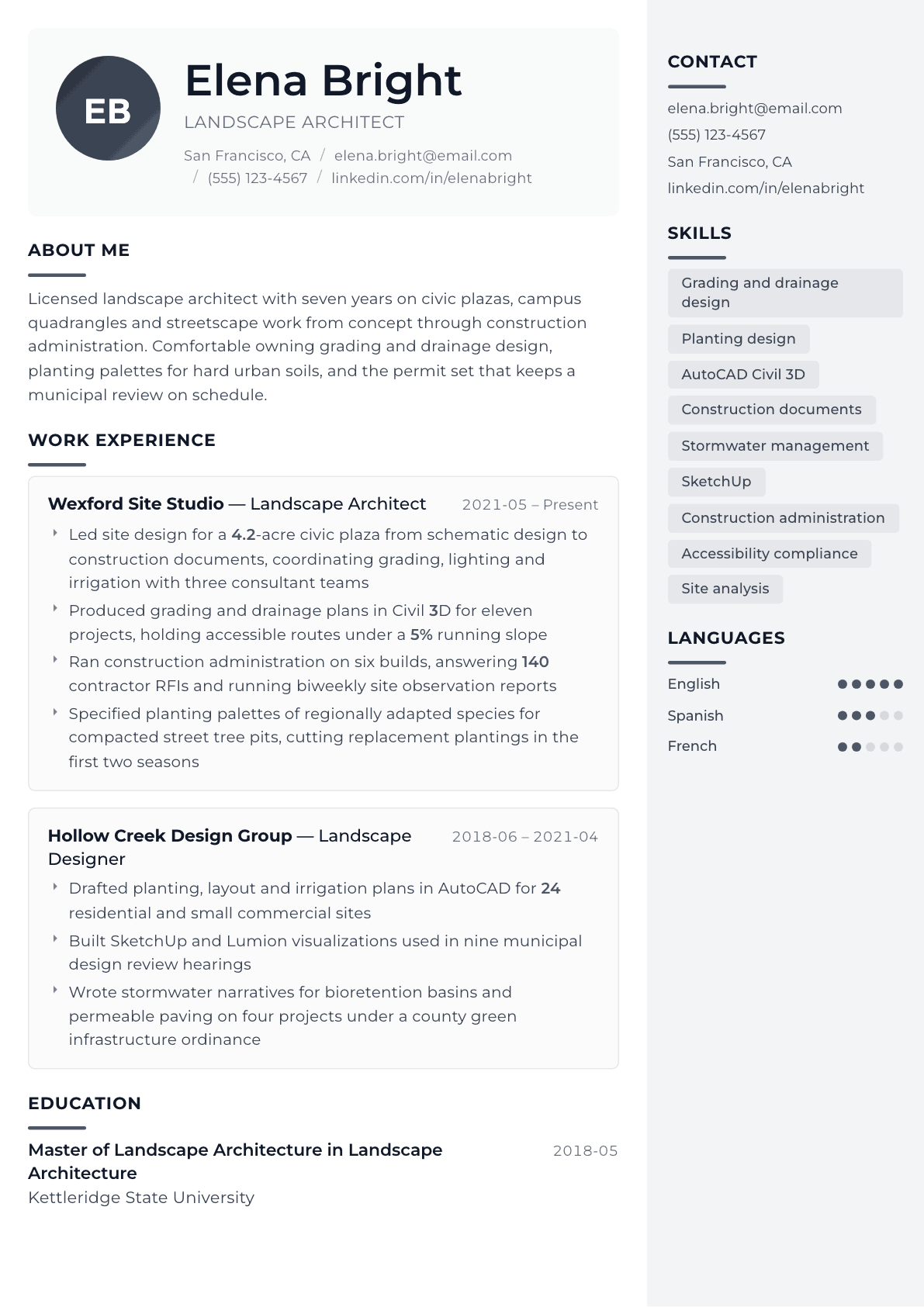
Example Landscape Architect summary
Licensed landscape architect with seven years designing public realm projects from concept sketches through construction administration. Strong in grading, drainage and planting design for compacted urban soils, with drawing sets produced in Civil 3D and Rhino. Presented eleven projects to municipal design review boards and administered construction on six completed builds. Looking for a project manager seat in a public realm studio.
Skills to list on a Landscape Architect resume
- Site planning
- Grading and drainage
- Planting design
- AutoCAD
- Civil 3D
- Rhino
- SketchUp
- Adobe Creative Suite
- GIS mapping
- Construction documentation
- Specification writing
- Stormwater design
- Irrigation design
- Cost estimating
- Client presentations
- Permit coordination
What actually gets this resume read
- Put your state licensure and your license number placement in the header so a firm can verify you before the interview.
- Name the project types you have carried: parks, campus, streetscape, residential estates or transit plazas each hire differently.
- Give acreage or budget scale on every project so a principal can judge whether you have run work of their size.
- Separate the phases you owned, because concept design and construction administration are two different hiring needs.
- List the software by exact product name, since firms filter on Civil 3D, Vectorworks Landmark, Rhino and Adobe Creative Suite.
- Mention the review bodies you have presented to, such as planning commissions, design review boards or historic commissions.
- Attach a portfolio link near your contact block, because no landscape architecture role is offered without drawings.
How to write a landscape architect resume
A landscape architect resume is screened by a studio principal who has a specific hole to fill: someone to run construction documents, someone to carry design development, or someone who can stand in front of a planning commission without the firm losing the room. The resume that gets a call answers which of those you are in the first six lines.
Licensure is the second filter. Registration decides who can stamp a drawing set, so a firm sorts the pile into licensed, sitting for the exam, and unlicensed before anyone reads a project description. Bury that fact on page two and the file is judged as if you were unlicensed.
The rest of the read is about project type and phase. Parks, campus master planning, streetscape, transit, resort and high end residential are separate hiring tracks with different clients and different drawing habits. This guide covers the format, the summary, how to write project experience that shows phase ownership, the software list, and the questions that come up in every landscape architecture job search.
Format: two pages, plus a portfolio link that actually opens
Reverse chronological, two pages once you are past your first job, one page while you are still a designer with a single position. Keep the layout clean enough that an applicant tracking system reads it, then send a portfolio separately, because no design office hires from words alone.
The portfolio link belongs in the contact block, next to your phone and email, as a plain URL. Check that it opens without a password prompt and that the file behind it is under the size limit most firm inboxes enforce.
- Header: name, professional credentials, city and state, phone, email, portfolio link.
- Section order: summary, licensure and registration, experience, education, software, professional service.
- A recent graduate moves education up and adds a studio project section with the site, program and scale of each.
Licensure and registration deserve their own block
Give the states where you are registered and note whether you hold certification from the Council of Landscape Architectural Registration Boards, since that is what makes reciprocity in a second state quick. If you are mid exam, list the sections you have passed and the section you are sitting next. That reads as momentum rather than as a gap.
Related credentials go in the same block: sustainability accreditations, erosion and sediment control certification, and any arborist or irrigation credential you carry. A firm chasing a green infrastructure contract reads that block as a capability list.
Experience: name the phase you owned, not the project you touched
Every job entry needs the studio, your title, and one line describing the work the office does. Under it, write projects rather than duties. A project bullet carries four things: what it was, how big, which phases you personally carried, and what happened when it was built.
Phase language is the vocabulary a principal scans for: site analysis, schematic design, design development, construction documents, bidding, construction administration. Saying you produced a full construction document set for a two acre park tells a reader more than three sentences about collaboration.
Coordination is worth a bullet of its own because it is most of the job. Naming the civil engineer, the electrical consultant, the irrigation designer and the geotechnical report you had to reconcile shows you can hold a drawing set together while five disciplines change it under you.
- Scale: acreage, linear feet of streetscape, construction cost range, or number of trees and beds.
- Phase: which drawings you produced and stamped, and which you reviewed.
- Outcome: permit approved, project built, award received, or a design review board vote.
Software and technical skills, by exact product name
Firms filter on tools. Write AutoCAD and Civil 3D separately, because grading in Civil 3D is a different skill from drafting in plain AutoCAD. Add Rhino and Grasshopper if you model terrain parametrically, Vectorworks Landmark if that is the office standard where you trained, and the visualization stack you actually use for boards and hearings.
Technical skills sit next to the tools: grading and drainage design, stormwater capture sizing, planting specification, irrigation zoning, cost estimating and accessible route design. These are the phrases a job posting repeats, so mirror the ones you can defend in an interview.
Keywords the applicant tracking system is filtering for
Public agency and large firm postings reuse the same phrases: site planning, construction documentation, construction administration, planting design, stormwater management, public engagement, and the state registration requirement. Put each phrase once where it belongs, in the summary, the skills block or a project bullet, and let the human read the rest.
For public sector work, add the procurement vocabulary too. Experience responding to a request for qualifications, working under a term contract, or presenting at a public meeting is what separates candidates for a municipal design office.
Landscape Architect resume summary examples
Recent graduate
Master of Landscape Architecture graduate with studio work in urban stream restoration and a 6-acre campus quad proposal. Skilled in Civil 3D grading, Rhino terrain modeling and Adobe layout. Completed a summer internship producing planting plans and construction details for two neighborhood park projects.
Five years in
Landscape designer with five years in a public realm studio, carrying schematic design through construction documents on streetscape and park projects up to 4 acres. Produces grading, layout, planting and detail sheets in Civil 3D. Passed three sections of the registration exam and presented at four design review hearings.
Licensed project manager
Registered landscape architect with twelve years leading civic and campus projects from pursuit through construction administration. Manages consultant teams, budgets and municipal approvals, and has stamped documents for eighteen built projects. Deep experience in green infrastructure retrofits and accessible route design on constrained downtown sites.
Work experience bullets: before and after
Before: Worked on park design projects for the firm.
After: Carried a 4-acre neighborhood park from schematic design through construction documents, producing grading, layout, planting and detail sheets on a mid seven figure construction budget.
The scale, the phases and the budget let a principal place you against the work sitting on their desk.
Before: Responsible for grading plans.
After: Designed grading and drainage for eleven sites in Civil 3D, holding accessible routes under 5% running slope and keeping cut and fill balanced to avoid export costs.
A tolerance and a cost consequence turn a task into evidence of technical judgment.
Before: Selected plants for projects.
After: Specified planting palettes of drought tolerant native species for 240 street tree pits with compacted subgrade, reducing first season replacements to under 4%.
Naming the condition and the survival outcome shows planting knowledge instead of a plant list.
Before: Attended community meetings.
After: Presented three schematic options at two public workshops, recorded resident feedback, and revised the plaza layout so the approved scheme passed design review on the first vote.
The bullet now shows a public process ending in an approval, which is what a civic client buys.
Before: Helped during construction.
After: Ran construction administration on six builds: reviewed 190 submittals, answered 140 requests for information, and issued biweekly field observation reports with punch list photos.
Submittal and information request volume is the only honest measure of construction administration experience.
Hard skills
- Site planning and analysis
- Grading and drainage design
- Planting design and specification
- AutoCAD Civil 3D
- Rhino and Grasshopper
- SketchUp and rendering
- Construction documentation
- Construction administration
- Stormwater and green infrastructure
- Irrigation design coordination
- Cost estimating
- GIS and site data analysis
- Accessible route design
Soft skills
- Consultant coordination
- Public presentation
- Client management
- Design critique and mentoring
- Deadline management under review cycles
- Written technical communication
Certifications worth listing
- CLARB Certification (Council of Landscape Architectural Registration Boards)
- LEED AP Building Design and Construction (Green Business Certification Inc.)
- SITES AP (Green Business Certification Inc.)
- Certified Professional in Erosion and Sediment Control (EnviroCert International)
- ISA Certified Arborist (International Society of Arboriculture)
Mistakes that cost landscape architect candidates the interview
- Hiding registration status at the bottom of the resume, so a firm sorting for a stamping role never finds it.
- Describing projects without scale, which leaves a principal unable to tell a courtyard from a regional park.
- Listing every phase on every project when you only drafted details on most of them, because references check this.
- Sending a heavily graphic resume that the applicant tracking system shreds; keep the graphics in the portfolio instead.
- Naming software as a single line called design tools rather than the specific products a posting filters on.
- Leaving out construction administration entirely, which reads as a candidate who has never seen a drawing get built.
Landscape Architect resume questions
Do I need a license to apply for a landscape architect position?
Not always, but the posting will say. Many firms hire unlicensed designers and expect exam progress. If a role involves stamping drawings or serving as the responsible professional, registration in that state is a hard requirement you cannot work around.
Should the portfolio go with the resume or wait until the firm asks?
Send a short portfolio or a link with the application every time. Design offices screen visually, and a resume with no images attached usually loses to one that arrived with ten pages of drawings and built photography.
How do I show construction administration experience on a resume?
Use volume and cadence. Give the number of projects you administered, how many submittals and information requests you handled, how often you were on site, and whether you closed out punch lists and final acceptance.
What if most of my work has been residential and I want civic projects?
Lead with the transferable technical work: grading, drainage, planting under difficult soil, and detailing that got built. Then name any public process exposure, permitting or agency review you handled, since that is the gap a civic studio worries about.
How many projects should I list under each job?
Three to five for your current role and two or three for earlier ones. Choose by relevance to the posting, not by how much you liked them, and keep one line each so the page stays readable.
Related resume examples
- Civil Engineer Resume example
- Construction Manager Resume example
- Landscape Designer Resume example
- Landscaper Resume example
- Architect Resume example
- Architectural Designer Resume example