Landscaper Resume Examples: free ATS score and gap list
A Sample Resume for Landscape Work, From Laborer to Foreman
By Mustafa Tarabya, founder of CVBooster · Published · Updated
Sample resumes for landscape work: laborer, crew leader and foreman, with a landscaping resume example written out and the keywords grounds employers read.
Sample resumes for a landscaper
The same landscaper content laid out in three CVBooster templates, so you can see what the finished document looks like before you write a word.
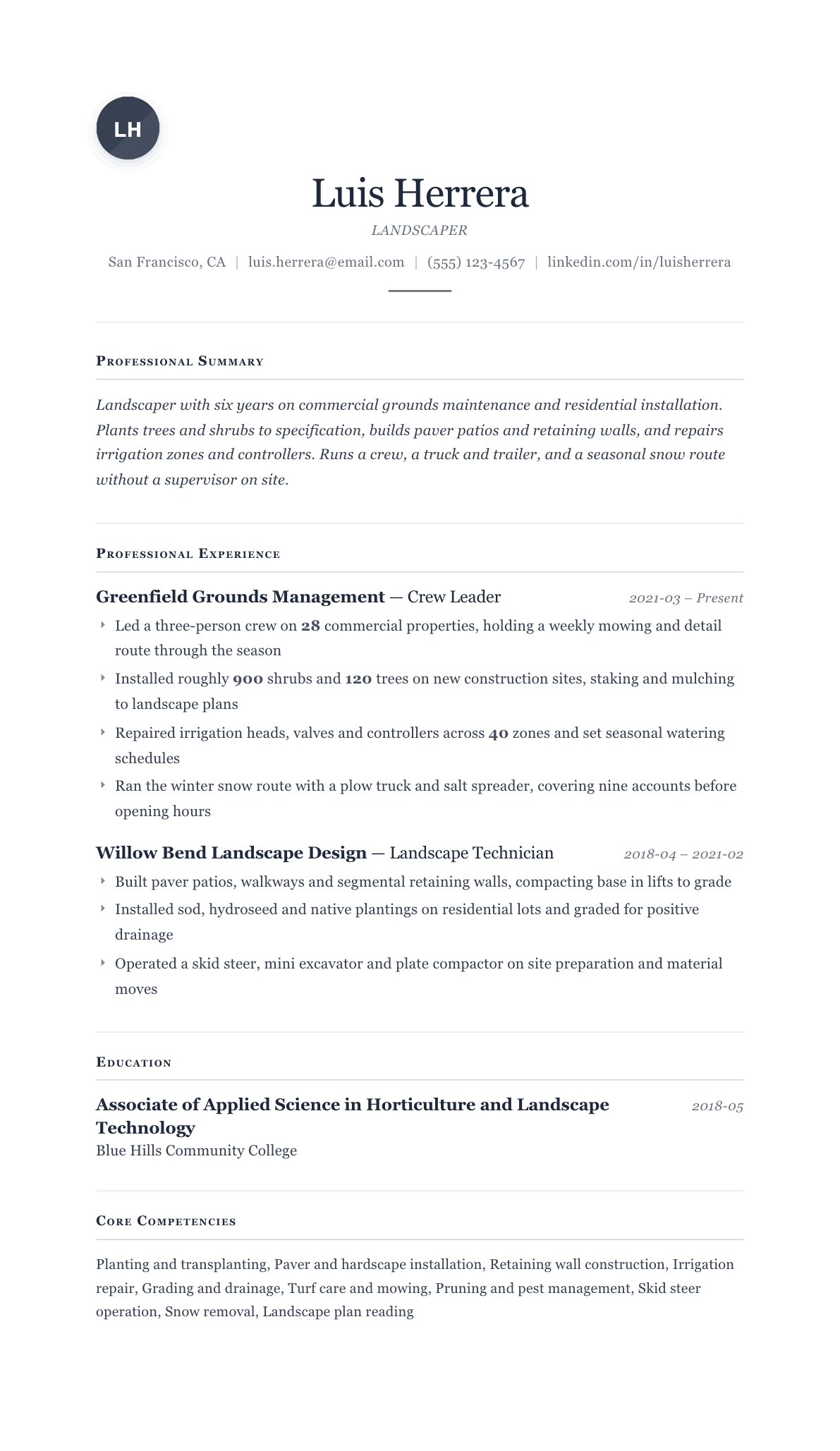
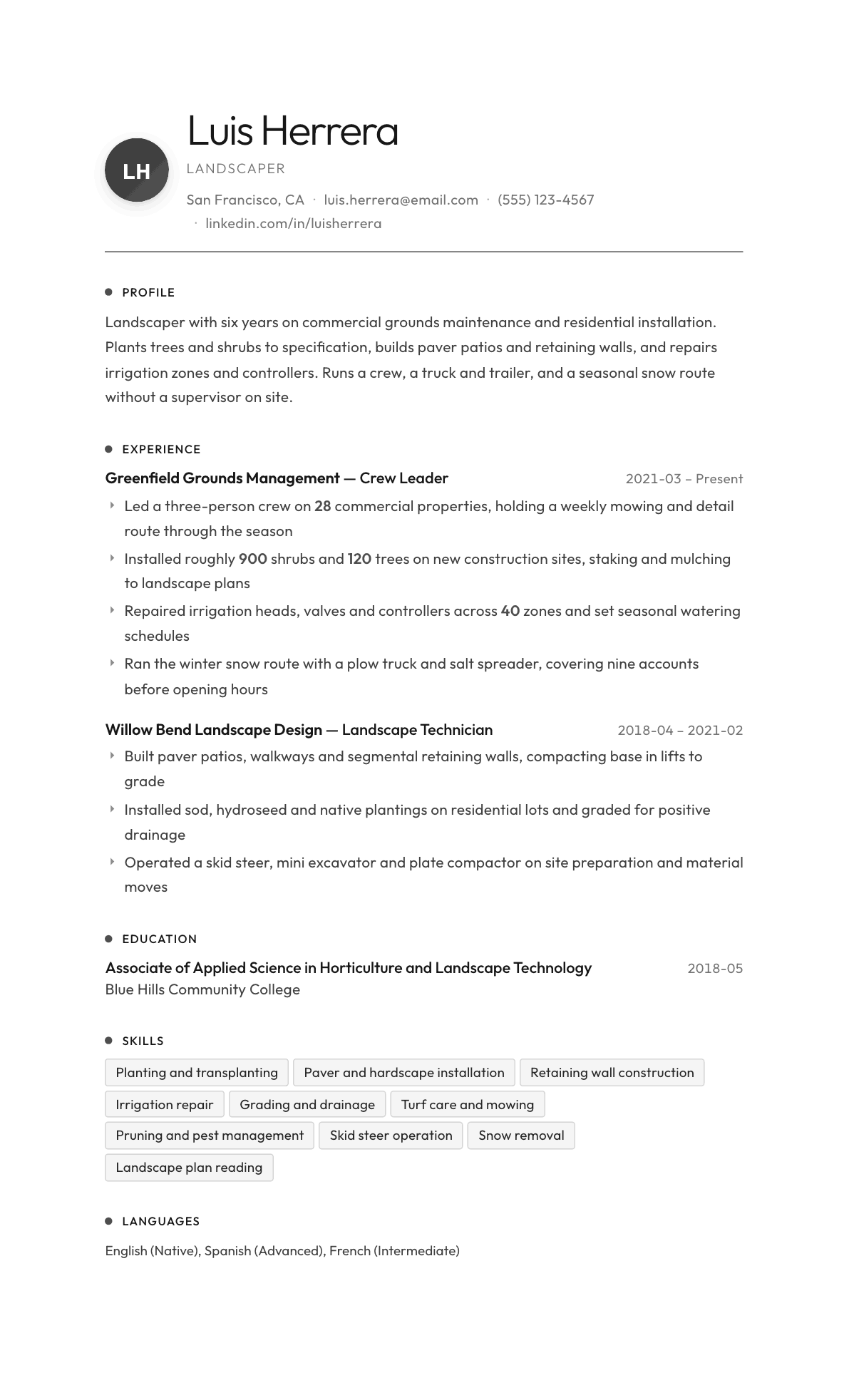
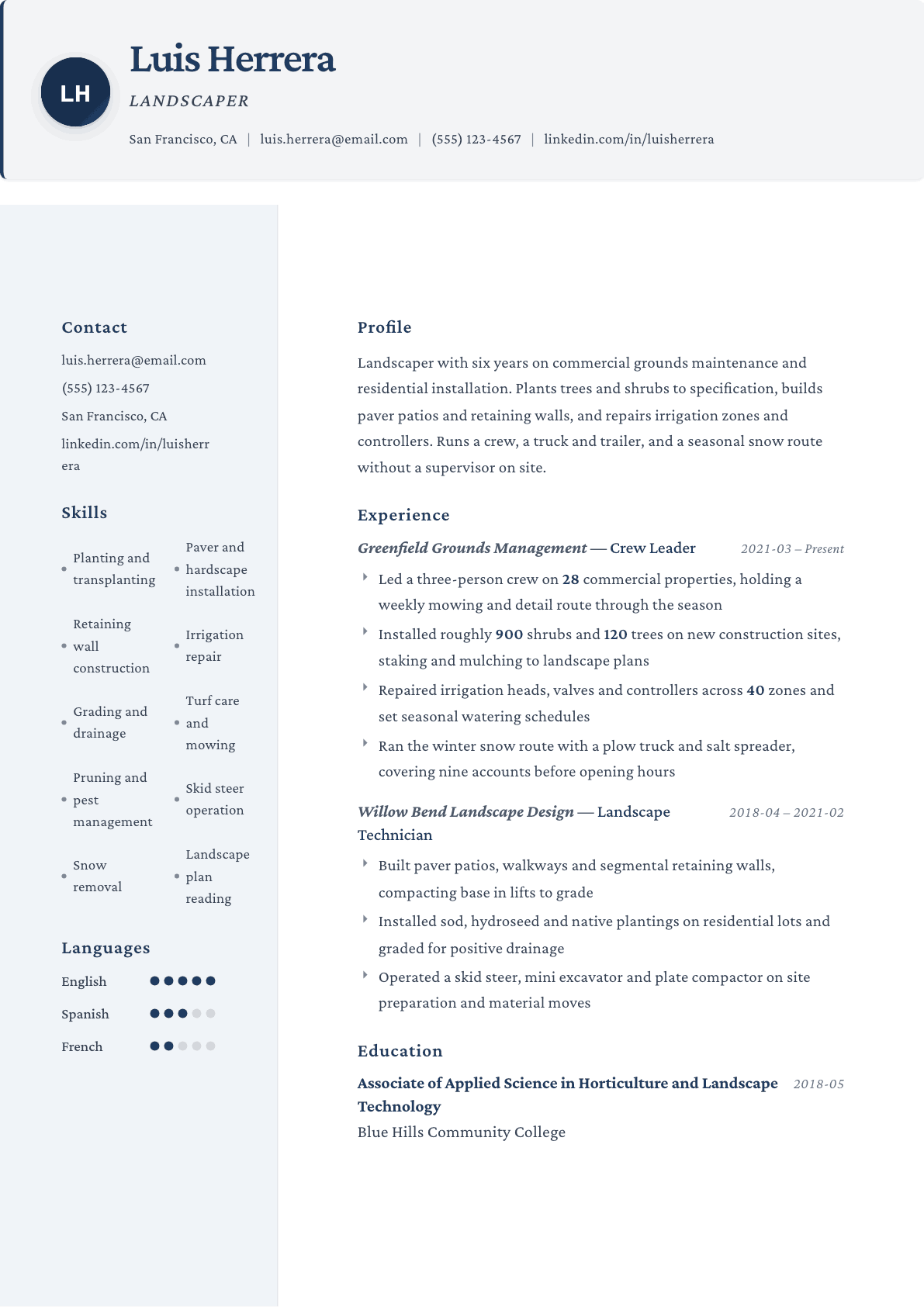
Example Landscaper summary
Landscaper with six years running commercial maintenance routes and building residential installations. Plants trees and shrubs to landscape plans, sets pavers and segmental walls over compacted base, and repairs irrigation zones and controllers. Leads a small crew, operates skid steer and mini excavator, and covers a winter plow route so accounts stay serviced all year.
Skills to list on a Landscaper resume
- Landscape installation
- Grounds maintenance
- Tree and shrub planting
- Pruning and trimming
- Turf management
- Sod and hydroseed
- Paver patios and walkways
- Segmental retaining walls
- Grading and drainage
- Irrigation installation and repair
- Controller programming
- Mulching and bed edging
- Skid steer and mini excavator
- Snow plowing and salting
- Landscape plan reading
- Crew leadership
What actually gets this resume read
- Separate maintenance work from installation work, because grounds crews and build crews are hired on different skills.
- Name the equipment you operate, from skid steer and mini excavator to stand-on mowers and plate compactors.
- Give property counts or route sizes so a manager can tell whether you can carry their book of accounts.
- List irrigation experience by task: head replacement, valve repair, controller programming and winterization.
- Mention pesticide applicator licensing and the state that issued it, since treatment work is legally restricted.
- Include snow and ice work if you have it, because year-round crews are worth more than seasonal ones to an employer.
How to write a landscaper resume
Landscaping companies live and die on route efficiency and callbacks. The person reading your resume is working out two things: how many properties you can carry in a week without supervision, and whether the plants you put in the ground are still alive next spring. Everything useful you can write serves one of those two questions.
The trade also splits into maintenance and installation, and the split matters more than most applicants realize. A maintenance crew leader runs a route, a schedule and a client list. An installation crew builds hardscape, moves dirt and reads a landscape plan. Some people do both, but a resume that never says which one you are leaves a hiring manager guessing.
This guide covers the layout, what belongs in each section, landscape resume examples written out for a laborer, a crew leader, a lawn care technician and a foreman, three summaries covering a crew member, a lead and a manager, five rewritten bullets, and the questions landscapers ask when they finally sit down to write.
Format: one page, maintenance and installation kept apart
One page, reverse-chronological, plain layout. Under each employer, split what you did into maintenance and installation if you did both, because a grounds manager hiring for a route and a design build company hiring for a build crew are reading for opposite things.
Put the practical facts high on the page: driving license class, whether you tow a trailer, whether you hold a pesticide applicator license and in which state, and whether you work through winter. Seasonality is the central problem of this industry, and an applicant who is available year round is worth more to an employer than one who is not.
- Header: name, role, city and state, phone, email, license class and towing experience.
- Order: summary, licenses and certifications, work history split by maintenance and installation, equipment, skills.
- Crew members list equipment operated and seasons worked before anything else.
Summary: route size, build scope and equipment
Open with scale. The number of properties on your route, the size of the crew you led, or the scope of the installations you built. A landscaper who has run twenty eight commercial accounts through a full season has proven something that no adjective can substitute for.
Then name the work: planting, pruning, turf care, irrigation, hardscape, grading and drainage, snow and ice. Add the equipment you operate, because a landscaper who can run a skid steer and a mini excavator can be put on a build crew on a rainy Tuesday when the mowers stay parked.
Experience: counts, plants and what survived
On maintenance work, give the route: number of properties, property type, crew size and the frequency you held. Then the tasks that require judgment rather than repetition, such as pruning timing on flowering shrubs, turf treatments and thresholds, bed renovation, and how you handled client complaints without a manager on site.
On installation work, give the quantities: trees and shrubs planted, square footage of sod or paver patio, linear feet of retaining wall, cubic yards of soil moved. Add the plan reading, because installing to a landscape architect drawing with a plant schedule and a planting detail is a different job from putting in what looks right.
Irrigation is the part most resumes shortchange. Head and nozzle replacement, valve and solenoid repair, wire tracing, controller programming, backflow testing where you are permitted to do it, and winterization all show a landscaper who can be sent to a problem rather than a routine.
- Property counts, crew size and service frequency on maintenance routes.
- Plant quantities, hardscape areas and wall lengths on installations.
- Irrigation tasks performed and the number of zones or controllers you managed.
- Snow and ice route details if you have them, including equipment and account count.
Licenses, equipment and safety
A pesticide applicator license belongs near the top with the issuing state, because treatment work is legally restricted and a licensed applicator changes what a crew can be scheduled to do. Add any horticulture credential, arborist certification or equipment training you hold, each with the body that issued it.
Then the equipment list, which functions as a capability list. Stand-on and zero-turn mowers, skid steer, mini excavator, compact track loader, plate compactor, stump grinder, chainsaws and pole saws, aerators and sod cutters, plow trucks and salt spreaders. Say which you have operated regularly rather than which you have touched once.
Keywords a landscape employer searches for
Mirror the language in postings: landscaper, grounds maintenance, crew leader, landscape installation, planting, pruning, turf management, fertilization, sod, hydroseed, mulching, bed edging, paver patio, segmental retaining wall, grading, drainage, irrigation repair, controller programming, backflow, snow removal, skid steer, pesticide applicator license. Use the ones that describe your real work.
Landscape resume examples and samples: laborer, crew leader, lawn technician, foreman
A landscaping resume is read for scope and reliability: what kind of work, how many properties or projects, which equipment, and whether you show up every day of the season. Postings call the same entry job a landscape worker, landscape laborer or groundskeeper, so use the title the posting uses. The landscaping resume samples below are written as one experience bullet set per level. Swap in your own route size, plants and machines, and keep the numbers.
Example top block for a crew leader: Luis Romero, Landscape Crew Leader. Five seasons in commercial maintenance and installation, leading a three person crew on a route of 28 properties. Holds a state pesticide applicator license and a clean commercial driving record, and runs a skid steer, mini excavator and zero turn mowers.
Example top block for a first season laborer: Tyler Brooks, Landscape Laborer. One season on a residential maintenance crew, mowing, edging, string trimming and blowing on a two person route, plus spring mulch and bed cleanups. Valid driver license, comfortable towing a trailer, available Saturdays and for snow callouts.
Example top block for a lawn care technician: Marcus Bell, Lawn Care Technician. Three seasons running a solo fertilization and weed control route of about 40 residential stops a day, with a state pesticide applicator license in the turf category. Calibrates the spreader and sprayer each morning, logs every application in the company record and leaves a service note at each door.
- Laborer: Mowed, edged and trimmed 30 residential properties a week on a two person crew, and helped install 2,000 square feet of paver patio in the spring season.
- Laborer: Planted and mulched annual beds for 14 commercial sites and kept a daily equipment checklist with no missed start times all season.
- Crew leader: Led a three person crew on a 28 property commercial route and finished the weekly schedule on time through a 10 week peak season.
- Crew leader: Installed and adjusted irrigation zones on six new builds and cut call backs for dry spots by walking every zone with the client at handover.
- Foreman: Ran four crews and 14 staff, scheduled the routes, and priced and built hardscape jobs including retaining walls and outdoor kitchens.
- Foreman: Trained new hires on equipment safety and kept the division free of lost time injuries for two seasons.
Landscaper resume summary examples
Seasonal crew member
Landscape crew member with two seasons on commercial maintenance, mowing, trimming, edging and mulching across a weekly route. Plants shrubs and annuals, spreads mulch and compost, operates handheld equipment and a stand-on mower, and holds a clean driving record with trailer towing experience.
Crew leader
Landscaper with six years leading a three-person crew across 28 commercial properties, holding a weekly mowing and detail schedule through the season. Installs trees, shrubs and sod to landscape plans, repairs irrigation heads and valves, and runs a winter plow route across nine accounts.
Operations manager
Landscape operations manager with fourteen years running maintenance and installation crews. Schedules four crews across commercial accounts, prices renewals and enhancement work, holds a state pesticide applicator license, and manages equipment maintenance, safety training and seasonal hiring.
Work experience bullets: before and after
Before: Took care of lawns and gardens for clients.
After: Led a three-person crew across 28 commercial properties, holding a weekly mowing, edging and detail schedule from spring through the last cleanup.
Property count, crew size and schedule frequency tell a manager exactly how much route you can carry alone.
Before: Planted trees and bushes on new jobs.
After: Installed roughly 900 shrubs and 120 trees on new construction sites, setting root flare to grade, staking where exposed and mulching to the plant schedule.
Quantities plus planting technique show both production and the horticultural judgment that decides what survives the first winter.
Before: Fixed sprinklers when they broke.
After: Repaired heads, nozzles, valves and solenoids across 40 irrigation zones, traced wire faults on two controllers and set seasonal watering schedules.
Naming components and zone counts turns a vague repair claim into evidence you can be sent to an irrigation call alone.
Before: Built patios and walls.
After: Built paver patios, walkways and segmental retaining walls, compacting base in lifts to grade and setting drainage behind every wall over three courses.
Base compaction and wall drainage are the two things that decide whether hardscape settles, so naming them signals real training.
Before: Did snow removal in the winter.
After: Ran a winter snow route with a plow truck and salt spreader, clearing nine accounts before opening hours and logging material use per event.
Route size, timing and material tracking show a landscaper who keeps the company earning through the off season.
Hard skills
- Grounds maintenance and route management
- Mowing, edging and trimming
- Turf management and fertilization
- Pruning and shrub renovation
- Tree and shrub planting
- Sod, seed and hydroseed installation
- Mulching and bed edging
- Paver patios and walkways
- Segmental retaining wall construction
- Grading and surface drainage
- Irrigation installation and repair
- Controller programming and winterization
- Skid steer and mini excavator operation
- Snow plowing and ice management
- Landscape plan and plant schedule reading
Soft skills
- Client communication on site
- Crew leadership and scheduling
- Reliability through long seasons
- Problem solving without a supervisor
- Care with property and equipment
Certifications worth listing
- Landscape Industry Certified Technician (National Association of Landscape Professionals)
- ISA Certified Arborist (International Society of Arboriculture)
- Certified Irrigation Technician (Irrigation Association)
Mistakes that cost landscaper candidates the interview
- Describing the work as general yard maintenance with no property counts, crew size or service frequency attached.
- Failing to separate maintenance from installation, when employers hire for one or the other and read accordingly.
- Leaving out equipment operated, which is often the single fact that decides whether you can be moved between crews.
- Omitting a pesticide applicator license and the issuing state, since treatment work is legally restricted to license holders.
- Ignoring irrigation entirely, even though repair calls are steady revenue and few applicants can handle them alone.
- Saying nothing about winter work, so an employer assumes you disappear for four months of the year.
- Writing about plants in general terms instead of naming quantities, planting detail and what you did to keep them alive.
Landscaper resume questions
Should a landscaper resume mention a pesticide applicator license?
Yes, near the top with the state that issued it. Treatment work is legally restricted, so a licensed applicator on the crew changes what the company can sell and schedule. It is one of the few credentials in this trade with direct commercial value.
How do I show experience if my work has been seasonal?
Count seasons rather than months and name the employer you returned to, since being asked back is itself a recommendation. Then list any winter work you did, whether snow routes, equipment maintenance or indoor work, so the year reads as continuous employment.
What numbers belong on a landscaping resume?
Property counts and crew size for maintenance, and plant quantities, square footage and wall lengths for installation. Add irrigation zone counts if you handle repairs. These figures let a manager size you against their own routes and crews immediately.
Should a sample resume for landscape work be in landscape orientation?
No. Despite the name, a landscaping resume uses the normal portrait page like any other resume. Landscape orientation squeezes the text into short lines, prints badly and often scrambles in applicant tracking systems. Keep one portrait page with your route size, equipment and licenses near the top.
What does a good landscaping resume example look like?
One page, with a short summary naming the work type, route size or project scale, and your licenses. Under each job, give counts such as properties maintained or square feet installed, the equipment you run and one reliability fact. Seasonal jobs go in as normal entries with the months, and winter work such as snow removal belongs too.
Related resume examples
- Groundskeeper Resume example
- Arborist Resume example
- General Laborer Resume example
- Construction Manager Resume example
- Landscape Designer Resume example
- Road Construction Worker Resume example