Landscape Designer Resume Examples: the lines they read
Build a Landscape Designer Resume That Books Residential Projects
By Mustafa Tarabya, founder of CVBooster · Published · Updated
Landscape designer resume example with planting plan bullets, design build keywords, software terms and a guide to writing each section.
Sample resumes for a landscape designer
The same landscape designer content laid out in three CVBooster templates, so you can see what the finished document looks like before you write a word.
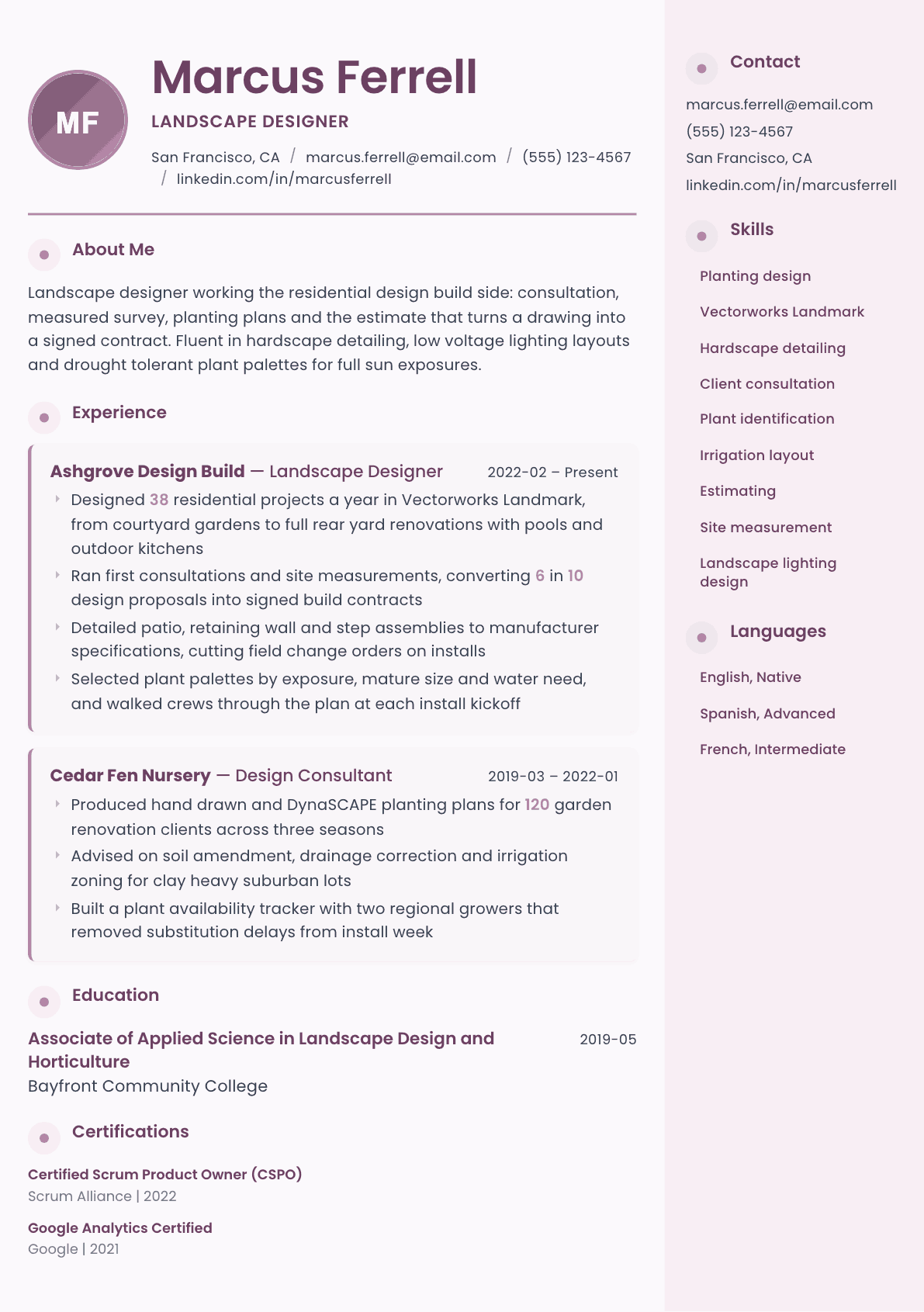
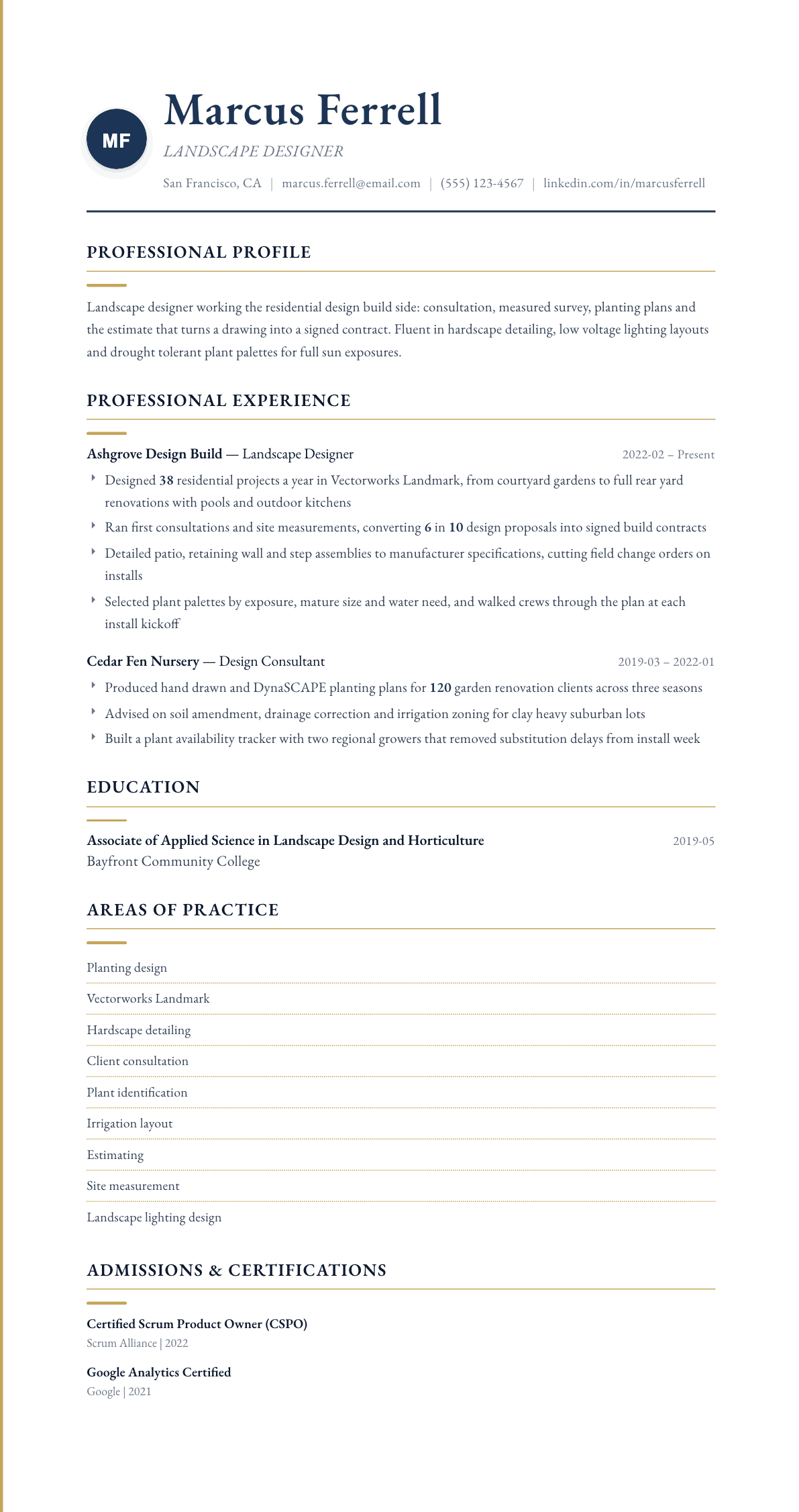
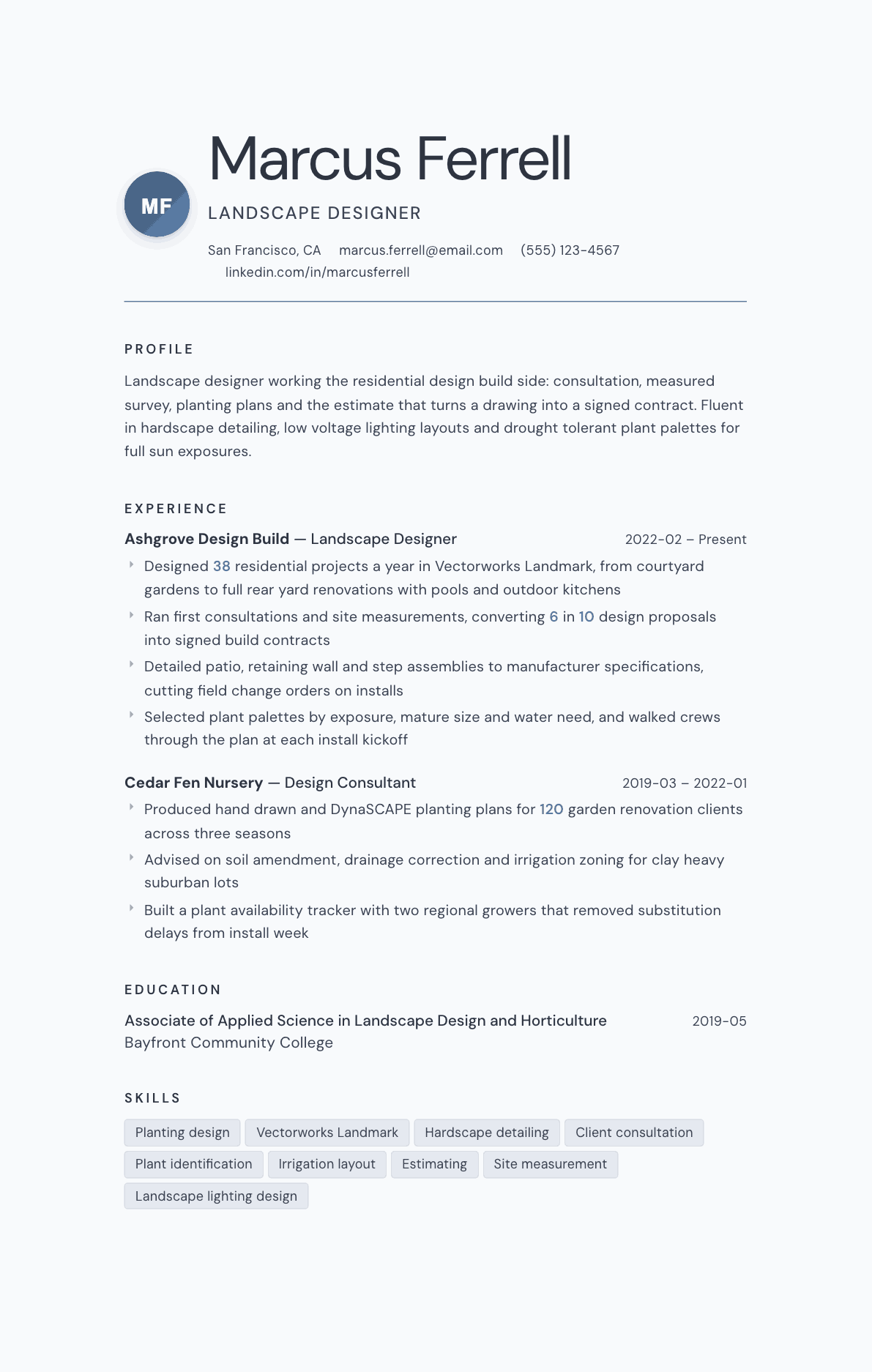
Example Landscape Designer summary
Landscape designer with five years in residential design build, producing around forty planting and hardscape plans a season in Vectorworks Landmark. Runs consultations, site measurement, plan presentation and the material estimate, and hands crews a drawing they can build without a redesign. Known for drought tolerant palettes and patio details that hold up in freeze thaw climates. Seeking a lead designer role.
Skills to list on a Landscape Designer resume
- Planting plans
- Hardscape design
- Vectorworks Landmark
- DynaSCAPE
- SketchUp
- Plant identification
- Soil and drainage assessment
- Irrigation zoning
- Landscape lighting
- Material estimating
- Client presentations
- Site measurement
- Grading concepts
- Rendering
What actually gets this resume read
- Say how many designs you produce in a season, because design build firms hire on drawing throughput as much as on taste.
- Give your design to contract conversion rate if you sell your own work, since that number is what an owner cares about.
- Name the drafting software exactly: Vectorworks Landmark, DynaSCAPE, SketchUp, Realtime Landscaping or hand rendering.
- Describe the project scale you handle, from courtyard planting refreshes to full rear yard builds with pools and structures.
- Show that you understand construction, not only aesthetics: drainage correction, base depths, wall drainage and soil volume.
- Include plant knowledge as a real skill by naming exposures, hardiness zones and the palettes you build for each.
How to write a landscape designer resume
Landscape designer is a sales role wearing a drawing pencil. Most of the openings sit inside design build companies, garden centers and maintenance firms that need someone to meet a homeowner, measure the property, draw something they will fall in love with, and price it so the crew can build it at a profit. A resume that only shows pretty plans misses half the job.
The person reading your resume is usually an owner or a design manager who is counting two things: how many designs you can turn out in a season, and what share of those designs turn into signed work. Everything else is supporting evidence.
This guide sets out the format, how to write a summary for a design build shop, how to describe projects so the reader can see the scope, which technical skills to list, and the mistakes that make an otherwise strong designer look like a hobbyist.
Format: one page, with the visual proof kept separate
Keep the resume to a single clean page. The temptation is to fill it with rendered plan snippets, but the file has to survive an applicant tracking system and a phone screen before anyone opens a portfolio. Put the portfolio link in the header and let the drawings do their own work.
If you sell your own designs, treat the resume like a sales resume that happens to include planting knowledge. Numbers belong on the page: designs produced, proposals presented, contracts signed, average project value expressed in ranges rather than exact figures.
- Header: name, title, service area, phone, email, portfolio or gallery link.
- Section order: summary, design experience, technical skills, plant and materials knowledge, certifications, education.
- A career changer with a horticulture background leads with plant knowledge and any install experience.
Summary: the market you design for and the volume you carry
Three lines. Name the market, whether that is small urban gardens, suburban rear yard renovations, estate properties or commercial common areas. Give the annual design volume and the software you draw in. Close with the thing you are known for, such as pool surrounds, native meadow conversions, or shade gardens on tight side yards.
Avoid describing yourself as passionate about nature. Every applicant writes that line, and a design manager reading twenty resumes stops seeing it after the third one.
Experience: sell the scope, the process and the handoff
For each role, write what kinds of projects came across your desk and how you moved them. A useful entry shows the whole cycle: initial consultation, site measurement and photography, concept presentation, revision rounds, material selection, estimate, and the walkthrough where you hand the plan to a crew.
The handoff bullet matters more than designers expect. Owners lose money when a drawing cannot be built as drawn, so any evidence that your plans reduce field changes, substitutions or callbacks is worth its own line.
Include the hardscape side explicitly. Patios, walls, steps, fire features, pergolas and drainage correction are where the budget lives, and a designer who only draws planting beds is a partial hire.
- Volume: designs per season, consultations per week, revisions per project.
- Conversion: proposals presented versus contracts signed, and the typical project value range.
- Craft: base depths, wall drainage, soil volume, irrigation zoning, lighting layout.
Technical skills: drawing tools, plant knowledge, and estimating
Write the drafting software by product name so a filter can match it: Vectorworks Landmark, DynaSCAPE, SketchUp, Land F/X or hand drafting and marker rendering. If you build three dimensional presentations, say which package and whether you produce still boards or walkthrough video.
Plant knowledge is a hard skill in this job and should read like one. Show that you select by exposure, mature size, water need, deer pressure and bloom sequence, and note the hardiness zones you have designed in. A designer who plants the same twelve shrubs everywhere gets found out in the first interview.
Estimating closes the section. Say whether you build the material takeoff, price it against supplier lists, and stand behind the number when the crew orders.
Keywords a design build employer filters on
Postings repeat a small vocabulary: planting plan, hardscape design, design build, consultation, estimating, plant identification, irrigation, landscape lighting, retaining walls, drainage. Place each once where it belongs and keep the prose readable, since the owner reads the file straight after the software does.
If you are targeting commercial or municipal maintenance contracts rather than residential work, swap the vocabulary: common area planting, contract renewal, specification compliance and site walkthrough reporting.
Landscape Designer resume summary examples
First design role
Horticulture graduate with two seasons on an installation crew and a portfolio of eight residential planting plans drawn in SketchUp and by hand. Identifies more than 300 regional ornamentals by sight and understands base preparation, wall drainage and irrigation zoning from field work.
Four seasons in
Landscape designer producing about thirty five residential plans a season in Vectorworks Landmark, covering planting, patios, walls and lighting. Runs consultations and measurements, presents concepts, and builds the material takeoff behind each estimate. Converts roughly half of presented proposals into signed build contracts.
Lead designer
Lead landscape designer for a design build firm, owning the design pipeline for rear yard renovations with pools, outdoor kitchens and structural walls. Mentors two junior designers, sets the plant palette standards the company builds from, and works with production to keep drawings buildable at bid price.
Work experience bullets: before and after
Before: Created landscape designs for clients.
After: Produced 38 residential designs a season in Vectorworks Landmark, from courtyard planting refreshes to full rear yard renovations with pools and outdoor kitchens.
Volume plus scope range shows an owner exactly what you can carry through a season.
Before: Met with homeowners to discuss projects.
After: Ran first consultations and site measurements for 90 homeowners a year, converting 6 in 10 presented proposals into signed build contracts.
A conversion rate turns a meeting into a revenue result, which is what the person hiring is buying.
Before: Chose plants suited to the site.
After: Built planting palettes by exposure, mature size and water need for full sun clay lots, cutting warranty replacements to fewer than 3% of installed stock.
The conditions and the warranty outcome prove horticultural judgment rather than plant preference.
Before: Designed patios and retaining walls.
After: Detailed patio, step and segmental wall assemblies to manufacturer specification, including base depth, geogrid placement and drainage, which removed most field change orders.
Naming the assemblies and the buildability payoff shows you design for the crew, not only for the client.
Before: Worked with the installation crews.
After: Walked each plan through a kickoff meeting with the install foreman, marking layout on site and confirming material substitutions before delivery week.
The specific handoff ritual shows how you protect the design once it leaves your desk.
Hard skills
- Planting plan production
- Hardscape layout and detailing
- Vectorworks Landmark
- DynaSCAPE and SketchUp
- Site measurement and base mapping
- Plant identification and selection
- Grading and drainage correction
- Irrigation zoning
- Landscape lighting layout
- Material takeoff and estimating
- Rendering and presentation boards
- Soil assessment and amendment
Soft skills
- Client consultation
- Design presentation
- Negotiating scope and budget
- Crew communication
- Seasonal scheduling
- Listening for what a client cannot describe
Certifications worth listing
- APLD Certified Landscape Designer (Association of Professional Landscape Designers)
- Landscape Industry Certified Technician (National Association of Landscape Professionals)
- Certified Irrigation Designer (Irrigation Association)
- Certified Concrete Paver Installer (Concrete Masonry and Hardscapes Association)
Mistakes that cost landscape designer candidates the interview
- Presenting a resume with no numbers on it, which leaves an owner guessing whether you draw four plans a year or forty.
- Listing plant knowledge as a single word instead of showing selection criteria and the zones you have worked in.
- Ignoring the estimating side, since a designer who cannot price a plan creates work for someone else.
- Filling the page with rendered images that break the file for screening software before a person ever sees it.
- Calling yourself a landscape architect when you are not registered, which ends interviews and can create legal trouble.
- Skipping hardscape and drainage detail, which makes the application read as decoration rather than construction.
Landscape Designer resume questions
What is the difference between a landscape designer and a landscape architect on a resume?
Registration. A landscape architect is licensed by a state board and can stamp drawings. Use the designer title unless you hold that license, and describe your work accurately, because misusing the protected title is treated seriously.
Do I need a degree to get a landscape design job?
Many employers hire on portfolio and plant knowledge alone. A horticulture or design certificate helps, but two seasons on an install crew plus a portfolio of buildable plans often beats a degree with no field experience.
How many projects should my portfolio show?
Eight to twelve is plenty. Include the plan drawing, a rendering or concept sketch, and a built photograph where you have one, since the built photo is the proof that your drawings survive construction.
Should I include sales numbers on a design resume?
Yes if you sell your own work. Design volume, proposal count, conversion rate and typical project size ranges give the hiring owner the picture they need. Leave exact company revenue out of it.
How do I move from maintenance work into a design position?
Build a small portfolio of real properties you have redesigned on paper, even unpaid ones. Then write your maintenance experience as plant and site knowledge: soils, drainage failures, pruning outcomes and what died where and why.
Related resume examples
- Landscape Architect Resume example
- Landscaper Resume example
- Carpenter Resume example
- General Contractor Resume example
- Architectural Designer Resume example
- Interior Architect Resume example