Civil Engineer Resume Examples: the lines they read
Build a Civil Engineer Resume on Solid Ground
By Mustafa Tarabya, founder of CVBooster · Published · Updated
Civil Engineer resume examples with expert tips, ATS keywords, and professional templates. See exactly what a winning senior civil engineer resume looks like.
Sample resumes for a civil engineer
The same civil engineer content laid out in three CVBooster templates, so you can see what the finished document looks like before you write a word.
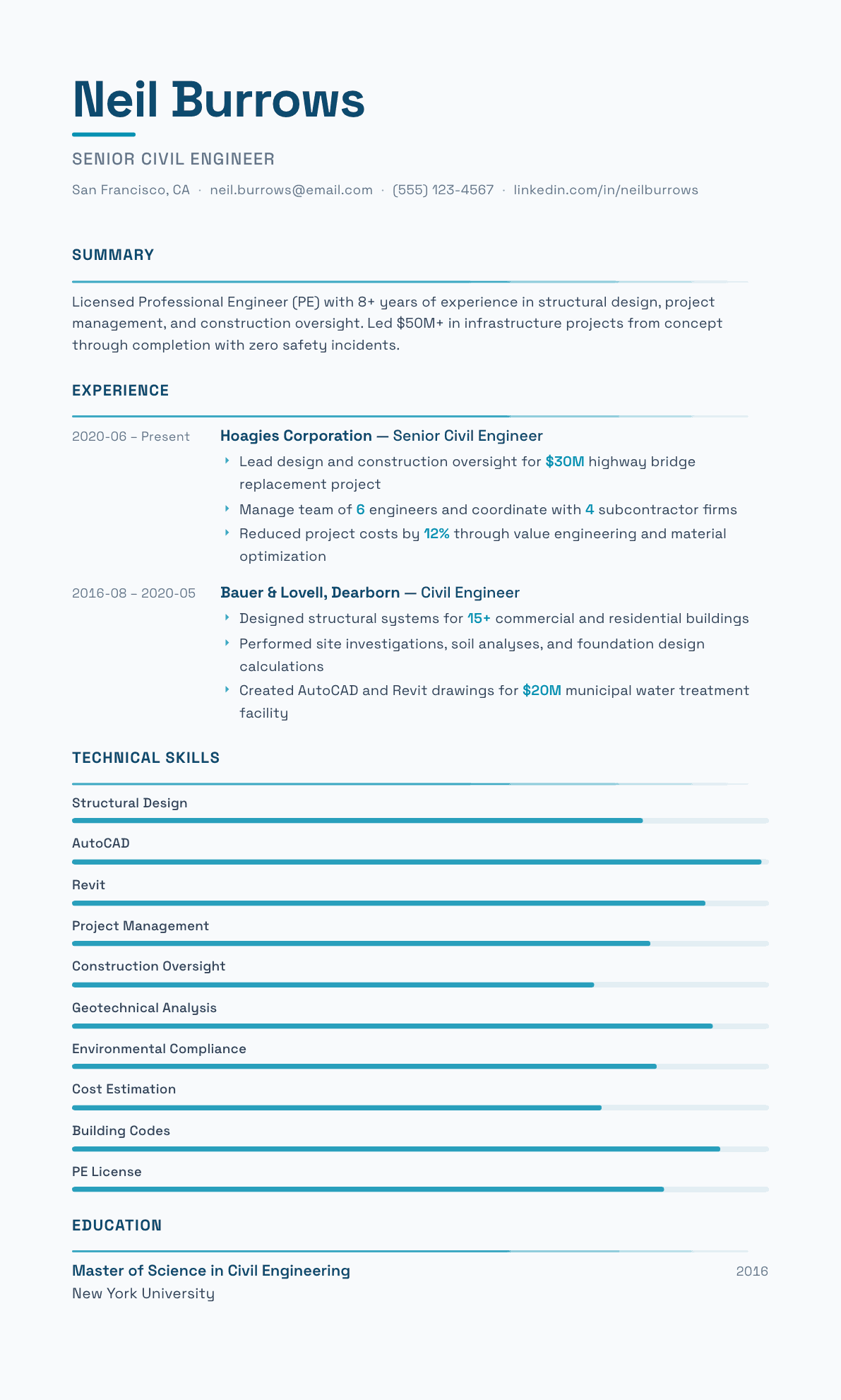
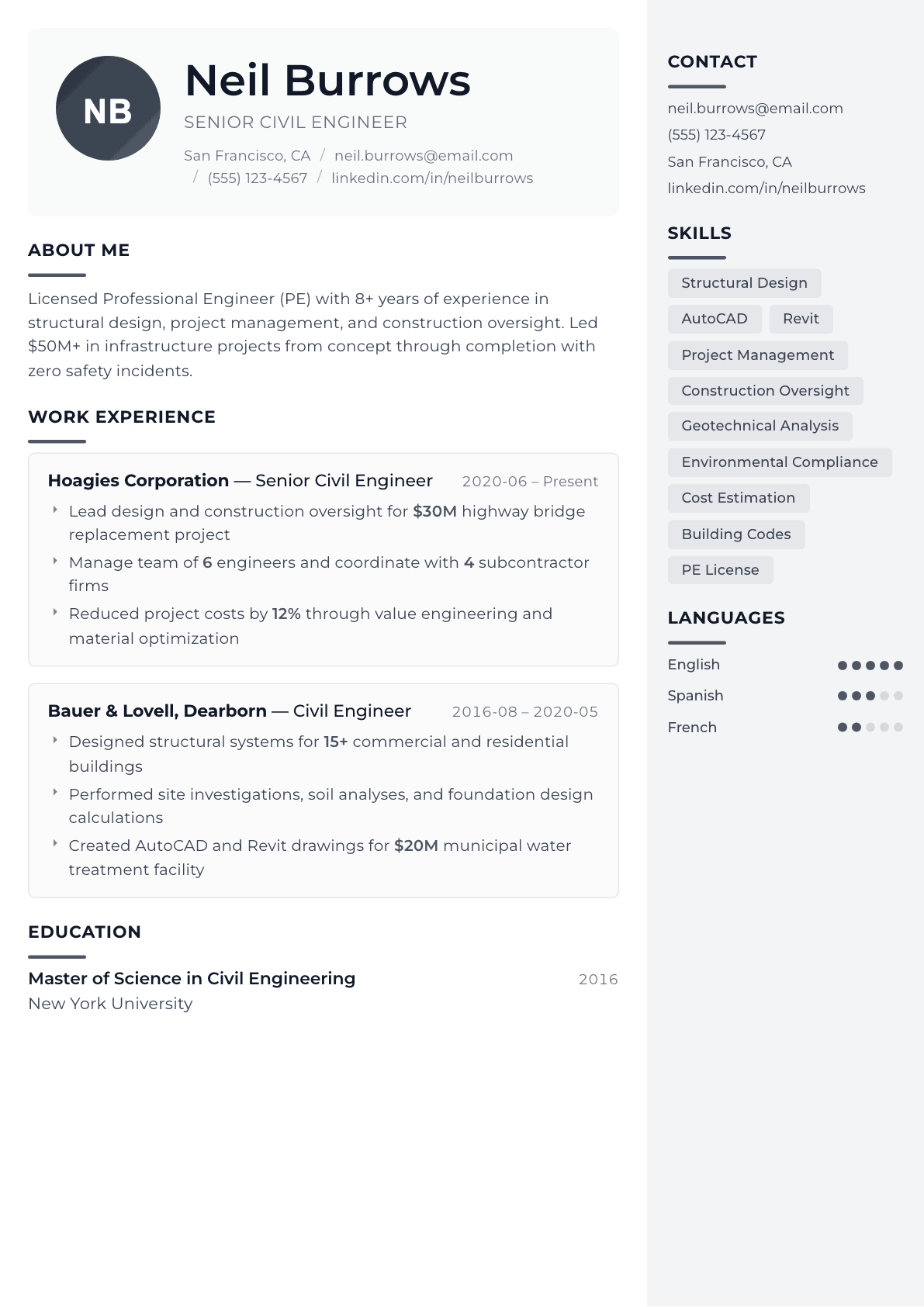
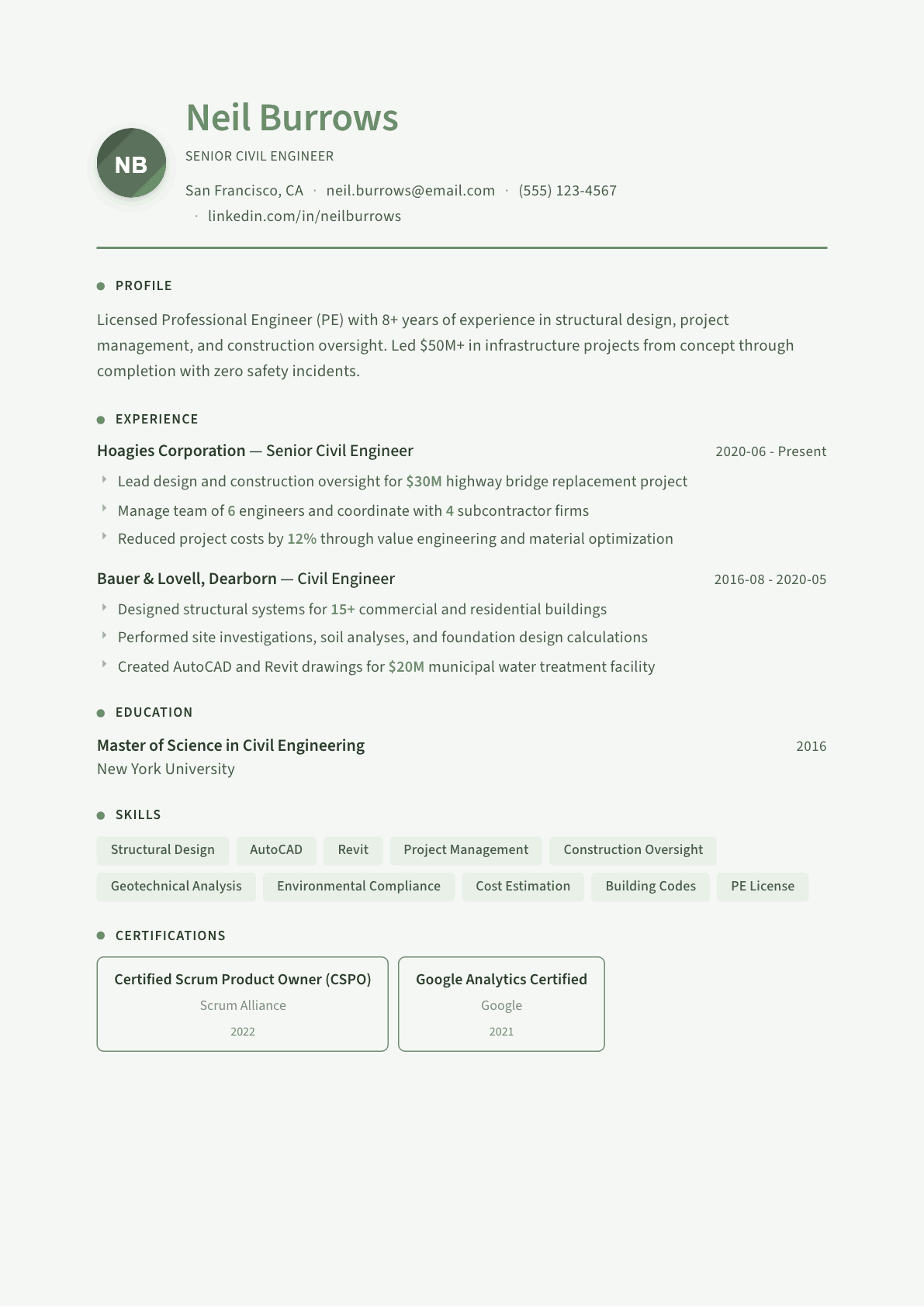
Example Civil Engineer summary
Licensed civil PE, 8 years, currently leading design and construction oversight on a $30M bridge replacement with six engineers and four subcontractor firms. Took 12% out of project cost through value engineering, and has designed structures and foundations for 15 commercial and residential buildings in AutoCAD and Revit.
Skills to list on a Civil Engineer resume
- Structural Design
- AutoCAD
- Revit
- Project Management
- Construction Oversight
- Geotechnical Analysis
- Environmental Compliance
- Cost Estimation
- Building Codes
- PE License
What actually gets this resume read
- List your PE license and any specialty certifications (SE, LEED).
- Quantify project budgets, team sizes, and timeline achievements.
- Include specific software proficiency (AutoCAD, Revit, SAP2000).
- Show experience with permitting, codes, and regulatory compliance.
- Highlight safety records and zero-incident achievements.
How to write a civil engineer resume
Civil engineering resumes are screened against a license and a project list. A design firm principal wants to know whether you stamp drawings, whether you have run a submittal and RFI cycle on a real construction job, and which agency reviewed your plans. A public works department wants to know whether you have been through their permitting process before. Neither reader cares about adjectives.
The single fastest way to be filtered out is burying your licensure. PE, EIT and the state you are registered in belong in the header and again in their own block, because half of civil postings are written with licensure as a hard requirement and the recruiter sorting the pile has a checklist, not curiosity.
What follows is the structure hiring managers in structural, geotechnical, transportation, water resources and land development actually read, with summaries for an EIT, a project engineer and a project manager, before and after bullets, and the questions that come up when engineers sit down to rewrite.
Format: license in the header, projects as the spine
Reverse chronological, one page until you have roughly eight years of design experience, two pages after that. Put credentials directly after your name: "Priya Raman, PE, LEED AP BD+C" and the registration states underneath. Consulting firms working across state lines filter on which states you carry, so list every active registration and note any pending applications through comity.
Civil work is remembered by project, not by employer. Under each job, either write project-led bullets or add a short key projects block naming the facility type, the construction value bracket, the delivery method and the reviewing agency. A resume that says "designed roadways" without a single named corridor or municipality reads as if the work was somebody else's.
- Header: name, PE or EIT, states of registration, city, phone, email.
- Order: summary, licensure and certifications, experience, key projects, education, technical skills.
- New graduates lead with education, the FE exam result and the capstone or co-op design.
Summary: discipline, delivery method, and the size of what you carry
Three lines. Name your discipline precisely, because "civil engineer" covers people who design bridge bearings and people who lay out subdivisions. Say structural, geotechnical, transportation, water resources, stormwater or site and land development, then the sectors you have served: state DOT, municipal utilities, private developers, industrial owners.
Add one hard qualifier a hiring principal can check. Registration and states, the design codes you work in daily, the delivery models you have worked under, or the fact that you have carried a project from concept through construction administration and closeout. Vagueness in the first three lines guarantees the rest is skimmed.
Experience: design, review, construction phase, in that order
For each role, open with the practice area and the scale you handled, then use bullets that follow the life of a project. Design bullets should name the analysis and the code: load path checks in ACI 318 or AISC 360, slope stability and settlement analysis, hydrologic modeling in HEC-HMS, hydraulic runs in HEC-RAS, pavement sections to AASHTO methods, water distribution modeling in WaterGEMS.
Then show the part most resumes skip: the approval. Name the reviewing authority and what you got through it, whether that is a county site plan approval, a NPDES construction general permit, a floodplain no-rise certification, a DOT encroachment permit or a utility relocation agreement. Permitting experience is the difference between a designer and an engineer a firm can bill on a real schedule.
Close each role with construction phase work if you have it: shop drawing review, RFIs answered, change order pricing, site observation reports, punch lists and record drawings. Owners pay for this and firms are chronically short of engineers who have done it.
Technical skills: analysis tools separated from drafting tools
Split the list so a reviewer can see both halves of your capability. Analysis and modeling on one line: SAP2000, ETABS, RISA-3D, STAAD, LPILE, Settle3, HEC-RAS, SWMM, WaterGEMS. Production on another: AutoCAD Civil 3D, Revit, MicroStation and OpenRoads, Bluebeam Revu for markups, and ArcGIS Pro if you do corridor or utility mapping.
Add the code and standard families you actually design to rather than a generic phrase about building codes: IBC, ACI, AISC, AASHTO LRFD, ASCE 7 wind and seismic loads, the local amendments your jurisdiction adds. Naming them proves the depth that "knowledge of building codes" only claims.
Education, exams and the licensure block
ABET accreditation of your degree matters because most state boards require it, so name the program exactly. Give the FE and PE exam disciplines you passed, since a structural firm reads a PE taken in Civil: Structural differently from one taken in Water Resources and Environmental. If you hold the SE, put it above everything else.
Keep training that has a real credential behind it and drop the rest. OSHA 30-hour construction, a state DOT contractor safety card, a stormwater inspector qualification and an erosion control certification are all worth a line. Generic lunch and learn attendance is not.
Civil Engineer resume summary examples
EIT, first two years
Civil engineer in training with an ABET accredited BSCE and 2 years in site and land development. Produced grading, drainage and utility plans in Civil 3D for 14 commercial sites, prepared SWPPP packages, and supported county plan review responses. FE passed, PE eligible in 2 years.
Project engineer, six years
Licensed civil engineer with 6 years in transportation design for state and county owners. Led roadway geometry, drainage and MOT plans on 3 corridor widening projects, ran HEC-RAS hydraulic analysis for 5 culvert replacements, and answered 120 contractor RFIs through construction administration.
Project manager, twelve years
Civil engineering project manager registered in 4 states, with 12 years in municipal water and wastewater infrastructure. Manages a 9 person design group, owns scope, fee and schedule on treatment and conveyance projects, and has carried 6 design build packages from preliminary engineering to substantial completion.
Work experience bullets: before and after
Before: Worked on roadway design projects for the DOT.
After: Designed 4.2 miles of urban arterial widening for the state DOT: horizontal and vertical geometry to AASHTO criteria, closed drainage system, signal warrants and staged maintenance of traffic plans through final plan turn-in.
Length, owner, criteria and deliverables tell a reviewer exactly which parts of the plan set you produced.
Before: Used AutoCAD and Revit to create drawings.
After: Produced 60 sheet site plan sets in Civil 3D with dynamic corridor and surface models, and coordinated structural sheets in Revit with architects on 8 mixed use buildings.
Naming the model type and the coordination shows engineering production, not software familiarity.
Before: Responsible for permitting.
After: Secured county site plan approval and a NPDES construction general permit on 11 developments, responding to 3 rounds of agency comments per project without a schedule slip.
The permits, the comment rounds and the schedule outcome are what a firm is actually buying.
Before: Managed construction of a bridge project.
After: Provided construction phase engineering on a 3 span prestressed girder bridge replacement: reviewed 140 shop drawings, resolved 62 RFIs, priced 9 change orders and issued weekly site observation reports.
Volume of submittals and RFIs is the honest measure of construction administration workload.
Before: Helped junior engineers with their work.
After: Checked and sealed calculations for 3 EITs, ran a weekly quality control review of plan sets before issue, and cut redline comments per submittal by roughly half over 4 quarters.
Sealing and quality control is the responsibility a firm promotes on, so it belongs on the page.
Hard skills
- AutoCAD Civil 3D
- Revit
- MicroStation and OpenRoads
- SAP2000 and ETABS
- RISA-3D and STAAD
- HEC-RAS and HEC-HMS
- SWMM stormwater modeling
- Geotechnical settlement and slope stability analysis
- AASHTO LRFD design
- ACI 318 and AISC 360
- ASCE 7 loading
- Cost estimating and quantity takeoff
- Construction administration and submittal review
- ArcGIS Pro
Soft skills
- Agency negotiation
- Client scope and fee discussions
- Design review under deadline
- Mentoring engineers in training
- Cross discipline coordination
- Technical writing for public record
Certifications worth listing
- Professional Engineer (PE) (State board of professional engineers, exam by NCEES)
- Engineer in Training (EIT) after the FE exam (NCEES and the state licensing board)
- Structural Engineering (SE) license (State board of professional engineers, exam by NCEES)
- LEED AP Building Design and Construction (Green Business Certification Inc.)
- Envision Sustainability Professional (ENV SP) (Institute for Sustainable Infrastructure)
- Certified Floodplain Manager (CFM) (Association of State Floodplain Managers)
- OSHA 30-Hour Construction (OSHA Outreach Training Program)
Mistakes that cost civil engineer candidates the interview
- Listing the PE only in a skills line at the bottom, so an automated screen looking for licensure never finds it.
- Writing "civil engineer" without naming the discipline, which forces the reader to guess whether you design bridges or subdivisions.
- Describing projects with no owner, no size and no delivery method, which makes every job on the resume look interchangeable.
- Leaving out permitting and agency review, the part of the job that decides whether a design ever gets built.
- Filling the skills section with drafting software while omitting the analysis packages that prove design capability.
- Claiming a project value the firm delivered and letting a reviewer assume you managed all of it, which collapses in the first interview question.
- Using a two column template with graphics, which parsers used by large engineering firms often read out of order.
Civil Engineer resume questions
Do I need a PE license to get hired as a civil engineer?
Not for design production roles, where firms hire EITs and expect licensure within a few years. You do need it to seal drawings, sign calculations and hold a project engineer or manager title, and most public agency postings list it as a hard requirement.
Should I list every project I have touched?
No. Pick the projects that match the posting by facility type, discipline and owner, usually five to eight, and give each one a scale, a delivery method and your specific role. A long undifferentiated list buries the ones that would win the interview.
How do I show construction experience on a design resume?
Give it its own bullets under the relevant job and count the work: shop drawings reviewed, RFIs answered, change orders priced, site visits made. Firms are short of designers who have been on site, so this is worth more space than most engineers give it.
What if my degree program was not ABET accredited?
State the degree honestly and add whatever your state board accepted as an equivalent path, including a credential evaluation for a foreign degree and any additional experience years required. Hiding it wastes everyone's time because licensure verification will surface it.
How do I move from land development to structural or transportation?
Say the move in your summary, then reorder your bullets so the transferable analysis leads: grading and drainage translate to hydraulics, retaining wall design translates to structural. Add the software the target discipline uses and the code families you have studied for the PE depth exam.
Related resume examples
- Mechanical Engineer Resume example
- Project Manager Resume example
- Construction Manager Resume example
- Structural Engineer Resume example
- Packaging Engineer Resume example
- Battery Engineer Resume example